The Seven Sleepers of Ephesus Myth Meaning & Symbolism
A group of faithful youths flee persecution, are sealed in a cave by God, and awaken centuries later as living proof of resurrection and divine timelessness.
The Tale of The Seven Sleepers of Ephesus
Listen, and let the veils of time grow thin. In the days of a tyrant king, when the air over Ephesus was thick with the incense of idolatry and the cold fear of persecution, there lived a band of young men. Their hearts were chambers lit by a single, unwavering flame—the belief in the One God. They could not bow. They would not kneel before stone.
Facing death or forced apostasy, they chose a third path: flight. With the desperate courage of the hunted, they stole from the city walls as the sun bled into the hills. Their feet found the stony goat paths, leading them higher, into the embrace of the wild mountains. Breath ragged, hearts pounding like war drums, they sought sanctuary. And the mountain offered it: a deep, dark cave, its mouth a silent yawn in the cliff face.
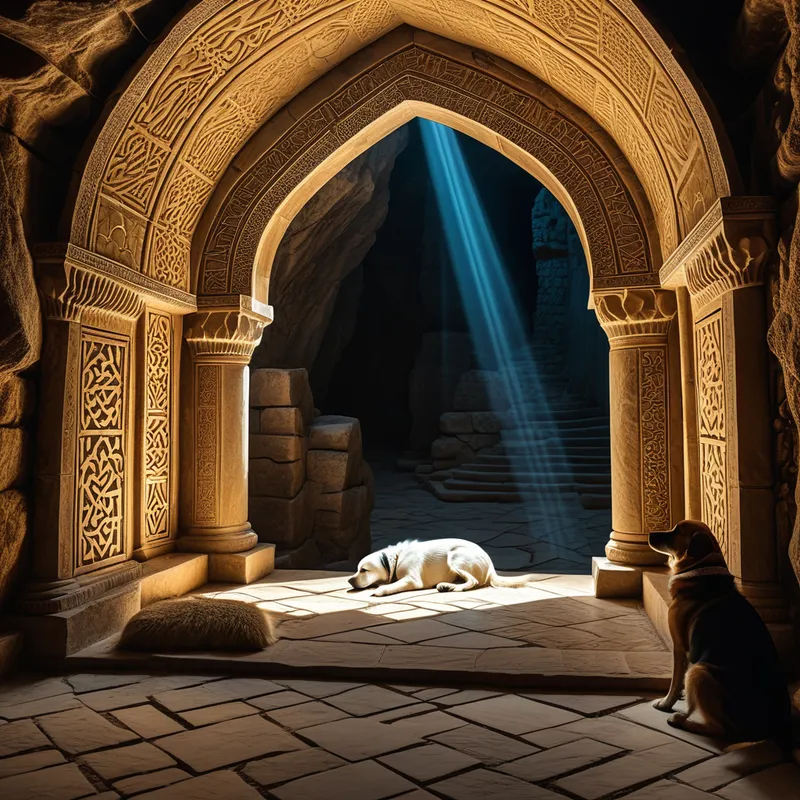
They entered the cool, earthy darkness, their loyal dog, Qitmir, following faithfully. Exhaustion, a heavier cloak than any they had worn, settled upon them. As they lay down to rest, a profound peace descended, unlike any natural sleep. It was a divine mercy, a blanket woven from God’s own command. And as they slept, the world outside did not.
The king’s soldiers came. Finding the entrance, they were ordered to seal it with mighty stones, entombing the youths alive. The masons worked, and the last sliver of light was extinguished. Inside, the sleepers did not stir. They slept on as decades turned to centuries. Leaves fell and grew, empires of Rome and Byzantium rose and cracked like old pottery, and the very face of the land shifted. God turned their bodies in their sleep so they would not waste away, and their cave became a sacred pocket outside of time.
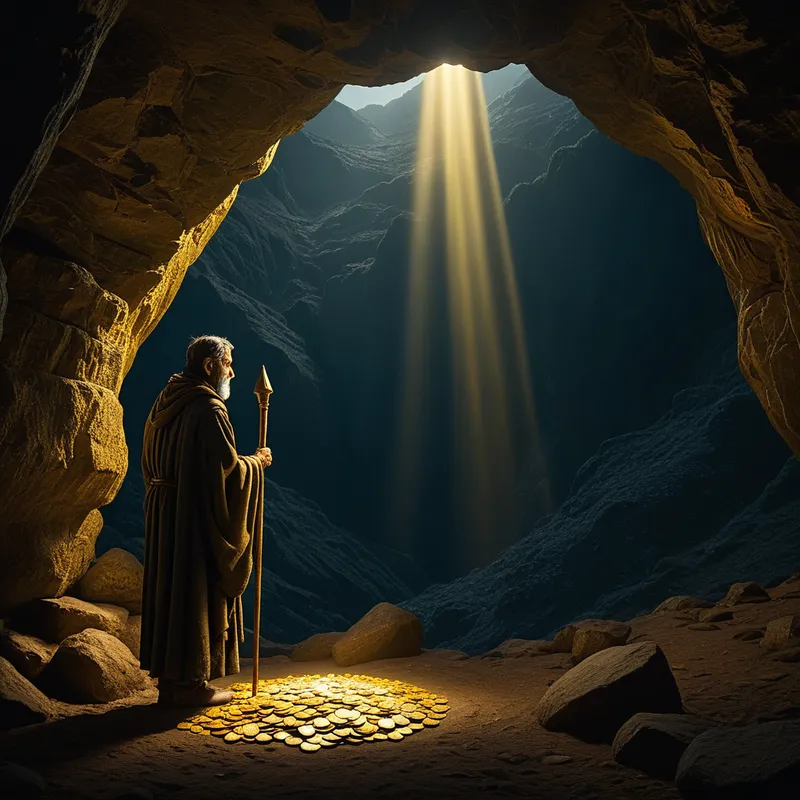
Then, in the fullness of divine decree, the mechanism of their slumber clicked. A shepherd, seeking a lost goat, moved the stones to use them for a pen. The sun of a new age poured in. One by one, the sleepers awoke, stretching as if from a single night’s rest. They were ravenous. Whispering, they sent one of their own, Yamlikha, down to the city with a silver coin from their era to buy bread, warning him to be cautious.
But Ephesus was unrecognizable. Crosses adorned buildings where idols once stood. The language sounded strange. When Yamlikha offered his ancient coin for bread, the baker, seeing a treasure from a bygone empire, accused him of finding a hidden hoard. Brought before the city governor and a learned bishop, the truth began to unravel. The youth told his impossible tale. The authorities followed him back to the cave, and there they saw them: the seven sleepers and their dog, awake and bearing witness.
Having delivered their testimony—a living proof of resurrection and God’s power over time itself—their work was complete. They laid back down upon the earth of the cave. And there, before the astonished eyes of the people, they were taken by God, their souls departing, their story now etched into the memory of the world. The cave was sealed once more, this time as a holy sanctuary.
Cultural Origins & Context
The story of the Aṣḥāb al-Kahf is not merely a folktale but a sacred narrative enshrined in the Qur’an, in Surah Al-Kahf (The Cave). Its inclusion grants it a profound theological weight within Islamic culture. The Qur’anic account, while concise, focuses on the core mysteries: the youths’ faith, their divinely ordained sleep, and the lesson they represent regarding the certainty of the Hour (Resurrection).
Scholars and storytellers, from muhaddithūn to poets, expanded the narrative with details drawn from earlier Christian and likely local Anatolian traditions, weaving it into the rich tapestry of Islamic Qiṣaṣ al-Anbiyā’. It functioned as a powerful apologetic tool, demonstrating God’s absolute power and the reality of life after death. It also served as a comforting parable for early Muslim communities facing persecution, assuring them that divine protection could take miraculous forms and that truth, though seemingly dormant, would awaken triumphant.
Symbolic Architecture
At its [heart](/symbols/heart “Symbol: The heart symbolizes love, emotion, and the core of one’s existence, representing deep connections with others and self.”/), this is a myth of the sanctuary. The cave is the ultimate [symbol](/symbols/symbol “Symbol: A symbol can represent an idea, concept, or belief, serving as a powerful tool for communication and understanding.”/) of retreat, not as escapism, but as a necessary, divinely-sanctioned [incubation](/symbols/incubation “Symbol: A period of internal development, rest, or hidden growth before emergence, often associated with healing, creativity, or transformation.”/).
The sacred sleep is not an absence of consciousness, but a transformation of it; a descent into the timeless substrate of the soul where the erosions of the worldly epoch hold no power.
The sleepers represent the innocent [archetype](/symbols/archetype “Symbol: A universal, primordial pattern or prototype in the collective unconscious that shapes human experience, behavior, and creative expression.”/) within each person—that part of us that knows a fundamental [truth](/symbols/truth “Symbol: Truth represents authenticity, honesty, and the quest for knowledge beyond mere appearances.”/) but must often hide from a hostile, [conformist](/symbols/conformist “Symbol: A person who adheres to established social norms, often suppressing individuality for acceptance.”/) outer world (the tyrannical [king](/symbols/king “Symbol: A symbol of ultimate authority, leadership, and societal order, often representing the dreamer’s inner power or external control figures.”/)/epoch). Their centuries-long slumber symbolizes a psychic process where a core value or [identity](/symbols/identity “Symbol: Identity represents the sense of self, encompassing personal beliefs, cultural background, and social roles.”/) must be put into a state of [suspended animation](/symbols/suspended-animation “Symbol: A state where biological processes are halted or slowed dramatically, often used in science fiction for space travel or medical preservation.”/) for its own preservation. The awakening is not a return, but a [revelation](/symbols/revelation “Symbol: A sudden, profound disclosure of truth or insight, often through artistic or musical means, that transforms understanding.”/): the world has changed because they held fast. They become the embodied bridge between eras, proving that what is essential is eternal.
The Dreamer’s Resonance
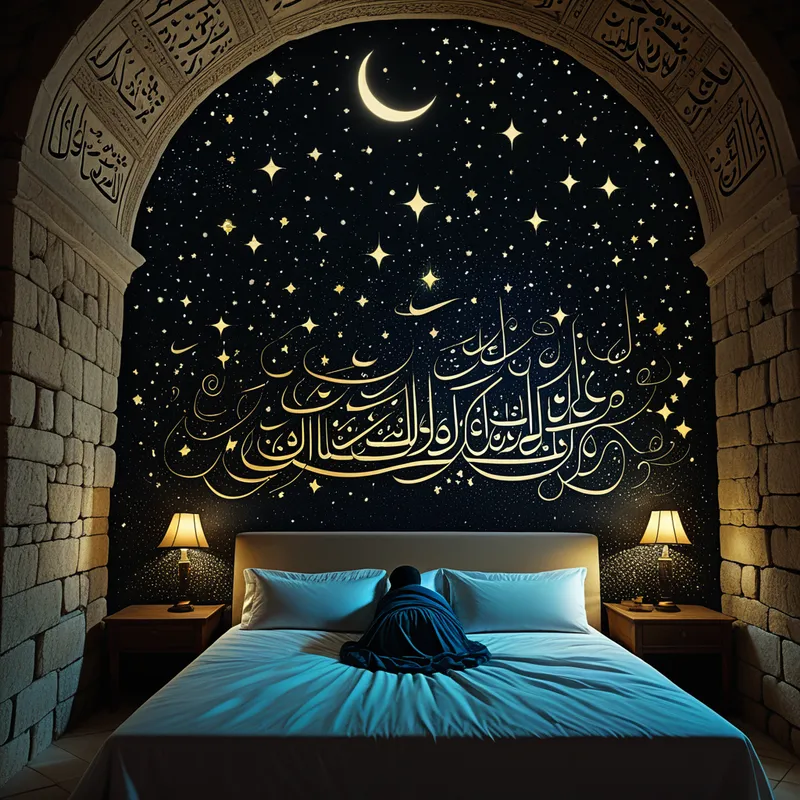
When this myth patterns a modern dream, it speaks to a profound process of psychic hibernation and re-emergence. Dreaming of being sealed in a safe, dark place while the world changes outside often coincides with periods of burnout, depression, or necessary withdrawal. The psyche is declaring a moratorium.
The somatic feeling is one of deep, almost cellular rest, coupled with a latent anxiety about “missing out” or being forgotten. This is the sleep of the individuation process, where an old attitude must die and a new one cannot yet be born. The dreamer is in the cave. The eventual awakening in the dream—often confusing, disorienting, yet carrying a sense of mission—signals that the incubation is complete. A long-protected truth is now ready to be offered to a world that may finally be able to hear it.
Alchemical Translation
The alchemy here is the transmutation of linear time into sacred time, and of passive hiding into active witness. The psychological “tyrant king” is the dominant, often oppressive, complex of the ruling conscious attitude—the persona, societal expectations, or internalized critic that demands we deny our true faith.
The first operation is not fight or flight, but descent: consciously entering the cave of the unconscious (the retreat, the therapy, the sabbatical, the deep introspection).
The sealing of the cave is crucial. It represents the conscious commitment to this process, cutting off the old inputs and engagements. The centuries of sleep are the slow, invisible work of the Self. Old psychic structures, represented by the decaying Roman empire, crumble. New potentials form. The sleeper is turned by God—by the Self’s guiding hand—so they do not decay; meaning, the core essence is preserved and nurtured even in darkness.
The awakening is the culmination: the formerly hidden, innocent truth now emerges as the most mature, authoritative part of the personality. It returns to the marketplace of life not with an old coin, but with a living testimony. The final, peaceful death in the cave signifies that once this truth has been integrated and witnessed, the isolated “band of youths” is no longer needed. They become part of the enduring structure of the soul itself, a permanent sanctuary within.
Associated Symbols
Explore related symbols from the CaleaDream lexicon:
- Cave — The primal sanctuary and womb of rebirth; it represents the protective embrace of the unconscious where profound psychic transformation occurs outside of chronological time.
- Sleep — A state of divine grace and incubation, not of inactivity but of deep, alchemical processing and preservation of the soul’s essential truth.
- Dog — Loyalty and guardianship at the threshold; this faithful companion symbolizes the instinctual nature that protects the vulnerable, incubating self and remains vigilant.
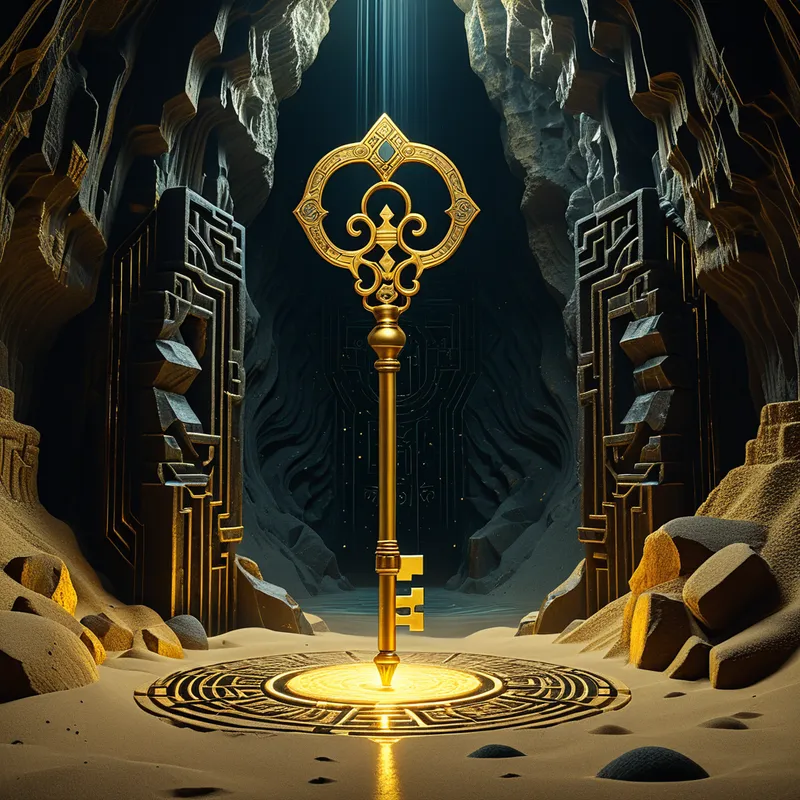
- Key — The divine decree or moment of awakening; it represents the precise intersection of timeless truth with historical moment, unlocking a new epoch of understanding.
- Stone — The seal of divine protection and the weight of chronological time; the stones that entomb also preserve, creating a sacred vessel for the timeless.
- Coin — A token from a forgotten era; it symbolizes the initial, disorienting evidence that the awakened self carries a truth that the current world perceives as ancient currency.
- Light — The divine mercy and the illumination of awakening; it is both the gentle sustenance during the long sleep and the shocking, revealing sun of a new age.
- Mountain — The place of refuge, trial, and revelation; it represents the arduous journey away from collective pressure toward a higher, more solitary perspective.
- Time — The central antagonist and medium of the myth; it is the river from which the sleepers are lifted, proving that soul-time operates on a different, sacred logic.
- Rebirth — The core promise and outcome; not a recycling of the old, but the emergence of a preserved essence into a world now capable of recognizing its value.
- Faith — The unwavering flame that motivates the flight and sanctifies the sleep; it is the active principle that chooses the cave over compromise.
- Islamic Mosque — The societal and spiritual context that eventually receives the testimony; it represents the new world-order built upon the principle of divine unity that the sleepers witnessed to.