The Seed Vault of the Gods Myth Meaning & Symbolism
A forgotten myth of a divine granary, hidden after Ragnarok, holding the blueprint for a new world within the ashes of the old.
The Tale of The Seed Vault of the Gods
Listen, and I will tell you of the silence after the scream.
The great wolf’s jaws have snapped shut. The serpent’s poison has scorched the sky. The fire of Surtr has roared over the plains, and the waves have swallowed the mountains. Ragnarok is done. The great tapestry of the Nine Worlds lies in tatters, smoldering in the long, cold dark.
But the story does not end in ash.
Through the choking haze walks Vidar, his shoe thick with the leather of forgotten ages. He does not weep for his fallen father, Odin. His grief is a cold, hard stone in his chest, a weight to be carried, not shed. His eyes, sharp as winter stars, scan the desolation. He sees the blackened stump of Yggdrasil, its roots still clinging deep to the corpse of the world. And he remembers a charge, whispered in the mead-hall before the final horn was blown.
He is not alone. From the soot-stained sea emerges Njord, his beard matted with salt and memory. From a crack in the earth, shielded by the very bones of the fallen, comes Baldr, returned from Hel’s domain, his presence a soft luminescence in the gloom. And with them, the children of the gods, their faces pale with shock but their hands unclenched.
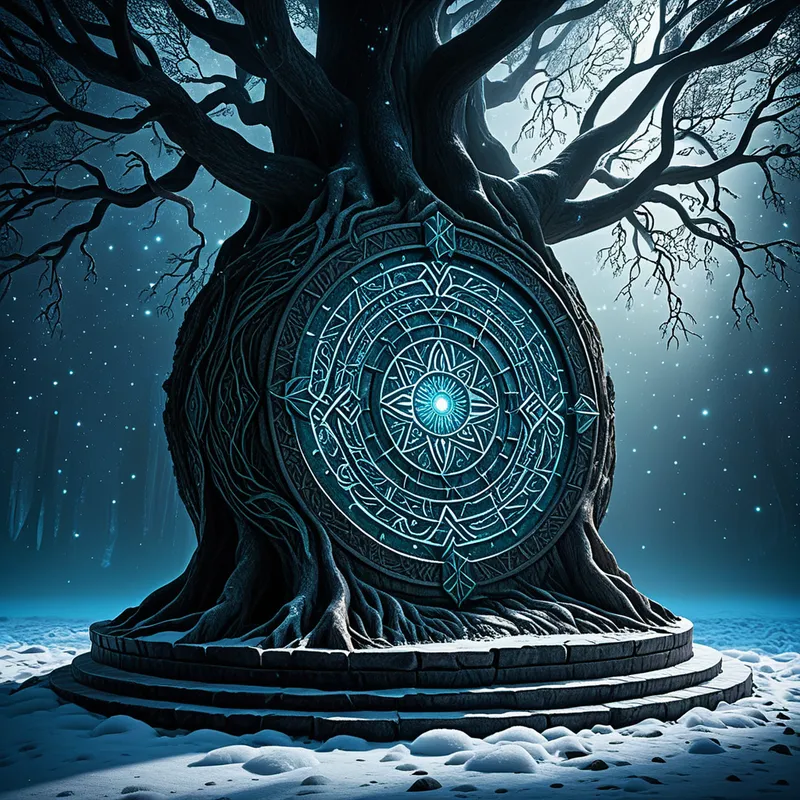
They gather at the one place that still holds a whisper of the old song: the deepest, most secret root of the World Tree. Here, the fire did not reach. Here, the ice of Niflheim and the heat of Muspelheim meet in a perpetual, gentle drip, feeding a hidden spring. And beside this spring, carved from the living rock and petrified heartwood of Yggdrasil itself, is the Vault.
Its door is not of iron, but of intertwined thorn and mistletoe, a puzzle of protection and paradox. Vidar places his hands upon it. He does not speak a spell; he offers a memory—the taste of spring water from Urd’s Well, the sound of Sæhrímnir sizzling on the hearth, the scent of pine in a high wind. The thorns shiver and part.
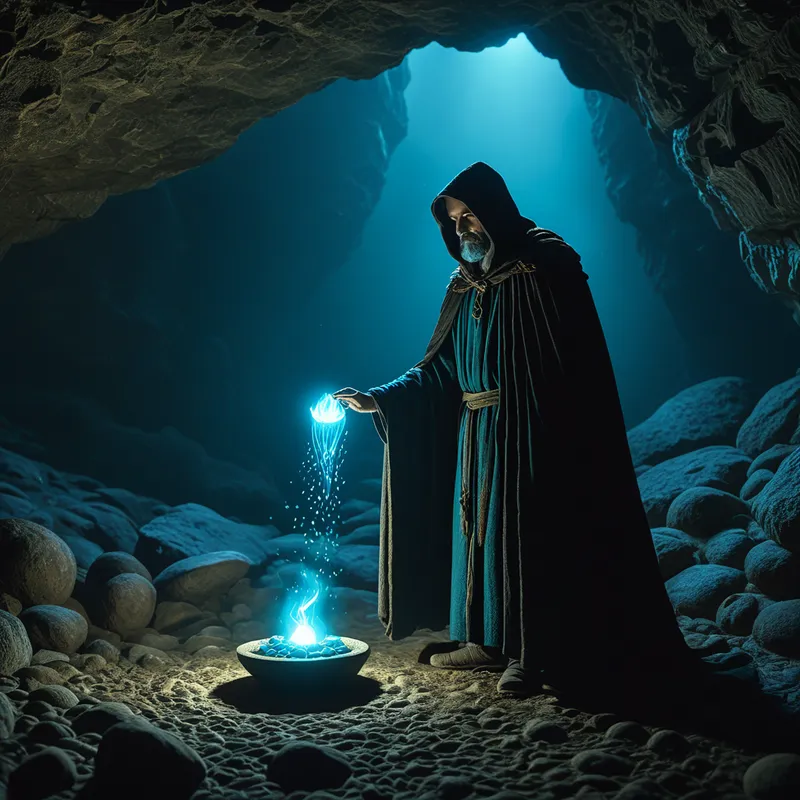
Within, it is neither dark nor light, but holds the quality of a held breath. On shelves of living fungus and pedestals of slow-dripping stone rest not gold, nor weapons, but seeds. A single acorn from the first oak. A nut from the tree Heimdallr once sheltered under. A grain of barley that fed the first man, Ask. Pollen from the meadows of Asgard. Spores from the fungi that fed on the wisdom of Mímir. This is the hoard that matters. This is the memory of the world, not as a story, but as a blueprint.
Together, the survivors place their own offerings. Vidar adds a seed from the last berry he ate before the battle. Baldr places a petal, still impossibly white, from the fields of his home. They do not speak of hope, for that word is too light for this duty. They speak of debt. A debt to what was, and a promise to what must be. They seal the Vault once more. Its location will fade from conscious knowledge, sinking into the collective dream of the new world that must, slowly, painfully, green from the ash.
Cultural Origins & Context
This myth, while not chronicled in the extant Prose or Poetic Eddas like the tales of Thor’s hammer or Odin’s sacrifice, lives in the profound silence between the recorded lines. It is a myth of implication, born from the Norse worldview’s central, brutal, yet cyclical truth: destruction is never absolute. The Urðr, Verðandi, and Skuld weave a tapestry that may be torn, but the loom remains.
The concept of a “Seed Vault” is a modern framing for a deeply ancient intuition. It would have been a story told not in the grand feasts, but in the long, dark winters, by the hearthside. It is a tale for survivors. After the apocalyptic climax of Ragnarok, the primary sources (like the Völuspá) tell us that a new, green world emerges, and some gods survive. The “how” of this regeneration is left to the imagination. This myth fills that sacred gap. It functions as a psychological and societal balm, asserting that even in total catastrophe, the essence of culture, law, nature, and memory is preserved. It transforms fate from a terminal sentence into a cyclical process, offering a form of cold comfort that is quintessentially Norse: not the promise of salvation, but the assurance of continuity.
Symbolic Architecture
The Seed Vault is not merely a granary; it is the collective unconscious of the cosmos itself. It represents the indestructible core of pattern and potential that exists beneath the phenomenal world of form, which is always subject to decay and destruction.
The Vault is the psyche’s deep memory bank, where the archetypes themselves are stored, untouched by personal trauma or collective catastrophe.
The key figures are not active heroes, but preservers. Vidar, the silent avenger, becomes the solemn archivist. Baldr, the resurrected god of light, becomes the bearer of pure, untainted potential. Their journey is inward and downward, to the root, not outward and upward to conquest. The seeds themselves are perfect symbols of the dynamis, the latent force within matter. An acorn is not a tiny tree; it is the law of “oak-ness,” the immutable pattern that will orchestrate soil, water, and sunlight into a specific form. In psychological terms, each seed is an archetypal pattern—the Creator, the Healer, the Sovereign—waiting for the correct conditions to manifest in a new life, a new society, a new phase of consciousness.
The Dreamer’s Resonance
When this myth stirs in modern dreams, it often surfaces during periods of profound personal “Ragnarok”—the collapse of a career, the end of a relationship, a seismic shift in identity or belief. The dreamer may find themselves in a vast, empty landscape (the post-apocalyptic psyche), feeling desolate and bereft.
The dream-image of the Vault itself is telling. It might appear as a forgotten basement in a childhood home, a sealed archive in a ruined library, or a secure server deep underground, humming with data. The act of finding it signifies the dreamer’s ego, battered by change, making contact with the enduring Self. The seeds may appear as data crystals, heirloom jewelry, or simple, glowing stones. To dream of holding such a seed is to somaticize the felt sense of core identity that survives all transformations. It is the dream-ego’s discovery that while the “world” (their current life-construct) has ended, the essential patterns of their being—their values, innate talents, and deepest loves—are intact, preserved in the psychic subsoil, ready for a new cycle.

Alchemical Translation
The alchemical process mirrored here is solve et coagula: dissolve and coagulate. Ragnarok is the ultimate solve, the brutal dissolution of all established forms, hierarchies, and certainties. The journey to the Seed Vault represents the crucial, often overlooked stage that follows: the careful, reverent gathering of the prima materia from the ashes. This is not about salvaging the old ego; it’s about identifying the incorruptible aurum non vulgi (the gold not of the vulgar) within oneself.
Individuation is not about building a fortress of the self, but about becoming a faithful keeper of one’s own inner seed vault, and a discerning sower in the seasons of life.
For the modern individual, the myth models a response to crisis that moves beyond grief or resistance into a stance of sacred curation. The “work” is to descend, in silence, into one’s own roots (through introspection, therapy, or art) after a personal downfall. There, one must identify what is truly essential—not the burned-out roles or shattered ambitions, but the core patterns of meaning, the “seeds” of one’s authentic nature. Preserving them is an act of faith in a future self one cannot yet imagine. Then, the final alchemical act: to wait for the right inner season, the thaw, and to plant those seeds in the newly cleared, fertile ground of a life reconfigured. The new world that grows will not be a replica of the old; it will be something both ancient and utterly new, grown from the eternal pattern within the seed of the Self.
Associated Symbols
Explore related symbols from the CaleaDream lexicon: