The Seamless Robe of Jesus Myth Meaning & Symbolism
A garment woven in one piece, gambled for at the foot of the cross, becoming a profound symbol of unity, destiny, and the undivided psyche.
The Tale of The Seamless Robe of Jesus
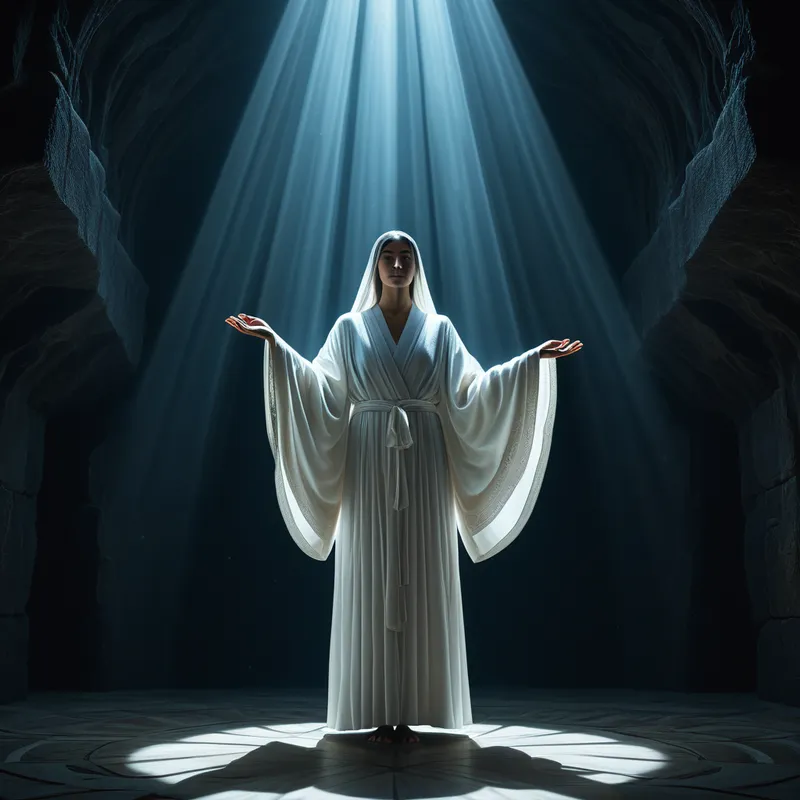
Listen, and hear a tale not of kingdoms or conquests, but of a garment. In the hour of the world’s deepest shadow, when the sky over Golgotha turned the color of a bruise, they led the man of sorrows up the hill. His body was a map of wounds, but upon his shoulders rested a robe unlike any other. It was not a king’s purple, nor a priest’s ornate vestment. It was simple, yet of a craftsmanship that whispered of eternity—woven in one piece from top to bottom. No seam, no join, no beginning or end in its making.
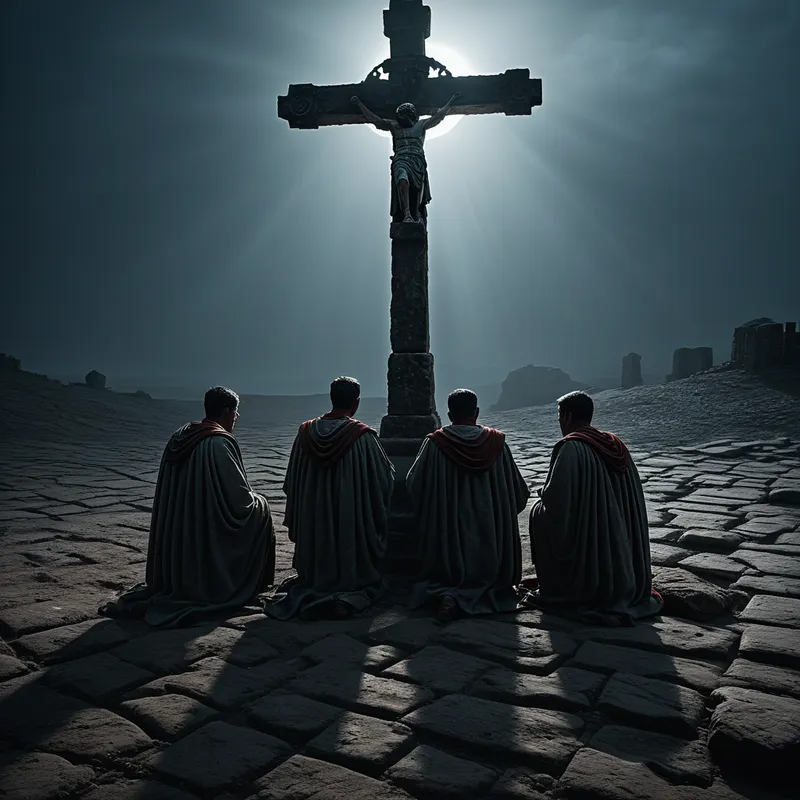
As the nails bit and the cross was raised, the soldiers below, their work grimly done, turned to the spoils. Four of them stood over the small pile of his earthly possessions: a cloak, a belt, sandals. And the robe. They could divide the rest, but this seamless garment posed a dilemma. To tear it would be to ruin its essence, its perfect unity. So they cast lots, letting the rattle of bones decide its fate. The dice tumbled on the hard, blood-dampened earth. As one soldier claimed the prize, the narrative of the gospels turns its eye away, leaving the robe in the hands of fate and history. Yet, in that moment, the garment became more than cloth. It became a silent witness, an intact whole amidst the ultimate fragmentation.
Cultural Origins & Context
The story originates in the Gospel of John (19:23-24), a text noted for its theological and symbolic depth. Unlike the synoptic gospels, which mention the soldiers dividing Jesus’s clothes, John specifically introduces the detail of the seamless tunic, chiton, and explicitly connects this act to the fulfillment of a Psalm (22:18). This was not casual reportage but deliberate myth-making within the early Christian community.
The seamless robe functioned as a powerful symbol for a community defining itself against fragmentation. In a world of theological disputes and persecutions, the image of an indivisible garment mirrored the ideal of an indivisible Church, the unified body of Christ. Later, various traditions claimed to possess the relic—most notably in Trier, Germany, and Argenteuil, France—fueling pilgrimage and devotion. The robe thus moved from textual symbol to tangible object of veneration, its very existence (or the belief in it) serving to solidify communal identity and connect the faithful to the physicality of the sacred narrative.
Symbolic Architecture
At its core, the seamless robe is an archetypal symbol of wholeness and integrity. In a scene defined by division—the dividing of garments, the separation of spirit from body, the rift between humanity and the divine—the robe remains un-torn.
The indivisible garment represents the Self that cannot be partitioned, the core identity that persists even through the dissolution of the ego.
Psychologically, it symbolizes the Self, the totality of the psyche which includes both conscious and unconscious elements. The casting of lots underscores that this wholeness is not claimed by effort, but is often a matter of fate, or synchronicity—it falls to whom it may. Furthermore, the robe, worn during the crucifixion, absorbs the resonance of the event. It becomes a symbol of the conjunctio oppositorum—the alchemical union of opposites: spirit and matter, suffering and glory, death and life, woven into a single, inseparable reality.
The Dreamer’s Resonance
When this mythic pattern surfaces in modern dreams, it rarely appears as a biblical tableau. Instead, one might dream of a piece of clothing that is impossibly whole, perhaps self-repairing, or of trying desperately to prevent a cherished garment from being torn. One might dream of gambling for a single, precious object while everything else is being divided and lost.
Somatically, this can correlate with a felt sense of integration or, conversely, a fear of disintegration. The dream is often active during life phases where one’s identity feels fragmented—by professional demands, familial roles, or internal conflicts. The seamless garment in the dream points to the psyche’s innate movement toward cohesion. The act of casting lots may reflect the dreamer’s feeling that their sense of wholeness is out of their hands, subject to external forces or unconscious processes. The dream is a reassurance: at the center of the experience of being torn apart, there is an essential, woven unity that cannot be destroyed.

Alchemical Translation
The alchemical process mirrored here is the creation of the Lapis Philosophorum. The crucifixion scene represents the nigredo, the blackening, the supreme dissolution of the known self. The ego’s possessions—its identities, achievements, and defenses—are stripped away and divided. Yet, at the heart of this dissolution lies the unum, the one thing that resists partition.
The psychic triumph is not in avoiding the gamble of fate, but in realizing that the true prize is the seamless whole that was worn all along.
For the modern individual, the path of individuation involves enduring the necessary divisions and sufferings of life (the casting of lots for our superficial attributes) while protecting and recognizing the innate, seamless core. This core is not manufactured by the ego; it is woven by the deeper Self, “from top to bottom.” The work is to stop trying to stitch together a patchwork identity from scattered parts, and instead to don the robe that is already whole—to identify with the indivisible Self that integrates our contradictions, our sufferings, and our glories into a single, meaningful fabric. The soldiers’ gamble becomes our own existential lesson: we cannot win wholeness by dividing the world; we discover it by honoring the seamless unity within.
Associated Symbols
Explore related symbols from the CaleaDream lexicon: