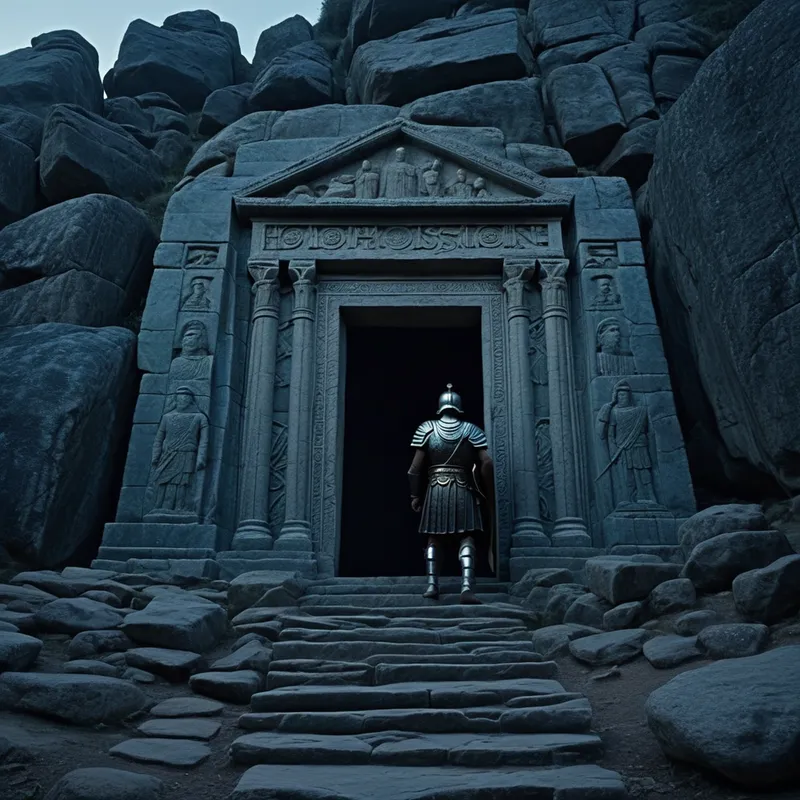
The Sealed Tomb Myth Meaning & Symbolism
A story of a divine hero, executed and sealed within stone, who shatters the ultimate boundary between death and life, despair and hope.
The Tale of The Sealed Tomb
Listen. There is a silence that is not empty, but full. It is the silence of a stone rolled into place, a final, grinding verdict against [the sky](/myths/the-sky “Myth from Persian culture.”/). It is the silence after the weeping, after the last friend has turned away into the gathering dark.
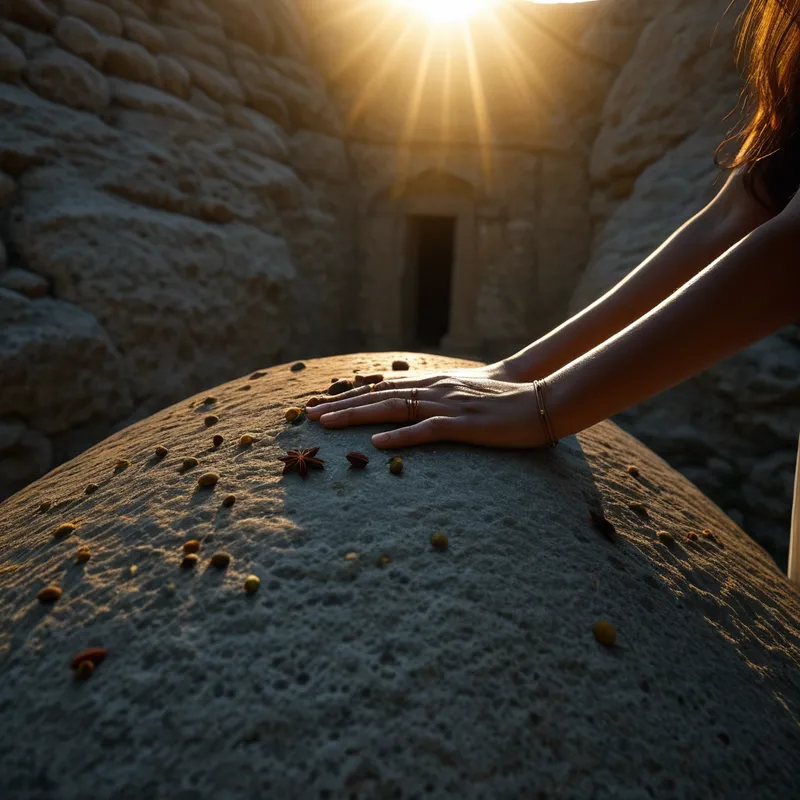
The one they called the Messiah was gone. His body, broken by the state and abandoned by the sun, lay wrapped in linen within a borrowed crypt. A garden tomb, they said, a place of quiet. But there was no quiet in the hearts of those who remained. Only the deafening finality of the stone—a great, disc-shaped slab heavier than regret, rolled down its groove to seal the entrance. The authorities, fearing the ghost of his influence more than his corpse, set a guard. They pressed the imperial seal into the wax across the stone and the rock face, a legal and spiritual lock. To break it was to invite annihilation.
For three days, [the world](/myths/the-world “Myth from Tarot culture.”/) held its breath. The tomb was not just a grave; it was the absolute conclusion. It was the answer to every hope, and the answer was “No.” Inside, only darkness, spice, and cold flesh. Outside, a world defined by loss, where every dream met the same immovable stone. The soldiers kept their watch, eyes on a door that would never open. The disciples huddled behind locked doors of their own, prisoners of a despair more total than any dungeon. The story was over. The stone had spoken.
But the stone… was a liar.
In the deep watch before dawn on the first day of the week, the silence within the sealed place became a different kind of fullness. It was not the stillness of death, but the gathering potential of a word about to be spoken. And then, without hands to push it, the stone—the legal seal, the military guard, the absolute end—was moved. Not broken, but set aside, as one might move a trifle. The light that poured forth was not of the sun, but from within. The linen wrappings lay empty, collapsed like a shed chrysalis.
The tomb was open. Not violated, but transcended. The seal was broken, not by thieves, but by a life that death could not grammar. The first witnesses were women, come to tend to death, who were met instead by a messenger in blinding white, sitting upon the stone as if it were a throne: “Why do you seek the living among the dead? He is not here.”
The sealed tomb was now a doorway. The place of ultimate confinement had become the site of impossible release. The end had become a beginning written in a language the world had forgotten how to read.
Cultural Origins & Context
This narrative forms the climax of the Gospels—Matthew, Mark, Luke, and John—texts composed in the decades following the events they describe, within a first-century Judean context under Roman occupation. It was not initially a written myth for scholars but an oral proclamation, a kerygma, shouted in marketplaces and whispered in homes: “He is risen!”
Its primary societal function was identity-forming and subversive. For a small, persecuted sect, the story of the sealed and emptied tomb was the foundational paradox that defined them against both Roman imperial power (which used crucifixion and sealed tombs to demonstrate absolute control) and against a despairing worldview. It was a story of divine reversal. It was passed down not as a pleasant metaphor but as testified witness, a historical claim that anchored a radical, hope-based cosmology. The Sunday observance itself replaced the [Sabbath](/myths/sabbath “Myth from Judeo-Christian culture.”/), directly commemorating the day the stone was rolled away, making the myth the rhythmic heartbeat of the community’s life.
Symbolic Architecture
Psychologically, the Sealed Tomb represents the psychic complex that feels absolute. It is the inner [prison](/symbols/prison “Symbol: Prison in dreams typically represents feelings of restriction, confinement, or a lack of freedom in one’s life or mind.”/) we believe is our final, unchangeable [reality](/symbols/reality “Symbol: Reality signifies the state of existence and perception, often reflecting one’s understanding of truth and life experiences.”/): a depression that feels permanent, a [trauma](/symbols/trauma “Symbol: A deeply distressing or disturbing experience that overwhelms the psyche, often manifesting in dreams as unresolved emotional wounds or psychological injury.”/) that seems to define us, a [pattern](/symbols/pattern “Symbol: A ‘Pattern’ in dreams often signifies the underlying structure of experiences and thoughts, representing both order and the repetitiveness of life’s situations.”/) of failure we are convinced is our [fate](/symbols/fate “Symbol: Fate represents the belief in predetermined outcomes, suggesting that some aspects of life are beyond human control.”/). The [stone](/symbols/stone “Symbol: In dreams, a stone often symbolizes strength, stability, and permanence, but it may also represent emotional burdens or obstacles that need to be acknowledged and processed.”/) is the [weight](/symbols/weight “Symbol: Weight symbolizes burdens, responsibilities, and emotional loads one carries in life.”/) of our own conclusions about ourselves—“I am broken,” “I will never change,” “This is all I deserve.” The [imperial seal](/symbols/imperial-seal “Symbol: A symbol of ultimate authority, divine mandate, and spiritual legitimacy, often representing the connection between earthly power and cosmic order.”/) is [the authority](/symbols/the-authority “Symbol: A figure representing power, control, and societal structure, often embodying rules, leadership, or external judgment.”/) we give to those conclusions, making them legal, binding, and real.
The figure within the tomb is the Self, the core of potential and [life](/symbols/life “Symbol: The symbol of ‘Life’ represents a journey of growth, interconnectedness, and existential meaning, encompassing both the joys and challenges that define human experience.”/), which the conscious ego believes is dead and lost. The three days in the darkness symbolize the necessary, fallow [period](/symbols/period “Symbol: Periods in dreams can symbolize cyclical patterns, renewal, and the associated emotions of loss or change throughout life.”/) of [incubation](/symbols/incubation “Symbol: A period of internal development, rest, or hidden growth before emergence, often associated with healing, creativity, or transformation.”/), where all conscious [effort](/symbols/effort “Symbol: Effort signifies the physical, mental, and emotional energy invested toward achieving goals and personal growth.”/) ceases and the transformative work happens in the unseen [depths](/symbols/depths “Symbol: Represents the subconscious, hidden emotions, or foundational aspects of the self, often linked to primal fears or profound truths.”/).
The most profound liberation begins not with breaking out, but with the realization that the walls themselves are an illusion sustained by our belief in their permanence.
The rolling away of the stone is not an act of violent escape, but of [revelation](/symbols/revelation “Symbol: A sudden, profound disclosure of truth or insight, often through artistic or musical means, that transforms understanding.”/). It reveals that the [barrier](/symbols/barrier “Symbol: A barrier symbolizes obstacles, limitations, and boundaries that prevent progression in various aspects of life.”/) between [death](/symbols/death “Symbol: Symbolizes transformation, endings, and new beginnings; often associated with fear of the unknown.”/) and life, [despair](/symbols/despair “Symbol: A profound emotional state of hopelessness and loss, often signaling a need for transformation or surrender to deeper truths.”/) and hope, was never structural to reality, but contingent upon a [perspective](/symbols/perspective “Symbol: Perspective in dreams reflects one’s viewpoints, attitudes, and how one interprets experiences.”/) bound by fear. The empty linens are the discarded [identity](/symbols/identity “Symbol: Identity represents the sense of self, encompassing personal beliefs, cultural background, and social roles.”/) of the “dead man,” the former self that needed to die for the new [consciousness](/symbols/consciousness “Symbol: Consciousness represents the state of awareness and perception, encompassing thoughts, feelings, and experiences.”/) to emerge.
The Dreamer’s Resonance
When this mythic pattern stirs in the modern dreamer, it often manifests as dreams of being trapped in a small, dark space—a basement room, a buried car, a sealed vault. The somatic feeling is one of crushing pressure, airlessness, and profound helplessness. There is often a door, but it is locked, barred, or impossibly heavy.
Psychologically, this dream state indicates that the dreamer is in the “three days” of the myth. A major life structure—a job, a relationship, a self-concept—has collapsed or been “executed.” The conscious ego is in the tomb with what it believes is its dead Self. The dream captures the agony of this incubation, where the old is gone but the new has not yet been revealed. The process at work is one of surrender and hidden transformation. The dreamer is being compelled to stop trying to force the stone open from inside and to endure the terrifying, fertile darkness where the only possible action is to let go. The eventual resolution in a dream sequence—a crack of light, the door being opened from the outside, finding an unexpected exit—signals the nascent emergence of this new consciousness, often before the waking mind is aware of any change.
Alchemical Translation
In the alchemical journey of individuation, the Sealed Tomb is the [nigredo](/myths/nigredo “Myth from Alchemical culture.”/)—the blackening, the descent into the utter darkness of the unconscious. It is the necessary death of [the ego](/myths/the-ego “Myth from Jungian culture.”/)’s current orientation, a crushing sense of meaninglessness and confinement. The hero’s crucifixion and burial represent the conscious sacrifice of a worn-out identity, willingly entering the tomb of the unknown.
The three days symbolize the albedo, the whitening, which occurs unseen. This is the psychic work of separating the essential from the non-essential in the pure darkness of introspection. The stone rolling away marks the transition to [rubedo](/myths/rubedo “Myth from Alchemical culture.”/)—the reddening, or dawn. It is the moment of illumination, where the integrated Self rises, having united the opposites of life and death, spirit and matter.
The stone is not rolled away to let the dead out, but to let the living in—to show the world that the prison is empty, and that life has already found a path outside of its logic.
For the modern individual, the myth models the complete process of psychic transmutation. We must first consent to our own “deaths”—the end of illusions, the failure of old ways. We must endure the sealed tomb of depression, stagnation, or grief without prematurely seeking escape. We must allow the old identity to be wrapped and laid aside. If we can bear the darkness, the transformation occurs ex opere operato—by the work having been worked. Our task is not to resurrect ourselves, but to discover, to our shock, that the life within us has already performed the impossible. We then emerge not merely restored, but transfigured, carrying the scars but operating under a new, unkillable principle. The sealed tomb, once the symbol of our end, becomes the proof of our liberation.
Associated Symbols
Explore related symbols from the CaleaDream lexicon: