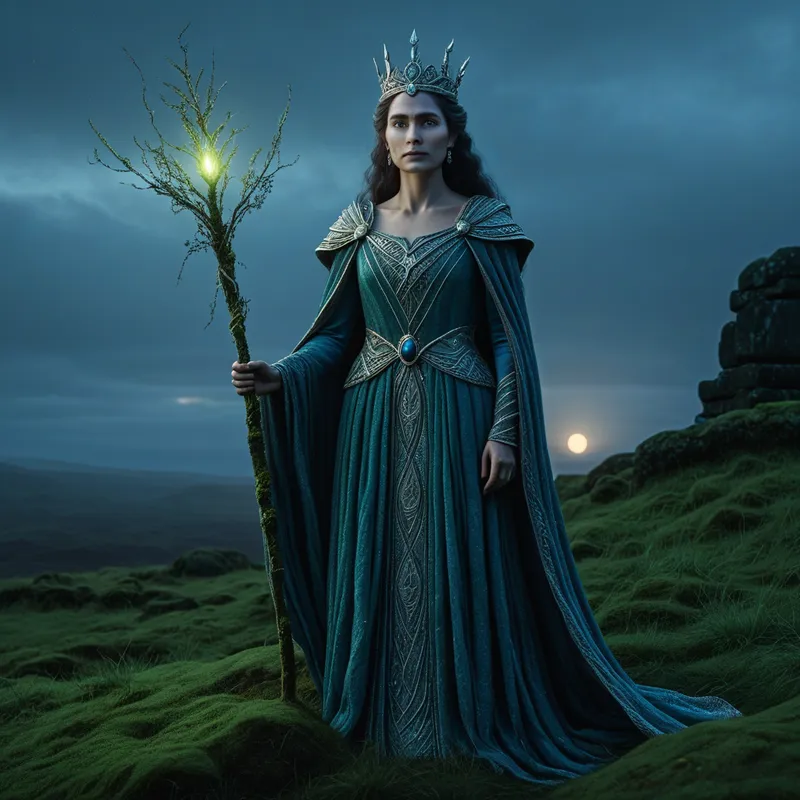
The Sídhe Myth Meaning & Symbolism
The story of the Sídhe, the ancient gods diminished to a hidden folk, guarding the threshold between the mortal world and the timeless Otherworld.
The Tale of The Sídhe
Listen, and hear the tale that the wind tells through the hollow hills. It speaks of a time before memory, when the land itself was a living god, and those who walked it were not as we are now. They were the Tuatha Dé Danann, the People of the Goddess Danu. They came from the four great cities of the north, bearing treasures of impossible power: the Spear of Lugh, the Sword of Nuada, the Cauldron of the Dagda, and the Lia Fáil.
They ruled with a brilliance that was neither cruel nor kind, but simply other. Theirs was a world woven from the raw threads of magic, where a feast could last a century and a song could raise the dead. But a new tide washed upon the shores of Éire: the Children of Mil, the mortal sons of men. A great battle was fought, not merely of sword and shield, but of druidic art and storm-raising will. The land shook with their strife.
And though the Tuatha Dé were mighty, the tide of mortality was a force they could not ultimately stem. A treaty was forged, not in halls of stone, but in the very fabric of the world. The great Amergin stood between the armies and spoke to the land itself. He divided it, not by acre, but by dimension. To the mortal race, he gave the surface, the world of sun and soil, of birth and decay. To the Tuatha Dé Danann, he gave the interior.
And so, they did not die. They withdrew. Using their profound art, they folded themselves into the landscape. They passed into the sídhe mounds, the hollow hills, the deep lakes, and the misty glens. Their great palaces of light and music now existed within the green hills mortals walked upon. Their time became different, a single night for them spanning decades in the world above. They diminished in stature to our eyes, becoming the Aes Sídhe, the People of the Mounds. The gods became the fairies, not out of weakness, but by a profound, magical retreat. They are there still, just beyond the corner of your eye, guardians of a timeless world, waiting behind the veil of every twilight.

Cultural Origins & Context
This is not a single myth, but a foundational cosmological narrative embedded in the Irish mythological cycle, primarily preserved in medieval manuscripts like the Lebor Gabála Érenn. It was the bardic explanation for the prehistoric passage tombs that dotted the landscape—Newgrange, Knowth, and others. These were not merely graves to the Celts; they were sídhe, the literal dwellings of a divine race that had been physically and spiritually displaced.
The story functioned as an etiological myth, explaining the origin of the fairy folk who permeated everyday folklore. More profoundly, it established a sacred geography. Every mound, well, and lone hawthorn tree became a potential caol áit, a “thin place.” The myth was told not to entertain children, but to instruct adults in the proper respect for the land. It encoded a warning and a wisdom: the world you see is not the whole world. The past is not dead; it is layered beneath your feet, alive and potent.
Symbolic Architecture
The myth of the Sídhe is a masterful symbolic map of the psyche’s own structure. The Tuatha Dé Danann represent the primal, archetypal forces of the unconscious—instinctual, creative, amoral, and potent. The mortal Children of Mil symbolize the emerging ego-consciousness, the daylight self that seeks to order, claim, and build upon the surface of reality.
The treaty of Amergin is the primordial pact between consciousness and the unconscious. We are granted sovereignty over the daylight world, but only if we acknowledge the eternal sovereignty of the hidden ones below.
The sídhe mound is the perfect symbol for the personal unconscious: an apparently ordinary, grassy hill (the conscious personality) that contains within it vast, timeless halls (the archetypal depths). The Sídhe themselves are the autonomous complexes, the “people” who live in our interior. They are our latent talents, our repressed memories, our ancestral patterns, and our creative daimons. They are “diminished” only because our conscious mind has ceased to perceive their divine nature, viewing them instead as superstitions, moods, or irrational impulses.

The Dreamer’s Resonance
When the motif of the Sídhe enters modern dreams, it signals an encounter with the autonomous, “other” life of the psyche. To dream of a grassy mound with a door or light within is to stand at the threshold of a deep unconscious content seeking recognition. To dream of the Sídhe folk—whether as beautiful, terrifying, or indifferent figures—is to personify these contents.
The somatic experience is often one of profound ambivalence: a magnetic pull mixed with dread, awe tinged with fear. This is the ego feeling both the allure and the threat of the unconscious. The Sídhe may offer a gift (a symbol of new potential) or issue a warning (a representation of a neglected inner truth). A dream of being trapped in the sídhe, where time distorts, reflects a state of being psychologically “in the complex,” lost in a mood or a pattern that exists outside normal chronological time. The process at work is one of recognition—the ego is being forced to acknowledge that it does not reign alone.
Alchemical Translation
The psychic transmutation modeled here is the integration of the ancestral and the autonomous. The individuation journey is not about conquering the unconscious, but about re-negotiating Amergin’s treaty. The mortal ego must learn to approach the mound.
The alchemical gold is not seized from the Sídhe; it is received in exchange for respectful engagement. One must lose mortal time to gain timeless insight.
This requires a ritual of approach: slowing down, attending to the “thin places” in one’s own life—dreams, synchronicities, creative impulses, and irrational wounds. It means offering respect (attention) to the hidden ones, not as superstition, but as psychological reality. The hero’s task is to journey into the mound, to sit at the feast of the Sídhe without eating their food (being wholly assimilated by the unconscious) and without stealing their treasure (inflating with archetypal energy). The triumph is to return to the surface world bearing a token of that encounter—a piece of poetry, a healed fragment of the soul, a deeper respect for the mystery within and without. One becomes, in a sense, a guardian of the threshold oneself, able to walk in both worlds, mortal yet touched by the magic of the interior hills.
Associated Symbols
Explore related symbols from the CaleaDream lexicon: