The Scales of Ma'at Myth Meaning & Symbolism
The soul's final journey to the Hall of Judgment, where its heart is weighed against the feather of truth to determine eternal fate.
The Tale of The Scales of Ma’at
The sun has set on your final day. The last breath has left your body, a sigh upon the wind. But you are not gone. You are a traveler now, a voyager on the darkest river, guided by whispers older than the pyramids. Your boat glides on silent waters, past banks where stars grow like reeds, toward a shore that is not a shore but a gateway.
You stand before a portal of obsidian and gold. This is the Hall of Ma’at. To enter is to be unmade. The air is thick, not with dust, but with the weight of every word you ever spoke, every deed you ever did. It hums with the memory of a thousand lifetimes.
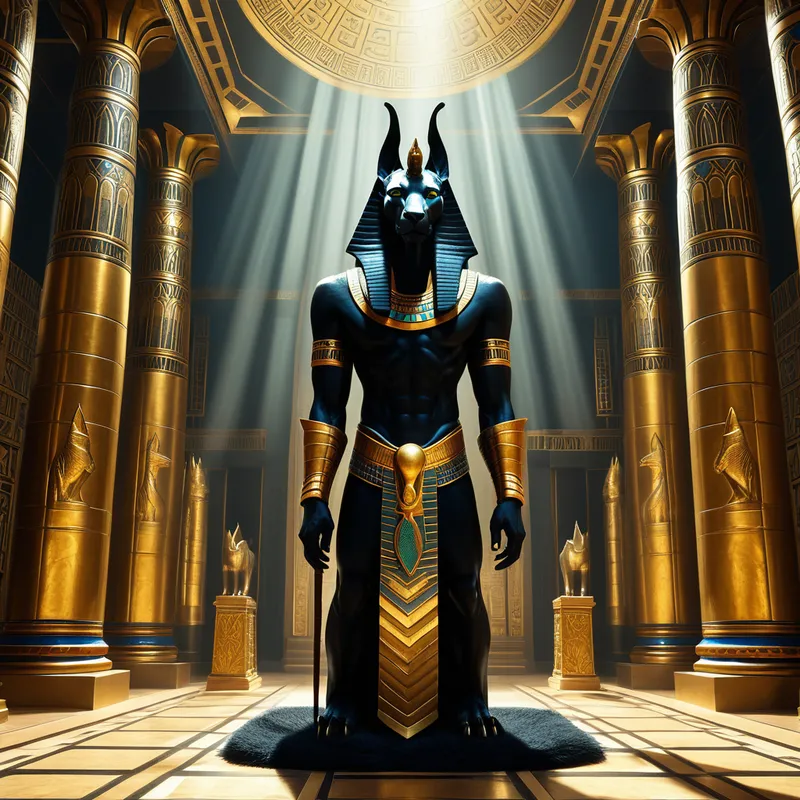
In the center of the vast, silent hall, a figure waits. He is tall, with the sleek, powerful head of a black jackal, ears pricked to hear the truth in the silence between heartbeats. This is Anubis, the Opener of the Ways. His eyes hold no malice, only the profound, unblinking focus of a master craftsman. Before him, a scale of perfect gold gleams in a light that has no source.
To his side sits a tribunal of forty-two figures, their forms shifting between the human and the divine. They are the Assessors, each one a manifestation of a principle—“I have not stolen,” “I have not caused pain,” “I have not told lies.” Their collective gaze is a pressure upon your soul.
And in the shadows, something stirs. A low growl rumbles through the stone. It is a creature of nightmare, a fusion of crocodile, lion, and hippopotamus—the Ammit, the Devourer. She does not judge; she only waits, jaws slightly parted, for the sentence to be passed.
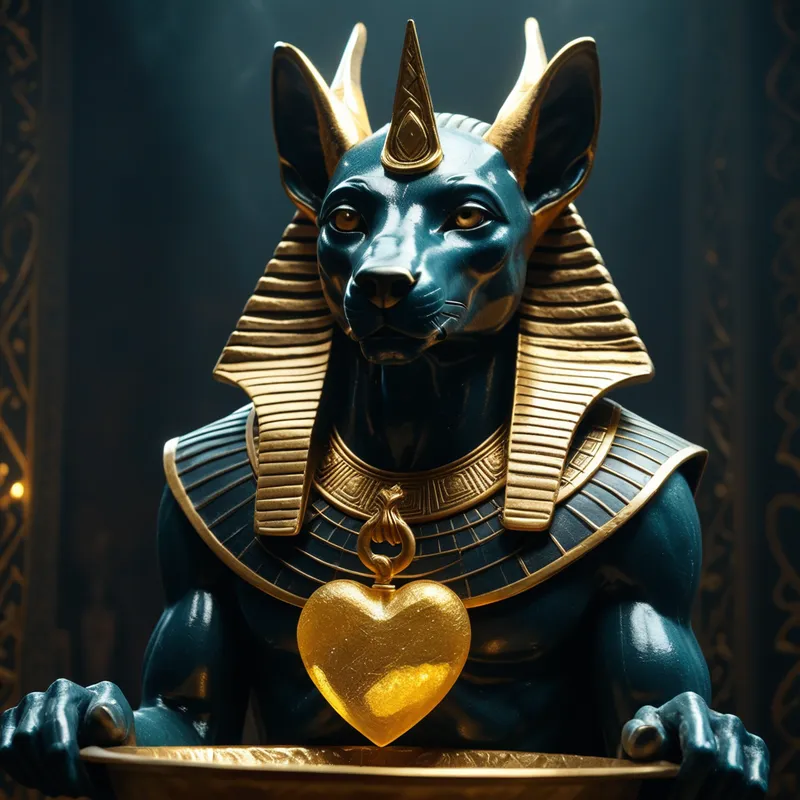
Anubis gestures. From your chest, he draws not your physical heart, but your ib—a glowing, translucent essence, pulsing with the record of your life. It is heavy with secret shames, bright with moments of kindness, scarred by envy, warmed by love. He places it with infinite care upon the left pan of the scale.
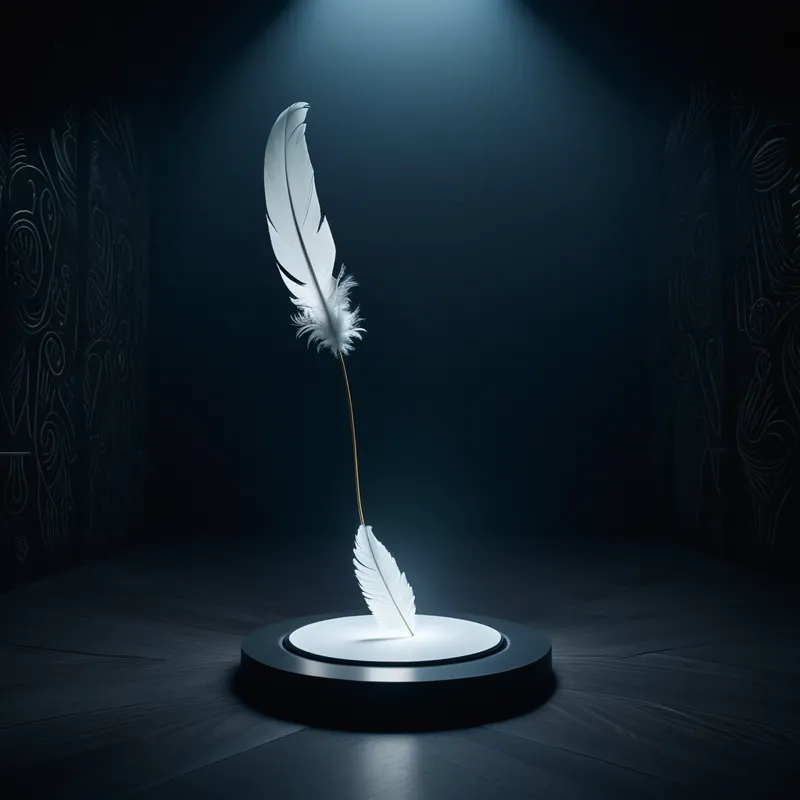
Upon the right pan, he places a single feather. It is the feather of Ma’at, the ostrich plume of truth. It is lighter than a thought, yet it contains the weight of the cosmos in balance. The universe holds its breath.
The scale begins to move. The heart dips, burdened. The feather rises, impossibly light. Your entire existence hangs in the trembling equilibrium. Anubis watches the pointer, his hand steady. The Assessors lean forward. The growl of Ammit grows louder.
Then, a new presence. Seated on a throne, a scribe with the head of an ibis dips his reed pen. This is Thoth, the divine recorder. He will inscribe the verdict. And overseeing all, from a greater throne, is the lord of the underworld himself, Osiris, crowned and wrapped in white, his green skin the color of rebirth. His eyes are pools of ancient, merciful stillness.
The scales slow… and find their balance. The heart and the feather rest, level. A perfect equipoise. A sigh like a desert wind moves through the hall. Thoth writes the blessed words. Osiris nods. You are declared “True of Voice.” The shadowy Ammit slinks back into the darkness, denied her feast.
Your heart is returned to you, not as a burden, but as a testament. You are led forward, past the throne of Osiris, toward the radiant fields of Aaru, where the sun rises on an eternal dawn. The judgment is complete. You have met your truth, and it has set you free.
Cultural Origins & Context
This was not merely a story to the ancient Egyptians; it was the central operating manual for the soul. The ritual of the Weighing of the Heart is detailed in the <abbr title="A collection of funerary spells and texts to guide the soul">Book of the Dead</abbr>, a personalized papyrus placed in the tomb. It was a democratic myth—not only for pharaohs, but for any soul who could afford the spells and pass the test. The myth was performed, not just narrated. Priests recited the “Negative Confessions” (the denials to the 42 Assessors) during funeral rites, and the <abbr title="A small scarab-shaped amulet placed over the heart">heart scarab</abbr> was inscribed with a spell begging the heart not to testify against its owner.
The myth’s societal function was profound. It externalized an internal ethical compass. To live in <abbr title="Truth, justice, harmony, and cosmic order">Ma'at</abbr> was to contribute to the stability of the cosmos itself. Every act of dishonesty or violence was a crack in universal order; every act of harmony and truth was a brick in its foundation. The myth provided a framework for justice that transcended human courts, offering ultimate accountability and the hope of redemption through truthful living.
Symbolic Architecture
The myth presents a complete symbolic architecture for the psyche’s confrontation with itself.
The heart is not judged against a law, but against a feather—the ultimate symbol of weightless integrity. The goal is not perfection, but balance.
The <abbr title="The spiritual heart, seat of emotion, conscience, and memory">ib</abbr> (heart) represents the total psychic substance: memories, desires, traumas, loves, and shames—the unvarnished record of a life. The Feather of <abbr title="Goddess of truth, justice, harmony, and cosmic order">Ma'at</abbr> symbolizes the core, unshakeable principle of rightness, the inner truth that resonates with cosmic harmony. The Scale is the mechanism of conscious evaluation, the space where the complex self is measured against the simple, profound standard.
Anubis is the psychopomp, the guide who facilitates this deep introspection. Thoth is the observing ego, the part of consciousness that records and witnesses the process. The forty-two Assessors are the specific, articulated aspects of conscience. Ammit represents the terrifying consequence of failure: total psychic disintegration, the annihilation of the self by its own unresolved shadow. Osiris, the resurrected god, embodies the potential outcome: a self that has faced its truth and been reconstituted, whole and eternal.
The Dreamer’s Resonance
When this myth stirs in modern dreams, the Hall of Judgment may appear as a courtroom, a doctor’s office, a job interview, or simply a stark, empty room with a scale. The dreamer is undergoing a profound somatic and psychological process of self-assessment.
Dreaming of being weighed often coincides with life transitions, moral dilemmas, or the nagging sense of inauthenticity. The somatic feeling is one of exposure, vulnerability, and intense scrutiny—a “gut feeling” made literal. The shadowy <abbr title="The devourer of condemned souls">Ammit</abbr> may manifest as a looming fear of failure, social annihilation, or a consuming anxiety. The dream is the psyche’s innate tribunal, forcing a confrontation between the life one is living and the truth one knows inwardly. It is a call to account, often arising when the ego has become too burdened by deceit—both to others and to itself.
Alchemical Translation
The journey through the Hall of Ma’at is a perfect map for the alchemical process of individuation—the Jungian path to psychic wholeness.
The alchemical “rubedo,” the reddening, is not the heart’s destruction, but its honest presentation. The gold is not created; it is revealed in the balance.
The first step is the mortificatio: the death of the old, unexamined identity (the physical death in the myth). The journey to the hall is the nigredo, the descent into the unconscious. The weighing itself is the central separatio—the meticulous sorting of the psychic contents. What is of the true self? What is borrowed, false, or burdensome? The feather represents the <abbr title="The true, innate self beyond the ego">Self</abbr> archetype, the organizing principle of the psyche.
The triumphant outcome—the balanced scale—is the coniunctio oppositorum, the sacred marriage of the complex, flawed human heart with the divine principle of truth. The heart is not made feather-light; it is made truthful enough to balance the feather. This is the transmutation. The condemned outcome, being consumed by <abbr title="The devourer of condemned souls">Ammit</abbr>, symbolizes the failure of this process: the ego being overwhelmed and disintegrated by the unintegrated shadow.
For the modern individual, the ritual is internal. We must, in moments of ruthless honesty, summon our own <abbr title="God of embalming and the afterlife">Anubis</abbr> to weigh our actions against our inner feather. We must face our personal Assessors and speak our “Negative Confessions”—not to deny our faults, but to consciously acknowledge them and thereby strip them of their hidden, destructive power. The goal is to become <abbr title="'True of Voice,' a justified one">Maa Kheru</abbr>, not to the gods of Egypt, but to the deepest law of our own being. In that balance lies not an eternal afterlife in <abbr title="The paradisiacal afterlife">Aaru</abbr>, but the liberated, authentic life of one who has faced their own heart and found it, however imperfectly, in harmony with their truth.
Associated Symbols
Explore related symbols from the CaleaDream lexicon: