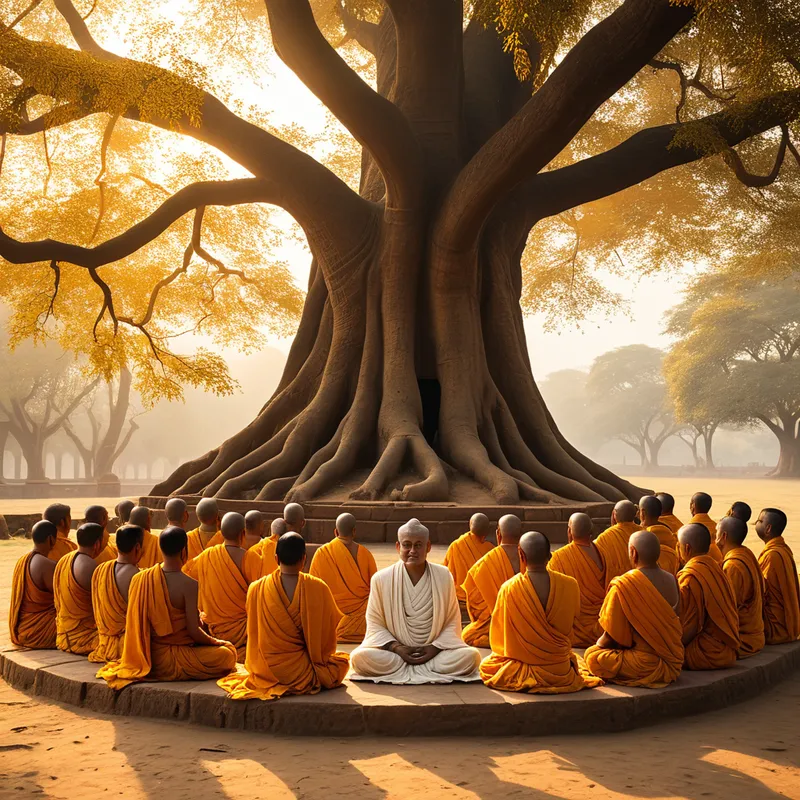
The Sangha Myth Meaning & Symbolism
The story of the Buddha establishing the first spiritual community, a refuge of shared practice and wisdom that became the living heart of the Dharma.
The Tale of The Sangha
In the hush that follows the great awakening, beneath the sacred Bodhi, a man sat. He was no longer a prince, nor merely an ascetic. He was the Buddha, and the truth he had grasped was vast, profound, and silent as deep space. The scriptures say he hesitated. How could words, those clumsy vessels, carry the taste of the deathless? The world, steeped in Samsara, seemed asleep, its ears stoppered with desire.
But compassion, that great river, began to flow. His gaze turned north, to a place called Isipatana. There, in a grove where deer roamed unafraid, five figures moved with the grim discipline of despair. These were his old companions, the ascetics who had shared his years of starvation, who had left him when he accepted a simple bowl of milk-rice. They saw him approach from a distance, a figure radiant with an unshakeable peace. A pact was made: they would not honor him, but they would not ignore him. A seat was prepared.
He sat, and the very air of the deer park grew still. He did not proclaim his enlightenment. He began to speak of a middle path, a way between the extremes of indulgence and self-mortification. He spoke of the noble truth of suffering, its origin, its cessation, and the path leading to its cessation. This was the Dhammacakkappavattana Sutta, the setting in motion of the wheel of truth. His words were not commands, but invitations to see.
And they saw. One by one, the scales of dogma and doubt fell from their eyes. Kondanna understood first, his face breaking into a smile of utter release. Then Vappa, then Bhaddiya, then Mahānāma, then Assaji. The truth, like a clear light, passed between them. They were no longer five isolated seekers, bound by rigid practice. They were a field where the seed of Dharma could be sown. The Buddha looked upon them and said, “Come, Bhikkhus. The Dharma has been well-proclaimed. Walk the path for the cessation of suffering.”
With those words, the Sangha was born. It was not a building, nor an institution, but a living stream. They became wanderers with a shared hearth—the truth. They moved from village to village, their saffron robes like flames of renunciation against the green earth, their alms bowls a silent testament to interdependence. Others came—wealthy merchants, haunted warriors, weary mothers—and heard the teaching. Some took the robes; others, the Upāsaka and Upāsikā, supported them. The solitary awakening of one man had become a communal path, a refuge built not of wood and stone, but of mutual commitment, ethical discipline, and shared insight. The Buddha, the Dharma, and the Sangha—the Triple Gem—now stood complete, a sanctuary in the midst of the world’s relentless turning.
Cultural Origins & Context
The mythos of the Sangha is not a legend of a distant past but the foundational narrative of a living tradition. Its setting is the Gangetic plain of the 5th century BCE, a time of profound social and philosophical ferment. The story is preserved not in a single epic, but woven into the earliest strata of the Buddhist canon, the Sutta Pitaka. It was passed down orally for centuries by the Sangha itself, chanted in unison by monks as a living memory and a reaffirmation of their collective identity.
Its primary societal function was constitutive and normative. It answered the urgent questions: What are we? How did we begin? How shall we live together? The tale of the first five disciples established the model for ordination and the primacy of understanding over blind faith. The subsequent growth of the community, including the later establishment of the Bhikkhunī Sangha after the persuasion of his foster mother Mahapajapati Gotami, provided a script for inclusion. The myth served as a social charter, encoding the rules of monastic life (Vinaya) within a narrative of sacred origin. It transformed a disparate group of renunciants into a “field of merit” for the laity and a protected vessel for the fragile flame of the Dharma, ensuring its survival long after the Buddha’s Parinibbāna.
Symbolic Architecture
At its core, the Sangha is a profound symbol of relational awakening. The Buddha’s initial solitude under the Bodhi tree represents the absolute, non-negotiable fact of individual insight. Yet, the myth insists this insight alone is incomplete. It must be communicated, shared, and embodied in relationship to become fully human and sustainable.
The Sangha is the Dharma made visible, the abstract truth taking human form in community.
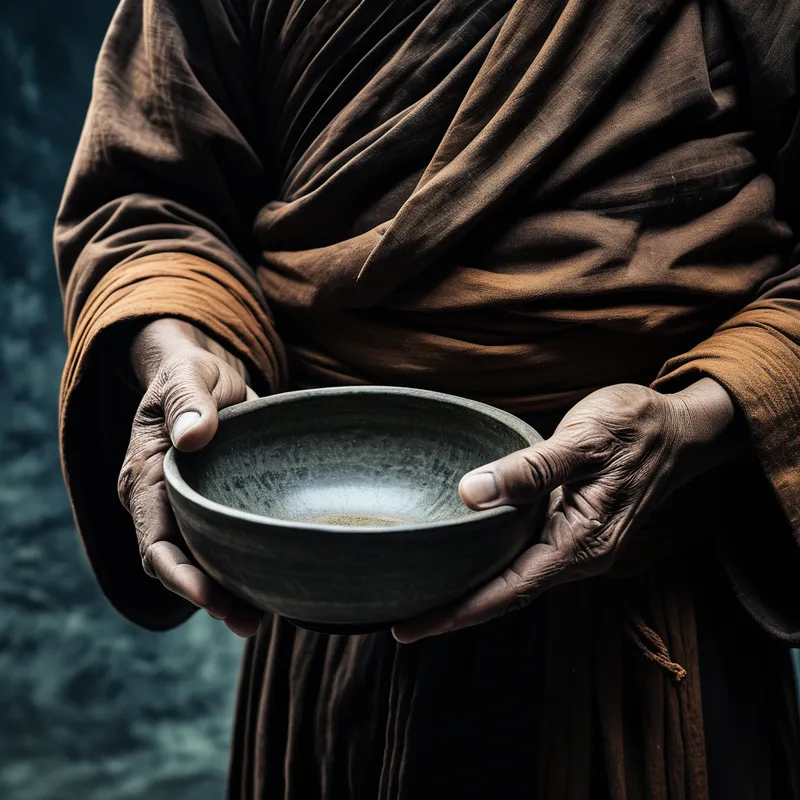
The five ascetics symbolize the fragmented, striving ego, attempting to conquer suffering through sheer will and austerity. Their transformation represents the ego’s surrender to a deeper, transpersonal truth. The alms bowl is a central symbol of radical interdependence—an empty vessel that must be filled by the world, and in turn, offers the nourishment of Dharma. The Triple Gem (Ti-Ratana) forms a complete psychic circuit: the awakened consciousness (Buddha), the objective truth of reality (Dharma), and the container of shared practice that nourishes and corrects the individual (Sangha). Psychologically, the Sangha represents the necessary “third” beyond the subject-object dichotomy—the communal field that holds the tension between personal experience and universal law, preventing enlightenment from devolving into spiritual solipsism.
The Dreamer’s Resonance
When the motif of the Sangha arises in modern dreams, it seldom appears as a historical tableau. Instead, it manifests as a profound somatic and psychological experience of seeking or finding the right container. One may dream of wandering through a vast, impersonal city (the modern Samsara) and stumbling upon a small, warmly lit room where a group is engaged in silent, purposeful activity. There is a palpable sense of relief, of “coming home” to a context where one’s deepest seeking is recognized and mirrored.
Conversely, one might dream of being in a dysfunctional group—a committee, a family gathering—where the rules are opaque and the communication is hostile. This is the shadow of the Sangha: the longing for authentic community manifesting as its opposite, highlighting the dreamer’s isolation and their unconscious yearning for a fellowship based on truth, not consensus or coercion. The somatic signature is often a shift from anxious contraction (the lone seeker) to a grounded expansion (the supported practitioner). The dream points to a process of moving from a psychology of “I” to an experience of “we,” where the “we” is aligned with a higher purpose than mere belonging.
Alchemical Translation
The alchemical journey modeled by the Sangha myth is the transmutation of the spiritual orphan into the connected adept. The process begins with the “noble solitude” of the Buddha—the necessary differentiation of the self from collective norms and personal history. This is the separatio. But the work does not end there. The crucible of individuation requires a conjunctio, a sacred marriage. Here, it is not a marriage with an anima/animus figure, but with the community of the similarly committed.
Individuation is not a journey out of relationship, but into a more conscious, sacred form of it.
The modern individual must first find their own “Bodhi” moment—a core insight or value that is authentically their own. The subsequent, often more difficult, alchemical stage is to “go to the Deer Park.” This means seeking out the fellowship that can reflect, challenge, and sustain that insight. It is the creation of a temenos, a protected space where the raw gold of personal revelation can be minted into the currency of compassionate action in the world. The Sangha myth teaches that our deepest realizations are fragile unless they are embedded in a network of ethical accountability and mutual support. The ultimate alchemical gold is not a solitary enlightenment, but an enlightened culture—a small, conscious community living the truth, which becomes the true “refuge” for a world adrift. It is the transformation of the individual seeker into a living cell within the body of awakening.
Associated Symbols
Explore related symbols from the CaleaDream lexicon: