The Sands of Time in Greek myt Myth Meaning & Symbolism
A tale of a mortal's desperate bargain with Chronos, the god of time, to save a loved one, revealing the cost of defying destiny's flow.
The Tale of The Sands of Time in Greek myt
Hear now a whisper from the edge of [the world](/myths/the-world “Myth from Tarot culture.”/), where the air grows thin and the stars press close. It is a tale not carved on temple walls, but breathed on [the wind](/myths/the-wind “Myth from Various culture.”/) that scours [the desert](/myths/the-desert “Myth from Biblical culture.”/)—a story of Chronos, who is not a titan of harvest, but the very substance of passing ages.
In a land where the olive trees knew the names of kings long dust, there lived a woman named Althea. Her love was not for a hero, but for her brother, a philosopher whose mind was a lantern in the world’s gloom. A wasting sickness took him, a thief in the night that no herb or prayer could deter. As his breath grew faint, Althea’s desperation became a living [thing](/myths/thing “Myth from Norse culture.”/). She journeyed beyond the maps, to the Hyperborean wastes, where it is said the fabric of the world wears thin.
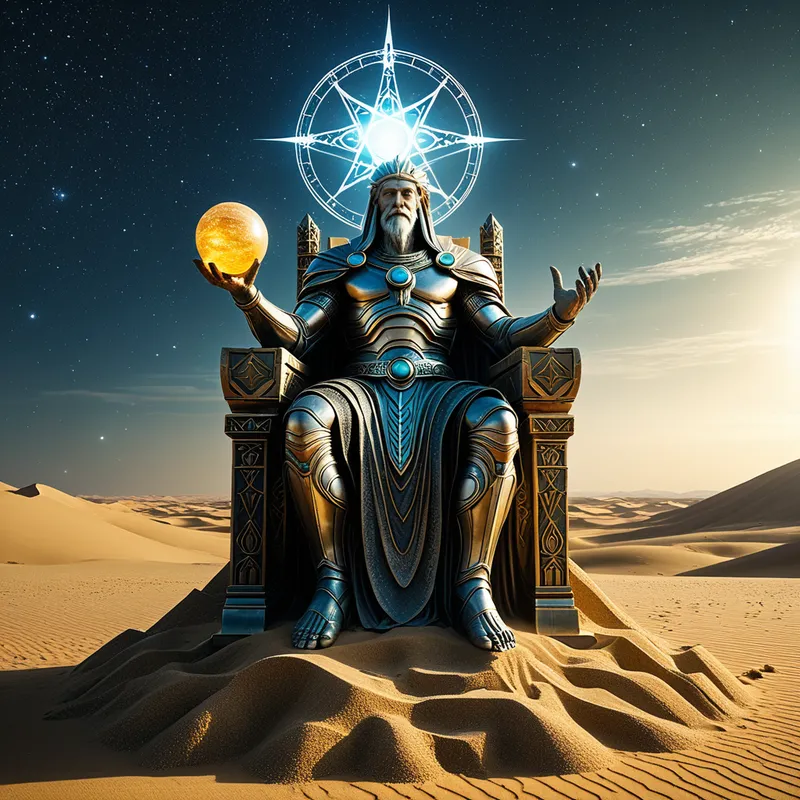
There, in a valley of glass and silence, she found the sanctuary of Chronos. It was no palace, but a vast, open plain of shifting, iridescent sand. In its center sat the god—or the idea of one. His form was both old man and newborn babe, solid rock and flowing river. Before him rested not an hourglass, but a single, seamless orb, within which all the sands of every life, every empire, every whispered thought, swirled in a silent, cosmic storm.
Althea fell to her knees, her voice cracking the immense quiet. “Lord of All Duration,” she pleaded, “stay your hand. Take from my allotted span and add it to his. Let my sand flow into his glass.”
Chronos did not speak with a voice, but with a sensation—the crushing weight of epochs, the fleeting joy of a mayfly’s dawn. A thought impressed upon her: “To give is to take. To alter one grain is to risk the dune. You may gather what you can carry from the sands at my feet—the time that has slipped, the moments lost to forgetfulness. But what you gather, you must bear, and its nature will change in your mortal hands.”
Althea scrambled forward. The sands at the god’s feet were not golden, but held every hue: the silver of forgotten promises, the blue of lost laughter, the grey of unmourned endings. She cupped her hands and gathered them, a sparkling, weightless heap. As she turned to run, the sand in her palms began to grow heavy. It pulsed with a heat that was not of the sun. She ran across the glassy plain, back toward the world of the living, feeling the substance in her hands condensing, becoming tangible, becoming cost.
She reached her brother’s side as the last light left his eyes. Pouring the strange sands over his still heart, she witnessed a miracle and a horror. Color returned to his cheeks, his chest rose—but the sands that had touched her skin left not dust, but fine, ineradicable lines, like cracks in [porcelain](/myths/porcelain “Myth from Chinese culture.”/). Her brother lived, speaking with a wisdom now tinged with melancholy, for he remembered [the threshold](/myths/the-threshold “Myth from Folklore culture.”/) he had crossed. Althea, however, carried the visible price. She had not merely given years; she had borne the raw substance of elapsed time itself, and it had aged her soul in an instant. She had traded the unmarked future for a present etched with the weight of what she had gathered from the floor of eternity.

Cultural Origins & Context
This narrative exists in the liminal space between canonical Greek mythology and the universal folk consciousness. While no single source in Hesiod or [Homer](/myths/homer “Myth from Greek culture.”/) recounts this exact tale, its components are deeply embedded in the Hellenic worldview. The philosophical concept of Chronos (distinct from the Titan [Kronos](/myths/kronos “Myth from Greek culture.”/)) evolved in later antiquity, particularly among pre-Socratic thinkers and Orphic traditions, representing irreversible, devouring time.
The story’s structure—a mortal journeying to the edge of creation to petition a primordial force—echoes quests like those for [the Golden Fleece](/myths/the-golden-fleece “Myth from Greek culture.”/) or journeys to [the Underworld](/myths/the-underworld “Myth from Greek culture.”/). Its transmission is that of a parabolic folktale, likely told not by epic bards but by philosophers and mystics as a teaching tool. It served a societal function less about explaining natural phenomena and more about grappling with existential dilemmas: the human desire to control fate, the ethical burden of intervention, and the intimate relationship between love, sacrifice, and the acceptance of mortality. It is a myth born from the anxiety of a culture deeply aware of Moira, yet fiercely devoted to the bonds of philia and philadelphia.
Symbolic Architecture
The myth’s power lies in its stark symbolic [architecture](/symbols/architecture “Symbol: Architecture in dreams often signifies structure, stability, and the framing of personal identity or life’s journey.”/). The Sands are not merely a measure of [duration](/symbols/duration “Symbol: Duration in dreams represents the perception of time’s passage, measuring life phases, patience, or existential awareness of one’s journey.”/) but the substance of lived experience—[memory](/symbols/memory “Symbol: Memory symbolizes the past, lessons learned, and the narratives we construct about our identities.”/), decay, and potential all at once. [Chronos](/symbols/chronos “Symbol: Ancient Greek personification of time as a destructive, all-devouring force, representing inevitable change, decay, and the cyclical nature of existence.”/)’s [realm](/symbols/realm “Symbol: The symbol of ‘Realm’ often signifies the boundaries of one’s consciousness, experiences, or emotional states, suggesting aspects of reality that are either explored or ignored.”/) is the unconscious [background](/symbols/background “Symbol: The background in a dream can reflect context, environment, and underlying influences in the dreamer’s life.”/) of [reality](/symbols/reality “Symbol: Reality signifies the state of existence and perception, often reflecting one’s understanding of truth and life experiences.”/) itself, where all possibilities exist as a swirling potential before being crystallized into the [linear](/symbols/linear “Symbol: Represents order, predictability, and a direct, step-by-step progression. It symbolizes a clear path from cause to effect.”/) [sequence](/symbols/sequence “Symbol: The symbol of ‘sequence’ often signifies the order of events and the progression towards a desired outcome or goal.”/) of a [life](/symbols/life “Symbol: The symbol of ‘Life’ represents a journey of growth, interconnectedness, and existential meaning, encompassing both the joys and challenges that define human experience.”/).
Althea’s act represents the heroic, yet ultimately [human](/symbols/human “Symbol: The symbol of a human represents individuality, complexity of emotions, and social relationships.”/), attempt to rationalize and manage the unmanageable force of time. Her gathering of the “lost” sands symbolizes the psychological attempt to reclaim wasted moments, regrets, and past traumas to serve a present need.
The bargain with time is never a trade, but a transformation. We do not exchange one commodity for another; we change the very nature of our being in the attempt.
The central tragedy and [beauty](/symbols/beauty “Symbol: This symbol embodies aesthetics, harmony, and the appreciation of life’s finer qualities.”/) is that the [sand](/symbols/sand “Symbol: Sand in dreams often symbolizes time, transience, or the foundation of life and the fluidity of existence.”/) changes in her hands. This is the core [truth](/symbols/truth “Symbol: Truth represents authenticity, honesty, and the quest for knowledge beyond mere appearances.”/): when we seek to manipulate [fate](/symbols/fate “Symbol: Fate represents the belief in predetermined outcomes, suggesting that some aspects of life are beyond human control.”/), to repurpose our past or our pain for another’s sake, the [material](/symbols/material “Symbol: Material signifies the tangible aspects of life, often representing physical resources, desires, and the physical world’s influence on our existence.”/) itself transmutes. It becomes [weight](/symbols/weight “Symbol: Weight symbolizes burdens, responsibilities, and emotional loads one carries in life.”/), wisdom, or wound. Her physical aging is the somatic [inscription](/symbols/inscription “Symbol: A permanent mark, carving, or writing on a surface, often carrying messages, records, or artistic expression meant to endure.”/) of a psychological [truth](/symbols/truth “Symbol: Truth represents authenticity, honesty, and the quest for knowledge beyond mere appearances.”/)—that deep sacrifice alters the sacrificer at a fundamental level. The [brother](/symbols/brother “Symbol: In dreams, a brother often symbolizes kinship, support, loyalty, and shared experiences, reflecting the importance of familial and social bonds.”/)’s melancholic wisdom signifies that life granted from borrowed time is life perceived through a different [lens](/symbols/lens “Symbol: A lens in dreams represents focus, perspective, clarity, or distortion in how one perceives reality, art, or self.”/), one forever aware of its contingency.

The Dreamer’s Resonance
When this myth patterns a modern dream, the dreamer is often at a crisis point of responsibility, guilt, or a desperate desire to “fix” a situation beyond their control. Dreaming of trying to gather sand that constantly slips away reflects anxiety about wasting time or failing to save someone (a relationship, a project, a loved one). The sand turning heavy or hot points to the somatic burden of carrying unresolved past issues or emotional debt.
Dreaming of meeting a figure like Chronos—often as a silent, imposing, or androgynous presence—suggests an encounter with [the Self](/myths/the-self “Myth from Jungian culture.”/)’s awareness of life’s finite arc. It is the [psyche](/myths/psyche “Myth from Greek culture.”/) forcing a confrontation with limits. If the dreamer, like Althea, succeeds in carrying the sand but is transformed, it indicates a nascent, painful integration. The psyche is processing a profound life choice where personal cost has been incurred for a greater love or duty, and the dream is the somatic and symbolic working-through of that new, heavier identity.
Alchemical Translation
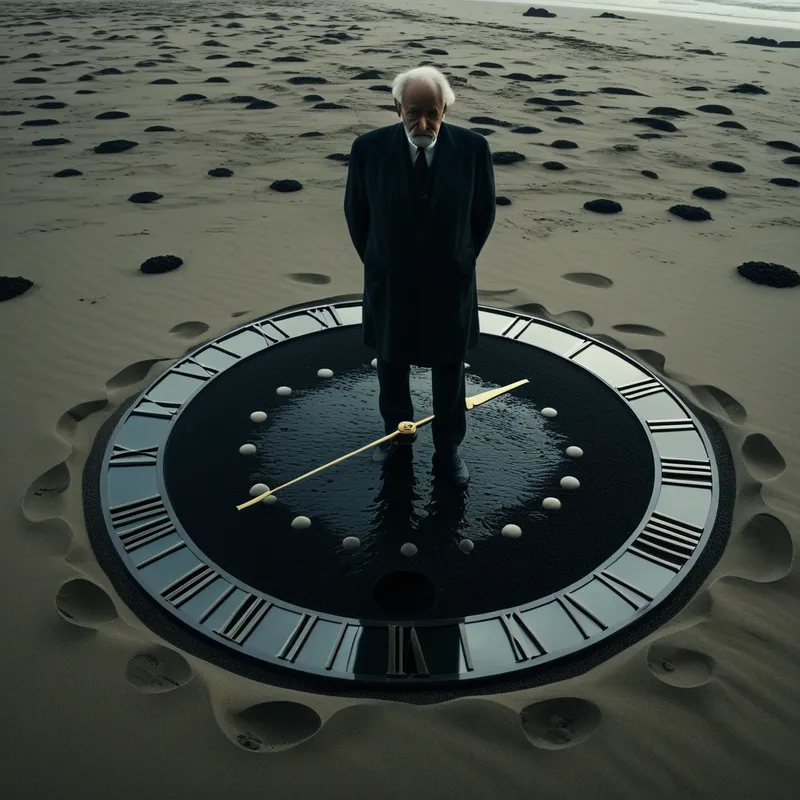
The myth models the alchemical [solve et coagula](/myths/solve-et-coagula “Myth from Alchemical culture.”/)—dissolve and coagulate—applied to the psyche. Althea’s journey is the solve: the dissolution of [the ego](/myths/the-ego “Myth from Jungian culture.”/)’s simple wish (to save her brother) in the face of the transcendent, impersonal reality of Chronos. Her plea is broken apart by the god’s terms.
The gathering and bearing of the sand is the fierce, painful coagula: the re-forming of a new, more complex consciousness. The “lost” sands she gathers are the shadow material of time itself—forgotten memories, repressed grief, unused potential. By willingly taking this into her own hands to serve love, she performs a supreme act of psychic transmutation.
Individuation is not about stopping time, but about consciously bearing the weight of the time we have been given, and the time we have chosen to carry for others.
For the modern individual, the allegory is clear. Our “bargain with Chronos” is any choice where we take on the weight of elapsed time—through therapy (revisiting the past), caregiving (giving our time to another’s need), or profound creative work (giving form to time’s passage). The “aging” is not merely physical; it is the acquisition of depth, the etching of character, the melancholic wisdom that replaces innocent hope. The [triumph](/myths/triumph “Myth from Roman culture.”/) is not in cheating fate, but in the quality of consciousness forged in the attempt. Althea’s heroism is the archetype of the one who, in facing the ultimate law of entropy and decay, chooses to imbue her fragment of time with a meaning so potent it bends, if only for a moment, the very flow of the sands.
Associated Symbols
Explore related symbols from the CaleaDream lexicon: