
The Sandman Myth Meaning & Symbolism
A mysterious figure from European hearth-tales who brings sleep and dreams, weaving the raw sand of the day into the tapestry of the night.
The Tale of The Sandman
Hush now. The day’s last light bleeds into the west, and the great, quiet clock of [the world](/myths/the-world “Myth from Tarot culture.”/) ticks over into the velvet hour. [The hearth](/myths/the-hearth “Myth from Norse culture.”/)’s embers sigh. In the corners of the room, the familiar shadows grow long and strange, whispering of a journey you must all take, but cannot remember. This is the hour of his coming.
He does not walk through the door, for doors are for the waking world. He arrives on the breath of the evening wind, a presence felt first as a deepening of the silence, a softening of the hard edges of chair and table. He is an old man, they say, but not old like the grandfather by the fire. He is old like the hills that remember the first rain, his cloak the color of a sky just after sunset, stitched with the first, hesitant stars. In his hand, he carries a simple pouch of worn leather, heavy not with gold, but with a substance more precious: the sand of dreams.
He moves from bed to bed, his footsteps making no sound upon the floorboards. To the restless child, whose mind still races with the day’s adventures, he leans close. His voice is the rustle of dry leaves, the distant murmur of a stream. “Close your eyes, little one,” it seems to say, though his lips do not move. From the pouch, he takes a pinch of fine, glimmering sand. It catches the moonlight, each grain a tiny, captive star. With a breath as soft as a moth’s wing, he sprinkles it over [the child](/myths/the-child “Myth from Alchemy culture.”/)’s eyelids.
And then, the magic. The grit of the day—the scuffed knee, the shouted laugh, the stubborn tear—is washed clean. The sand is not an eraser, but a translator. It takes the raw, sharp material of waking life and begins to spin it into another substance entirely. The child’s breathing deepens, becomes the tide of a far-off sea. The Sandman watches for a moment, a keeper of this sacred threshold, ensuring the passage is safe. Then, he moves on, to the next house, the next village, casting his gentle, weightless spell over an entire continent of sleepers. He is the weaver at the loom of night, and the sand is his thread.

Cultural Origins & Context
The figure of the Sandman is a soft-focus phantom in the vast gallery of European folklore, less a single, codified deity and more a collective whisper passed from hearth to hearth. His roots are tangled in the rich soil of 19th-century oral tradition, particularly within German, Danish, and broader Scandinavian and Anglo storytelling. He belongs not to the grand, epic myths of gods and heroes, but to the intimate, domestic mythology of the nursery and the fireside.
He was a story told by parents and grandparents, a narrative tool of gentle authority. “Be good, or the Sandman will not come,” was a common refrain, positioning him as a reward for peace, not a threat. This distinguishes him sharply from more terrifying nocturnal figures like the Mare or the Nix. His function was societal and psychological: to ease the transition from the communal, structured world of day into the solitary, unstructured realm of night. He ritualized bedtime, transforming a potential moment of fear and separation into one of enchantment and anticipated journey. He was the personification of a universal human need—the blessing of sleep—and a folk explanation for the mysterious, granular sensation of tiredness in the eyes.
Symbolic Architecture
The Sandman is not a god of dreams, but a porter of sleep, a crucial distinction. He represents the necessary, benevolent force that allows the dream world to be accessed. Psychologically, he symbolizes [the ego](/myths/the-ego “Myth from Jungian culture.”/)’s conscious surrender to the unconscious.
The guardian of the threshold does not build the world beyond it; he simply gives you the key and assures you the door is safe to open.
His [sand](/symbols/sand “Symbol: Sand in dreams often symbolizes time, transience, or the foundation of life and the fluidity of existence.”/) is the core [symbol](/symbols/symbol “Symbol: A symbol can represent an idea, concept, or belief, serving as a powerful tool for communication and understanding.”/). It is the [residue](/symbols/residue “Symbol: What remains after a process or event; traces left behind that persist beyond the original occurrence.”/) of the day, the gritty, particulate matter of conscious experience—facts, sensations, interactions. His [alchemy](/symbols/alchemy “Symbol: A transformative process of purification and creation, often symbolizing personal or spiritual evolution through difficult stages.”/) is to take this inert, [daytime](/symbols/daytime “Symbol: Daytime often symbolizes clarity, awareness, and the active aspects of life, contrasting with night, which represents the unconscious.”/) [material](/symbols/material “Symbol: Material signifies the tangible aspects of life, often representing physical resources, desires, and the physical world’s influence on our existence.”/) and transform it into the fertile, liquid medium of dreams. The act of sprinkling it on the eyes, the windows of the [soul](/symbols/soul “Symbol: The soul represents the essence of a person, encompassing their spirit, identity, and connection to the universe.”/), signifies the deliberate clouding of literal, external [sight](/symbols/sight “Symbol: Sight symbolizes perception, awareness, and insight, representing both physical and inner vision.”/) to activate internal, symbolic [vision](/symbols/vision “Symbol: Vision reflects perception, insight, and clarity — often signifying the ability to foresee or understand deeper truths.”/). He is [the psychopomp](/myths/the-psychopomp “Myth from Various culture.”/) who guides us not to the land of the dead, but to the land of the not-fully-alive, the [realm](/symbols/realm “Symbol: The symbol of ‘Realm’ often signifies the boundaries of one’s consciousness, experiences, or emotional states, suggesting aspects of reality that are either explored or ignored.”/) of [memory](/symbols/memory “Symbol: Memory symbolizes the past, lessons learned, and the narratives we construct about our identities.”/), processing, and archetypal [drama](/symbols/drama “Symbol: Drama signifies narratives, emotional expression, and the exploration of human experiences.”/).
The Sandman himself, as an old, gentle, yet mysterious man, embodies the [Senex](/symbols/senex “Symbol: The wise old man archetype representing spiritual authority, ancestral wisdom, and the integration of life experience into transcendent knowledge.”/) [archetype](/symbols/archetype “Symbol: A universal, primordial pattern or prototype in the collective unconscious that shapes human experience, behavior, and creative expression.”/) in its most nurturing form. He is [knowledge](/symbols/knowledge “Symbol: Knowledge symbolizes learning, understanding, and wisdom, embodying the acquisition of information and enlightenment.”/) tempered by [compassion](/symbols/compassion “Symbol: A deep feeling of empathy and concern for others’ suffering, often involving a desire to help or alleviate their pain.”/), [authority](/symbols/authority “Symbol: A symbol representing power structures, rules, and control, often reflecting one’s relationship with societal or personal governance.”/) without tyranny. He is the internalized, positive [father](/symbols/father “Symbol: The father figure in dreams often symbolizes authority, protection, guidance, and the quest for approval or validation.”/)-principle who says, “Your work here is done. It is safe to rest. I will watch over you while you [journey](/symbols/journey “Symbol: A journey in dreams typically signifies adventure, growth, or a significant life transition.”/) within.”

The Dreamer’s Resonance
When the pattern of the Sandman emerges in modern dreams, it rarely appears as the literal folk figure. Instead, it manifests as the experience he facilitates. It is the somatic feeling of a great, gentle weight being lifted from your eyelids. It is the dream of finding a pouch of glittering dust and instinctively knowing its purpose. It is the presence of a calm, non-intrusive watcher at the periphery of a dream scene, ensuring the narrative unfolds without catastrophic interruption.
To dream of this pattern is to undergo a psychological process of release and permission. The dreamer’s [psyche](/myths/psyche “Myth from Greek culture.”/) is signaling that it is time, or is attempting, to consciously surrender a burdensome level of control. The “sand” in the dream might be the accumulated grit of anxiety, over-analysis, or hyper-vigilance. The dream is a somatic ritual, performed by the unconscious itself, to granulate those solid blocks of worry and transform them into something malleable that can be worked with in the dream space. Resistance to this figure—dreams of a threatening or withholding Sandman—often points to a deep fear of letting go, of losing the ego’s daytime dominion, and a distrust of what the unconscious might contain.
Alchemical Translation
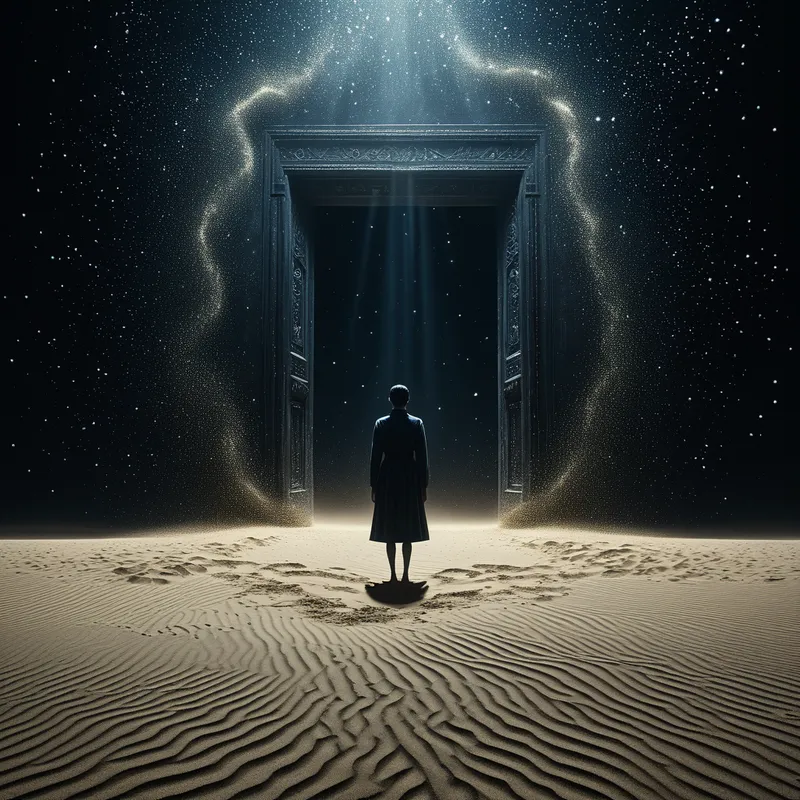
The Sandman’s nightly ritual is a perfect model for the alchemical process of psychic transmutation, central to individuation. His work is the opus in miniature, performed not in a laboratory but in [the crucible](/myths/the-crucible “Myth from Alchemical culture.”/) of the human soul at dusk.
[The first stage](/myths/the-first-stage “Myth from Alchemical culture.”/), [nigredo](/myths/nigredo “Myth from Alchemical culture.”/) (blackening), is represented by the end of the day—the dissolution of light, the gathering of shadows, the fatigue that feels like a kind of death. The Sandman accepts this blackness not as an end, but as a prerequisite. His pouch of sand is the [prima materia](/myths/prima-materia “Myth from Alchemical culture.”/), the base matter of conscious life. The act of sprinkling is the albedo (whitening), the washing and purifying. The gritty, colored experiences of the day are bleached by moonlight into a neutral, potent substance.
The most profound alchemy occurs not in defiance of gravity, but in surrender to it. The Sandman teaches us to fall asleep consciously.
Finally, the transformation of this sand into the living tapestry of dreams is the [rubedo](/myths/rubedo “Myth from Alchemical culture.”/) (reddening), the creation of the new, valuable substance—the [lapis philosophorum](/myths/lapis-philosophorum “Myth from Alchemical culture.”/) or philosopher’ stone. In psychological terms, this is the nightly synthesis of conscious and unconscious material, producing insight, emotional processing, and symbolic revelation. For the modern individual, the myth instructs us to become our own Sandman. We must learn to consciously gather the “sand” of our daily experiences, to ritually acknowledge the end of the day’s conscious work, and to willingly, trustingly sprinkle that sand over our own perception, allowing the deeper, wiser Self to weave it into the fabric of our becoming. The [triumph](/myths/triumph “Myth from Roman culture.”/) is not in staying awake, but in learning how to fall asleep—how to descend—with faith, again and again, into the nourishing dark.
Associated Symbols
Explore related symbols from the CaleaDream lexicon: