The Samudra Manthan Myth Meaning & Symbolism
Gods and demons churn the cosmic ocean for immortality, unleashing chaos and treasures, modeling the soul's arduous journey toward wholeness.
The Tale of The Samudra Manthan
In the twilight of an age, a great weariness settled upon the cosmos. The Devas had grown weak, their radiance dimmed. The Asuras, mighty and relentless, pressed against the boundaries of the worlds. A shadow of mortality crept over all, for the nectar of immortality, the amrita, was lost in the depths of the primordial sea.
Driven by desperation and a shared hunger for eternal life, the arch-rivals made a pact, a temporary truice woven from mutual need. Their goal was the [Samudra Manthan](/myths/samudra-manthan “Myth from Hindu culture.”/)—to churn the cosmic ocean itself and bring forth its hidden treasures.
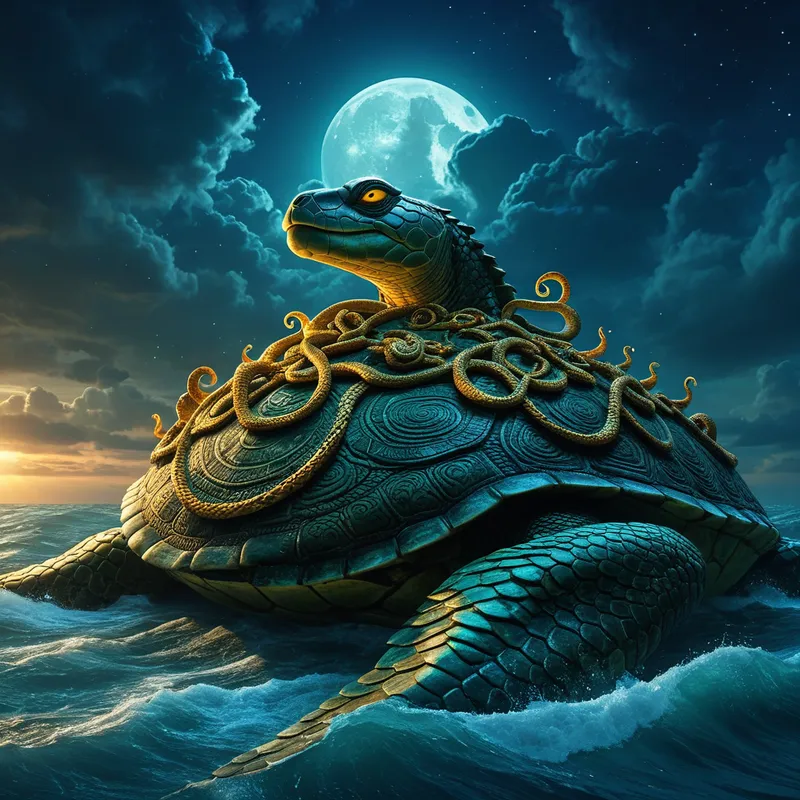
They uprooted the colossal Mount Mandara. For a churning rope, they summoned the king of serpents, the mighty Vasuki. The Devas took the serpent’s head, the Asuras his tail, and they began to pull. The mountain spun, but it began to sink into the soft ocean bed, threatening to swallow their hopes. Then, from the depths of his cosmic compassion, [Vishnu](/myths/vishnu “Myth from Hindu culture.”/) appeared in the form of [Kurma](/myths/kurma “Myth from Hindu culture.”/), a [tortoise](/myths/tortoise “Myth from Greek culture.”/) of immeasurable size, and offered his back as the pivotal foundation.
The churning began anew. A great groaning filled the universe as the mountain turned, Vasuki’s body straining, his fiery breath and venom scorching the Asuras at the tail. The ocean, once calm and deep, frothed and roared. And from its tortured depths, things began to emerge.
First came Halahala, a virulent, smoking poison so potent it threatened to dissolve creation itself. In the ensuing panic, [Shiva](/myths/shiva “Myth from Hindu culture.”/) gathered the poison and drank it, holding it in his throat, which turned blue—a sacrifice that saved all worlds. Then came treasures: the wish-fulfilling cow [Kamadhenu](/myths/kamadhenu “Myth from Hindu culture.”/), the goddess of wine Varuni, the celestial tree Parijata, and [the moon](/myths/the-moon “Myth from Tarot culture.”/), which [Shiva](/myths/shiva “Myth from Hindu culture.”/) placed upon his head.
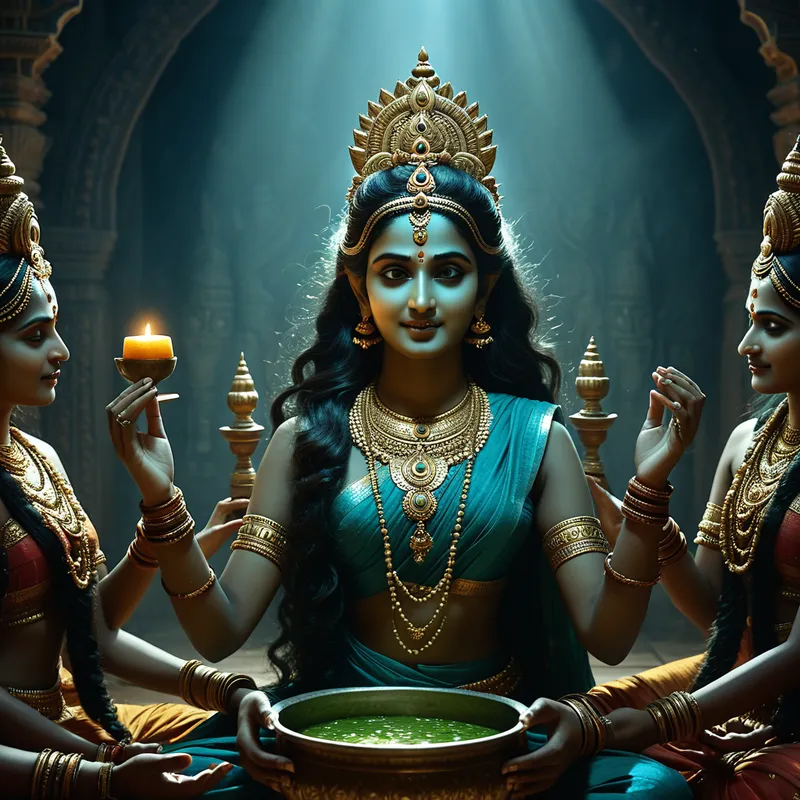
Finally, the physician of the gods, Dhanvantari, emerged, bearing the radiant pot of amrita. A frenzy broke the truce. The Asuras seized the pot. Once more, Vishnu intervened, now in the form of Mohini, an enchantress of breathtaking beauty. Captivating the Asuras with her dance, she took the amrita and distributed it only to the Devas. One Asura, Rahu, slipped among them, but the sun and moon gods alerted Vishnu, who severed his head with the discus [Sudarshana Chakra](/myths/sudarshana-chakra “Myth from Hindu culture.”/). Rahu’s head became immortal, forever chasing the sun and moon in an eternal eclipse.
The Devas, renewed, restored order. The Asuras, thwarted, retreated to the shadows. The cosmos, having passed through a crucible of chaos and creation, breathed anew, forever marked by the great churning.
Cultural Origins & Context
The myth of the Samudra Manthan is a cornerstone of Puranic literature, most elaborately detailed in texts like the Vishnu Purana and the Bhagavata Purana. It is not merely a story but a cosmological map and a societal allegory. Passed down through millennia by storytellers, priests, and in temple sculptures, it functioned as a grand narrative explaining the origins of celestial objects (the moon, poison in the ocean), divine beings, and natural phenomena (eclipses).
Its societal function was profound. It illustrated the necessity of temporary alliances, the perils of unchecked desire (the Asuras’ greed), and the ultimate [triumph](/myths/triumph “Myth from Roman culture.”/) of dharma through divine intervention. It reinforced the idea that creation is not a peaceful event, but a violent, collaborative, and sacrificial process involving both light and dark forces. The myth served as a metaphor for the Vedic ritual of churning butter from milk—a microcosm of the cosmic act—linking everyday spiritual practice to the grand scale of universe-making.
Symbolic Architecture
At its [heart](/symbols/heart “Symbol: The heart symbolizes love, emotion, and the core of one’s existence, representing deep connections with others and self.”/), the Samudra Manthan is a profound [allegory](/symbols/allegory “Symbol: A narrative device where characters, events, or settings represent abstract ideas or moral qualities, conveying deeper meanings through symbolic storytelling.”/) for the [birth](/symbols/birth “Symbol: Birth symbolizes new beginnings, transformation, and the potential for growth and development.”/) of [consciousness](/symbols/consciousness “Symbol: Consciousness represents the state of awareness and perception, encompassing thoughts, feelings, and experiences.”/) and the arduous [path](/symbols/path “Symbol: The ‘path’ symbolizes a journey, choices, and the direction one’s life is taking, often representing individual growth and exploration.”/) of individuation. The [Kshirasagara](/myths/kshirasagara “Myth from Hindu culture.”/) represents the primordial, undifferentiated unconscious—a soup of potential containing both [life](/symbols/life “Symbol: The symbol of ‘Life’ represents a journey of growth, interconnectedness, and existential meaning, encompassing both the joys and challenges that define human experience.”/)-giving nectar and annihilating poison.
The unconscious does not yield its treasures without a struggle. It requires a tension of opposites, a deliberate churning.
The Devas and Asuras symbolize the eternal psychic opposites: order and [chaos](/symbols/chaos “Symbol: In Arts & Music, chaos represents raw creative potential, uncontrolled expression, and the breakdown of order to forge new artistic forms.”/), [spirit](/symbols/spirit “Symbol: Spirit symbolizes the essence of life, vitality, and the spiritual journey of the individual.”/) and matter, conscious aspiration and unconscious instinct. Their temporary [alliance](/symbols/alliance “Symbol: A formal or informal union between individuals or groups for mutual benefit, support, or protection.”/) is the essential, if fraught, cooperation between [the ego](/myths/the-ego “Myth from Jungian culture.”/) (the Devas, seeking [strength](/symbols/strength “Symbol: ‘Strength’ symbolizes resilience, courage, and the ability to overcome challenges.”/) and order) and the [shadow](/symbols/shadow “Symbol: The ‘shadow’ embodies the unconscious, repressed aspects of the self and often represents fears or hidden emotions.”/) (the Asuras, representing repressed power and desire) for a greater goal. Mount Mandara is the [axis](/symbols/axis “Symbol: A central line or principle around which things revolve, representing stability, orientation, and the fundamental structure of reality or consciousness.”/) mundi, the central pillar of the [psyche](/myths/psyche “Myth from Greek culture.”/) or the disciplined focus required for inner work. Vasuki is the [kundalini](/symbols/kundalini “Symbol: A dormant spiritual energy coiled at the base of the spine, representing untapped potential and awakening consciousness through ascension.”/) [energy](/symbols/energy “Symbol: Energy symbolizes vitality, motivation, and the drive that fuels actions and ambitions.”/), the [serpent](/symbols/serpent “Symbol: A powerful symbol of transformation, wisdom, and primal energy, often representing hidden knowledge, healing, or temptation.”/) power that, when harnessed, drives transformation but also emits the “[venom](/symbols/venom “Symbol: Venom represents a potent, often hidden, toxic influence that can cause harm or transformation. It symbolizes both danger and potential healing.”/)” of purgative psychic pain.
The sequential [emergence](/symbols/emergence “Symbol: A process of coming into being, rising from obscurity, or breaking through a barrier, often representing birth, transformation, or revelation.”/) from the [ocean](/symbols/ocean “Symbol: The ocean symbolizes the vastness of the unconscious mind, representing deeper emotions, intuition, and the mysteries of life.”/) is the process of bringing unconscious contents to light. The first-born poison, Halahala, signifies that confronting the unconscious initially releases toxic [material](/symbols/material “Symbol: Material signifies the tangible aspects of life, often representing physical resources, desires, and the physical world’s influence on our existence.”/)—repressed [trauma](/symbols/trauma “Symbol: A deeply distressing or disturbing experience that overwhelms the psyche, often manifesting in dreams as unresolved emotional wounds or psychological injury.”/), [shame](/symbols/shame “Symbol: A painful emotion arising from perceived failure or violation of social norms, often involving exposure of vulnerability or wrongdoing.”/), and shadow aspects. Shiva’s containment of the poison models the essential act of holding and transmuting this toxicity without being destroyed by it.
The final emergence of Dhanvantari with the amrita represents the ultimate goal: the attainment of the atman, the integrated, immortal Self. Yet, even this prize is contested, requiring the guile of Mohini—the integrative function of the psyche that can navigate illusion (Maya) to ensure the nourishing elements serve the development of consciousness, not the [inflation](/symbols/inflation “Symbol: A dream symbol representing feelings of diminishing value, loss of control, or expansion beyond sustainable limits in one’s life or psyche.”/) of the ego or the [dominance](/symbols/dominance “Symbol: A state of power, control, or influence over others, often reflecting hierarchical structures, authority, or social positioning.”/) of [the shadow](/myths/the-shadow “Myth from Jungian culture.”/).
The Dreamer’s Resonance
When this myth stirs in the modern dreamer, it signals a profound somatic and psychological process of integration. One may dream of being on a vast, turbulent sea, pulling on a rope with great effort alongside unfamiliar allies or adversaries. There may be dreams of discovering a radiant object in murky [water](/myths/water “Myth from Chinese culture.”/), only to have it turn threatening, or of trying to contain a spreading, dark substance.
These dreams point to an active “churning” within. The somatic sensation is often one of deep, rhythmic labor—a feeling of being in the grip of a process larger than the ego. Psychologically, it is the phase where long-buried aspects of [the self](/myths/the-self “Myth from Jungian culture.”/) (talents, traumas, desires) are being forcibly brought to the surface. The initial emergence is rarely pleasant; it often feels like being poisoned by one’s own history or emotions. The dreamer is in the stage of confronting their personal Halahala. The presence of both helpful and hostile figures in the dream mirrors the internal alliance and conflict between different parts of the personality, all engaged in this transformative work.

Alchemical Translation
The Samudra Manthan is a perfect map for the alchemical process of psychic transmutation, or Jungian individuation. The entire operation is the opus magnum, [the great work](/myths/the-great-work “Myth from Alchemical culture.”/).
Individuation is not about becoming perfect, but about becoming whole. It requires the churning together of our golden virtues and our leaden flaws.
The first alchemical stage, [nigredo](/myths/nigredo “Myth from Alchemical culture.”/) (the blackening), is represented by the dark, chaotic ocean and the emergence of the black poison—the confrontation with the shadow, depression, and the “[prima materia](/myths/prima-materia “Myth from Alchemical culture.”/)” of the soul. Shiva’s act is the mortificatio, a willing submission to this darkness for the sake of transformation.
The subsequent emergence of treasures—the white moon, the wish-fulfilling cow—symbolizes the albedo (the whitening) and citrinitas (the yellowing), stages of purification and the dawning of spiritual insight. Finally, the radiant amrita embodies the [rubedo](/myths/rubedo “Myth from Alchemical culture.”/) (the reddening), the creation of the philosopher’s stone—the fully realized, immortal Self.
For the modern individual, this myth teaches that wholeness is not achieved by avoiding conflict or repressing the “demonic” aspects of one’s nature. It is achieved by engaging them, forming a temporary, conscious alliance with our own inner Asuras—our rage, our greed, our power—and using that energy as the necessary force to churn the depths of our being. The foundation for this work (Kurma) is patience, stability, and a connection to the earthly, embodied self. The process will release poison before it releases nectar, and the final integration requires the wisdom of Mohini—the ability to discern what truly nourishes the soul from what merely inflates the ego. The goal is not to destroy the shadow, but to include it in a new, more complex, and resilient consciousness.
Associated Symbols
Explore related symbols from the CaleaDream lexicon: