The Sacred Vessel Myth Meaning & Symbolism
A myth of a divine vessel, shattered and scattered, whose fragments must be gathered to restore cosmic and personal wholeness.
The Tale of The Sacred Vessel
Listen, and hear the story that [the wind](/myths/the-wind “Myth from Various culture.”/) tells the mountains, that [the river](/myths/the-river “Myth from Buddhist culture.”/) whispers to [the sea](/myths/the-sea “Myth from Greek culture.”/). In the time before time, when [the world](/myths/the-world “Myth from Tarot culture.”/) was a single, dreaming breath, the Great Weaver shaped the first [thing](/myths/thing “Myth from Norse culture.”/) from the clay of chaos and the [water](/myths/water “Myth from Chinese culture.”/) of potential. This was not a god, nor a beast, nor a world. It was a Vessel.
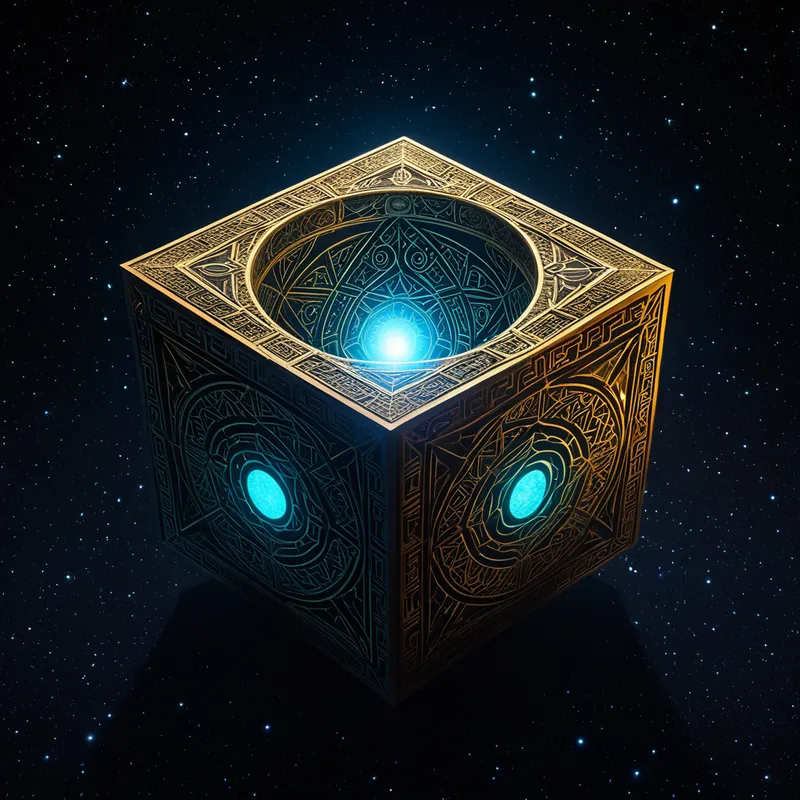
It was the Sacred Vessel. To look upon it was to see the universe in miniature: its curves held the arc of the heavens; its depth, the mystery of [the underworld](/myths/the-underworld “Myth from Greek culture.”/); its rim, [the horizon](/myths/the-horizon “Myth from Various culture.”/) where all things meet. Within it swirled the unformed song of all that would be—the green of forests, the cry of eagles, the laughter of children yet unborn, the salt of tears not yet shed. It was [the womb](/myths/the-womb “Myth from Various culture.”/) and [the grail](/myths/the-grail “Myth from Arthurian culture.”/), [the cornucopia](/myths/the-cornucopia “Myth from Global/Universal culture.”/) and [the crucible](/myths/the-crucible “Myth from Alchemical culture.”/), all in one. The Great Weaver placed it at the heart of existence, and from its overflowing essence, the world blossomed into being.
But wholeness is a state that duality cannot long abide. The Twin Serpents of Division, born from the first shadow cast by [the Vessel](/myths/the-vessel “Myth from Alchemical culture.”/)‘s own light, grew jealous of its perfect unity. Where there was one, they craved two. Where there was harmony, they sowed discord. In a crescendo of shattering sound that echoed through the bones of creation, they struck. The Vessel did not merely break; it exploded.
A million, million shards of it flew outward. A fragment containing the melody of rain fell into the deepest ocean. A sliver holding the secret of flight lodged in a mountain peak. A piece imprinted with the pattern of courage was buried in desert sands. The essential song of life was scattered, and the world, though still existing, grew dimmer, quieter, haunted by a ghost of its original splendor. A great forgetting settled over all things.
The story then turns to the Gatherers. They are not born heroes, but are made by a longing they cannot name—a hollow feeling, a sense that something vital is out there, missing. One feels compelled to walk beyond the known borders, driven by a dream of a glowing bowl. Another hears a faint, beautiful hum in a particular stone or stream. Their journey is the myth. It is a pilgrimage of attention. They must learn to listen with their hands, to see with their hearts. They brave not monsters, but the immense loneliness of the search. They face the temptation to keep a shard that brings personal joy—a fragment of pure laughter—for themselves, rather than surrendering it to the whole.
One by one, in caves, on battlefields, in crowded marketplaces, and in silent forests, the fragments are found. Each recovery is a small awakening. When the final piece, the keystone shard that holds the memory of the Vessel itself, is lifted from the mud of a forgotten riverbank, the Gatherers converge. They do not know how to reassemble the puzzle. But as they bring their fragments together, the shards move of their own accord, pulling toward each other with a magnetic yearning. There is a flash of silent, radiant light—not a blast, but a reintegration.
The Vessel Restored does not return to a pedestal at the center of the world. It hangs, luminous and whole, in the air before them, but now it is transparent. The world seen through it is sharper, more vibrant, more real. The song of life flows again, not from a single source, but through every gathered fragment, through every Gatherer who undertook the search. The Vessel is both within and around them. The world is not simply repaired; it is remembered. And the sacred task becomes not guarding the Vessel, but remembering that everything—every stone, every person, every moment—contains a shard of its original, holy light.

Cultural Origins & Context
The myth of the Shattered Vessel is a profound example of a polygenetic myth—a story that emerges independently across disparate cultures, speaking to a fundamental human experience. We find its echoes in the Jewish mystical tradition of Shevirat HaKelim, where divine light proves too potent for its containers, scattering spiritual sparks into the material world. It resonates in the Greek story of the [Pandora’s Pithos](/myths/pandoras-pithos “Myth from Greek culture.”/) (often mistranslated as “box”), and in the Norse myth of the Mead of [Kvasir](/myths/kvasir “Myth from Norse culture.”/), stolen and spilled, its droplets gifting inspiration wherever they fell.
In oral traditions from West Africa to Indigenous Americas, tales exist of a god’s calabash, pot, or basket of life-forces being overturned or broken, dispersing blessings and hardships across [the earth](/myths/the-earth “Myth from Hindu culture.”/). This was not a story told only by priests in temples, but by grandmothers at hearthsides and hunters around fires. Its societal function was multifaceted: it explained the origin of suffering and fragmentation in the world, it offered a sacred purpose (the gathering of the scattered good), and it encoded an ethical imperative to see [the divine spark](/myths/the-divine-spark “Myth from Gnostic culture.”/) in all things. The myth taught that creation is an ongoing process of repair (Tikkun Olam) in which every individual has a role.
Symbolic Architecture
At its core, the myth maps the [psyche](/myths/psyche “Myth from Greek culture.”/)‘s [journey](/symbols/journey “Symbol: A journey in dreams typically signifies adventure, growth, or a significant life transition.”/) from a perceived state of primal unity ([infancy](/symbols/infancy “Symbol: A symbol of beginnings, vulnerability, and foundational development, often representing a return to origins or a state of pure potential.”/), unconsciousness) into the necessary [fragmentation](/symbols/fragmentation “Symbol: The experience of breaking apart, losing cohesion, or being separated into pieces. Often represents disintegration of self, relationships, or reality.”/) of ego-[consciousness](/symbols/consciousness “Symbol: Consciousness represents the state of awareness and perception, encompassing thoughts, feelings, and experiences.”/) (individuation, encountering the world), and the lifelong yearning to reconstitute a more conscious, earned wholeness.
The [Vessel](/symbols/vessel “Symbol: A container or structure that holds, transports, or protects something essential, representing the self, emotions, or life journey.”/) symbolizes [the Self](/myths/the-self “Myth from Jungian culture.”/)—the total, integrated [personality](/symbols/personality “Symbol: Personality in dreams often symbolizes the traits and characteristics of the dreamer, reflecting how they perceive themselves and how they believe they are perceived by others.”/). It is the container of our entire potential. The Shattering represents the [trauma](/symbols/trauma “Symbol: A deeply distressing or disturbing experience that overwhelms the psyche, often manifesting in dreams as unresolved emotional wounds or psychological injury.”/) of [birth](/symbols/birth “Symbol: Birth symbolizes new beginnings, transformation, and the potential for growth and development.”/), of socialization, of [life](/symbols/life “Symbol: The symbol of ‘Life’ represents a journey of growth, interconnectedness, and existential meaning, encompassing both the joys and challenges that define human experience.”/)‘s wounds that fracture our innate wholeness into complexes, personas, and repressed shadows. We are born whole, but we live in pieces.
The catastrophe is also the genesis. Without the shattering, the sparks would never have descended to animate the world; without our fractures, we would never embark on the quest that forges consciousness.
The Scattered [Shards](/symbols/shards “Symbol: Fragments of a broken whole, representing destruction, potential reconstruction, or irreparable loss.”/) are the lost parts of ourselves: forgotten talents, buried traumas, exiled emotions, and innate potentials that we have projected onto the world around us (“That person has all the courage; I have [none](/symbols/none “Symbol: The absence represented by ‘none’ can signify emptiness, potential, or a yearning for substance.”/)”). The Gatherer is [the ego](/myths/the-ego “Myth from Jungian culture.”/), initially identified with its own hollowness, but gradually becoming the servant of the Self, undertaking the heroic, humble [task](/symbols/task “Symbol: A task represents responsibilities, duties, or challenges one faces.”/) of re-collection. The final Restoration is not a return to infantile unity, but the [achievement](/symbols/achievement “Symbol: Symbolizes success, mastery, or reaching a goal, often reflecting personal validation, social recognition, or overcoming challenges.”/) of the Self—a wholeness that consciously includes and transcends the fractures.
The Dreamer’s Resonance
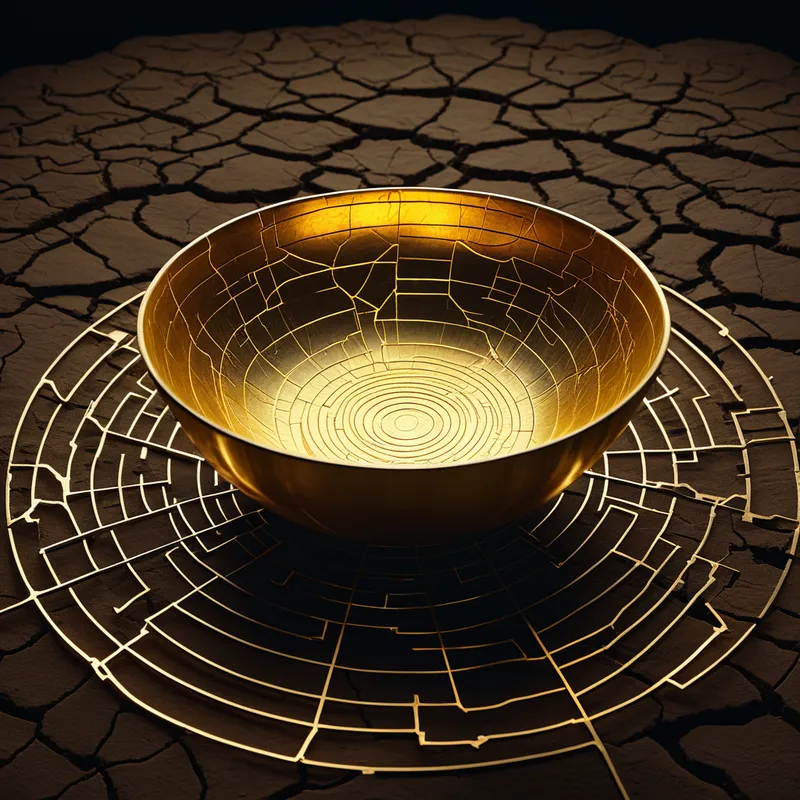
When this myth stirs in the modern unconscious, it manifests in dreams of searching, collecting, and repairing. To dream of gathering pieces of broken pottery, glass, or mosaic is a classic expression. One might dream of painstakingly gluing together a shattered heirloom, or of wandering through a vast, dim landscape picking up glowing stones or lost keys.
Somatically, this process can feel like a deep, often melancholic yearning—a “divine homesickness.” Psychologically, it signals a critical stage in withdrawing projections. The dreamer is beginning to recognize that what they admire, desire, or despise “out there” is actually a disowned part of themselves “in here.” The dream work is the psyche’s ritual of reclamation. It is often accompanied by a sense of urgency (“I must find all the pieces”) and the profound relief of finding a single, significant fragment. These dreams ask the dreamer: What have you scattered? What part of your essential song have you left in a past relationship, a forsaken career, a silenced passion?
Alchemical Translation
The alchemical opus, [the great work](/myths/the-great-work “Myth from Alchemical culture.”/) of transforming leaden consciousness into golden awareness, is perfectly modeled by this myth. The initial, unified Vessel is the [prima materia](/myths/prima-materia “Myth from Alchemical culture.”/)—the original, unconscious state. The Shattering is the essential first stage of [separatio](/myths/separatio “Myth from Alchemical culture.”/) and mortificatio (separation and death), where the substance must be broken down, analyzed, and dissolved. This is the painful but necessary deconstruction of old identities and illusions.
The gathering of the shards is the long, meticulous labor of coagulatio—giving solid form to insights, integrating shadow material, and consciously reclaiming lost energies. Each fragment recovered is a piece of [the philosopher’s stone](/myths/the-philosophers-stone “Myth from Alchemical culture.”/). The final restoration is the coniunctio oppositorum ([the sacred marriage](/myths/the-sacred-marriage “Myth from Various culture.”/) of opposites), resulting in the vas philosophorum—the philosopher’s vessel, which is both the perfected container and the transformed content.
The alchemist and the Gatherer do the same work: they tend to the fragments with devotion, knowing that the act of mindful gathering itself performs the transmutation.
For the modern individual, this translates to the practice of active imagination, journaling, therapy, and any sincere introspection. It is understanding that our flaws, our wounds, and our “broken” parts are not mistakes to be discarded, but sacred shards of our totality waiting to be recognized, honored, and reintegrated. We do not become whole by adding something new from outside, but by recovering the sacred, scattered light we already contain. The myth assures us that fragmentation is not the end of the story; it is the very condition that makes the sacred quest—and the discovery of our true, capacious Self—possible.
Associated Symbols
Explore related symbols from the CaleaDream lexicon: