The Sacred Grove of Dodona Myth Meaning & Symbolism
The oldest Greek oracle, where Zeus spoke through the rustling leaves of a sacred oak grove, guiding seekers with the voice of the earth itself.
The Tale of The Sacred Grove of Dodona
Before the marble of Delphi was quarried, before the laurel of Apollo was woven, there was a sound. It was not a voice of man or god, but the voice of [the earth](/myths/the-earth “Myth from Hindu culture.”/) herself, sighing through a grove of ancient oaks on [the wind](/myths/the-wind “Myth from Various culture.”/)-scoured slopes of Epirus. This is the tale of Dodona.
Listen.
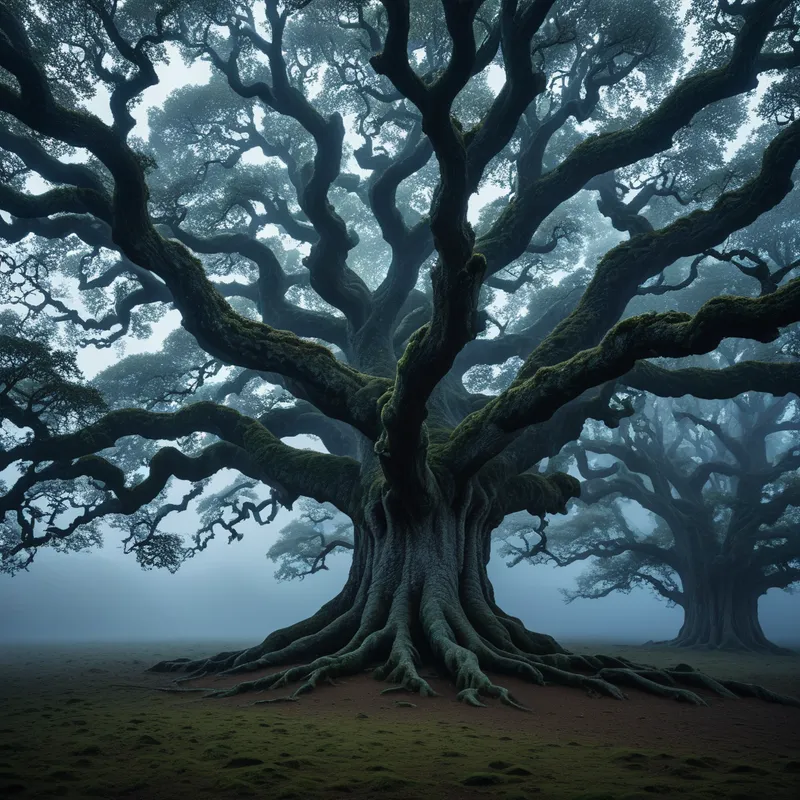
In the beginning, when [the world](/myths/the-world “Myth from Tarot culture.”/) was still speaking clearly to those who had ears to hear, a black dove—or some say a priestess—flew from the ancient sands of Thebes in Egypt. Weary, soul-lost, she followed a calling deeper than memory, a pull in her blood. She crossed the wine-dark sea and flew inland, over jagged mountains, until she found a valley cradled by peaks. There, in its heart, stood a grove of oak trees so old they seemed to hold up [the sky](/myths/the-sky “Myth from Persian culture.”/). Their roots drank from hidden springs, and their leaves whispered secrets in a language older than words.
Exhausted, the dove alighted on the mightiest oak, a giant whose branches were a kingdom. As she settled, a great wind rose, not from the sky, but from the very bones of the mountain. It rushed through the leaves, and the grove erupted in sound—a rushing, sibilant chorus, a thousand voices speaking as one. The dove understood. This was no ordinary wind. It was the breath of Zeus himself, and these trees were his tongue.
Word spread, carried by shepherds who heard the grove sing at dusk, by travelers who felt a profound stillness beneath its boughs. They came, hearts heavy with questions. Will my child live? Should I go to war? Where is my stolen herd? They brought gifts of bronze—tripods and cauldrons—hanging them from the sacred branches until the grove chimed and murmured with every breeze, a forest of metal leaves amplifying the god’s whisper.
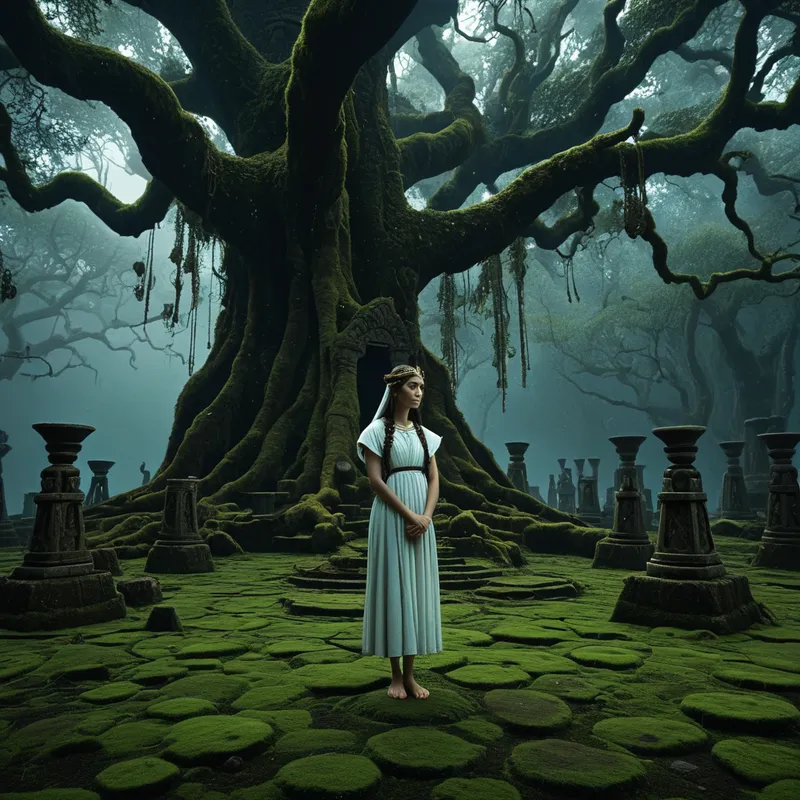
The seekers would wait in the clear, cold air. Then, the Peleiades, the dove-priestesses, would emerge. Barefoot on the damp moss, they would stand, eyes closed, faces turned to the canopy. They did not go into trances; they fell into a deeper listening. They heard the specific rustle, the particular note of a clanging cauldron, the rhythm of the leaves against the bronze. From this chaotic symphony, they wove a thread of meaning, translating the voice of the oak into a prophecy for the waiting soul. The answer was never a simple yes or no. It was a riddle, a direction, a warning carried on the wind—a piece of the world’s own wisdom, offered to those humble enough to listen to a tree.
Cultural Origins & Context
Dodona’s origins are shrouded in a mist as thick as that which often cloaked its valley. It is considered the oldest Hellenic oracle, predating the famous site at Delphi by centuries. Its antiquity is echoed in [Homer](/myths/homer “Myth from Greek culture.”/), who references it in both the Iliad and the Odyssey, where Achilles prays to “Zeus of Dodona, Pelasgian, whose priests dwell afar, who never wash their feet and sleep on the ground.” This description hints at a primal, chthonic practice, far removed from the later grandeur of classical temples.
The oracle was not a monument to human achievement but a integration with a natural phenomenon. It served a societal function as a deeply respected, decentralized source of guidance. While kings and heroes like [Jason](/myths/jason “Myth from Greek culture.”/) consulted it for grand ventures, its primary audience was likely local communities and individuals. It provided a way to navigate uncertainty—from personal illness and agricultural decisions to matters of [justice](/myths/justice “Myth from Tarot culture.”/)—by appealing to the ultimate authority: the divine order of nature itself, voiced through its most steadfast inhabitants, the oaks.
Symbolic Architecture
At its core, Dodona symbolizes the belief that wisdom is not manufactured, but received. It is an [emergent property](/symbols/emergent-property “Symbol: A complex phenomenon arising from simpler interactions, where the whole becomes greater than the sum of its parts.”/) of the world, waiting to be heard by a [consciousness](/symbols/consciousness “Symbol: Consciousness represents the state of awareness and perception, encompassing thoughts, feelings, and experiences.”/) attuned to its [frequency](/symbols/frequency “Symbol: In dreams, frequency often represents rhythm, cycles, patterns, or the rate of occurrence of events, thoughts, or emotions.”/).
The oracle does not speak; it sounds. Truth is not a statement to be decoded, but a pattern to be perceived within the chaos.
[The sacred oak](/myths/the-sacred-oak “Myth from Celtic culture.”/), the Dodonaean Oak, is an [axis](/symbols/axis “Symbol: A central line or principle around which things revolve, representing stability, orientation, and the fundamental structure of reality or consciousness.”/) mundi—a world [tree](/symbols/tree “Symbol: In dreams, the tree often symbolizes growth, stability, and the interconnectedness of life.”/) connecting [earth](/symbols/earth “Symbol: The symbol of Earth often represents grounding, stability, and the physical realm, embodying a connection to nature and the innate support it provides.”/), humanity, and the divine sky (Zeus). Its roots in the dark [soil](/symbols/soil “Symbol: Soil symbolizes fertility, nourishment, and the foundation of life, serving as a metaphor for growth and stability.”/) represent the unconscious, the chthonic [memory](/symbols/memory “Symbol: Memory symbolizes the past, lessons learned, and the narratives we construct about our identities.”/) of the [earth](/symbols/earth “Symbol: The symbol of Earth often represents grounding, stability, and the physical realm, embodying a connection to nature and the innate support it provides.”/). Its [trunk](/symbols/trunk “Symbol: The trunk in dreams typically denotes the core structure or foundation of one’s identity, values, or beliefs.”/) is the pillar of conscious existence, and its leaves reaching for the sky are the intellect and [spirit](/symbols/spirit “Symbol: Spirit symbolizes the essence of life, vitality, and the spiritual journey of the individual.”/), stirred by the [breath](/symbols/breath “Symbol: Breath symbolizes life, vitality, and the connection between the physical and spiritual realms.”/) ([pneuma](/myths/pneuma “Myth from Greek culture.”/), spirit/wind) of the divine. The listening priestess, the Pelias, represents the [human](/symbols/human “Symbol: The symbol of a human represents individuality, complexity of emotions, and social relationships.”/) [capacity](/symbols/capacity “Symbol: A measure of one’s potential, limits, or ability to contain, process, or achieve something, often reflecting self-assessment or external demands.”/) for receptive [intuition](/symbols/intuition “Symbol: The immediate, non-rational understanding of truth or insight, often described as a ‘gut feeling’ or inner knowing that bypasses conscious reasoning.”/), the vital link that translates the raw, archetypal [language](/symbols/language “Symbol: Language symbolizes communication, understanding, and the complexities of expressing thoughts and emotions.”/) of [nature](/symbols/nature “Symbol: Nature symbolizes growth, connectivity, and the primal forces of existence.”/) into a form the conscious mind can grasp.

The Dreamer’s Resonance
When this myth appears in modern dreams, it often manifests during periods of intellectual gridlock or emotional noise. The dreamer may find themselves in a dense, dark forest, hearing whispers they cannot understand. They may see a single, magnificent tree in a landscape, feeling a compelling urge to touch its bark or listen closely.
Psychologically, this signals a process of somatic listening. The conscious, problem-solving ego is overwhelmed. The [psyche](/myths/psyche “Myth from Greek culture.”/) is directing the dreamer to stop thinking and start sensing. The rustling leaves are the murmurs of the body’s wisdom, the intuition, the gut feeling, and the ancestral knowledge stored in the nervous system—all that is drowned out by the internal monologue. The dream is an invitation to cultivate the inner Pelias: to become still, to attend to the subtle signals (moods, bodily sensations, synchronicities) that guide us toward wholeness, just as the priestesses attended to the specific sounds in the grove.

Alchemical Translation
The alchemical process modeled by Dodona is the transmutation of chaos into counsel. In the journey of individuation, we are all seekers coming to the grove with our questions, our life’s confusing cacophony.
The first operation is Mortificatio: the humbling of the ego. One must approach the sacred grove not as a conqueror, but as a supplicant. The arrogant mind that demands clear answers is silenced. This is the “priests who never wash their feet”—a symbolic surrender of civilized pretense to stand on the raw earth.
The second is [Solutio](/myths/solutio “Myth from Alchemical culture.”/): dissolution into the medium. The hanging bronze vessels represent the hard, defined structures of our assumptions and biases. The wind (Zeus, [the Self](/myths/the-self “Myth from Jungian culture.”/)) blows through them, setting them clanging against each other, dissolving their rigid separateness into a complex symphony. Our conscious mind is immersed in the seemingly chaotic data of our inner and outer experience.
Finally, Coniunctio: [the sacred marriage](/myths/the-sacred-marriage “Myth from Various culture.”/). The priestess (receptive intuition) listens to the symphony of dissolved elements (the clanging bronze, the rustling leaves). She does not invent meaning; she discerns the pattern within it. This is the moment of insight, where the chaos coalesces into a meaningful direction. The individual ego aligns with the wisdom of the greater Self, finding a path forward not by logic alone, but by listening to the deep, rustling voice of one’s own nature, which is part of the nature of the world. The oracle’s answer is the birth of a new, more integrated consciousness, forged in [the sacred grove](/myths/the-sacred-grove “Myth from Celtic culture.”/) of the soul.
Associated Symbols
Explore related symbols from the CaleaDream lexicon: