The Sacred Bull Apis of Egypti Myth Meaning & Symbolism
A divine bull, born of celestial fire, becomes the living vessel of gods, uniting heaven and earth through its sacred life and ritual death.
The Tale of The Sacred Bull Apis of Egypti
Hark, and listen to the tale written not on [papyrus](/myths/papyrus “Myth from Egyptian culture.”/), but in the very pulse of the land. In the time when the Nile’s black soil first drank the sun’s tears, a silence fell over [the temple](/myths/the-temple “Myth from Jewish culture.”/) of Ptah in Memphis. The air grew thick, charged with the scent of myrrh and impending thunder. The old bull was gone, his ka having flown to the western horizon. The land held its breath, for without the Bull, the bridge between earth and sky was broken.
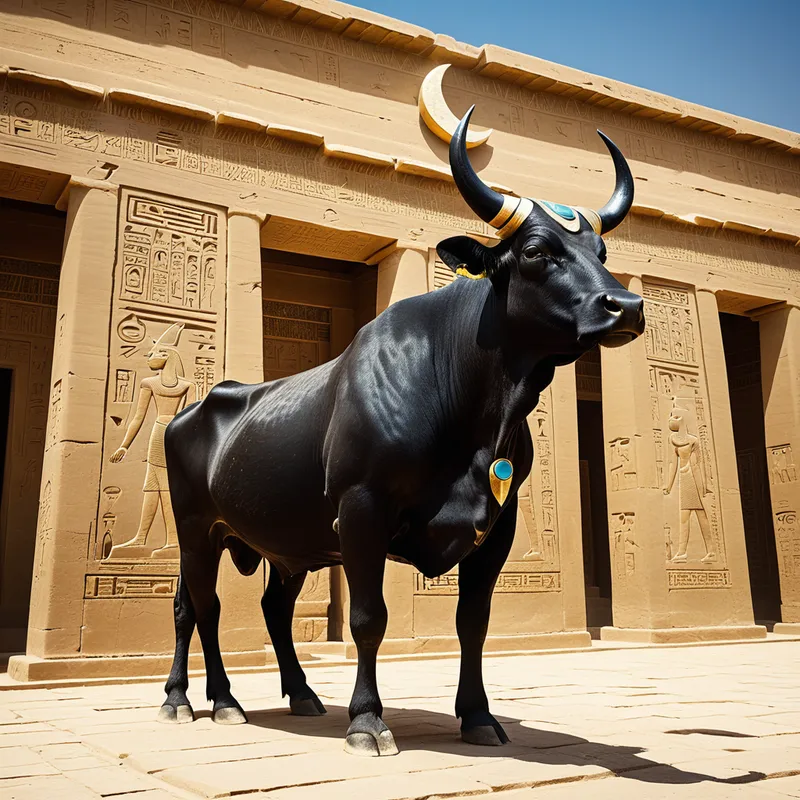
Then, a sign. A farmer, tending his field near the riverbank, saw a calf unlike any other. It was not born of ordinary cattle. Its hide was the black of the fertile silt after the inundation, so deep it seemed to drink the light. Upon its brow blazed a perfect white triangle, a diamond of pure celestial light. On its right flank, the mark of a white crescent moon lay as if painted by the hand of Nut herself. And when it lowed, the sound was not of this earth—it was the deep, resonant hum of a stone bell struck in a star-chamber.
The priests, clad in pure white linen, came with trembling reverence. They examined the sacred marks—the beetle-shaped lump under its tongue, the double hairs of its tail. All was confirmed. This was He. The Apis. Not a symbol, but the god himself, walking. They led him, this young god-calf, in a procession of palm fronds and hymns back to the Per-Ankh, the House of Life. For twenty-five years, he would reign.
His life was a daily ritual of cosmic maintenance. In his stall of alabaster, he was the still point of the turning world. His breath was the north wind that brought coolness; his mere presence in the fields guaranteed the harvest. He was the strength of [the Pharaoh](/myths/the-pharaoh “Myth from Egyptian culture.”/), the fertility of the land, the beating heart of the nation. People journeyed from the farthest nomes to whisper their prayers into his flickering ear, to feel the solid, warm reality of the divine beneath their hands.
But the gods are cyclical, like the Nile. A shadow, subtle at first, entered the Per-Ankh. The Bull’s step, once earth-shaking, grew measured. His deep eyes, once pools of infinite vitality, began to hold the knowing twilight of the Duat. The priests watched, their hearts a tumult of dread and sacred duty. The moment arrived, not with a crash, but with a quiet laying down of the great head. The living god had chosen to depart.
What followed was not an end, but a furious, beautiful unraveling. The Bull’s body was treated not as a corpse, but as the most precious relic of creation. In a hidden chamber, the Heri-Seshta worked their alchemy, preserving [the vessel](/myths/the-vessel “Myth from Alchemical culture.”/) that had held a star. For seventy days, the land mourned. Then, under a moonless sky, the mummified god was placed upon a colossal sledge of gold and cedar. The procession to the Serapeum was a river of torchlight and lamentation. The people wailed, tearing their clothes, for they knew the truth: the god must die so that the god may live.
In the profound darkness of the granite sarcophagus, sealed in a tomb among his forebears, the final mystery unfolded. The ka of the Bull, the vital force of Ptah, was released. But it did not vanish. It flew on the wings of ritual and grief, merging with the eternal, resurrected form of [Osiris](/myths/osiris “Myth from Global/Universal culture.”/), becoming [Osiris](/myths/osiris “Myth from Global/Universal culture.”/)-Apis. And even as the last seal was set, in some distant field, a new calf was being born, marked with the celestial signs, ready to be found. The bridge was rebuilt. The heart of [the world](/myths/the-world “Myth from Tarot culture.”/) beat once more.
Cultural Origins & Context
The worship of the Apis Bull is one of the most enduring and tangible threads in the tapestry of ancient Egyptian religion, originating in the Predynastic period and flourishing for over three millennia. Centered in Memphis, the political and cultural capital of the Old Kingdom, the Apis was not merely a sacred animal but a state divinity. His identification was a precise science managed by the priesthood of Ptah, involving a strict checklist of physical omens—the specific markings—that signified the divine incarnation.
This myth was not “told” in a conventional narrative like those of Seth and [Horus](/myths/horus “Myth from Egyptian culture.”/). Instead, it was performed and lived. It was enacted through the Bull’s very public life of ceremonial appearances and oracular consultations, and through the spectacular, state-funded drama of his death and burial. The myth’s societal function was multifaceted: it was a guarantor of cosmic and political order (linking [Pharaoh](/myths/pharaoh “Myth from Egyptian culture.”/), Ptah, and the land’s fertility), a powerful national unifier during the elaborate funeral rites, and a profound public theology of death and renewal that made the abstract concepts of the ka, the ba, and resurrection physically visible and emotionally immediate.
Symbolic Architecture
The Apis is a supreme [symbol](/symbols/symbol “Symbol: A symbol can represent an idea, concept, or belief, serving as a powerful tool for communication and understanding.”/) of divine immanence—the god made flesh, dwelling tangibly among humanity. He is the incarnated [logos](/myths/logos “Myth from Christian culture.”/), the [word](/symbols/word “Symbol: Words in dreams often represent communication, expression, and the power of language in shaping our realities.”/) or creative power of Ptah, given physical form. His black hide symbolizes the fertile, [life](/symbols/life “Symbol: The symbol of ‘Life’ represents a journey of growth, interconnectedness, and existential meaning, encompassing both the joys and challenges that define human experience.”/)-giving black [soil](/symbols/soil “Symbol: Soil symbolizes fertility, nourishment, and the foundation of life, serving as a metaphor for growth and stability.”/) of the Nile [inundation](/symbols/inundation “Symbol: A flood or overwhelming deluge, often representing emotional overwhelm, cleansing, or uncontrollable forces.”/) (Kemet, “the Black Land”), while his markings connect him to celestial bodies, embodying the union of earthly [fertility](/symbols/fertility “Symbol: Symbolizes creation, growth, and abundance, often representing new beginnings, potential, and life force.”/) and cosmic order.
The sacred vessel must be shattered for the spirit within to be liberated and universalized.
His life represents the phase of containment: the [spirit](/symbols/spirit “Symbol: Spirit symbolizes the essence of life, vitality, and the spiritual journey of the individual.”/) perfectly housed, providing [stability](/symbols/stability “Symbol: A state of firmness, balance, and resistance to change, often represented by solid objects, foundations, or steady tools.”/), [strength](/symbols/strength “Symbol: ‘Strength’ symbolizes resilience, courage, and the ability to overcome challenges.”/), and predictable blessings. His [death](/symbols/death “Symbol: Symbolizes transformation, endings, and new beginnings; often associated with fear of the unknown.”/) and transformation into Osiris-Apis symbolize the necessary [dissolution](/symbols/dissolution “Symbol: The process of breaking down, dispersing, or losing form, often representing transformation, release, or the end of a state of being.”/) of a specific form to achieve a higher, more eternal state of being. The cycle—the immediate search for the successor—models the [psyche](/myths/psyche “Myth from Greek culture.”/)’s understanding that life, [death](/symbols/death “Symbol: Symbolizes transformation, endings, and new beginnings; often associated with fear of the unknown.”/), and [rebirth](/symbols/rebirth “Symbol: A profound transformation where old aspects of self or life die, making way for new beginnings, growth, and renewal.”/) are not [linear](/symbols/linear “Symbol: Represents order, predictability, and a direct, step-by-step progression. It symbolizes a clear path from cause to effect.”/) but a perpetual, recursive spiral. The [Bull](/symbols/bull “Symbol: The bull often symbolizes strength, power, and determination in many cultures.”/) is both the individuated [soul](/symbols/soul “Symbol: The soul represents the essence of a person, encompassing their spirit, identity, and connection to the universe.”/) (a unique, marked [creature](/symbols/creature “Symbol: Creatures in dreams often symbolize instincts, primal urges, and the unknown aspects of the psyche.”/)) and the eternal [archetype](/symbols/archetype “Symbol: A universal, primordial pattern or prototype in the collective unconscious that shapes human experience, behavior, and creative expression.”/) (the [office](/symbols/office “Symbol: Dreaming of an office often symbolizes a space of responsibility, work-related stress, or the pursuit of goals in one’s waking life.”/) of Apis that never dies).
The Dreamer’s Resonance
To dream of a bull of such majesty, particularly one that is dying, being prepared, or transforming, signals a profound somatic and psychological process underway. It often appears when the dreamer’s identity or life structure—a career, a relationship, a long-held self-image—has served its sacred purpose but is now reaching its natural [terminus](/myths/terminus “Myth from Roman culture.”/). The bull in the dream is the “living god” of that personal paradigm: it has been the source of strength, fertility, and identity.
The grief felt in the dream is real; it is the psyche mourning the impending death of a once-vital way of being. The preparation of the body mirrors the inner work of honoring what is passing, of carefully preserving its essence (the lessons, the strengths) through conscious reflection. The dream may culminate in the bull’s burial—a feeling of descending into a deep, dark, interior tomb. This is not a nightmare, but a necessary descent. The psyche is ritualizing the end of a major life chapter, preparing the dreamer for the 70 days of incubation, after which the essence of that old self will be reborn in a new, more integrated form (Osiris-Apis).
Alchemical Translation
The Apis myth is a perfect map for the alchemical process of psychic transmutation, or individuation. The initial stage, the finding of the marked calf, is the [nigredo](/myths/nigredo “Myth from Alchemical culture.”/)—the discovery of the unique, divine spark within the mundane “field” of [the personal unconscious](/myths/the-personal-unconscious “Myth from Jungian Psychology culture.”/). This is the call to a sacred purpose.
The Bull’s 25-year reign is the albedo—the conscious cultivation and “whitening” of that inner divinity. It is a phase of building a life around this central, organizing principle, experiencing its generative power in the world. But this phase cannot last forever in its initial form.
Individuation demands not just the cultivation of the sacred self, but the ritual sacrifice of the form it first took.
The death of the Bull is the crucial [rubedo](/myths/rubedo “Myth from Alchemical culture.”/), the reddening, often experienced as a painful crisis, depression, or life-shattering event. It is the necessary death of the identified form of [the Self](/myths/the-self “Myth from Jungian culture.”/) so that the Self-as-archetype can be liberated. The meticulous mummification is the psychological work of sublimation: extracting the eternal gold from the experience, preserving what was truly sacred, not just the outer shell.
The burial in the Serapeum represents the final surrender to the unconscious, trusting the process in the darkness. The emergence as Osiris-Apis is the citrinitas, the dawn of a new, more profound consciousness that integrates the mortal experience (Apis) with the eternal, resurrected spirit (Osiris). The search for the new calf that begins immediately is the promise that the cycle continues at a higher octave—the Self is eternal, forever dying to its old skins and being reborn, more whole, more universal, with each sacred passage.
Associated Symbols
Explore related symbols from the CaleaDream lexicon: