The Ruins of Troy Myth Meaning & Symbolism
A city's fall, sparked by a golden apple and a stolen queen, becomes an eternal story of pride, fate, and the ruins from which we rebuild.
The Tale of The Ruins of Troy
Hear now the tale of a city built on prophecy and pride, whose high towers were destined for the dust. It begins not with a sword, but with an apple. A wedding feast of the gods, spoiled by the spite of Eris, who cast a golden fruit into the midst of the revelry. Upon it, three words burned: To the Fairest. And so the great goddesses—Hera, Athena, and Aphrodite—turned from sisters to rivals, their divine pride a poison seeping into [the world](/myths/the-world “Myth from Tarot culture.”/) of men.
The judge was Paris, a shepherd-prince on the slopes of Mount Ida. Each goddess offered a bribe: Hera, dominion over all lands; Athena, glory in war; Aphrodite, the love of the most beautiful woman in the world. Paris, young and led by desire, chose the last. The most beautiful woman was Helen, wife to Menelaus. So Paris sailed to Sparta, a guest who betrayed his host, and under Aphrodite’s spell, he stole Helen away across the wine-dark sea to the high walls of Troy.
The air grew thick with the scent of myrrh and impending doom. In the halls of Sparta, Menelaus’s cry for vengeance became a rallying call. His brother, Agamemnon, assembled a thousand ships, a fleet that blotted out the harbor at Aulis. The greatest heroes of Achaea answered: the swift Achilles, the cunning [Odysseus](/myths/odysseus “Myth from Greek culture.”/), the mighty Ajax. For ten long years, they laid siege to the towering walls built by [Poseidon](/myths/poseidon “Myth from Greek culture.”/) and Apollo. The plain before Troy became a churning field of bronze, blood, and dust. The clash of shields was thunder; the screams of dying men, a terrible song. Heroes fell like ripe wheat: Patroclus, slain by Hector; Hector himself, dragged behind [the chariot](/myths/the-chariot “Myth from Tarot culture.”/) of a vengeful Achilles; and finally Achilles, felled by Paris’s arrow in his vulnerable heel.
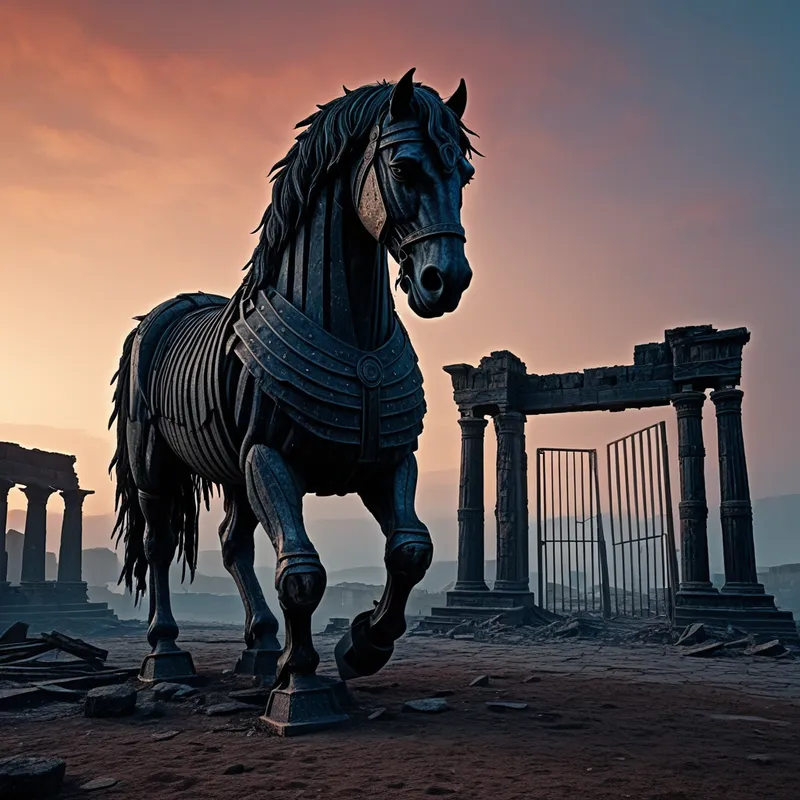
The war became a stagnant river, choked with corpses and despair. Then, from the mind of Odysseus, sprang the seed of the city’s end: not force, but guile. The Greeks built a monstrous offering, a horse of seasoned pine, hollow as a tomb. They filled its dark belly with armed men, then burned their camp and sailed away, as if in defeat. The Trojans, believing the ordeal over, breached their own impregnable walls to drag the colossal idol within. They feasted and drank, their joy a fragile shell over the horror coiled in their city’s heart.
In the dead of night, the belly of the beast split open. Greek warriors spilled into the sleeping streets, their swords flashing in the firelight. Gates were thrown open, and the waiting army flooded in. What followed was not battle, but slaughter. The air, once perfumed with incense, filled with the stench of smoke and blood. King Priam was slain at his own altar. The women, including the prophetic Cassandra, were taken as slaves. The palaces of Paris and Hector were put to the torch. By dawn, the glory that was Troy was no more than a pyre, its black smoke a funeral shroud against the rising sun. Only the ruins remained, and the echoes of a name.

Cultural Origins & Context
The story of Troy is the foundational epic of the Greek world, crystallized in the twin pillars of [Homer](/myths/homer “Myth from Greek culture.”/)’s Iliad and Odyssey. These were not mere books, but the living breath of an oral tradition, performed by rhapsodes for centuries before being written down in the 8th century BCE. The tale functioned as a national saga, defining Greek identity against a noble, yet fated, “other.” It explored the tensions between individual glory (kleos) and communal fate (moira), between human agency and the overwhelming will of the gods.
The myth served as a cultural mirror. [The Trojan War](/myths/the-trojan-war “Myth from Greek culture.”/) was seen as a pivotal, semi-historical event that ushered in the Heroic Age and its eventual end. For the Greeks, it was a lesson in the catastrophic cost of hubris—a lesson applicable to Paris, to Agamemnon, to Achilles, and to the Trojans themselves in their moment of fatal credulity. The ruins of Troy stood in the collective imagination as a permanent [memento mori](/myths/memento-mori “Myth from Christian culture.”/), a reminder that even the greatest works of men and gods are subject to time, fate, and their own hidden flaws.
Symbolic Architecture
The Ruins of Troy are not merely a historical casualty; they are the [psyche](/myths/psyche “Myth from Greek culture.”/)’s [landscape](/symbols/landscape “Symbol: Landscapes in dreams are powerful symbols representing the dreamer’s emotional state, personal journey, and the broader context of life situations.”/) after a [cataclysm](/symbols/cataclysm “Symbol: A sudden, violent upheaval or disaster of immense scale, often representing profound transformation, destruction, or the collapse of existing structures.”/) of its own making. The [city](/symbols/city “Symbol: A city often symbolizes community, social connection, and the complexities of modern life, reflecting the dreamer’s relationships and societal integration.”/) itself symbolizes the complex, fortified [structure](/symbols/structure “Symbol: Structure in dreams often symbolizes stability, organization, and the framework of one’s life, reflecting how one perceives their environment and personal life.”/) of the conscious ego—proud, seemingly impregnable, built on a [foundation](/symbols/foundation “Symbol: A foundation symbolizes the underlying support systems, values, and beliefs that shape one’s life, serving as the bedrock for growth and development.”/) of divine [favor](/symbols/favor “Symbol: ‘Favor’ represents the themes of acceptance, goodwill, and the desire for approval from others.”/) (or parental blessing) and personal [destiny](/symbols/destiny “Symbol: A predetermined course of events or ultimate purpose, often linked to spiritual forces or cosmic order, representing life’s inherent direction.”/).
The Trojan Horse is the ultimate symbol of the enemy within, the accepted gift that contains the seeds of one’s own destruction. It represents the repressed content, the unintegrated shadow, welcomed into the citadel of the self with celebration, only to unleash chaos from the inside.
The [apple](/symbols/apple “Symbol: An apple symbolizes knowledge, temptation, and the duality of good and evil, often representing the pursuit of wisdom with potential consequences.”/) of discord is the spark of unconscious envy and comparison that shatters unity. [The judgment of Paris](/myths/the-judgment-of-paris “Myth from Global/Universal culture.”/) is the fateful [choice](/symbols/choice “Symbol: The concept of choice often embodies decision-making, freedom, and the multitude of paths available in life.”/) of values—a choice for personal desire (Aphrodite) over power (Hera) or wisdom (Athena)—that sets an entire [life](/symbols/life “Symbol: The symbol of ‘Life’ represents a journey of growth, interconnectedness, and existential meaning, encompassing both the joys and challenges that define human experience.”/) on a [collision](/symbols/collision “Symbol: A sudden, forceful impact between objects or forces, often representing conflict, unexpected change, or the meeting of opposing elements in life.”/) [course](/symbols/course “Symbol: A course represents direction, journey, or progression in life, often choosing paths to follow.”/). The ten-[year](/symbols/year “Symbol: A unit of time measuring cycles, growth, and passage. Represents life stages, progress, and mortality.”/) siege is the long, grinding conflict between opposing aspects of [the self](/myths/the-self “Myth from Jungian culture.”/), a stalemate that brute force cannot resolve. The final conflagration, then, is not simple defeat, but the necessary, devastating [dissolution](/symbols/dissolution “Symbol: The process of breaking down, dispersing, or losing form, often representing transformation, release, or the end of a state of being.”/) of an old, rigid order. [The ego](/myths/the-ego “Myth from Jungian culture.”/)-structure, however magnificent, must fall so that something new can be imagined from the ashes.
The Dreamer’s Resonance
To dream of ruins—specifically of a great, fallen city like Troy—is to encounter a profound moment in the dreamer’s inner biography. The somatic feeling is often one of awe mixed with desolation: walking among shattered columns, touching cold, weathered stone, under a vast, silent sky.
Psychologically, this dreamscape signals that a long-held psychic structure has collapsed. This could be a career identity, a foundational relationship, a core belief, or a life plan. The dreamer is surveying the aftermath. The feeling is not necessarily of failure, but of monumental ending. [The Trojan Horse](/myths/the-trojan-horse “Myth from Greek culture.”/) in a modern dream might appear as a beloved hobby that becomes an addiction, a trusted friend who betrays, or a promotion that leads to isolation—anything that was welcomed and celebrated but contained a hidden, destructive principle. Such dreams ask: What fortified citadel in your soul have you been defending? What gift did you accept that carried your own undoing within it? And now, amidst the ruins, what remains truly yours?
Alchemical Translation
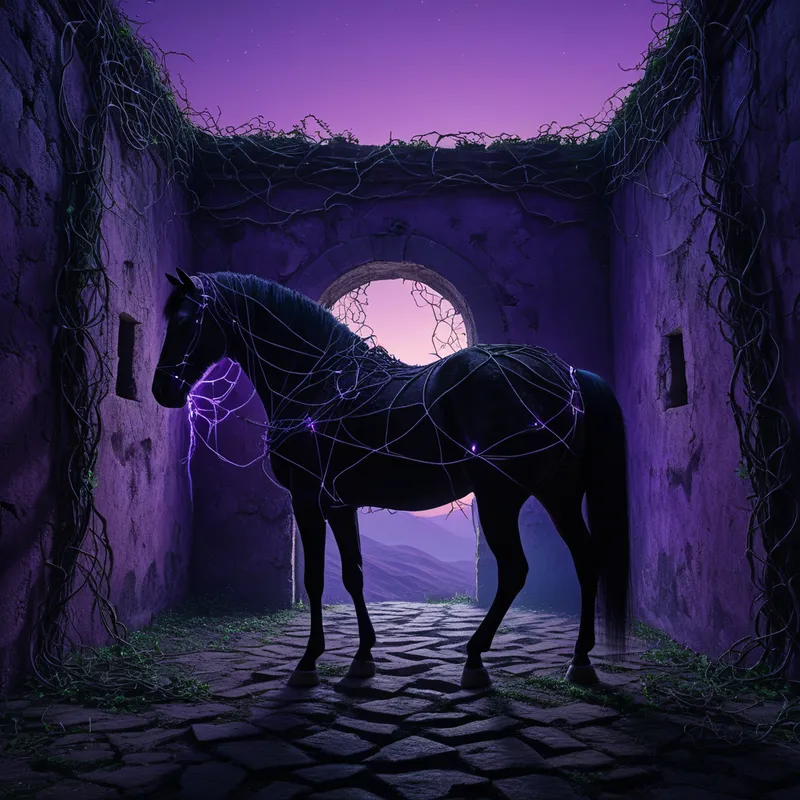
The alchemical process mirrored in the myth is [nigredo](/myths/nigredo “Myth from Alchemical culture.”/)—the blackening, the putrefaction, the reduction of complex matter to primal, chaotic stuff. It is the essential first step of transmutation, without which no gold can be made.
The heroic journey here is not about preventing [the fall](/myths/the-fall “Myth from Biblical culture.”/), but about surviving it and learning its language. Odysseus, the mind that conceived the Horse, is also the one who must wander for ten more years to find his way home. Aeneas, who escapes the burning city with his father on his back and his [household gods](/myths/household-gods “Myth from Ancient Egyptian culture.”/) in his hands, becomes the carrier of the sacred remnant. He does not rebuild Troy; he uses its essence to found something new: Rome.
The individuation process demands a Trojan War. It requires the ego to engage in a seemingly endless conflict with its own depths, until it finally accepts the deceptive “gift” of its shadow (the Horse). The ensuing ruin is the death of the old, naive self.
For the modern individual, the “alchemical translation” is the work done in the ashes. It is the sifting of the rubble to find what is indestructible: the pietas of Aeneas (duty, reverence), the enduring cunning of Odysseus, the memory of Hector’s nobility. The ruins are not the end of the story, but the fertile ground for the next. The psychic gold is forged not in the glory of the intact city, but in the humility and clarity that comes after its fall. We do not resurrect Troy. We carry its lessons, its stories, and its [sacred fire](/myths/sacred-fire “Myth from Various culture.”/) within us, and we build anew, conscious that all walls, inner and outer, are both sanctuary and prison.
Associated Symbols
Explore related symbols from the CaleaDream lexicon: