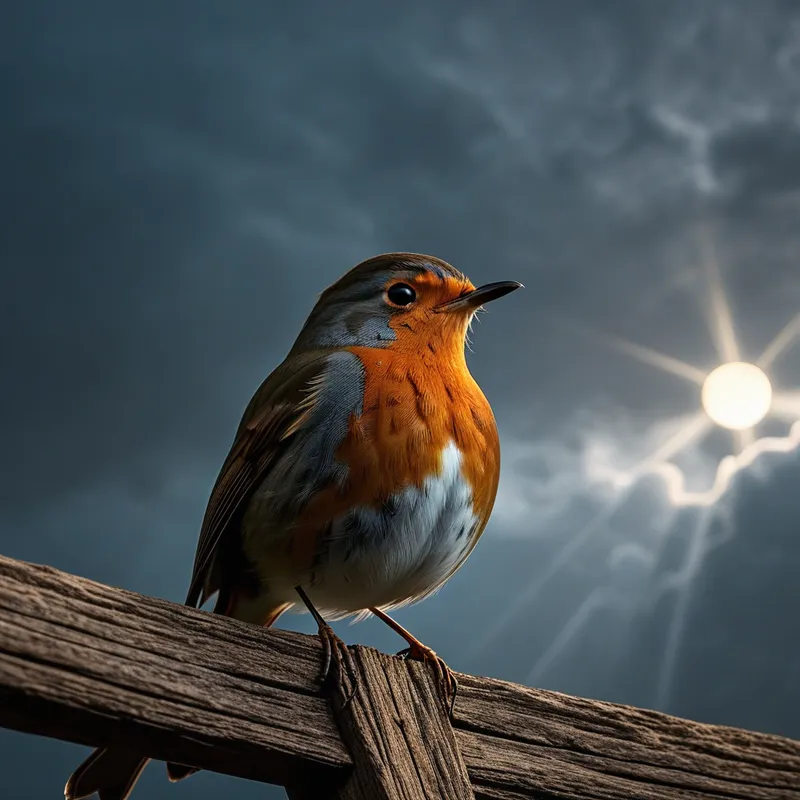
The Robin's Breast Myth Meaning & Symbolism
A small bird, moved by compassion, burns its breast trying to ease the suffering of the crucified Christ, receiving a mark of eternal grace.
The Tale of The Robin’s Breast
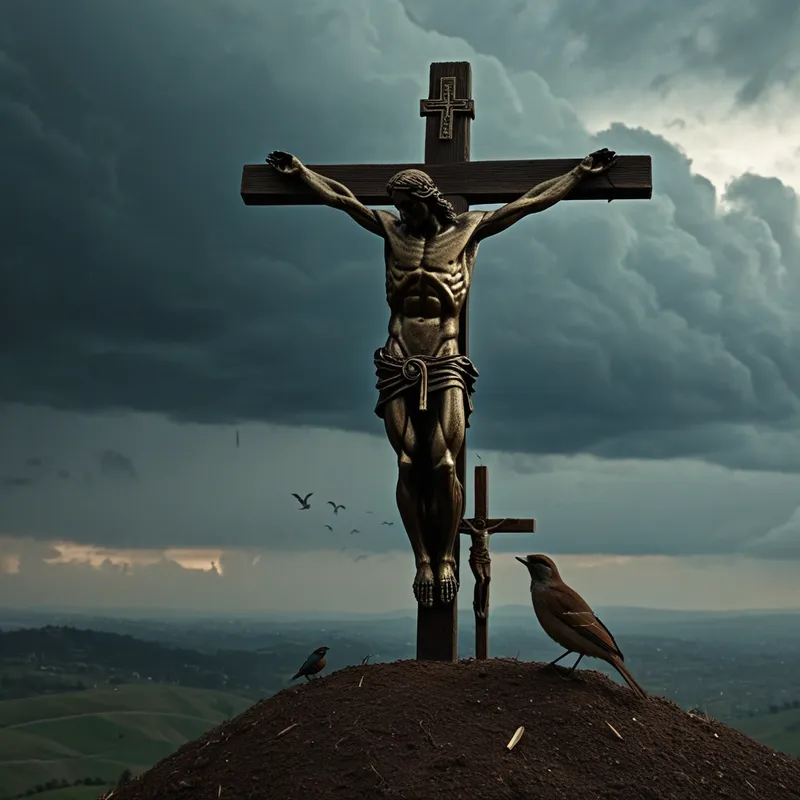
The sky over Golgotha was the color of a fresh bruise, a heavy, weeping purple that promised no mercy. The air tasted of iron and dust, thick with the murmurs of the crowd and the ragged, agonized breaths of the three figures nailed to the rough-hewn timbers. All of creation seemed to hold its breath, the very birds fallen silent in the gnarled trees.
But one creature watched, its small heart a frantic drum against its ribs. A plain, brown bird, a creature of earth and thicket, had flown to that terrible hill. It did not understand the politics of priests or the scheming of empires. It saw only suffering—the crown of thorns biting into flesh, the dark stains spreading from hands and feet, the profound exhaustion in the eyes of the central figure.
As the hours wore on and the sun hid its face, a new agony emerged. A single, long thorn had worked itself deep into the brow of the dying man. A bead of blood, black in the gloom, welled and traced a path down his temple. The bird felt a pang sharper than hunger. It could not lift the cross, could not pull the nails. But it saw the thorn.
With a flutter of desperate wings, it alighted on the crossbeam. The scent of blood and sweat was overwhelming. Ignoring the jeers from below, it hopped closer, tilting its head. With all its tiny might, it began to tug at the thorn. It pulled and worried at the base, its beak slipping on the blood-slick wood. The task was impossible; the thorn was embedded in bone.
Then, a different thought came to it. If it could not remove the thorn, perhaps it could soothe the wound. It saw the slow, relentless seep of blood. And so, the little bird pressed its soft, feathered breast directly against the piercing point. It pushed, offering its own body as a cushion, a pathetic bandage against the world’s cruelty.
In that moment of supreme compassion, a miracle and a martyrdom occurred together. The blood of the divine, touched by this ultimate act of earthly empathy, did not stain. It transfigured. A searing warmth, not of pain but of sacred fire, bloomed where its breast met the thorn. The plain brown feathers smoked and curled, burning away to reveal a patch of vibrant, glowing crimson—a permanent stain of grace, a badge of fearless love earned not in battle, but in a moment of tender, futile care.
The bird, marked forever, flew from the cross as the first rumble of thunder shook the earth. It carried away no trophy, only a transformed heart, wearing its compassion for all the world to see.
Cultural Origins & Context
This tale belongs not to scripture, but to the rich, living soil of Christian folklore—the “hagiography” of the natural world. It emerged in Medieval Europe, passed down not from pulpits but from hearths, told by mothers to children and by farmers observing the creatures of the field. Its tellers were often those closest to the cycles of life, death, and compassion: peasants, monks in monastic gardens, and the wise women who knew the properties of herbs and the language of birds.
The myth served a profound societal function. In a worldview that saw divine presence in all creation, it answered a deep need: to bridge the terrifying, cosmic event of the Passion with the intimate, knowable world. It humanized—or rather, animalized—the narrative of sacrifice, making it accessible. If even the smallest, most insignificant creature was moved to participate, then the event’s gravity was absolute and its call to compassion universal. The robin became a living parable, a flying sermon on the duty of mercy, its red breast a constant, visual reminder that the sacred intersects with the mundane in acts of selfless love.
Symbolic Architecture
At its core, the myth is an alchemy of empathy. The robin represents the untransformed soul—plain, earthly, and instinctual. Its journey is not one of questing heroism, but of witnessing and responding. The thorn is a perfect symbol of focused, penetrating suffering—not the grand catastrophe, but the specific, nagging, relentless pain that defines so much human experience.
The most profound transformations often begin not with a quest for glory, but with an unbearable sensitivity to the pain of another.
The act of pressing its breast against the thorn is the critical moment of participation mystique—a blurring of boundaries between self and other. The bird does not calculate; it merges with the suffering. This is the essence of compassion (com-passio: to suffer with). The resulting “burn” is not a punishment, but the inevitable scar of true empathy. One cannot truly touch profound suffering and remain unchanged. The crimson breast is thus the stigmata of the natural world, a permanent record of a moment when instinct was transcended by love, marking the creature as both wounded and sanctified.
The Dreamer’s Resonance
When this myth pattern stirs in the modern psyche, it often manifests in dreams of burning or marking. You might dream of a small animal with a glowing wound, of your own chest feeling warm or tender, or of trying futilely to remove a splinter or thorn from someone else’s body. Somaticly, this can correlate with actual sensations in the heart center—tightness, warmth, or ache—as the body processes empathetic overload.
Psychologically, this dream signals a profound process of ethical awakening. The dreamer is likely in a situation where they are witnessing deep suffering—in a loved one, a community, or within a part of themselves—and feeling the helpless, instinctual pull to “do something,” even if the action seems insignificant. The dream confirms that this impulse is not foolish, but sacred. The “burn” represents the inevitable cost of caring in a wounded world. The dream asks: Are you willing to be marked by your compassion? Are you willing to carry the visible, permanent change that comes from truly touching another’s pain?

Alchemical Translation
For the individual on the path of individuation, the Robin’s Breast myth models the transformation of the Caregiver archetype from a naive impulse into a conscious, sacred function.
The initial state is the prima materia: the plain, brown bird of unconscious instinct. We see suffering and feel a vague, anxious pull. The nigredo, the blackening, occurs on Golgotha—the confrontation with the darkest, most painful reality of existence (crucifixion, despair, mortality). The bird’s decision to act is the albedo, the whitening—a purification of intention, moving from anxiety to focused compassion.
The crucible of the heart transforms the leaden weight of helplessness into the gold of compassionate presence. The wound becomes the seal of authenticity.
The pressing against the thorn is the rubedo, the reddening—the central, fiery operation. This is the ego’s sacrifice. We must offer our own “breast,” our own vulnerable self, to the point of pain. We must stop trying to “fix” the unfixable thorn and instead learn to be with the wound. The resulting crimson mark is the lapis philosophorum, the philosopher’s stone: not an end to suffering, but the discovery that one’s identity is now irrevocably woven with the capacity for sacred empathy. The individual is no longer just a creature of the earth. They are a marked witness, carrying a testament of love that forever alters their relationship to the world’s thorns. Their compassion, once instinctual, has become their defining, transfiguring essence.
Associated Symbols
Explore related symbols from the CaleaDream lexicon: