
The River Styx Myth Meaning & Symbolism
The sacred, binding river of the Underworld, a boundary of oaths and final passage, where the dead pay the ferryman and the living gods swear unbreakable vows.
The Tale of The River Styx
Listen, and hear of the river that knows no sun. Not in the deep valleys where mortals toil, nor in the sun-drenched courts of Olympus, does this water flow. Its course is carved through the very bedrock of the world, in the realm of Hades, a place of echoes and forgotten light.
This is the River Styx, the eldest daughter of Oceanus. Her waters are not blue, nor green, but the color of a starless midnight, cold enough to still the warmest soul. A profound silence hangs over her, broken only by the soft, ceaseless lapping against shores of grey ash and the occasional, heart-wrenching sigh of a shade remembering life’s breath.
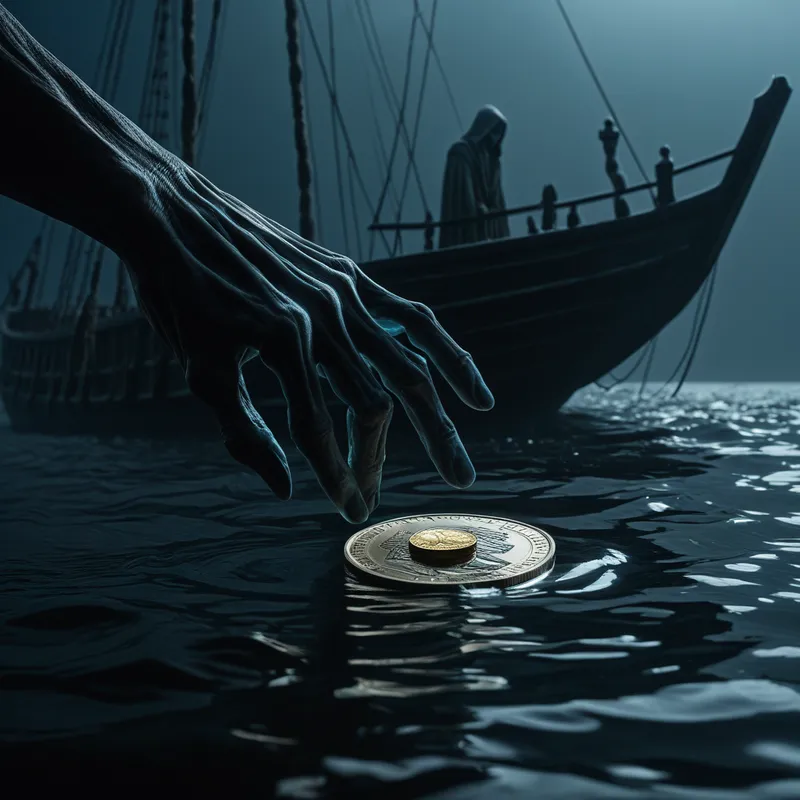
Upon these waters plies the only vessel: a rotten, worm-eaten boat steered by Charon. His eyes are hollow coals, his grip skeletal and unyielding. He speaks no welcome, offers no comfort. His demand is simple, ancient, and absolute: a single coin, an obol, placed upon the tongue of the dead for their passage. Those who come unprovided for—the unburied, the unmourned—are condemned to wander the desolate bank for a hundred years, their whispers joining the mist.
But the Styx is not only for the dead. High above, in the radiant chaos of the divine, the Styx holds the ultimate power. When a god must swear an oath of terrible import, an oath upon which the fate of the cosmos might turn, they do not swear by the bright peak of Olympus. They call for Styx herself. Iris, the rainbow, descends to the underworld, draws a chalice of the black water, and bears it to the heavens.
The god, standing before all their kin, pours the libation and speaks the vow. The moment the water of Styx touches the divine lips, the oath is forged in the fabric of reality. To break it is unthinkable. The punishment is a Great Year of breathless stupor, exiled from the nectar of the gods and the council of the immortals. Thus, the coldest river below binds the mightiest powers above.
This is the tale of the boundary. The final price. The unbreakable word. It is the first truth and the last promise, flowing forever in the dark.
Cultural Origins & Context
The myth of the Styx is woven into the earliest layers of Greek thought, appearing in the epic poetry of Homer and the theogonic catalog of Hesiod. For the Greeks, geography was theology; rivers were personified deities, and the Styx was the most fearsome and sacred of them all. It served a dual societal function.
Firstly, it provided a concrete, ritualistic answer to the terrifying abstraction of death. The journey across the Styx, mediated by the coin for Charon (Charon’s obol), formalized the rites of burial. To ensure a loved one’s passage was a sacred duty, reinforcing social bonds and the importance of proper funeral rites. The myth thus acted as a powerful enforcer of cultural norms surrounding death and remembrance.
Secondly, its role in divine oaths established a cosmological principle of order and consequence, even for the gods. In a pantheon known for its caprice and conflict, the Styx was the ultimate guarantor. It represented a law older and more absolute than the will of Zeus himself. This idea—that even power must be bound by sacred promise—was a foundational concept for Greek notions of justice (dike) and cosmic balance. The myth was passed down by bards and poets not merely as a scary story, but as a fundamental chapter in the map of reality, describing the ultimate penalties and the final thresholds.
Symbolic Architecture
The River Styx is not merely a location; it is a living symbol of the ultimate threshold. It represents the point of no return, the irreversible transition from one state of being to another. Psychologically, it maps onto the profound transformations the ego fears yet must inevitably face: the death of an old identity, the end of a major life chapter, or the surrender required for deep psychological growth.
The River Styx is the embodied moment when the known self dissolves into the current of the unknown. It is the price that must be paid to move from one shore of being to the other.
The coin for Charon symbolizes the necessary sacrifice. Nothing passes freely. To cross from life to death, or from one psychic state to another, requires a payment—a cherished belief, a comfortable illusion, a familiar pain we must finally let go. The unburied, wandering shades represent parts of ourselves we have not properly laid to rest, psychic fragments condemned to haunt the borders of our consciousness because we refused to pay the price of their integration.
Most profoundly, the Styx as the oath-water for the gods symbolizes the moment a conscious commitment is made absolute. It is the point where a choice or a vow moves from casual intention to binding destiny, etched into the very structure of the soul. To break such an oath is to fall into a psychic coma, a state of spiritual exile and stagnation.

The Dreamer’s Resonance
When the waters of the Styx flood into modern dreams, the dreamer is standing at a profound inner crossroads. To dream of a dark, impassable river, a silent ferryman, or the anxious search for a toll is a signal from the deep unconscious: a fundamental transition is at hand.
The somatic experience often accompanies feelings of cold dread, weightlessness, or being stuck. You may dream of missing a boat, of not having the right coin, or of watching others cross while you remain behind. This is the psyche illustrating its resistance to a necessary ending. The “unburied” aspects—unprocessed grief, unexpressed rage, an outgrown version of yourself—are clamoring for attention, demanding their ritual passage.
Conversely, a dream of successfully crossing, or of solemnly drinking from dark water, can indicate a readiness to commit to a profound inner vow or to finally accept a life-altering change. The dream Styx asks the essential questions: What must you pay to move forward? What have you left unburied on the shore? And what oath are you now ready to swear, with the full weight of your being?

Alchemical Translation
In the alchemical vessel of individuation, the journey across the Styx models the nigredo—the blackening, the dissolution of the ego’s known forms. It is the dark night of the soul, where all light seems extinguished and one must float upon a seemingly hostile element.
The alchemical work requires the aspirant to become their own Charon and their own shade. You must identify the “coin”—the conscious acknowledgment, the felt grief, the surrendered control—that serves as the fare. You must actively “bury” the dead: honor what was, grieve its passing, and release your attachment, so that aspect of the psyche may complete its journey and be transformed, rather than remain a restless ghost draining your vitality.
The alchemical oath sworn upon the Styx is the commitment to the process itself—the vow to endure the dissolution, to hold faith in the darkness, and to serve the truth of one’s own becoming above the comfort of the familiar shore.
Finally, the integration is the discovery that the fearsome river of separation is also the ring of binding integrity. The oath sworn upon it creates a new, unbreakable unity within the self. What emerges from the far shore is not the same person who embarked. The ego has paid its toll, been dissolved in the black waters, and is reconstituted under a new, more binding law—not the law of external expectation, but the sacred oath sworn to one’s own deepest, and often most difficult, truth. The Styx, in the end, is not just a boundary of death, but the crucible for a more authentic life.
Associated Symbols
Explore related symbols from the CaleaDream lexicon:
- Passage
- Muddy
- Overflowing Sink
- Spooky Graveyard
- Marshy Wetland
- Illusory Bridge
- Volatile Chlorine
- Swamp Land
- Serpent-like River
- Slide Guitar
- Dialectical Tide
- Riverbank Shadows
- Wetlands Whisper
- Cypress Swamp
- River Bank
- Oily Slick
- Wet Slime
- Oily Slickness
- Digital Divide
- Virtual Limbo
- Groove
- Viscosity
- Rift
- Vows
- Nausea
- Phlegm
- Brackish