
The River of No Return Myth Meaning & Symbolism
A myth of a sacred, one-way river where souls journey to the afterlife, embodying the finality of death and the acceptance of destiny.
The Tale of The River of No Return
Listen, and let the firelight carry you to a time when the world was closer to the sky. In the land where the baobab trees remember everything, there flowed a river unlike any other. It was called Omi-Aiyé, the Water of the World’s End. Its source was not in any mountain, but in the first tear shed by the Olodumare when he saw the loneliness of his own creation. Its waters were the color of twilight, holding both the last copper of the sun and the first indigo of the night.
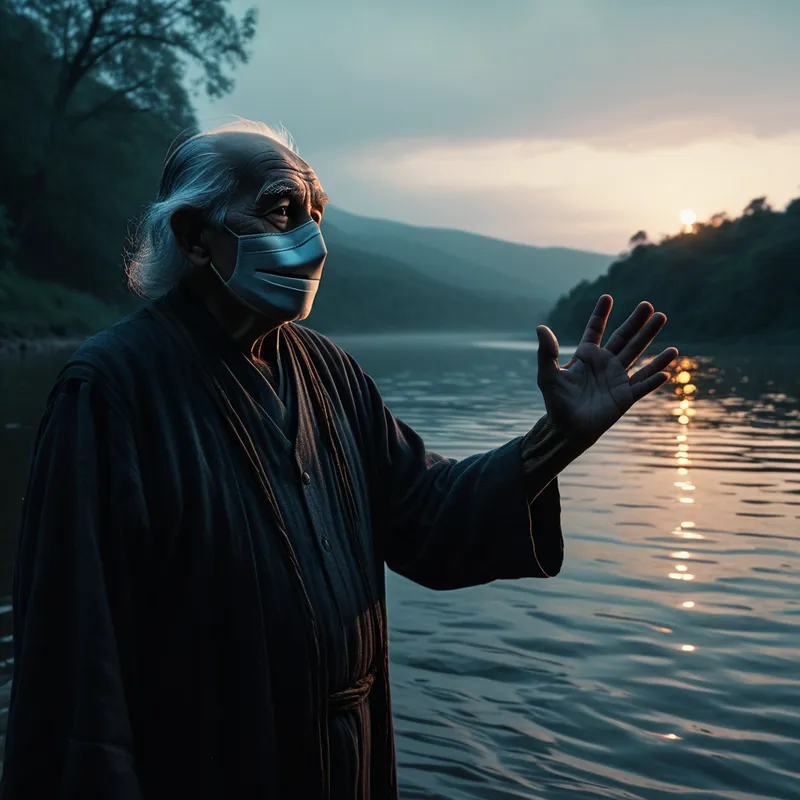
The river did not babble or roar. It flowed with a deep, silent current, a sound like the slow beating of a great, sleeping heart. It wound through the forest and the savannah, visible to all, yet its far bank was always shrouded in a soft, silver mist. The people knew this river. They fished from its tributaries, but they never set foot in this water. For this was the path for the Egungun alone.
The tale is of a great hunter named Ikúndélé. His arrows never missed, and his heart was as brave as the lion. But pride grew in him like a thorn tree. He boasted that he feared no path, not even the path of spirits. When his beloved father passed into the world of the ancestors, a grief like a physical wound opened in Ikúndélé’s chest. At the funeral rites, as the drums spoke the language of loss, he made a vow. He would not let his father travel the final road alone. He would walk with him, just to the mist, to ensure he was not afraid.
The elders warned him. The diviners cast their cowrie shells and saw only swirling darkness. “The river flows one way, Ikúndélé,” they said, their voices grave. “Its current is the current of Ayànmọ́. To enter is to accept its pull. There is no return.” But the hunter’s grief was louder than their wisdom. At the moment when his father’s spirit, a faint shimmer in the air, was drawn to the riverbank, Ikúndélé stepped forward.
The water was not cold, but it was heavy. It felt like stepping into liquid memory. With each step, the sounds of the world behind him—the crickets, the wind in the grass, the distant village drums—grew faint, as if muffled by thick cloth. Ahead, he saw the shimmering form of his father, moving steadily toward the mist. Ikúndélé called out, but his voice made no ripple. He pushed forward, the current now tugging insistently at his knees, then his waist.
He reached for his father’s form just as it entered the silver veil. For a fleeting second, their eyes met—his father’s were filled with a peace so profound it was terrifying. Then, the form dissolved into the mist. Ikúndélé turned, suddenly desperate for the familiar bank, for the smell of earth and woodsmoke. He fought the current, muscles straining, but the water held him like a gentle, implacable hand. The bank, once so close, now seemed a distant, blurry painting. The pull was absolute. He had chosen the path of spirits while the blood still flowed in his veins. The river accepted his choice. With a final, silent sigh that was not his own, the mist enveloped him, and the world of the living saw him no more.
Cultural Origins & Context
This myth finds its roots in the rich oral traditions of numerous West African peoples, particularly among the Yoruba, Akan, and Edo cultural spheres. It was not a tale for casual entertainment but a sacred narrative, often recounted by griots, elders, or during rites of passage and funerary ceremonies. Its primary function was pedagogical and ontological—it taught the fundamental, non-negotiable order of the cosmos. It delineated the boundary between Ayé and Òrun, the seen and the unseen.
The story served as a powerful social and spiritual anchor. It reinforced respect for ancestral wisdom (the warnings of the elders), the acceptance of divine ordinance (Ayànmọ́), and the profound finality of death as a transition, not an end. By personifying this transition as a physical journey on a specific river, it made the abstract concrete, providing a vivid cosmological map for the soul’s journey. It cautioned against the hubris of attempting to override spiritual laws with human will, no matter how profound the love or grief that motivated it.
Symbolic Architecture
The River of No Return is the ultimate symbol of irreversible process. It is the linear thread of time, the one-way journey of the soul, and the concrete manifestation of fate.
The river does not argue; it simply flows. To stand in its current is to consent to its destination.
The riverbank represents the threshold of consciousness, the liminal space where life and death, choice and consequence, meet. Ikúndélé is not a villain, but the embodiment of the human heart in its raw, defiant state—the part of us that believes love or willpower can suspend natural law. His journey is not one of evil, but of tragic error, a confusion of realms. The silent, heavy water symbolizes the weight of destiny and the absorbing nature of the unconscious, into which the conscious ego (Ikúndélé) disappears when it attempts to navigate realms beyond its capacity.
The mist is the veil of mystery, the point of no return where individual identity is subsumed into a larger, ancestral pattern. The myth’s power lies in its lack of a heroic reversal; it is a lesson in acceptance, not conquest.
The Dreamer’s Resonance
When this myth stirs in the modern psyche, it often surfaces in dreams of irrevocable change or profound helplessness. To dream of standing by or in such a river is to be somatically processing a point of existential passage from which there is no going back.
This could manifest as dreams of watching a loved one drift away on a current, of being on a train or boat that cannot stop, or of signing a contract in a language you cannot read. The somatic feeling is often one of heavy, viscous pressure—the “heavy water” of the myth. Psychologically, the dreamer is at the threshold of accepting a fate they have long resisted: the end of a relationship, the loss of a life phase, the integration of a painful truth, or the acknowledgment of their own mortality. The dream is the psyche’s ritual enactment of this acceptance, preparing the conscious self for the release of what was and the inevitable journey toward what must be.

Alchemical Translation
In the alchemy of individuation, the myth models the critical stage of mortificatio—the necessary death of an old attitude or identification. Ikúndélé’s conscious, heroic, willful self must “die” to its own hubris to be transformed.
The ultimate sacrifice is the sacrifice of the illusion of control. The river demands not your life, but your resistance.
The modern individual faces their own Omi-Aiyé whenever they encounter a life transition that requires the surrender of a former identity: the professional who must retire, the parent whose children have left, the individual facing a health crisis. The “elder” warnings are the inner voices of wisdom and instinct we ignore. The “grief” that drives us into the water is our attachment to a self-image that is no longer viable.
The alchemical triumph here is not in reversing the flow, but in consciously choosing to stop fighting the current. It is the transformation of defiance into dignified surrender, of ego-driven action into fate-aligned being. By accepting the pull of the river—the demands of our own deepest destiny—we do not cease to exist. Instead, like Ikúndélé, we are translated. We move from the known bank of a limited identity into the misty realm of the ancestral, the collective, the transpersonal Self. We become part of the larger flow of life, death, and meaning, having finally learned that some journeys are meant to be completed, not conquered.
Associated Symbols
Explore related symbols from the CaleaDream lexicon:
- River — The central symbol of irreversible flow, destiny, and the soul’s one-way journey from the realm of the living to the realm of the ancestors.
- Death — The ultimate transformation and the necessary passage the river represents, not as an end, but as a transition to a different state of being.
- Journey — The core narrative structure of the myth, depicting the final, sacred voyage every soul must undertake.
- Fate — The invisible current of the river, representing the divine ordinance and destiny that guides the soul’s passage.
- Spirit — The essential self, the Egungun, that is the true traveler on the river, separate from the physical body.
- Sacrifice — Ikúndélé’s unintended offering of his earthly life, born from love and pride, which completes the ritual of passage.
- Threshold — The riverbank, the critical liminal space where the choice to cross over is made, separating the known world from the unknown.
- Mist — The veil that obscures the destination, symbolizing the ultimate mystery of what lies beyond death and the dissolution of individual perception.
- Ancestor — The destination and the guiding presence; those who have completed the journey and now reside beyond the river, welcoming the newly arrived.
- Pride — The fatal flaw of the hunter, the human arrogance that believes it can navigate or alter spiritual laws, leading to his absorption by the river.
- Grief — The powerful, human emotion that acts as the catalyst for the journey, blinding one to wisdom and compelling a fateful choice.
- Destiny — The immutable pull of the river’s current, the pre-ordained path that accepts all who enter its waters.