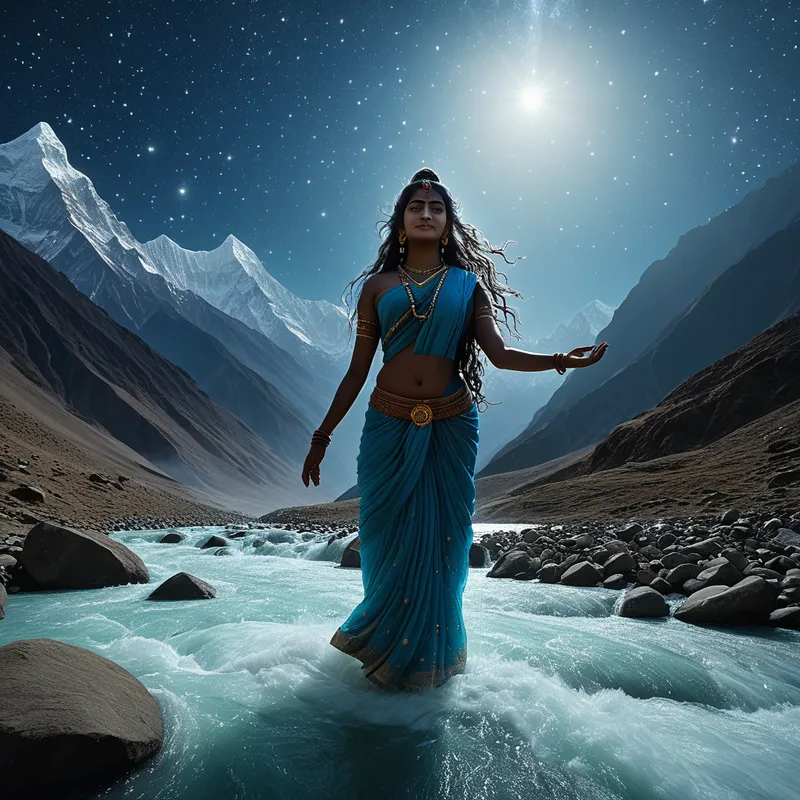
The River Ganges Myth Meaning & Symbolism
A sacred river descends from heaven to cleanse the ashes of ancestors, borne by the god Shiva's matted hair, bringing life, liberation, and divine grace to the mortal world.
The Tale of The River Ganges
Hear now the tale of [the river](/myths/the-river “Myth from Buddhist culture.”/) that flows from heaven to earth, a story not of creation, but of divine negotiation, desperate penance, and a grace so fierce it could shatter [the world](/myths/the-world “Myth from Tarot culture.”/).
In an age long past, the noble King Sagara of the Ikshvaku line sought to perform the Ashwamedha. But the sacrificial horse was stolen, vanishing into [the underworld](/myths/the-underworld “Myth from Greek culture.”/). The king sent his sixty thousand sons to find it. They searched the very bowels of [the earth](/myths/the-earth “Myth from Hindu culture.”/), and there, deep in the nether regions, they found the horse grazing peacefully beside a meditating sage. Believing him the thief, they hurled insults. The sage, Kapila, opened his eyes. His gaze was a fire of pure consciousness. In an instant, the sixty thousand princes were reduced to mounds of silent ash.
Generations passed, their souls trapped, unable to ascend. The weight of this ancestral debt fell upon a later king, Bhagiratha. He could think of nothing but their liberation. The sages told him: only the waters of the celestial [Ganga](/myths/ganga “Myth from Hindu culture.”/), flowing from the toe of [Vishnu](/myths/vishnu “Myth from Hindu culture.”/) in the highest heaven, could wash those ashes and grant the souls [moksha](/myths/moksha “Myth from Hindu culture.”/). But who could convince the goddess to leave her heavenly abode? And who could bear the cataclysmic force of her fall?
Bhagiratha renounced his throne. He walked to the Himalayas, the abode of snow and silence. For centuries, he stood on one foot, arms raised, his penance so intense it heated the very heavens. The gods were moved. Brahma appeared. “Your austerity is peerless, Bhagiratha. Ganga will descend. But her plunge from the celestial realm will crack the earth. Only one can break her fall.”
All eyes turned to the great ascetic, [Shiva](/myths/shiva “Myth from Hindu culture.”/), meditating in the icy fastness of Mount Kailash. Bhagiratha prayed to him. [Shiva](/myths/shiva “Myth from Hindu culture.”/), the compassionate destroyer, agreed. He stood beneath the point of descent, his matted locks piled high like a cosmic net.
Then, with a roar that shook the pillars of space, Ganga descended. She was not a gentle stream but the concentrated power of liberation, a furious, prideful deluge intent on washing Shiva himself into the [underworld](/myths/underworld “Myth from Greek culture.”/). The river-goddess crashed into his hair—and was lost. The mighty, universe-shattering flow vanished into the infinite, labyrinthine tangles of Shiva’s jata. For years, she swirled there, trapped, humbled, her fury turned to a gentle murmur.
Only when Bhagiratha prayed once more did Shiva release a single, slender stream from his hair. Ganga, now tempered, followed the king’s chariot across the plains, to the very spot where the ashes of the sixty thousand lay. Her waters touched the gray mounds. A light rose from them, a sigh of release heard in the soul of the world. The ancestors were free. And the river that remained became the sacred [Ganges](/myths/ganges “Myth from Hindu culture.”/), flowing forever, a promise of purity and liberation for all who touch her.

Cultural Origins & Context
The myth of [Ganga’s descent](/myths/gangas-descent “Myth from Hindu culture.”/), or Gangavatarana, is woven into the epic narratives of the Ramayana and, more prominently, the Mahabharata. It belongs to the Puranic tradition, which expanded and popularized Vedic cosmology through story. This was not a tale confined to priestly classes; it was recited by bards, enacted in temple reliefs (most famously at Mahabalipuram), and integrated into daily ritual life.
Its societal function was multifaceted. It provided an etiological narrative for the supreme sacredness of [the Ganges River](/myths/the-ganges-river “Myth from Hindu culture.”/), explaining why her waters are considered inherently purifying (papahara). It reinforced the critical dharma of pitr yajna—the duty to one’s ancestors—showing that the actions of descendants directly affect the spiritual state of the forebears. Furthermore, it established a theological model of grace: liberation is not achieved by human effort alone (Bhagiratha’s penance) but requires divine intervention (Brahma’s boon, Shiva’s interception, Ganga’s consent), a cooperative dance between human aspiration and cosmic compassion.
Symbolic Architecture
At its core, the myth maps a profound psychic and cosmological process. [The Ganges](/myths/the-ganges “Myth from Hindu culture.”/) represents the flow of divine [consciousness](/symbols/consciousness “Symbol: Consciousness represents the state of awareness and perception, encompassing thoughts, feelings, and experiences.”/) or grace—pure, potent, and from a higher order of [reality](/symbols/reality “Symbol: Reality signifies the state of existence and perception, often reflecting one’s understanding of truth and life experiences.”/). Its untamed descent symbolizes the raw, undifferentiated power of the unconscious or [spirit](/symbols/spirit “Symbol: Spirit symbolizes the essence of life, vitality, and the spiritual journey of the individual.”/), which, if it hits the conscious “[earth](/symbols/earth “Symbol: The symbol of Earth often represents grounding, stability, and the physical realm, embodying a connection to nature and the innate support it provides.”/)” directly, would be annihilating.
The divine must be mediated to become nourishing; the unconscious must be tempered by structure to become conscious.
Shiva’s matted [hair](/symbols/hair “Symbol: Hair often symbolizes identity, power, and self-expression, reflecting how we perceive ourselves and how we wish to be perceived by others.”/) is the ultimate [symbol](/symbols/symbol “Symbol: A symbol can represent an idea, concept, or belief, serving as a powerful tool for communication and understanding.”/) of this mediation. It is not a dam, but a labyrinthine filter—the complex, tangled structures of the [psyche](/myths/psyche “Myth from Greek culture.”/) (ascetic discipline, yogic practice, or simply the [winding path](/symbols/winding-path “Symbol: A winding path embodies life’s journey, embodying the complexities and unpredictability of experiences along the way.”/) of a lived [life](/symbols/life “Symbol: The symbol of ‘Life’ represents a journey of growth, interconnectedness, and existential meaning, encompassing both the joys and challenges that define human experience.”/)) that must contain and slow the influx of overwhelming numinosity. The [hair](/symbols/hair “Symbol: Hair often symbolizes identity, power, and self-expression, reflecting how we perceive ourselves and how we wish to be perceived by others.”/) transforms destructive force into [life](/symbols/life “Symbol: The symbol of ‘Life’ represents a journey of growth, interconnectedness, and existential meaning, encompassing both the joys and challenges that define human experience.”/)-giving flow. Bhagiratha represents [the ego](/myths/the-ego “Myth from Jungian culture.”/)‘s relentless, focused intent—the will toward healing and [integration](/symbols/integration “Symbol: The process of unifying disparate parts of the self or experience into a cohesive whole, often representing psychological wholeness or resolution of internal conflict.”/), driven by the burden of ancestral [karma](/myths/karma “Myth from Hindu culture.”/) (the unresolved complexes and sins of the past). The liberation of the ancestors signifies the [resolution](/symbols/resolution “Symbol: In arts and music, resolution refers to the movement from dissonance to consonance, creating a sense of completion, release, or finality in a composition.”/) of these deep, inherited psychic patterns, allowing [energy](/symbols/energy “Symbol: Energy symbolizes vitality, motivation, and the drive that fuels actions and ambitions.”/) bound in old wounds to be released and transformed.
The Dreamer’s Resonance
When this myth stirs in the modern dreamer, it often signals a process of profound emotional or spiritual purification. To dream of a mighty, terrifying river from [the sky](/myths/the-sky “Myth from Persian culture.”/) may point to an impending influx from the unconscious—a surge of insight, creativity, or long-repressed emotion that feels both awe-inspiring and threatening. The dream ego may be in the position of Bhagiratha: feeling a solemn, desperate responsibility to “clean up” something from the past, a familial pattern or a personal sin that weighs like ash on the soul.
Somatically, this can feel like pressure in [the crown](/myths/the-crown “Myth from Various culture.”/) of the head (the point of descent) or a constriction in the chest (the trapped ashes). The dream may seek its Shiva—a symbolic container. This could manifest as finding a complex network (a forest, a web, a intricate machine) that safely channels [the flood](/myths/the-flood “Myth from Biblical culture.”/). The resolution is the feeling of release, of a burden washed away, often accompanied by dream imagery of clear, flowing [water](/myths/water “Myth from Chinese culture.”/) after a period of tension. The myth plays out in the psyche as the body-mind prepares to integrate a powerful new energy, ensuring it nourishes rather than devastates.
Alchemical Translation
The alchemical journey modeled here is the [solve et coagula](/myths/solve-et-coagula “Myth from Alchemical culture.”/)—dissolve and coagulate—applied to the soul. The “ashes of the ancestors” are the [prima materia](/myths/prima-materia “Myth from Alchemical culture.”/), the base matter of our unresolved history, our psychic dross. Bhagiratha’s penance is the initial, fiery stage of calcinatio—burning away worldly attachment through focused, often painful, introspection and discipline (the [tapas](/myths/tapas “Myth from Hindu culture.”/)). This heats the psyche enough to call down the “celestial water,” the aqua permanens or divine solvent.
The descent of grace is contingent upon the heat of human longing; the unconscious answers only when the conscious effort reaches its breaking point.
But the crucial, often overlooked stage is Shiva’s intervention—the coagulatio. This is where the dissolved elements are re-formed at a higher level. The raw, spiritual experience (ecstasy, revelation, breakdown) is caught in the “matted hair” of conscious integration. It is reflected upon, woven into the existing fabric of the personality, given form in art, relationship, or new understanding. The river is not stopped; it is directed. The final, liberated flow that reaches the plains is the [lapis philosophorum](/myths/lapis-philosophorum “Myth from Alchemical culture.”/), [the philosopher’s stone](/myths/the-philosophers-stone “Myth from Alchemical culture.”/)—now a permanent, accessible source of renewal within the individuated psyche. The individual becomes both Bhagiratha (the seeker), Shiva (the container), and the river itself (the nourishing spirit), capable of transforming their own inner ashes into liberation.
Associated Symbols
Explore related symbols from the CaleaDream lexicon: