The Ring of Gyges Myth Meaning & Symbolism
A shepherd finds a ring granting invisibility, testing the nature of justice and revealing the hidden self when all constraints of being seen are removed.
The Tale of The Ring of Gyges
Beneath the sun-scorched hills of Lydia, where the earth kept its dead secrets close, there lived a shepherd named Gyges. He was a man of the wind and the flock, his life measured by the bleating of sheep and the slow arc of the sun. His world was one of visible cause and effect, where every action cast a shadow and every man was known by his deeds.
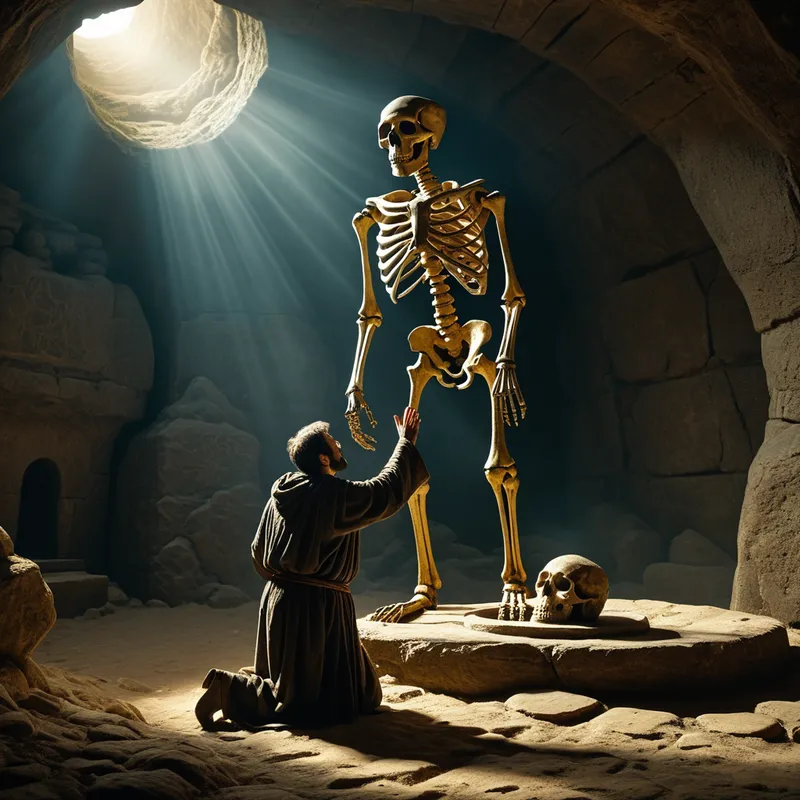
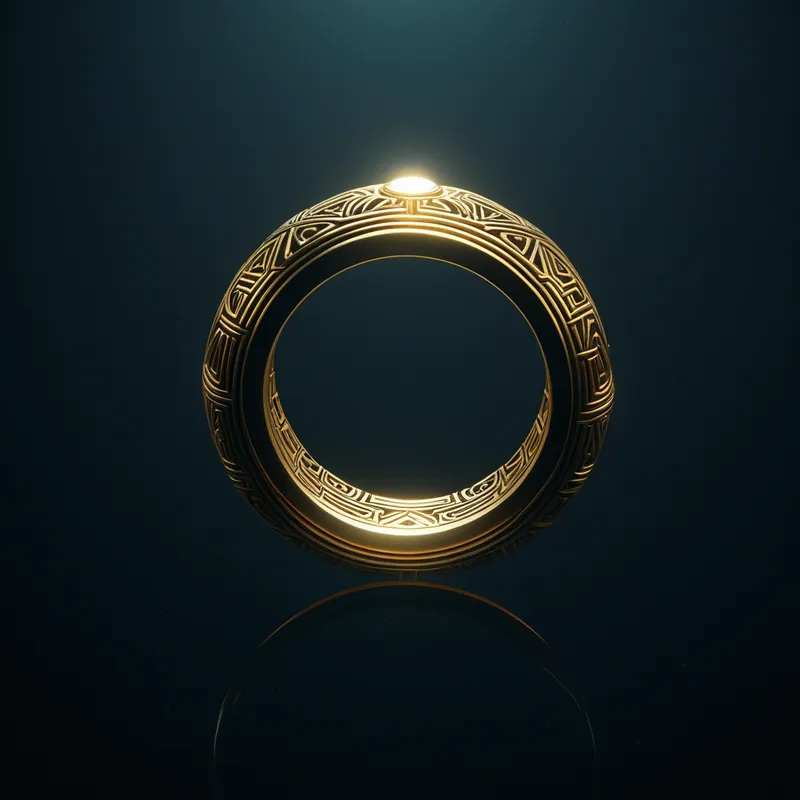
One day, a great chasm opened in the earth after a violent quake and a deluge of rain. Curiosity, that ancient serpent, coiled in his heart. Gyges descended into the darkness, leaving the world of light behind. The air grew cold and still, smelling of wet stone and ancient dust. In the belly of the earth, his torchlight fell upon a wonder that stopped his breath: a tomb, not of stone, but seemingly of the earth itself. And within, upon a bier, lay the colossal form of a man, a giant of bronze and bone, long returned to the elements. The corpse wore no crown, bore no scepter, but on one skeletal finger rested a ring of heavy, untarnished gold.
Gyges, his hand trembling not with fear but with a fateful pull, took the ring. As he climbed back to the world of the living, he sat among his fellow shepherds at their monthly gathering. He turned the ring idly upon his finger—and vanished.
A silence fell, not of peace, but of profound absence. He heard his name called, felt hands pass through the space he occupied. He was a ghost among the living. With a turn of the bezel inward, he returned, solid and seen, to their stunned faces. The power was in the ring’s orientation. A turn outward, and he slipped the bonds of the visible world. A turn inward, and he was bound once more.
The seed of a terrible thought was planted. What is a man when he is not a man seen? That night, he turned the ring and walked unseen into the royal palace. He passed guards like a sigh, through halls of marble as a chill draft. He entered the chamber of King Candaules, who slept in ignorant peace. And he saw the queen. A desire, sharp and lawless, rose in him—a desire that, in the light of day, would have been checked by shame, by consequence, by the very eyes of others. But here, in the absolute privacy of invisibility, there was no Other. There was only will.
He did not act then. But the poison was in his blood. Soon after, summoned by a king foolishly proud of his wife’s beauty, Gyges was commanded by Candaules to hide and gaze upon her nakedness. The queen, perceiving the violation, later confronted Gyges. She offered him a harrowing choice: slay the king who betrayed her, take his throne and her as wife, or be slain himself. The ring, hidden on his hand, whispered its solution. There was no choice at all for a man who could act without witness.
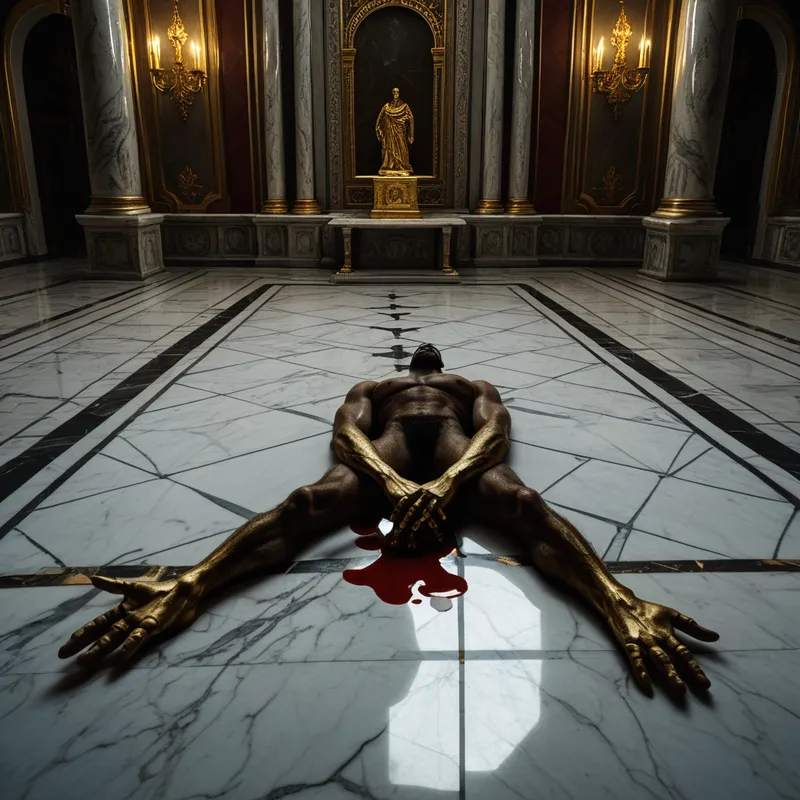
Gyges turned the bezel. He became a walking silence, a blade of air. He entered the king’s chamber once more, and where there should have been the clash of steel, there was only the soft, wet sound of a murder without a murderer. The king fell, slain by an invisible hand. Gyges, his hands stained with a king’s blood, turned the ring and stepped into the light, into the throne, into a kingdom built upon a foundation unseen.
Cultural Origins & Context
This profound and unsettling tale comes to us not from native Roman lore, but as a treasured inheritance from Greek philosophy, meticulously preserved and transmitted by the Roman intellectual tradition. It is found in Plato’s Republic, written in Greek in the 4th century BCE, but it was Roman scholars, statesmen, and philosophers like Cicero who adopted, debated, and disseminated such Greek thoughts, weaving them into the fabric of their own moral and political discourse.
The myth was not a popular folktale recited in the Forum, but a philosophical device employed in the aristocratic villas and schools of Rome. Its teller was, ultimately, the character of Plato through his mouthpiece, Socrates. Its function was stark and revolutionary: to pose the most fundamental question of ethics. Cicero and later Stoics would have recognized its power. In a culture deeply concerned with dignitas (personal prestige and honor) and the watchful eyes of gods and community, the story served as a radical thought experiment. It asked the Roman patrician: Is justice merely the advantage of the stronger, or is it a good in itself? If the constraints of reputation and law—the very things that defined a Roman’s public life—were removed, what would remain of his virtue?
Symbolic Architecture
The Ring of Gyges is not a tool of magic but a mirror of the soul. It represents the ultimate condition of absolute psychological privacy—the removal of the social, moral, and divine gaze. It makes literal the fantasy of acting without consequence, of being a subject who is never an object in another’s field of vision.
The ring does not corrupt; it reveals. It strips away the persona, the carefully constructed mask we wear in the theater of the world, and exposes the raw, unmediated impulses of the shadow.
Gyges himself is Everyman. His journey from shepherd to king is an allegory for the descent into the unconscious (the chasm, the tomb) and the retrieval of a potent, amoral power (the ring). The giant in the tomb symbolizes the buried, archaic layers of the psyche—the chthonic powers that predate civilization and its moral codes. The ring is the knowledge of how to activate one’s own shadow, to make the unconscious impulses conscious and deploy them.
The pivotal act—the murder of King Candaules—is not merely a political coup. It is the symbolic murder of the outer authority, the “king” of conventional morality and social law. It represents the moment the individual’s hidden, self-serving will usurps the throne of conscience. The queen who orchestrates this is a fascinating figure: she represents the anima, the inner feminine principle that connects a man to his deeper, often ambiguous, psyche. She guides him, not toward light, but toward the enactment of a dark, necessary fate that severs him from his old, naive loyalty.
The Dreamer’s Resonance
When this myth stirs in the modern dreamer, it rarely appears as a literal ring of invisibility. Its pattern manifests in subtler, more insidious forms. The dreamer may find themselves in a workplace, a family home, or a public space, suddenly realizing they are not perceived. They speak and no one hears; they act and no one reacts. This is not a fantasy of freedom, but a somatic experience of profound existential terror or intoxicating liberation—often both.
This dream signals a critical psychological process: a confrontation with the parts of the self that operate “invisibly.” It may emerge when one feels their true intentions, resentments, or desires are hidden from others, or when they fear their social self is a facade. The somatic feeling—the chill of being a ghost, the thrill of unobserved power—indicates where the dreamer stands in relation to their own shadow. Are they terrified of its emergence, or are they, like Gyges in the tomb, curiously reaching for it? The dream is an invitation to ask: What would I do if I were sure I would never be seen? The answer, however uncomfortable, is a fragment of one’s own shadow coming to light.

Alchemical Translation
The alchemical journey modeled by the Ring of Gyges is the integration of the shadow, a central stage in Jungian individuation. The myth does not glorify this process; it warns of its perils and acknowledges its inevitability for the one who descends.
The first stage, descent (into the chasm), is the nigredo, the blackening. It is the conscious decision to explore one’s own darkness, the repressed greed, envy, and aggression buried in the personal tomb. Retrieving the ring is the invention of the prima materia—the shocking recognition of this amoral power within oneself.
The true alchemical work begins not with using the ring, but with holding it. The temptation is to turn the bezel outward immediately—to act out the shadow, to live a life of hidden manipulation and secret gratifications. This is psychic corruption, leading to a kingdom built on a lie (the blood of the king).
The transmutation occurs when, instead of using the ring to become invisible to the world, one uses it to become visible to oneself. One must turn the ring’s power inward. This is the albedo, the whitening. It means sitting in the absolute privacy of one’s own soul and gazing, without flinching, at the Gyges within—the part that would steal, betray, and murder if it could. This is not an act of condemnation, but of profound recognition.
Integrating this shadow does not mean acting on it. It means acknowledging its presence as a source of potent, undifferentiated life force. The energy used for hidden manipulation can be redirected into conscious will. The desire for unobserved power can be transformed into the strength to stand alone in one’s convictions, even when seen. The kingdom one eventually rules is then not an external Lydia stolen through murder, but an internal kingdom of self-knowledge, where the conscious ego is no longer a naive shepherd, but a ruler aware of both its noble public face and its chthonic, invisible powers. The ring remains on the finger, a permanent reminder of the shadow’s presence, but its bezel is turned inward, binding the individual to the difficult, visible, and authentic work of being a whole person.
Associated Symbols
Explore related symbols from the CaleaDream lexicon: