The Ring of Fisher King Myth Meaning & Symbolism
A knight's quest for a sacred ring becomes a journey into a wounded king's domain, where healing the land depends on asking the right question.
The Tale of The Ring of Fisher King
Listen, and I will tell you of a wound that is a kingdom, and a king who is a wound.
The air in the land of Logres grew thin and sour. Springs ran slow and thick. Crops withered in the field before they could bear fruit, and the hearts of the people grew heavy with a dull ache they could not name. This was [the Wasteland](/myths/the-wasteland “Myth from Arthurian culture.”/). And at its heart, in a castle that seemed carved from grey twilight, sat its sovereign and its sufferer: the [Fisher King](/myths/fisher-king “Myth from Arthurian culture.”/).
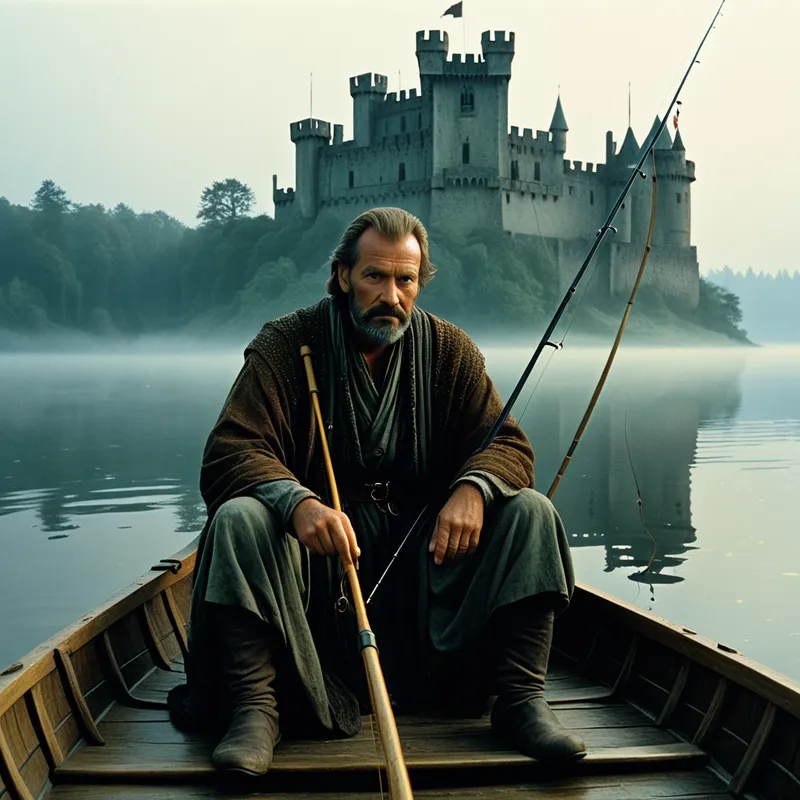
He was once a mighty guardian, a keeper of profound mysteries. But a grievous wound, struck in a forgotten battle, festered in his thigh. It would not kill him, yet it would not heal. It bound him to a twilight existence. His only solace, his only action, was to take his boat upon the murky waters of the lake surrounding his castle and fish with silent, infinite patience. He was a king reduced to a fisherman, a ruler of stagnation.
Into this blighted realm came a knight. Not the greatest of the [Round Table](/myths/round-table “Myth from Arthurian culture.”/), but one driven by a whispered quest: to find a sacred Ring, said to be worn by this very Fisher King. Some tales say it was a wedding band, a symbol of a lost union. Others whisper it was the seal of his office, its power muted. The knight journeyed through leafless forests and across brackish streams, guided by a deepening sense of dread and destiny.
He found the king upon the [water](/myths/water “Myth from Chinese culture.”/), a spectral figure in [the mist](/myths/the-mist “Myth from Celtic culture.”/). Without a word, [the Fisher King](/myths/the-fisher-king “Myth from Arthurian culture.”/) beckoned. The knight followed him into the castle, a place of profound silence. In the great hall, a feast was laid—rich meats, shining fruits, wine in golden cups. Yet the king did not eat, and a profound lassitude filled the air. The knight, weary and bound by courtly habit, also remained silent. He saw a solemn procession: a youth carrying a white lance from whose tip a single drop of blood fell, then a maiden bearing a shining [Grail](/myths/grail “Myth from Christian culture.”/), and finally another with a silver platter.
The Ring was there, upon the Fisher King’s hand, plain and heavy. The entire castle held its breath. The question hung in the air, thicker than the incense. “Whom does [the Grail](/myths/the-grail “Myth from Arthurian culture.”/) serve?” or “What ails you, lord?” or even “What is the meaning of this Ring?” But the knight, overcome by the solemnity or trapped in the prison of his own mind, asked nothing. He slept, and upon waking, the castle was empty. The hall was barren, the king gone. He stood alone on the desolate shore, the Wasteland stretching before him, the quest unfulfilled. The moment of healing had passed, sealed by a silence more devastating than any storm.
Cultural Origins & Context
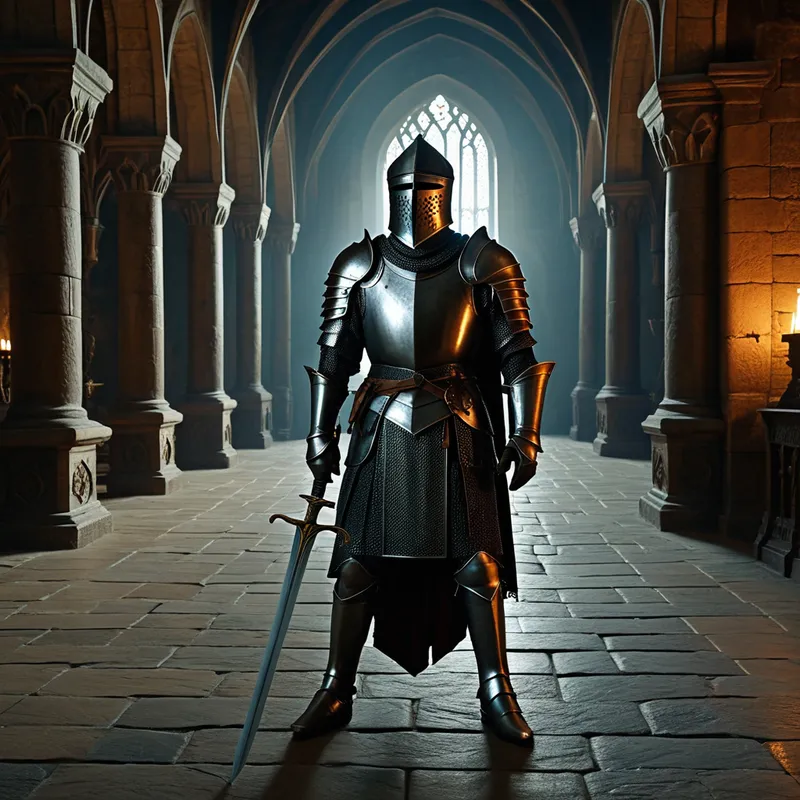
The figure of the Fisher King is woven into the later, more mystical strands of the Arthurian cycle, most profoundly in the unfinished Conte del Graal by Chrétien de Troyes and its subsequent continuations. The motif of the Ring, while less prominent than the Grail or Lance, appears in variants and later interpretations, often as a secondary symbol of the king’s identity, his broken sovereignty, or his lost generative power.
These stories were not mere entertainment in the courts of the 12th and 13th centuries. They were the psychological and spiritual literature of their time, transmitted by poets and conteurs who acted as mediators between the earthly and the mythic. The function of the Fisher King’s tale was to present a cosmic problem: the connection between the ruler’s vitality and the land’s fertility, a concept known as the king and the land are one. His wound and the resulting Wasteland served as a powerful metaphor for a society, or a soul, in a state of spiritual sterility, awaiting a catalyzing consciousness to restore the flow of life.
Symbolic Architecture
The myth is a masterful [blueprint](/symbols/blueprint “Symbol: A blueprint represents the foundational plan or design for something, often symbolizing potential, structure, and the mapping of one’s inner self or future.”/) of a psychic impasse. The Fisher [King](/symbols/king “Symbol: A symbol of ultimate authority, leadership, and societal order, often representing the dreamer’s inner power or external control figures.”/) is not a [villain](/symbols/villain “Symbol: A character representing opposition, moral corruption, or suppressed aspects of self, often embodying fears, conflicts, or societal threats.”/), but the embodiment of a complex—a wounded ruling principle of the [psyche](/myths/psyche “Myth from Greek culture.”/). His thigh wound is symbolic castration, a blow to his vital, generative, and instinctual power. He is [the ego](/myths/the-ego “Myth from Jungian culture.”/) that has been struck by a [trauma](/symbols/trauma “Symbol: A deeply distressing or disturbing experience that overwhelms the psyche, often manifesting in dreams as unresolved emotional wounds or psychological injury.”/) (the “dolorous blow”) and has retreated into a passive, ruminative state.
The Wasteland is the interior reality of a life lived from an unhealed wound. All energy turns inward to nurse the hurt, leaving the outer world barren.
The castle, surrounded by [water](/symbols/water “Symbol: Water symbolizes the subconscious mind, emotions, and the flow of life, representing both cleansing and creation.”/), is the isolated, self-contained psyche. The feast that cannot be eaten represents the [abundance](/symbols/abundance “Symbol: A state of plentifulness or overflowing resources, often representing fulfillment, prosperity, or spiritual richness beyond material needs.”/) of [life](/symbols/life “Symbol: The symbol of ‘Life’ represents a journey of growth, interconnectedness, and existential meaning, encompassing both the joys and challenges that define human experience.”/) and [spirit](/symbols/spirit “Symbol: Spirit symbolizes the essence of life, vitality, and the spiritual journey of the individual.”/) that is present but unavailable to the wounded [consciousness](/symbols/consciousness “Symbol: Consciousness represents the state of awareness and perception, encompassing thoughts, feelings, and experiences.”/). The silent [knight](/symbols/knight “Symbol: The knight symbolizes honor, chivalry, and the pursuit of noble causes, reflecting the ideal of the noble warrior.”/) represents the nascent, questing [aspect](/symbols/aspect “Symbol: A distinct feature, quality, or perspective of something, often representing a partial view of a larger whole.”/) of [the self](/myths/the-self “Myth from Jungian culture.”/) that arrives at [the threshold](/myths/the-threshold “Myth from Folklore culture.”/) of transformation but fails the crucial test. His failure is not one of courage, but of [perception](/symbols/perception “Symbol: The process of becoming aware of something through the senses. In dreams, it often represents how one interprets reality or internal states.”/) and [relationship](/symbols/relationship “Symbol: A representation of connections we have with others in our lives, often reflecting our emotional state.”/). He sees the symbols—the Grail, the [Lance](/symbols/lance “Symbol: A long thrusting weapon symbolizing focused energy, penetration, direction, and masculine power. It represents both aggression and protection.”/), the Ring—but does not engage with their meaning for the other. He is trapped in a spectator consciousness.
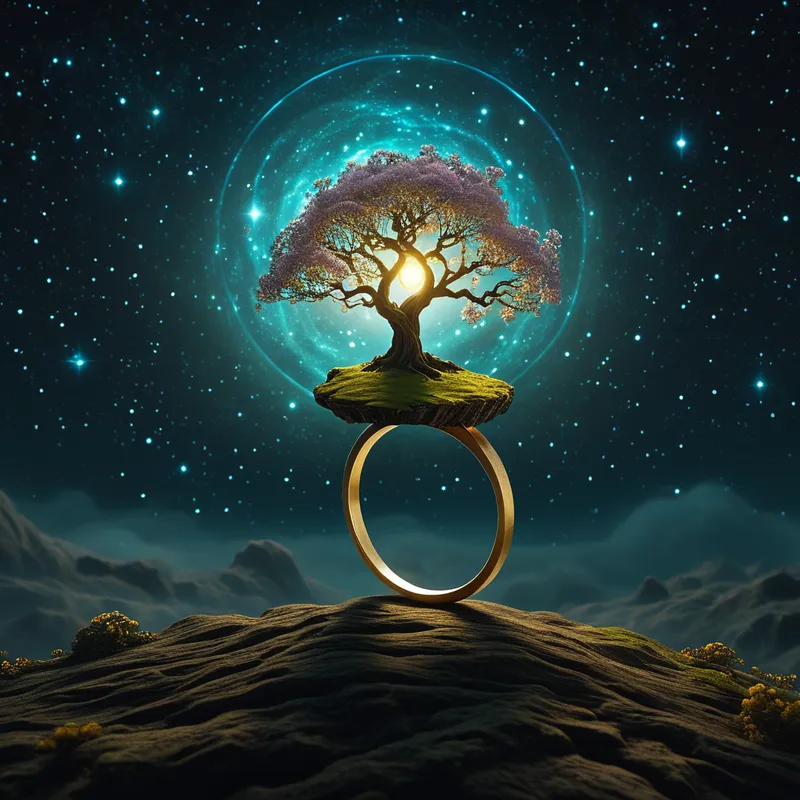
The Ring itself is a profound [symbol](/symbols/symbol “Symbol: A symbol can represent an idea, concept, or belief, serving as a powerful tool for communication and understanding.”/). As a circle, it represents wholeness, sovereignty, and [connection](/symbols/connection “Symbol: Connection symbolizes relationships, communication, and bonds among individuals.”/). On the Fisher King’s hand, it is a broken circle, a contract or a union that is intact in form but void in function. It signifies his trapped state; he holds the [symbol](/symbols/symbol “Symbol: A symbol can represent an idea, concept, or belief, serving as a powerful tool for communication and understanding.”/) of completion but cannot enact it.
The Dreamer’s Resonance
When this myth stirs in the modern unconscious, it often manifests in dreams of profound frustration and missed connection. The dreamer may find themselves in a decaying, beautiful house (the castle) where a faucet drips incessantly (the wound) or where a sumptuous meal turns to dust when they try to eat it (the sterile feast). They may encounter a silent, authoritative, or sorrowful figure (the King) who seems to expect something from them, filling the dream with agonizing social anxiety.
Somatically, this can correlate with a feeling of “stuckness,” chronic fatigue, or ailments that resist diagnosis—a literal embodiment of the Wasteland. Psychologically, the dreamer is at the nexus of their own wounding pattern. The dream is presenting the interior castle and its wounded ruler. The critical moment—the failure to ask the question—replays the ego’s habitual avoidance of directly engaging with the core pain, preferring instead to observe the symptoms (the procession of symbols) with a detached, analytical, or paralyzed gaze.

Alchemical Translation
The alchemical process modeled here is the [solve et coagula](/myths/solve-et-coagula “Myth from Alchemical culture.”/)—the dissolution of the old, rigid state and the coagulation of the new. The knight’s failed visit is the necessary first stage: the confrontation with the [prima materia](/myths/prima-materia “Myth from Alchemical culture.”/), the leaden, stagnant state of the soul (the Wasteland). Failure is essential, for it creates the conscious suffering and the burning question that fuels the true quest.
The healing does not come from finding a magical object, but from formulating the magical question—the question that bridges the isolate self and the wounded other within.
The true “alchemical translation” occurs when the psyche, after its initial failure, must return. This is the process of individuation: to consciously re-enter that hall of mirrors, to sit with [the wounded Fisher King](/myths/the-wounded-fisher-king “Myth from Arthurian culture.”/) within, and this time, to break the silence. To ask, “What wounds you?” is to extend empathy to the disowned part of oneself. To ask, “Whom does the Grail serve?” is to inquire into the purpose of one’s own deepest spiritual energy.
The Ring’s transformation is key. It begins as a symbol of the problem (the binding, sterile contract with the wound). The act of asking the liberating question is the act of taking the ring—not by force, but through understanding. In that moment, the ring is remade. It becomes the rotundum, the alchemical circle of wholeness, signifying the healed connection between the king (the ruling principle) and the land (the lived life). The waters flow, the feast nourishes, and the Wasteland flowers, because the psychic energy bound in maintaining the wound is finally released back into [the world](/myths/the-world “Myth from Tarot culture.”/). The knight and the king are revealed as two aspects of a single, now-integrated self.
Associated Symbols
Explore related symbols from the CaleaDream lexicon: