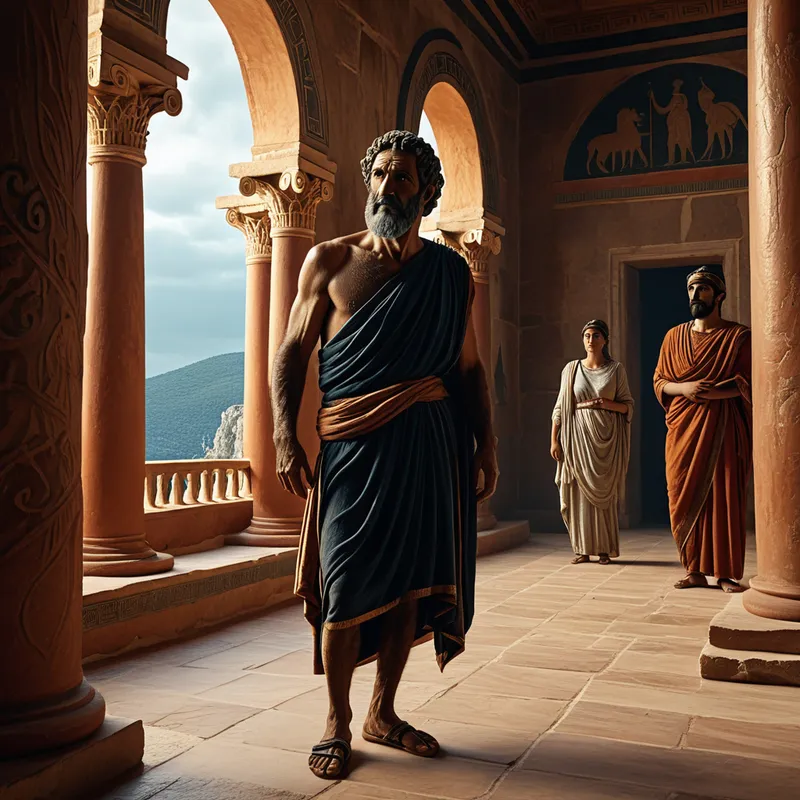
The Return of Odysseus in Home Myth Meaning & Symbolism
A warrior, lost for twenty years, returns to a home that has forgotten him, forced to prove his identity and reclaim his throne through cunning and memory.
The Tale of The Return of Odysseus in Home
Hear now the final labor of the man of many turnings, the one who sailed the wine-dark sea and stared into [the abyss](/myths/the-abyss “Myth from Kabbalistic culture.”/). For twenty years, the halls of Ithaca have been hollow, echoing with the ghost of a king. [Odysseus](/myths/odysseus “Myth from Greek culture.”/), breaker of cities, is a name sung by bards and a memory fading like paint on a tomb. He is a rumor, a sigh in [the wind](/myths/the-wind “Myth from Various culture.”/) that stirs the olive trees on the rocky shore.
He arrives not on a proud ship with a cheering crew, but alone, cast upon his own beach by the mercy of the Phaeacians, asleep on a bed of leaves. The goddess Athena, his steadfast ally, cloaks him in the form of a wretched, aged beggar. His skin is leather, his eyes hold the deep salt of countless shores, and his hands, which once strung the great bow, now tremble as they clutch a staff. He walks the familiar, stony paths as a stranger. He sees his own palace from a hill, but the sound that drifts down is not of orderly rule, but of raucous feasting—the sound of the suitors, who devour his wealth and court his wife, [Penelope](/myths/penelope “Myth from Greek culture.”/), as if he were dust.
The conflict is not with monsters now, but with forgetting. His own son, [Telemachus](/myths/telemachus “Myth from Global/Universal culture.”/), grown to manhood in his absence, does not know him. His dog, Argos, lying on a dung heap, lifts its head at the scent of its master, wags its tail once, and dies. The home itself has become a foreign land, its hearth occupied by hostile, laughing shadows.
The rising action is a slow, painful weaving of proof. In the swineherd Eumaeus’s hut, he tells tales of the lost king, watching for a spark in Telemachus’s eyes. He enters his own palace as a supplicant, is mocked, and has a footbath poured by his old nurse, Eurycleia. Her hands, washing the travel-worn feet of the beggar, find the scar—the old wound from the boar’s tusk on Parnassus. Her breath catches; her eyes meet his in the dim light. A silent pact is sealed. The past, in the form of a ridged mark on the skin, pierces the present.
The resolution is an act of supreme, violent recognition. Penelope, in her despair, sets the contest of the bow. The suitors, bloated and arrogant, cannot even string the weapon of the true king. The beggar asks to try. Laughter dies as his hands, remembering their strength, bend the bow with ease. The twang of the string is the sound of a world snapping back into place. He stands revealed. Then comes the storm of arrows, the cleansing of the hall, a terrible and necessary violence to reclaim what was defiled. Finally, in the quiet aftermath, he must prove himself to Penelope one last time. He describes the secret of their marriage bed, built around the living olive tree, immovable. The final wall of her doubt crumbles. The exile is home. [The stranger](/myths/the-stranger “Myth from Biblical culture.”/) is the king. The circle is closed.
Cultural Origins & Context
This tale is the climax of the Odyssey, a foundational epic of ancient Greek culture, composed orally in the 8th century BCE and attributed to the poet [Homer](/myths/homer “Myth from Greek culture.”/). It was not mere entertainment but a cultural compass, performed at festivals by traveling bards known as rhapsodes. Its societal function was multifaceted: it reinforced the sacred Greek values of [xenia](/myths/xenia “Myth from Greek culture.”/) (guest-friendship, brutally violated by the suitors), cunning intelligence ([metis](/myths/metis “Myth from Greek culture.”/)), and the paramount importance of the oikos (the household, the fundamental unit of society). The story of the Return served as a mythic template for the veteran’s reintegration, the re-establishment of rightful order after chaos, and the profound psychological truth that the longest journey is often the one that leads back to a self and a place that have changed in your absence.
Symbolic Architecture
The myth is a masterful map of the [psyche](/myths/psyche “Myth from Greek culture.”/)’s [journey](/symbols/journey “Symbol: A journey in dreams typically signifies adventure, growth, or a significant life transition.”/) toward [integration](/symbols/integration “Symbol: The process of unifying disparate parts of the self or experience into a cohesive whole, often representing psychological wholeness or resolution of internal conflict.”/). Odysseus is not just a man returning to a physical [island](/symbols/island “Symbol: An island represents isolation, self-reflection, and the need for separation from the external world.”/); he is the conscious ego, the “I,” returning to the seat of [the Self](/myths/the-self “Myth from Jungian culture.”/) after a long sojourn in the unconscious ([the sea](/myths/the-sea “Myth from Greek culture.”/), the monsters, the goddesses). Home—Ithaca—symbolizes the Self, the core of one’s authentic [identity](/symbols/identity “Symbol: Identity represents the sense of self, encompassing personal beliefs, cultural background, and social roles.”/) and rightful place in [the world](/myths/the-world “Myth from Tarot culture.”/).
The most perilous strait is not between Scylla and Charybdis, but between who you were and who you must become to be recognized.
The [beggar](/symbols/beggar “Symbol: A symbol representing vulnerability, need, and social inequality, often reflecting the dreamer’s feelings of lack, dependence, or neglected aspects of self.”/)’s disguise is crucial. It represents the necessary humility and [dissolution](/symbols/dissolution “Symbol: The process of breaking down, dispersing, or losing form, often representing transformation, release, or the end of a state of being.”/) of the heroic [persona](/symbols/persona “Symbol: The social mask or outward identity one presents to the world, often concealing the true self.”/). To reclaim his [throne](/symbols/throne “Symbol: A seat of authority, power, and sovereignty, representing leadership, divine right, or social hierarchy.”/), the [king](/symbols/king “Symbol: A symbol of ultimate authority, leadership, and societal order, often representing the dreamer’s inner power or external control figures.”/) must first become a nobody, must see his [life](/symbols/life “Symbol: The symbol of ‘Life’ represents a journey of growth, interconnectedness, and existential meaning, encompassing both the joys and challenges that define human experience.”/) from the [perspective](/symbols/perspective “Symbol: Perspective in dreams reflects one’s viewpoints, attitudes, and how one interprets experiences.”/) of the lowest. The suitors are the psychic parasites—the unresolved complexes, the inflated egos, and the societal pressures that consume our [energy](/symbols/energy “Symbol: Energy symbolizes vitality, motivation, and the drive that fuels actions and ambitions.”/) and occupy the sacred inner [space](/symbols/space “Symbol: Dreaming of ‘Space’ often symbolizes the vastness of potential, personal freedom, or feelings of isolation and exploration in one’s life.”/) when the ruling principle (the [king](/symbols/king “Symbol: A symbol of ultimate authority, leadership, and societal order, often representing the dreamer’s inner power or external control figures.”/)) is absent. The bow is the [symbol](/symbols/symbol “Symbol: A symbol can represent an idea, concept, or belief, serving as a powerful tool for communication and understanding.”/) of unique, innate skill and rightful sovereignty; only the true Self can “string” the full potential of one’s [life](/symbols/life “Symbol: The symbol of ‘Life’ represents a journey of growth, interconnectedness, and existential meaning, encompassing both the joys and challenges that define human experience.”/). Penelope represents the [anima](/symbols/anima “Symbol: The feminine archetype within the male unconscious, representing soul, creativity, and connection to the inner world.”/), the [soul](/symbols/soul “Symbol: The soul represents the essence of a person, encompassing their spirit, identity, and connection to the universe.”/)-[connection](/symbols/connection “Symbol: Connection symbolizes relationships, communication, and bonds among individuals.”/), who holds the [space](/symbols/space “Symbol: Dreaming of ‘Space’ often symbolizes the vastness of potential, personal freedom, or feelings of isolation and exploration in one’s life.”/) for the true Self through faithful discernment, refusing to be wed to any false claimant.
The Dreamer’s Resonance
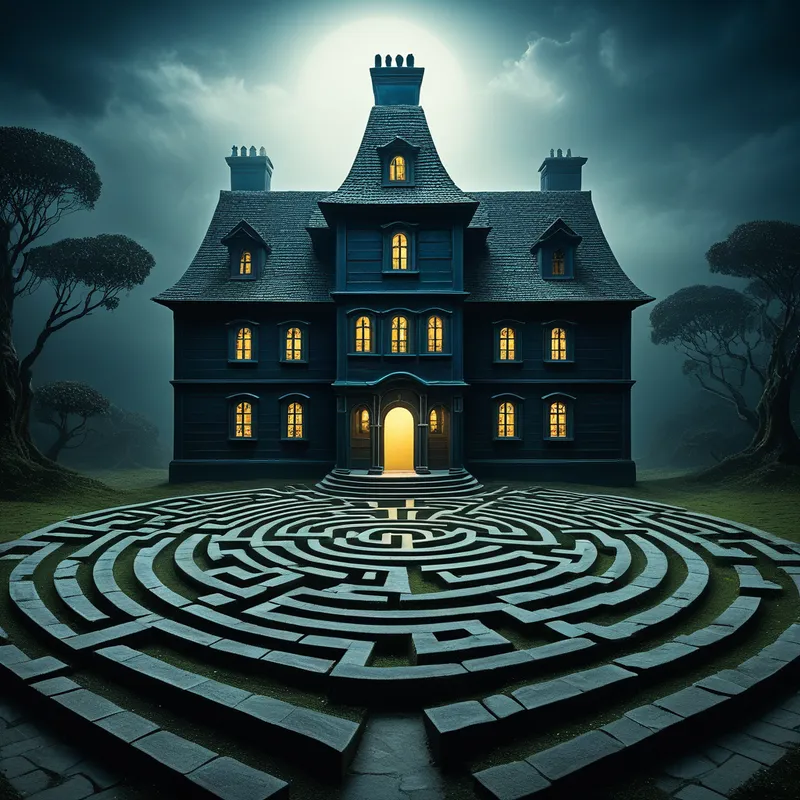
When this myth stirs in modern dreams, it often manifests as dreams of returning to a childhood home that is now unfamiliar, hostile, or occupied by strangers. The dreamer may wander through rooms that have shifted layout, or face familiar people who do not recognize them. This is the psyche working through a process of re-identification. Somatically, it can feel like anxiety, a tightness in the chest, or a profound sense of alienation. Psychologically, it indicates a phase where one’s old identity (the pre-journey self) no longer fits, but the new, integrated self has not yet been fully acknowledged by the internal “court” or the external world. The dream is the psyche’s workshop for rehearsing the act of proving, through subtle signs and deep memory, who you truly are now.
Alchemical Translation
The alchemical process modeled here is the opus contra naturam—the work against nature, which in psychological terms is the work against the passive drift of disintegration. The long exile is the [nigredo](/myths/nigredo “Myth from Alchemical culture.”/), the blackening, the dissolution and suffering that strips away all outer attachments. The beggar’s disguise is the albedo, the whitening, the purification through humility and the assumption of a lesser form.
The throne can only be reclaimed by the one who has willingly sat in the ashes.
The stringing of the bow is the citrinitas, the yellowing, the moment where inner authority is tested and proven in a decisive, transformative act. The final recognition by Penelope—the sharing of the secret of the immovable bed—is the [rubedo](/myths/rubedo “Myth from Alchemical culture.”/), the reddening, [the sacred marriage](/myths/the-sacred-marriage “Myth from Various culture.”/) (hieros gamos) of the conscious ego with the soul, resulting in the creation of the philosophical gold: the integrated personality. For the modern individual, this translates to the arduous process of individuation. It is the journey back to one’s core values and authentic life after being shaped, battered, and disguised by life’s trials. It demands that we lay down our trophies and titles (the hero’s cloak), enter our own inner space in humility, confront the parasitic forces that waste our spirit, and, through a definitive act of truth-telling to our deepest self, reclaim our rightful sovereignty. Home is not a place you find, but a truth you remember and courageously enact.
Associated Symbols
Explore related symbols from the CaleaDream lexicon: