The Remnant Myth Meaning & Symbolism
A sacred few survive divine judgment, carrying the covenant's seed through desolation to become the nucleus of a world reborn from ash.
The Tale of The Remnant
Hear now a tale not of beginnings, but of endings that are not ends. It is a story written not in ink, but in the ash of empires and the salt of tears.
The air grew thick with the scent of burnt offerings turned sour. In the great cities, the wheels of commerce turned, grinding the poor to dust. The temples stood, their altars gleaming, but the prayers were empty shells, rattling like dry bones in a tomb. The covenant—that sacred bond of heart and law—lay shattered, a mirror broken by a thousand small betrayals. The voice of the prophets became a cry in the wilderness, a warning carried on a wind that no one would feel until it became a gale.
Then came the hammer. It fell not from a single hand, but from the turning of the world itself, an instrument of a patient, wounded love that had become a consuming fire. The armies, polished and pitiless, swept in like a flood of iron. The sky itself seemed to weep fire. The great walls, which had laughed at lesser foes, crumbled like stale bread. The magnificent gates were splinters. The streets, once rivers of life, ran with a different torrent. It was the Day of the Yahweh, a day of darkness and not light.
All was carried away—the skilled hands, the learned minds, the proud kings—into the bitter exile. The land was left to gasp, a body without a soul. The holy mountain was silent. It seemed that the story was over, that the song of a people had reached its final, dissonant chord.
But in the silence after the thunder, a different sound emerged. Not a trumpet, but a whisper. Not a multitude, but a breath.
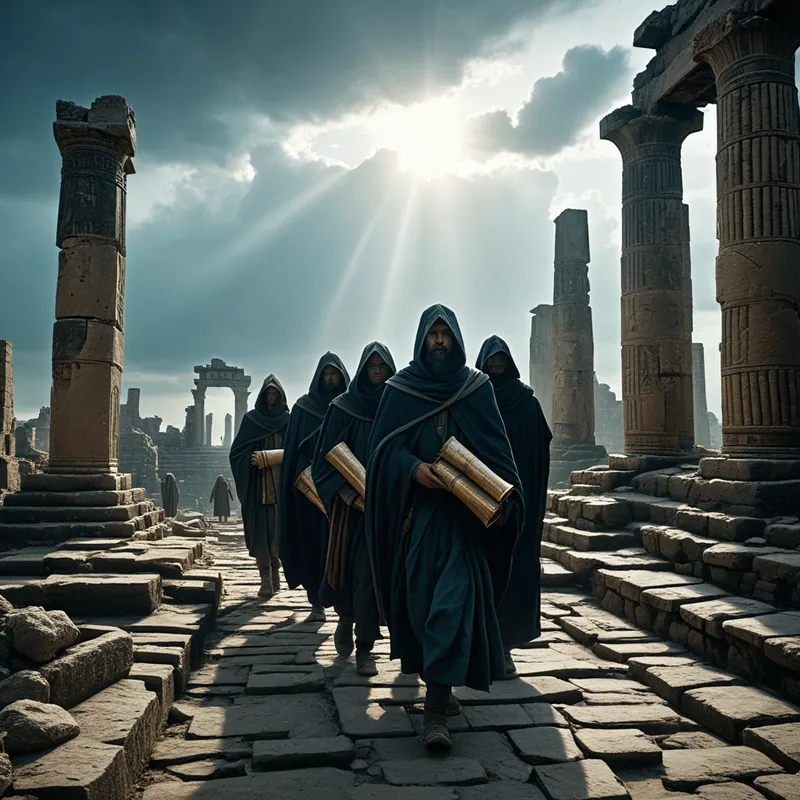
Look. There, amidst the scorched earth and the haunting silence. A family, clinging together. A few faithful, who had hidden the words of the covenant not in scrolls alone, but in the chambers of their hearts. They were not the mighty, nor the flawless. They were the scarred, the grieving, the ones who had wept for the broken city. They were the Remnant.
They were the seed buried in the winter soil of history. They carried with them no treasure but memory and promise. Through the desolation, they moved, a fragile vessel carrying a single, undying flame. They were the answer to the question the ruins screamed: Is there anything left? They were the “yes.” A yes so small it could be crushed by a boot, yet so potent it contained the blueprint of a new heaven and a new earth. They were the bridge between the world that died and the world waiting to be born.
Cultural Origins & Context
The myth of the Remnant is not a single story but a profound, recurring pattern woven through the prophetic literature of the Hebrew Bible. It emerges most powerfully in the context of the Assyrian and Babylonian exiles (8th-6th centuries BCE), periods of national catastrophe that threatened the total annihilation of identity, faith, and culture.
This narrative was forged by the prophets—figures like Isaiah, Jeremiah, and Ezekiel. They were not mere predictors of doom but diagnosticians of the soul of a nation. Their function was societal and psychological: to make meaning of unimaginable trauma. The Remnant myth served as a crucial survival mechanism. It transformed a story of total punishment into a story of purposeful purification. It asserted that the covenant with the divine was not annulled but refined; the people were not erased but distilled.
This idea was passed down as both warning and comfort. It warned the powerful that collective identity is not guaranteed by institutions alone but by faithful living. It comforted the devastated that even in total collapse, a nucleus of meaning and continuity is preserved by the divine hand, often through the most unexpected and humble of vessels. It is a myth of radical hope born in the furnace of despair.
Symbolic Architecture
Psychologically, the Remnant represents the indestructible core of the Self, the Self-archetype, that survives the ego’s catastrophes. The prosperous city symbolizes the inflated, complex, and often corrupt structure of the conscious personality—the ego in its identification with power, tradition, and external validation. Its destruction is the necessary, brutal process of nigredo, the dark night of the soul.
The Remnant is not the part of us that avoided the fall, but the part of us that was forged within it.
The exile represents the state of alienation, depression, and meaninglessness that follows such a collapse. The Remnant, then, is not the “good” parts we saved, but the essential, often unrecognized truth of who we are that is revealed by the fire. It is the handful of irreducible values, the core wound that contains our destiny, the silent, stubborn love that refuses to extinguish. It symbolizes the psyche’s innate, non-negotiable movement toward wholeness, even when that wholeness must be rebuilt from a single fragment.

The Dreamer’s Resonance
When this myth stirs in the modern dreamer, it often manifests in periods of profound personal dissolution: the end of a career, the collapse of a long-held identity, the ashes of a relationship, or a deep existential crisis. The somatic experience is one of hollowing out, of being a ghost in one’s own life.
Dreams may present images of being part of a small group fleeing a destroyed city; of finding a single, precious object intact in a burned-out house; of tending a tiny, vulnerable flame in a vast darkness; or of being a lone seed buried under winter snow. These are not nightmares of pursuit, but dreams of stark, eerie preservation. The emotional tone is not typically terror, but a profound, sobering grief intertwined with a strange, quiet determination.
The psychological process is the unconscious initiating a necessary reduction. The psyche is burning away the non-essential—the outdated roles, the borrowed beliefs, the performative aspects of the personality—to locate the irreducible, authentic core. The dreamer is experiencing the first, raw emergence of the Remnant within themselves.

Alchemical Translation
The journey of the Remnant is a perfect map for the alchemical process of individuation. It begins with Nigredo: the judgment and fall, the experience of utter ruin where all former structures of meaning and identity are destroyed. This is not a mistake, but the first, crucial operation.
The remnant—the small, surviving group—embodies Albedo. This is the phase of washing, of separating the pure from the impure. The remnant is distilled essence. They wander (the psychological state of liminality and reflection), carrying the sacred texts (the core, guiding principles of the Self). They do not yet rebuild; they simply carry.
To become the Remnant is to consent to be the bridge between what has died and what must be born, with no guarantee of seeing the other side.
Finally, their return and renewal signify Rubedo. The seed sprouts. The preserved essence is planted back into the world, not to recreate the old kingdom, but to found a new one built on the wisdom of the ruin. For the modern individual, this translates to the rebirth of the personality. After the crisis, one does not simply “recover.” One is reconstituted from a deeper, truer foundation. The new life is not a return to normal, but a life lived from the Remnant core—more vulnerable, more intentional, and paradoxically, more resilient and authentic than the sprawling, fragile city that once stood. The myth teaches that our deepest transformations are not renovations, but resurrections.
Associated Symbols
Explore related symbols from the CaleaDream lexicon: