The Red Lion Myth Meaning & Symbolism
A myth of the raw, solar force that must be tamed and united with its celestial counterpart to birth the philosopher's stone.
The Tale of The Red Lion
In the beginning, before the stone, there was only the raw and roaring heart of the world. It slept in the deepest veins of the earth, a restless, molten dream. The sages called this sleeping force the Prima Materia—the mother of all things, and the tomb of all potential.
From this dark womb, a heat began to stir. It was not the gentle warmth of the sun, but the fierce, inward fire of a forge, of fermentation, of a fever. This heat gathered substance, drawing the sulphurous breath of the earth and the metallic blood of the mountains. It coalesced, pulsed, and then, with a soundless roar that shook the foundations of the laboratory, it awoke.
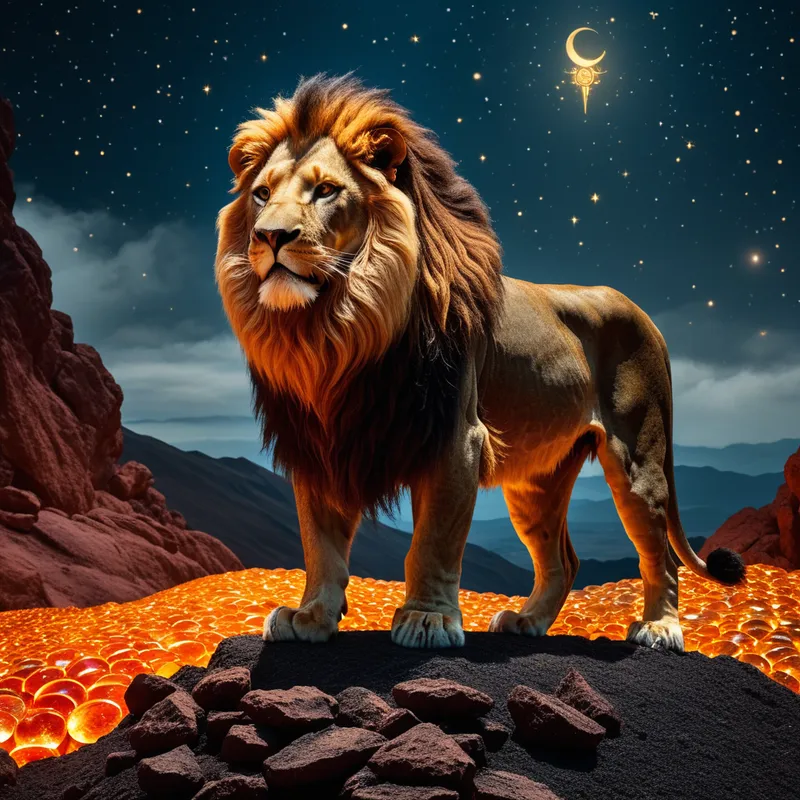
It was the Red Lion. It manifested not as a beast of flesh, but as a principle of pure, unbridled force. Its body was the color of freshly spilled arterial blood and burning copper. Its mane was a corona of dancing, hungry flames. Its eyes were twin suns seen through a haze of passion. It embodied the fixed, volatile spirit—the relentless, masculine energy of Sulphur. It was desire, aggression, the will to act, the ego in its most potent and dangerous form.
The Red Lion raged through the inner landscape. It sought dominion, to burn away all that was not itself. It devoured lesser metals, turning them to slag with its breath. It was power, but power without direction; fire, but fire without a vessel. It was the king without a kingdom, the warrior without a cause, a god trapped in its own radiance.
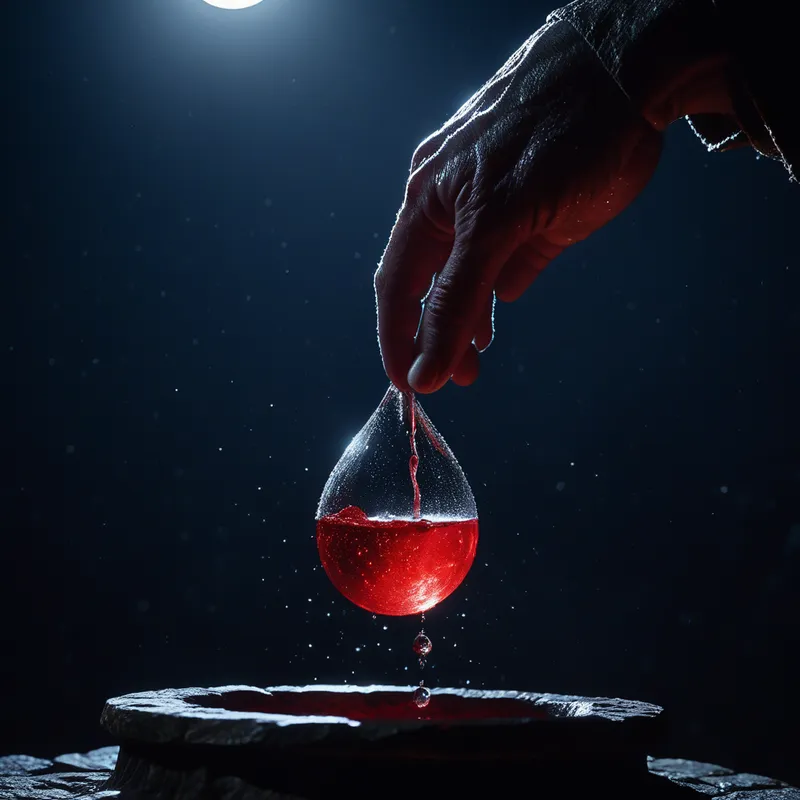
Yet, in its solitary, blazing fury, the Lion grew weary. Its fire, fed only by itself, began to consume its own heart. In the deepest hour of its cyclic despair, when its flames guttered low, a change occurred in the heavens above the alchemist's vessel. A cool, silver light descended. It was the light of the moon, but distilled into a liquid essence—the White Eagle.
The White Eagle was the antithesis and the complement. Where the Lion was hot, it was cool. Where the Lion was fixed and raging, the Eagle was volatile and serene. It was the feminine principle of Mercury, the spirit that dissolves and unites. It did not fight the Lion; it descended upon it like a blessing of dew.
The meeting was a cataclysm of opposites. A hissing scream filled the cosmos of the flask as fire met quicksilver, passion met reflection, sun met moon. The Lion roared and lashed out, but the Eagle simply flowed around its fury, embracing it. This was the Coniunctio, the chymical wedding. It was not a gentle union, but a violent, ecstatic dissolution. The red and the white swirled in a chaotic, luminous dance, each consuming and being consumed by the other.
From this terrible and beautiful struggle, a silence eventually fell. The roaring ceased. The swirling settled. In the center of the vessel, where the two principles had utterly annihilated their separate natures, a new substance was born. It was neither red nor white, but held the memory of both. It was a deep, resonant gold, and it pulsed with a quiet, inner light. The Red Lion was gone, and in its place, having integrated its fierce heart, was the Philosopher's Stone.
Cultural Origins & Context
The myth of the Red Lion is not a narrative from a single culture, but a core operative metaphor from the European Hermetic Alchemical tradition, spanning from the late medieval period through the Renaissance. It was never a "story" told to the public, but a coded instruction, an allegory passed between initiates in cryptic texts and lavish, symbolic illustrations.
Alchemists like Paracelsus and those who contributed to the seminal Rosarium Philosophorum used this symbolism. The myth was "told" through laboratory practice itself. The alchemist, in heating antimony or iron oxides (which could produce red hues), would witness the violent, "leonine" reactions, and interpret them through this spiritual lens. Its societal function was dual: it was a technical guide for material transmutation (the pursuit of literal gold) and, for the spiritual alchemist, a precise map for inner transformation. It served a clandestine community seeking knowledge outside the sanctioned doctrines of the Church and early Academia.
Symbolic Architecture
Psychologically, the Red Lion represents the raw, untamed libido—not merely sexual energy, but the total life force of the individual in its most concentrated, assertive, and often disruptive form. It is the fire of ambition, the heat of anger, the driving force of the ego, and the passionate will to exist and to conquer.
The Red Lion is the solar self, brilliant and alone, destined to burn out in its own radiance if it cannot find its reflecting pool.
The White Eagle symbolizes the complementary force: the cool, reflective power of the mind, the fluidity of emotion, the capacity for self-awareness, intuition, and dissolution of rigid structures. It is the consciousness that can observe the passion without being consumed by it.
Their conflict and marriage symbolize the central drama of individuation: the integration of the conscious and the unconscious, the ego and the shadow, the masculine and feminine principles within a single psyche. The Lion is often linked to the Animus in its raw state, or the unintegrated masculine principle in a man. The violent struggle is necessary; the ego (the Lion) must experience the threat of dissolution by the unconscious (the Eagle) to be reborn into a higher synthesis.

The Dreamer's Resonance
When this myth stirs in the modern dreamscape, it often manifests as dreams of confronting a powerful, frightening, yet magnificent animal—a lion, a bull, or a dragon of fiery red hue. The dreamer may feel both terror and awe. Alternatively, one might dream of uncontrollable fires, volcanic eruptions, or feeling consumed by a rage or passion so intense it feels alien.
Somatically, this can correlate with periods of intense stress, creative ferment, or a feeling of being "heated up" or pressurized by life circumstances. Psychologically, it signals that a powerful, instinctual content from the unconscious is demanding recognition. The ego is being challenged by a force greater than itself. The dream is the vessel where this Red Lion energy first appears, often in a threatening form because the conscious mind perceives its integrating counterpart (the cooling, dissolving Eagle) as a threat to its current structure. The process underway is one of primal self-confrontation, where a dominant, one-sided attitude is being forced to encounter its opposite.

Alchemical Translation
For the modern individual, the myth models the process of sublimation: the transmutation of base, instinctual drives into refined, purposeful energy. The first step is recognizing the Lion—acknowledging one's raw passions, ambitions, angers, and desires without immediate judgment or repression. This is the "seeing of the red tincture."
The second, more difficult step is allowing the Coniunctio. This means consciously engaging with the opposing force that can temper it. For the person driven by fiery ambition (the Lion), the Eagle may be the call to reflective solitude, art, or compassion. For the person lost in cool analysis (a latent Eagle), the Lion may be the call to embodied action, passion, and risk. This engagement feels like a death, a loss of the familiar self.
The gold is not the destruction of passion, but passion become conscious and purposeful; it is will aligned with meaning.
The final birth of the "Stone"—the integrated self—is not a static achievement but a state of being. It is characterized by a calm potency. The individual retains the Lion's strength and vitality, but it is now directed, sustainable, and in harmony with the Eagle's wisdom and fluidity. The struggle of red and white resolves into the gold of a personality that has made peace with its own depths, where power serves consciousness, and consciousness gives direction to power. The myth, therefore, is an eternal promise: our most chaotic and dangerous energies hold the secret to our greatest refinement.
Associated Symbols
Explore related symbols from the CaleaDream lexicon: