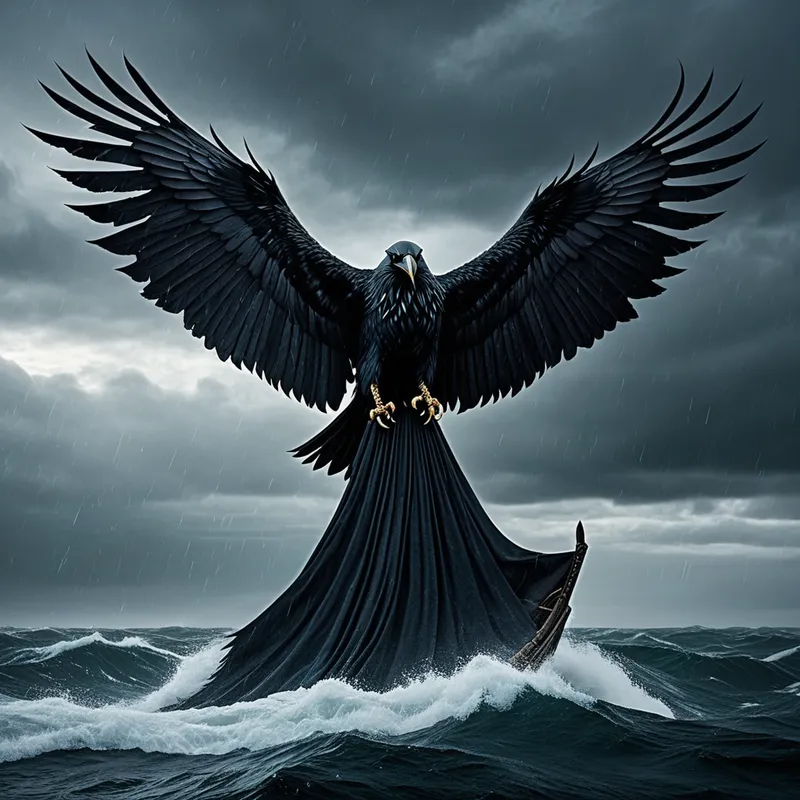
The Raven Banner Myth Meaning & Symbolism
A legendary war banner, woven by seeresses, that promised victory but demanded a king's life, embodying the fatal pact between power and destiny.
The Tale of The Raven Banner
Hear now a tale not of a god, but of a cloth. A story whispered on salt-spray winds, carried from the fjords to the foreign shores where men go to win a name or lose their life. It begins in the dim, smoke-hung halls of the north, where the firelight dances on faces that have seen the edge of the world.
There was a king, a son of the Yngling line, whose hunger was not for meat or mead, but for the unbroken line of victory. He was a storm on the sea, a wolf among sheep, yet a shadow clung to his prow—the shadow of chance, of the unlucky spear-thrust, of the tide that turns. This shadow he sought to master. So he went not to his warriors, but to those who speak with the roots of the world. He sought out the völva, the seeresses whose fingers know the threads of ørlög.
In a grove apart, under a sky bruised with twilight, they worked. No ordinary weavers these. They gathered wool black as a midnight between stars, and thread spun from silver mined under a waning moon. Their chants were not songs, but the low names of the Norns: Urd, Verdandi, Skuld. Into the loom they cast more than thread; they cast the breath of the battlefield, the cry of the raven, the silence of the chosen dead. And from their hands it emerged: The Banner. Upon the field of night-black cloth, a raven was wrought in silver, wings spread as if for flight. But this was no mere bird. Those who looked upon it swore that when the wind caught the cloth, the raven stirred, its eye holding the cold gleam of the hunter.
The völva presented it to the king. “This is the fylgja of your luck,” they intoned, their voices like stone on stone. “Where this banner leads, victory will follow your host like a hound. But know the weave of its making: it is hungry. It must be fed. And its price is the king who bears it. Before the sun sets on the day it flies without triumph, the lord of the host must die.”
The king took the staff, his hands steady. He heard the price, and in his heart, which was the heart of a wolf, he deemed it fair. What is a king’s life, if not the coin for everlasting fame? And so the banner flew. It flew at the prow of his dragon-ship, and the winds favored him. It flew before his shield-wall, and the enemy lines broke like rotten wood. His name became a thunderclap across the lands. The raven feasted well, and the king lived, battle to battle, year to year, riding the crest of the doom he had purchased.
But fate’s weave has no loose ends. The years wore on him, as they wear on stone. A final campaign, a shore at the edge of his world. The banner was raised, its silver raven snapping in a gale. But on that day, the luck had grown thin. The battle was a grinding of bones, a stalemate painted in mud and blood. No clear victory was won as the long northern twilight began to bleed across the sky.
The king stood on a rise, the banner planted beside him. He looked at the dark cloth, at the raven that now seemed still and heavy. He remembered the words of the völva. He saw his thanes, weary but unbroken. He saw the path of his long, victorious life, leading inexorably to this damp field. And he understood the final clause of the pact. Not with despair, but with the grim acceptance of one who has read the last line of his own saga, he turned to face the fray. He did not seek death, but he no longer barred its gate. And before the last light failed, the price was paid. The king fell. The banner was captured, or lost, or consumed by the earth. But its story, like the raven’s cry, echoed long after.
Cultural Origins & Context
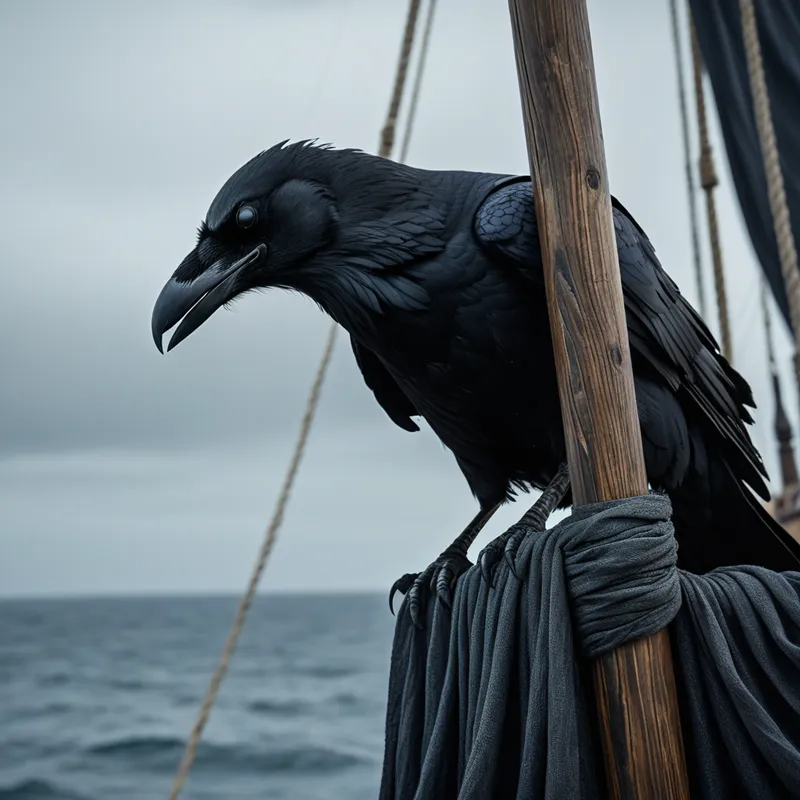
The Raven Banner is not a single artifact from a single saga, but a potent recurring motif woven through the Poetic Edda and later Icelandic sagas. It appears in tales of legendary kings and heroes like Sigurd, and most famously in the histories of Viking Age warlords such as the sons of Ragnar Lodbrok. This repetition signals it was less a specific flag and more a powerful archetype of royal and military power.
Its origins are deeply rooted in the Norse worldview, where the raven was not a bird of ill omen, but the companion of the Allfather, Odin. Odin’s ravens, Huginn and Muninn, flew across the world each day, bringing him knowledge. The raven on the battlefield was thus a symbol of Odin’s presence, a scavenger yes, but also a witness and a chooser of the slain for Valhalla. A banner bearing this image was an invocation of this divine, terrible patronage.
The banner’s creation by völur (seeresses) is critical. It places the source of a king’s temporal power in the hands of those who traffic with the invisible, feminine forces of fate. The banner was a talisman, a physical knot tying a leader’s hamingja (luck) to the cosmic order. Its curse was not a flaw, but an intrinsic feature—a recognition that ultimate power and sovereignty are leased from fate, not owned, and the final installment is always the self.
Symbolic Architecture
At its core, the Raven Banner is an emblem of the fatalistic contract of leadership. It represents the terrifying burden of sovereignty, where the fate of the collective is bound to the life of the individual who dares to stand at the front.
The Banner is the visible form of an invisible pact: to wield true authority, one must pledge one’s very being as collateral.
The raven itself is a complex symbol. It is Odin’s knowledge-bringer, linking the banner to foresight and strategy. It is the battlefield scavenger, representing the harsh reality that power is built upon the consumption of resources—including lives. Most profoundly, it is a psychopomp, a guide of souls, foreshadowing the king’s inevitable journey to the afterlife. The banner does not cause death; it announces it, making the hidden thread of destiny visible to all.
The curse is not a malicious spell, but the expression of a natural law. In a universe governed by ørlög, nothing of such magnitude comes without an equivalent exchange. The king trades his biological life for a symbolic immortality—his name etched in the memory of his people. The banner is the loom on which his public legend and his private doom are woven into a single, inseparable tapestry.
The Dreamer’s Resonance
When the Raven Banner rises in the modern dreamscape, it rarely appears as a historical artifact. It manifests as the dreamer’s personal standard of ambition—a job title, a creative project, a relationship, or a role of immense responsibility that they feel destined to achieve, yet fear will consume them.
The dreamer may find themselves holding a staff from which flies a flag bearing their own personal symbol rendered ominous and demanding. The atmosphere is one of immense pressure and fatalistic grandeur. There is often a crowd, a tribe, or an organization behind them, depending on their success. The somatic feeling is of a heart both swelling with pride and clenched with dread. This is the psyche presenting the “kingly” complex: the part of the self that seeks to lead, to manifest, to claim its territory in the world, while simultaneously confronting the shadow of that desire—the isolation, the burden of expectation, and the potential sacrifice of a simpler, more private life.
The dream asks the terrifying question: “What are you willing to pay for the throne you seek? Are you prepared to give your whole self to this purpose?”
Alchemical Translation
The myth of the Raven Banner models a critical stage in the alchemy of individuation: the Coniunctio of the ruler and the sacrifice. This is not about becoming a literal monarch, but about integrating the inner Ruler archetype in a conscious, mature way.
The first step is the Invocation—the dreamer, feeling a call to greater authority or purpose (the king seeking the banner), must consult their deepest inner knowing (the völva). This is not egoic ambition, but a calling from the Self. The crafting of the banner is the formulation of a personal code, a vision, or a life’s work that is imbued with soul and connected to one’s fate.
The curse is the wisdom: any authentic power we claim in the outer world must be rooted in an acceptance of our mortality and limitations in the inner world.
The flying of the banner is the act of stepping into that role publicly, with all its risks and rewards. The final battle, where victory is unclear, represents the inevitable point where the project, the role, or the leadership demands more than skill or effort—it demands a piece of the ego’s identity. The king’s acceptance of death is the alchemical Mortificatio—the “killing” of the childish fantasy of power without cost. It is the moment the ego relinquishes its claim to absolute sovereignty and acknowledges it serves a larger pattern, the Self.
The true transmutation occurs when the individual realizes that the “king” who must die is the inflated, isolated ego that holds the power, and what is born is the Conscious Ruler: an individual who leads from a place of service to the whole, aware that their authority is a temporary stewardship, and that their ultimate gift is to pour their life—their time, energy, and care—into what they have been called to build. The banner then is no longer a cursed object, but a symbol of a life fully owned, where one’s destiny and one’s sacrifice have been recognized as one and the same.
Associated Symbols
Explore related symbols from the CaleaDream lexicon: