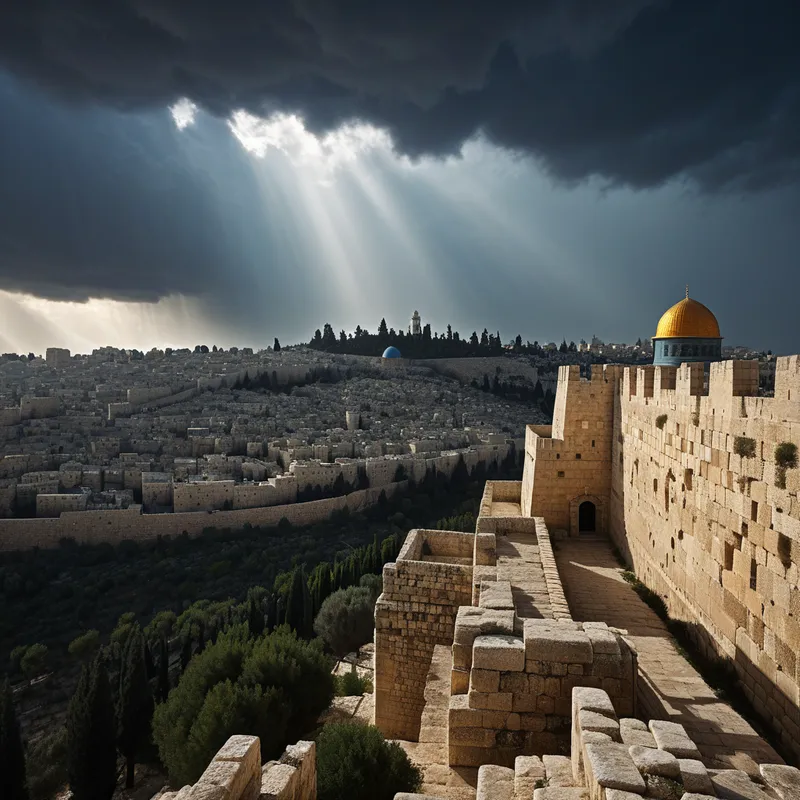
The Ramparts of Jerusalem Myth Meaning & Symbolism
A myth of divine promise and human defiance, where the walls of a city become the sacred boundary between cosmic order and primordial chaos.
The Tale of The Ramparts of Jerusalem
Hear now, and listen with the ears of your spirit. Before time was counted in kings, when [the earth](/myths/the-earth “Myth from Hindu culture.”/) still remembered the taste of chaos, there stood a city upon the hills of Zion. Its stones were not yet warmed by the sun of peace, for it was a city besieged, not by armies of flesh and iron, but by the very Tehom itself—a whispering, formless dread that pressed against the edges of creation.
The people within huddled, their prayers rising like thin smoke. They could feel it in the marrow of their bones: the ancient, slithering darkness that hated the straight line, the defined space, the named [thing](/myths/thing “Myth from Norse culture.”/). It hated the wall.
For the ramparts of [Jerusalem](/myths/jerusalem “Myth from Biblical culture.”/) were no mere pile of rock. They were the utterance of the Divine Name made manifest in limestone and mortar. They were sung into being by prophets and anointed by kings who walked in the terrible, clarifying light of covenant. Each stone was laid with a decree: Here, chaos ends. Here, order begins. Here is a place for My name to dwell.
Yet the wall was not yet complete. A psychic wound, a gap of doubt and forgotten oath, yawned in its circuit. And through this breach, the sigh of [the abyss](/myths/the-abyss “Myth from Kabbalistic culture.”/) entered. It carried the scent of forgotten graves and the chill of absolute isolation. It promised the relief of dissolution, [the sweet poison](/myths/the-sweet-poison “Myth from Alchemical culture.”/) of returning to the formless mass where no self stands alone, accountable.
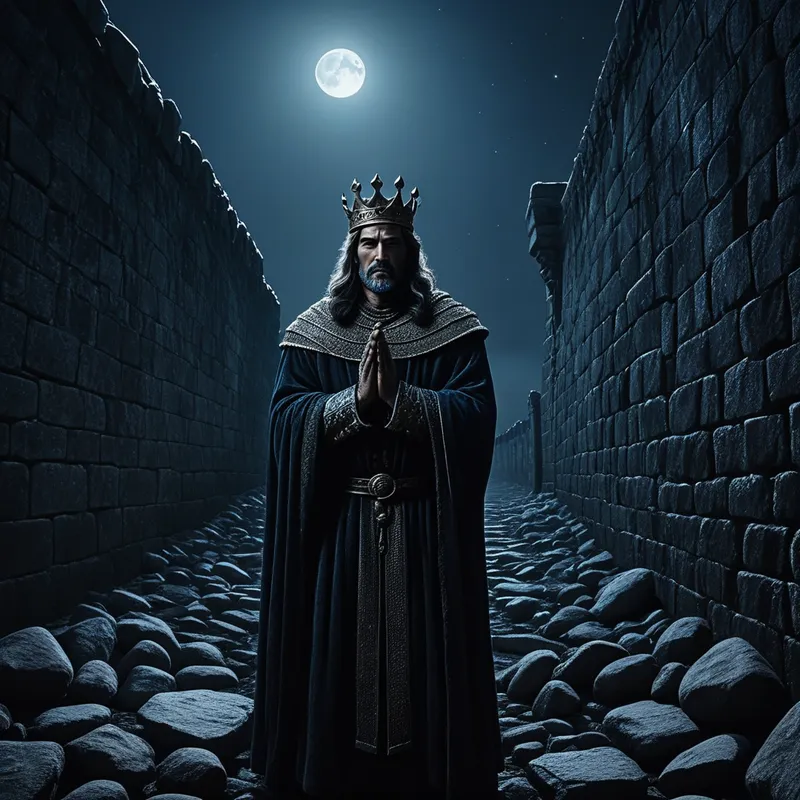
Then came the king in the midnight hour. Not with sword, but with a heart hammered thin on the anvil of despair. He climbed the broken section, [the wind](/myths/the-wind “Myth from Various culture.”/) tearing at his robes. He placed his bare hands upon the cold stone, and he did not pray for deliverance. He commanded. He spoke to the stones as if they were sleeping warriors. He recited the ancient promises, the laws, the stories of deliverance—each word a brick, each memory a layer of mortar. He was not building a wall against men, but against the mythic, the existential night. He was defining a soul against [the void](/myths/the-void “Myth from Buddhist culture.”/).
As he spoke, a sound began—a deep, resonant hum from the earth’s core. The stones themselves began to glow with a soft, mother-of-[pearl](/myths/pearl “Myth from Chinese culture.”/) luminescence. The creeping tendrils of chaos recoiled, hissed, and melted like shadow before a kindled flame. Where the breach had been, the wall stood seamless, whole, and thrumming with a silent, immovable song. The ramparts were sealed. Not just against enemy spears, but against the eternal, gnawing nothing. The city, and the soul it mirrored, had been given a shape, a boundary, a sacred Yes enclosed by a necessary No.
Cultural Origins & Context
This mythic pattern is woven throughout the tapestry of the Hebrew Bible, most vividly in the narratives surrounding David’s conquest of the city and his son [Solomon](/myths/solomon “Myth from Biblical culture.”/)’s consolidation of its walls and temple. It is not a single story but a foundational motif passed down by priests, prophets, and psalmists. Its societal function was paramount: to explain the existential necessity of covenant and law.
In a world perceived as spiritually perilous, where identity was constantly threatened by surrounding cultures and cosmic forces, the physical walls of Jerusalem became the ultimate symbol of theological and social integrity. [The prophets](/myths/the-prophets “Myth from Biblical culture.”/), like Jeremiah and Ezekiel, told and retold this myth. They warned that breached walls were not just military failures but the direct consequence of a breached covenant—moral and spiritual corruption within. The wall’s strength was directly proportional to the people’s collective fidelity to [the law](/myths/the-law “Myth from Biblical culture.”/). It was a story told to bind a people together, to make them understand that their collective ethical life was the true mortar holding their world together.
Symbolic Architecture
The ramparts are far more than a [military](/symbols/military “Symbol: The military symbolizes discipline, authority, and often the need for structure or control in one’s life.”/) feature. They are the symbolic [skin](/symbols/skin “Symbol: Skin symbolizes the boundary between the self and the world, representing identity, protection, and vulnerability.”/) of the [psyche](/myths/psyche “Myth from Greek culture.”/), the individuation made visible. They represent [the principle](/symbols/the-principle “Symbol: A fundamental truth, law, or doctrine that serves as a foundation for a system of belief, behavior, or reasoning, often representing moral or ethical standards.”/) of discrimination—the sacred [ability](/symbols/ability “Symbol: In dreams, ‘ability’ often denotes a recognition of skills or potential that one possesses, whether acknowledged or suppressed.”/) to say “this is me, and that is not me; this is sacred, and that is profane.”
The wall is not a prison, but the definition of the temple. Without a boundary, the holy cannot be contained, and the self dissolves into everything and therefore becomes nothing.
The encircling, formless [chaos](/symbols/chaos “Symbol: In Arts & Music, chaos represents raw creative potential, uncontrolled expression, and the breakdown of order to forge new artistic forms.”/) represents the unintegrated [shadow](/symbols/shadow “Symbol: The ‘shadow’ embodies the unconscious, repressed aspects of the self and often represents fears or hidden emotions.”/) and the pull of the undifferentiated unconscious—the lure of abandoning complex, responsible [consciousness](/symbols/consciousness “Symbol: Consciousness represents the state of awareness and perception, encompassing thoughts, feelings, and experiences.”/) for the blissful ignorance of instinct or collective anonymity. The [king](/symbols/king “Symbol: A symbol of ultimate authority, leadership, and societal order, often representing the dreamer’s inner power or external control figures.”/) or [prophet](/symbols/prophet “Symbol: A messenger or seer who receives divine revelations, often warning of future events or guiding moral direction.”/) who repairs the breach is the nascent ego, or the emerging Self, taking [responsibility](/symbols/responsibility “Symbol: Responsibility in dreams often signifies the weight of duties and the expectations placed upon the dreamer.”/) for the integrity of its own psychic [space](/symbols/space “Symbol: Dreaming of ‘Space’ often symbolizes the vastness of potential, personal freedom, or feelings of isolation and exploration in one’s life.”/). The glowing, resonant stones symbolize activated psychic contents—memories, values, and traumas—that, when consciously integrated and “spoken to,” become sources of [strength](/symbols/strength “Symbol: ‘Strength’ symbolizes resilience, courage, and the ability to overcome challenges.”/) rather than points of [vulnerability](/symbols/vulnerability “Symbol: A state of emotional or physical exposure, often involving risk of harm, that reveals authentic self beneath protective layers.”/).
The Dreamer’s Resonance
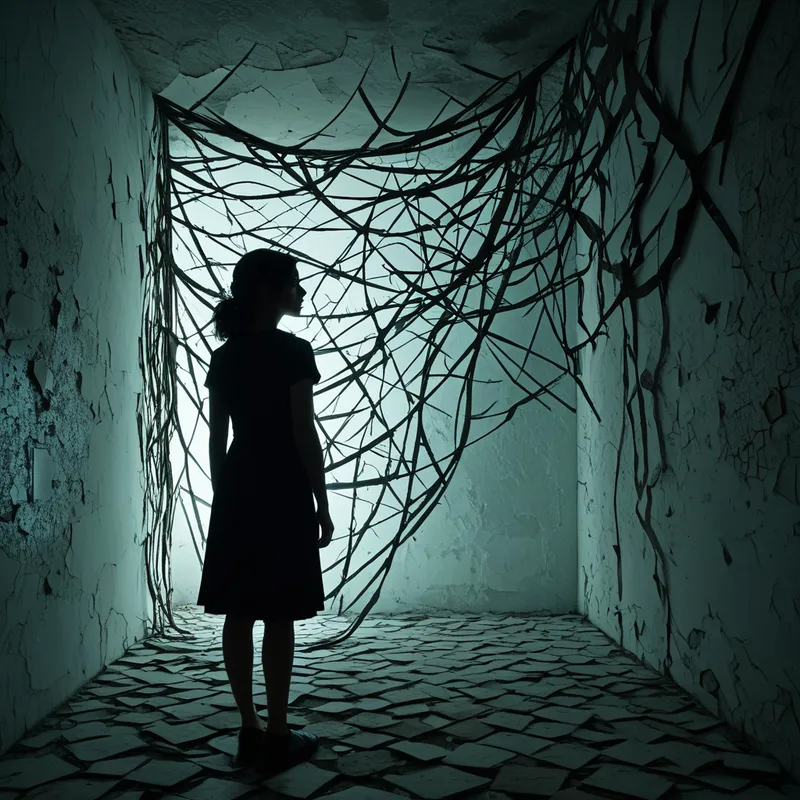
When this myth stirs in the modern dreamer, it often manifests as dreams of broken walls, crumbling fences, or invaded houses. The somatic experience is one of profound vulnerability, a chilling exposure. You may dream of trying frantically to patch a hole with inadequate materials, or of watching helplessly as a dark, nebulous substance seeps through a crack.
Psychologically, this signals a crisis of boundaries. The dreamer is undergoing a process where old structures of identity—perhaps based on profession, relationship, or outdated self-concepts—are failing. The “chaos” pressing in could be repressed emotions, a moral dilemma, a tidal wave of unmet needs, or the unsettling waters of a life transition. The dream is not merely a warning; it is a call to the inner sovereign. It asks: What covenant with yourself have you broken? What sacred law of your own being have you neglected? Where have you failed to define and defend the sacred ground of your own values, time, or emotional well-being?
Alchemical Translation
The alchemical process modeled here is coagulatio—the operation of condensation, of giving spirit a solid form. It is the antithesis of dissolution ([solutio](/myths/solutio “Myth from Alchemical culture.”/)). The psychic journey begins in a state of [nigredo](/myths/nigredo “Myth from Alchemical culture.”/), the black chaos of confusion and boundary-loss.
The alchemy of the rampart is the work of turning the lead of diffuse anxiety into the gold of conscious, embodied limit. The wall is the lapis of the psyche.
The first step is the recognition of the breach—the conscious admission that one’s psychic integrity is compromised. This is the painful, honest self-assessment. Next is the midnight work: the solitary, often despairing task of repair. This is the hard, unglamorous labor of therapy, journaling, difficult conversations, or simply sitting with one’s pain instead of fleeing from it. One must “speak to the stones”—revisit and re-consecrate one’s core values, reactivate forgotten strengths, and integrate shadow material.
The final transmutation is the sealing and illumination. The repaired boundary no longer feels like a brittle barrier of fear, but a resonant, glowing definition of self. The integrated psyche no longer experiences the “outside” or the “other” as a threatening chaos to be walled off absolutely, but can engage with it from a place of secure, differentiated identity. The wall becomes not a siege barrier, but the beautiful, strong outline of a sanctuary—a contained, holy space from which one can genuinely relate to [the world](/myths/the-world “Myth from Tarot culture.”/). The ramparts stand, and within them, the soul’s temple is secure.
Associated Symbols
Explore related symbols from the CaleaDream lexicon: