The Rainbow Bridge Myth Meaning & Symbolism
A celestial bridge of impossible beauty, connecting realms, demanding sacrifice, and offering a perilous path to wholeness.
The Tale of The Rainbow Bridge
Listen, and I will tell you of the span that is not a span, the path that is not a path. In the time before time, when the Great Unity first dreamed of separation, the realms were born: the Clay-Footed World below, and the Sky-Vault Realm above. And between them lay the Howling Gulf, a chasm of silence and forgetting so vast that a soul’s cry would die a thousand times before reaching the other side.
The people of the Clay-Footed World looked up and saw the glimmering lights of [the Sky](/myths/the-sky “Myth from Persian culture.”/)-Vault, heard whispers of its perfect music on [the wind](/myths/the-wind “Myth from Various culture.”/), and their hearts ached with a longing they could not name. The spirits of [the Sky](/myths/the-sky “Myth from Persian culture.”/)-Vault looked down and saw the vibrant, messy, suffering beauty of life below, and felt a pull of compassion so fierce it was a kind of pain. They were two halves of a broken song, each incomplete.
Then came the Weaver-in-Between. They were not of the Clay nor of the Sky, but of the moment a tear falls and catches the light. The Weaver saw the sorrow of the separation and conceived a mad, beautiful plan. They went to the highest peak of the Clay-Footed World, where the air is thin and thoughts become clear, and they began to gather.
Not stone, not wood, but the stuff of promise itself. They gathered the last sigh of a dying hero, the first laugh of a newborn, the unspoken forgiveness between old rivals, and the courage of a small act of kindness in a dark time. These intangible things they spun into threads of impossible light. With a loom made of starlight and mountain wind, they began to weave.
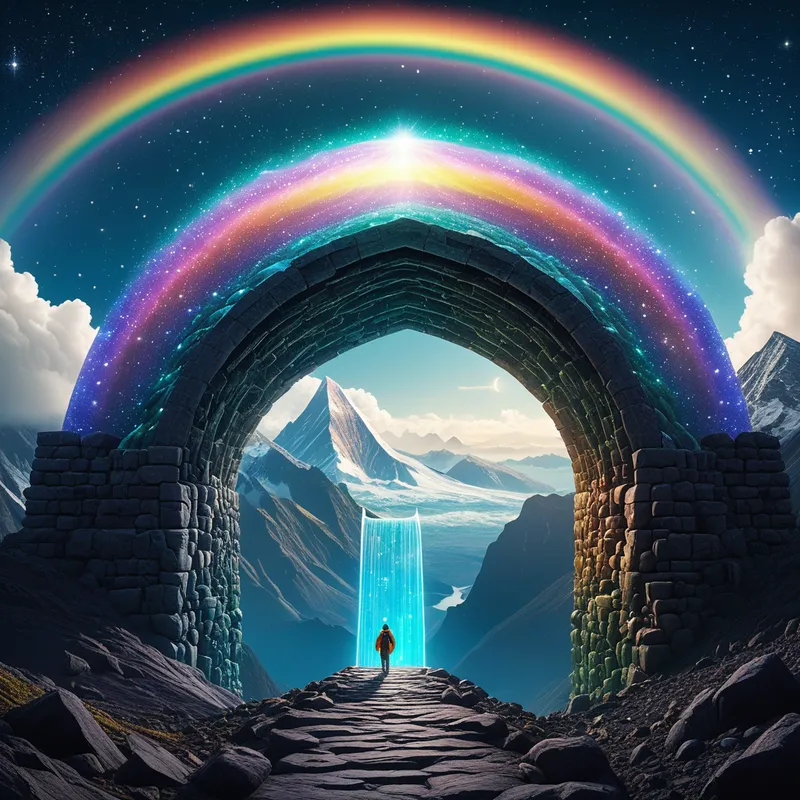
For seven cycles of [the moon](/myths/the-moon “Myth from Tarot culture.”/) they wove, and what emerged was not a [thing](/myths/thing “Myth from Norse culture.”/), but an event: a bridge of solidified dawn, of liquid evening, of every color that ever was or could be. It arched from the sacred mountain peak, across the terrifying emptiness of the Howling Gulf, to the lowest gate of the Sky-Vault. It was the [Rainbow Bridge](/myths/rainbow-bridge “Myth from Universal culture.”/). It shimmered with a music that was both a memory and a hope.
But the Weaver-in-Between spoke a law into its very fabric, a price for its perfection: “This bridge will hold only for the one who brings the key. The key is not of this world, nor of that one. It is the one thing you possess that you believe you cannot live without. You must offer it at the foot of the bridge. Only then may you cross, and only then will the bridge hold for your return.”
For ages, the bravest, wisest, and most desperate souls approached. Warriors offered their swords, which turned to dust. Kings offered their crowns, which melted like ice. Sages offered their knowledge, which blew away like smoke. The bridge remained shimmering, impassable, a beautiful taunt. Until one came, not a warrior or a ruler, but a heartbroken gardener from the valleys below, who had lost all they loved. They carried only a single seed from a tree that would never again bear fruit in their lifetime. At the base of the luminous arch, with nothing left to lose, they offered the seed, planting it in the barren rock.
The seed glowed. The first arch of the rainbow ignited with a light so profound it cast no shadow. The bridge hummed, solid and true. [The gardener](/myths/the-gardener “Myth from Christian culture.”/) stepped onto the path of light and began the long, terrifying, and glorious walk between worlds.
Cultural Origins & Context
The motif of the Rainbow Bridge is perhaps one of the most widespread and ancient in human storytelling, appearing not as a single myth but as a profound archetypal pattern. We find it in the Bifröst of Norse lore, guarded by the god [Heimdallr](/myths/heimdallr “Myth from Norse culture.”/). It is present in the Buddhist concept of the [Rainbow Body](/myths/rainbow-body “Myth from Tibetan Buddhist culture.”/) (jalü), a bridge of consciousness between [samsara](/myths/samsara “Myth from Buddhist culture.”/) and [nirvana](/myths/nirvana “Myth from Buddhist culture.”/). It echoes in the Aboriginal Australian [Songlines](/myths/songlines “Myth from Aboriginal culture.”/), where ancestral beings created pathways of connection across the land that are also stories and maps. In Mesoamerican and Japanese traditions, rainbows were seen as serpents or floating bridges of the gods.
This is a “Global/Universal” myth because it does not belong to any one culture; it is a psychic structure born from the universal human condition of experiencing separation—separation from the divine, from our ideals, from each other, and from parts of ourselves. It was passed down not just by bards and priests, but in the quiet moments of longing when anyone gazes at a rainbow after a storm. Its societal function was to give form to the ultimate human quest: the search for reconnection and meaning. It provided a symbolic map for the shaman’s journey, the hero’s quest, and the mystic’s ascent, teaching that the path to wholeness is beautiful, perilous, and requires a sacred exchange.
Symbolic Architecture
The [Rainbow Bridge](/symbols/rainbow-bridge “Symbol: The rainbow bridge symbolizes connection, transformation, and the passage between different realms or states of being, often associated with hope and new beginnings.”/) is the ultimate [symbol](/symbols/symbol “Symbol: A symbol can represent an idea, concept, or belief, serving as a powerful tool for communication and understanding.”/) of the tertium non datur, the “third” that emerges when we dare to hold two opposing realities in [consciousness](/symbols/consciousness “Symbol: Consciousness represents the state of awareness and perception, encompassing thoughts, feelings, and experiences.”/). It is not the earthly [realm](/symbols/realm “Symbol: The symbol of ‘Realm’ often signifies the boundaries of one’s consciousness, experiences, or emotional states, suggesting aspects of reality that are either explored or ignored.”/), nor the spiritual ideal, but the living, dynamic [relationship](/symbols/relationship “Symbol: A representation of connections we have with others in our lives, often reflecting our emotional state.”/) between them.
The bridge does not deny the chasm; it is made from the acknowledgment of the chasm. Its beauty is born of the distance it spans.
The [Clay](/symbols/clay “Symbol: Clay symbolizes malleability, creativity, and the potential for transformation, representing the foundational aspect of life and the ability to shape one’s destiny.”/)-Footed World represents the [psyche](/myths/psyche “Myth from Greek culture.”/)‘s identification with the personal, the historical, the [body](/symbols/body “Symbol: The body in dreams often symbolizes the dreamer’s self-identity, personal health, and the relationship they have with their physical existence.”/), and the complex web of Ego. The Sky-[Vault](/symbols/vault “Symbol: A secure, enclosed space for storing valuables or secrets, often representing hidden aspects of the self or protected resources.”/) Realm symbolizes [the Self](/myths/the-self “Myth from Jungian culture.”/), the transpersonal, [the world](/myths/the-world “Myth from Tarot culture.”/) of archetypes and unmanifest potential. The Howling [Gulf](/symbols/gulf “Symbol: A large, deep inlet of sea often representing separation, transition, or vast emotional distance between states of being.”/) is the shadowland of the unconscious, the disorienting gap between who we are and who we sense we could be, filled with fear, forgotten memories, and creative [chaos](/symbols/chaos “Symbol: In Arts & Music, chaos represents raw creative potential, uncontrolled expression, and the breakdown of order to forge new artistic forms.”/).
The Weaver-in-Between is the [archetype](/symbols/archetype “Symbol: A universal, primordial pattern or prototype in the collective unconscious that shapes human experience, behavior, and creative expression.”/) of [the psychopomp](/myths/the-psychopomp “Myth from Various culture.”/), the guide of souls—but also the creative function of the psyche itself that can synthesize opposites. The “key” that must be offered is the crux of the myth. It represents the central attachment of [the Ego](/myths/the-ego “Myth from Jungian culture.”/), the cherished [identity](/symbols/identity “Symbol: Identity represents the sense of self, encompassing personal beliefs, cultural background, and social roles.”/), possession, or belief we clutch as our very self. The myth states unequivocally that to make the [journey](/symbols/journey “Symbol: A journey in dreams typically signifies adventure, growth, or a significant life transition.”/) toward wholeness, this idol must be relinquished. It is not destroyed, but transformed into the substance of the [path](/symbols/path “Symbol: The ‘path’ symbolizes a journey, choices, and the direction one’s life is taking, often representing individual growth and exploration.”/) itself.
The Dreamer’s Resonance
When the Rainbow Bridge appears in a modern dream, it signals a psyche at a critical threshold. The dreamer is likely experiencing a powerful tension between a deeply felt inner ideal (a career, a state of being, a relationship) and their current earthly reality. The chasm feels un-crossable.
Somatically, this may manifest as anxiety in the chest (the fear of the leap), tightness in the legs (feeling stuck), or a feeling of vertigo. Psychologically, this is the process of numinous inflation followed by crashing deflation: we see the beautiful ideal (the bridge), feel called to it, but then confront the terrifying gap and the impossible price (the sacrifice).
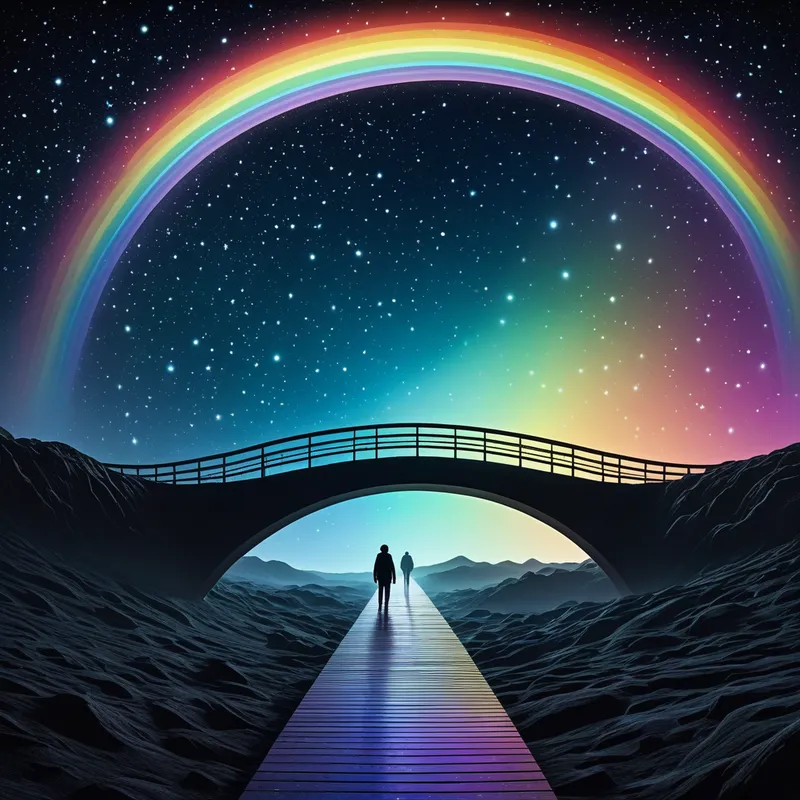
The dream is an invitation from the Self. The specific condition of the bridge—is it crumbling, brilliantly solid, crowded, or empty?—mirrors the dreamer’s inner assessment of their readiness. The nature of the “key” they struggle to offer in the dream often points directly to the Ego attachment currently blocking their development. To dream of standing frozen at the foot of the bridge is to experience the agony and necessity of the [kairos](/myths/kairos “Myth from Global/Universal culture.”/) moment.
Alchemical Translation
For the modern individual, the myth of the Rainbow Bridge is a precise allegory for the Jungian process of individuation. The journey is not about “going to heaven” or escaping the world, but about forging a conscious connection between the personal ego and the transpersonal Self, thereby creating a stable channel for the Self’s energy to manifest in a grounded life.
The Alchemical Stage is the coniunctio oppositorum ([the conjunction](/myths/the-conjunction “Myth from Alchemical culture.”/) of opposites). The “Clay” and the “Sky” are the sol and luna, the conscious and unconscious, the masculine and feminine principles within one psyche. The bridge is the elusive [lapis philosophorum](/myths/lapis-philosophorum “Myth from Alchemical culture.”/) ([Philosopher’s Stone](/myths/philosophers-stone “Myth from Alchemical culture.”/)), the integrated personality.
The sacrifice at the foot of the bridge is the mortificatio—the necessary death of an old, outgrown identity. The gardener’s seed is the perfect symbol: it is a death (the end of its current form) that contains the promise of future life, but not for the one who plants it. This is altruistic sacrifice, for a future self.
The perilous crossing is the enduring of the tension of the opposites without falling into one side or the other. It is walking the razor’s edge between inflation (identifying with the Sky-Vault) and despair (collapsing back into the Clay). The successful return—implied in the myth’s structure—is the [rubedo](/myths/rubedo “Myth from Alchemical culture.”/), the reddening, where the integrated consciousness, having touched the transcendent, returns to imbue ordinary, “clay-footed” life with meaning, color, and purpose. The bridge, once crossed, becomes an internal reality: a permanent connection within the individual, allowing them to be fully in the world, yet never severed from the source. They become, themselves, a living bridge.
Associated Symbols
Explore related symbols from the CaleaDream lexicon: