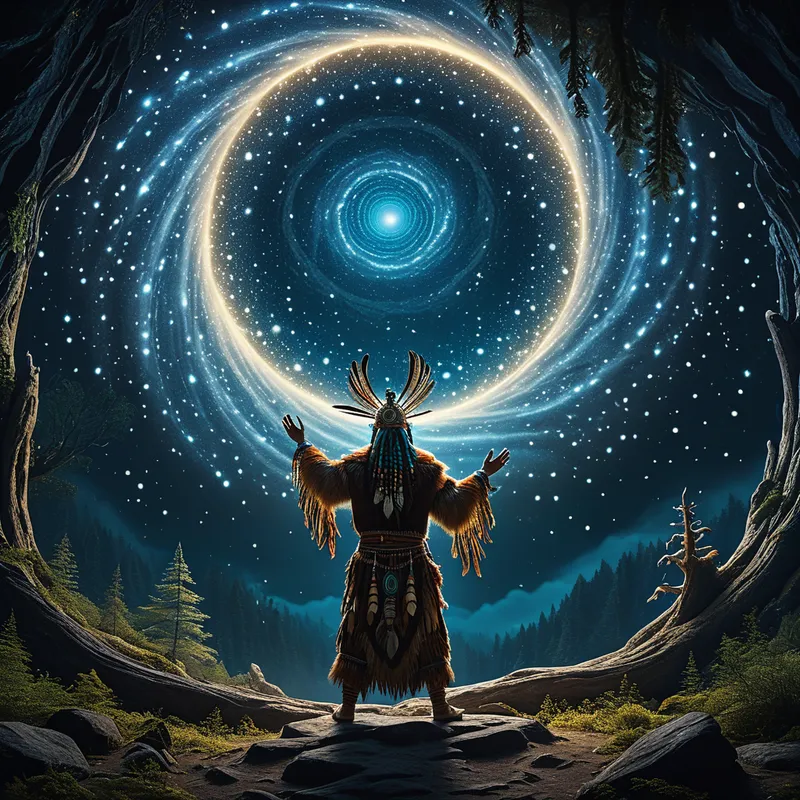
The Shaman's Journey Myth Meaning & Symbolism
A universal myth of a chosen one's descent into the spirit world, facing dismemberment and rebirth to heal their community.
The Tale of The Shaman’s Journey
Listen. [The world](/myths/the-world “Myth from Tarot culture.”/) is sick. The people cough with a fever that no herb can cool. The game has fled from the forests, and the rivers run thin. In the center of the village, the fire sputters, its light growing dim. This is a sickness of the soul, a tear in the web that connects the people to the land, to the ancestors, to the very breath of life. The elders murmur a single, dreaded word: broken.
From among them, one is called. It is not a choice. It is a lightning strike. Perhaps it is the quiet hunter who survived [the fall](/myths/the-fall “Myth from Biblical culture.”/) from the cliff, whose eyes now see flickers in the air where others see nothing. Perhaps it is the woman who walked into the blizzard and returned three days later, speaking in tongues. They are marked by crisis—a profound illness, a terrifying vision, a loss that cracks the shell of ordinary reality. The community gathers, their hope a fragile thread. The drums begin. A steady, heartbeat rhythm that shakes [the earth](/myths/the-earth “Myth from Hindu culture.”/) beneath the feet.
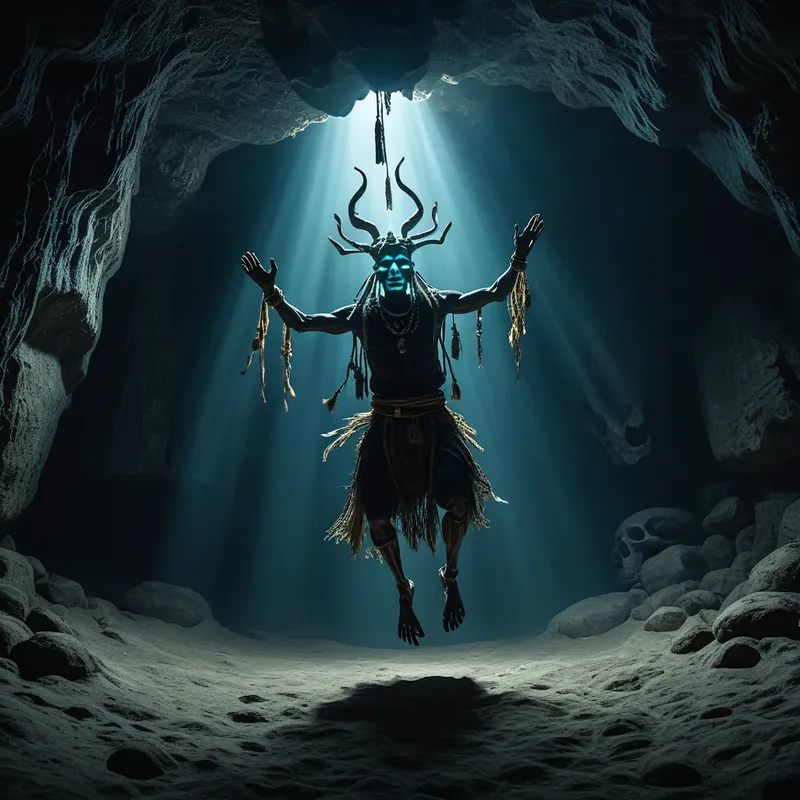
The chosen one, the shaman, closes their eyes. The drumbeat is no longer outside; it is the pulse of their own blood, a current pulling them down. They feel the ground give way. They are falling, not through earth, but through layers of memory, through the roots of the great [World Tree](/myths/world-tree “Myth from Global culture.”/), into the damp, singing darkness of the [Underworld](/myths/underworld “Myth from Greek culture.”/). The air grows thick and cold. Strange lights dart like fish. Whispers coil around them, voices of the forgotten dead, of the animal masters who hold the secrets of life.
Then, the guardians appear. They are not monsters of flesh, but of essence—a bear of shimmering stone, a serpent with eyes of molten sky, a flock of birds with beaks of sharpened shadow. They do not speak. They know. They see the human clinging to its form, its name, its story. And they find it… insufficient. With a thought that is also an action, they take [the shaman](/myths/the-shaman “Myth from Siberian culture.”/) apart.
This is the dismemberment. It is not metaphor. In that realm, it is utter reality. Fingers are separated from hands. Bones are cleaned of flesh. Eyes are lifted from their sockets. The shaman watches, a consciousness scattered, as their own form is methodically unraveled. There is agony beyond screaming, a terror that dissolves the very concept of “I.” Yet, in the core of that annihilation, a spark remains. A witness. A curious, accepting awareness that watches the dissolution not as an end, but as a necessary unbinding.
Only when the last shred of the old self is stripped away do the spirits begin their work. They do not rebuild the same person. They assemble a new being. The bones are polished by [the river](/myths/the-river “Myth from Buddhist culture.”/) of time. The flesh is rewoven with threads of starlight and mycelium. The eyes are replaced with orbs that can perceive the spirit in the stone and the sorrow in [the wind](/myths/the-wind “Myth from Various culture.”/). The shaman is reassembled, but now they are a hybrid creature—part human, part spirit, a walking bridge between worlds. They are given gifts: a song that can call the rain, a dance that mends broken bones, the language to bargain with the lords of the game.
With this new body and these new powers, they complete their quest. They find the stolen soul-piece of the sick child, trapped in a crystal held by a jealous rock spirit. They retrieve the song that will call the caribou back from their hiding. They drink from the well of memory and speak with the ancestors. Then, following the now-thundering call of [the drum](/myths/the-drum “Myth from West African / Diasporic culture.”/), they surge upward, racing along the roots of [the World Tree](/myths/the-world-tree “Myth from Celtic culture.”/), bursting back into the world of light and air, collapsing into their physical body by the dying fire.
They open their eyes. The village holds its breath. The shaman sits up, and their gaze is different—ancient and newborn all at once. They take a breath, and begin to sing the healing song they brought back from the land of the dead.
Cultural Origins & Context
The myth of the Shaman’s Journey is not the property of a single culture, but a profound narrative pattern emerging independently across the globe—from the Evenki of Siberia to the Shipibo of the Amazon, from the Sami of the Arctic to the First Nations of North America. This is not a story told for entertainment around a fire; it is a living, experiential template transmitted through direct initiation and oral tradition. The primary “tellers” of this myth are the shamans themselves, who have lived its sequences. They pass it on to their apprentices not as a fable, but as a map of a terrifying yet necessary territory.
Its societal function is one of profound ecology and psychology. The shaman acts as the community’s immune system and psychic regulator. When imbalance strikes—sickness, famine, spiritual malaise—the myth provides the protocol: a designated individual must journey to the source of the imbalance in the spirit world and negotiate, battle, or retrieve what has been lost. The myth legitimizes the shaman’s often-traumatic personal crisis (the “shamanic illness”) as a sacred calling, not madness. It frames extreme suffering as the prerequisite for the power to heal, creating the archetype of the wounded healer.
Symbolic Architecture
At its core, the [journey](/symbols/journey “Symbol: A journey in dreams typically signifies adventure, growth, or a significant life transition.”/) is a master [symbol](/symbols/symbol “Symbol: A symbol can represent an idea, concept, or belief, serving as a powerful tool for communication and understanding.”/) of [death](/symbols/death “Symbol: Symbolizes transformation, endings, and new beginnings; often associated with fear of the unknown.”/)-and-[rebirth](/symbols/rebirth “Symbol: A profound transformation where old aspects of self or life die, making way for new beginnings, growth, and renewal.”/), the universal [pattern](/symbols/pattern “Symbol: A ‘Pattern’ in dreams often signifies the underlying structure of experiences and thoughts, representing both order and the repetitiveness of life’s situations.”/) of transformation. The initial “call” represents the [psyche](/myths/psyche “Myth from Greek culture.”/)‘s inability to continue in its old configuration; it is a [crisis](/symbols/crisis “Symbol: A crisis symbolizes turmoil, urgent challenges, and the need for immediate resolution or change.”/) that demands a descent into the unknown.
The journey to the Underworld is not an escape from the self, but a ruthless confrontation with the self’s most basic architecture.
The [Underworld](/symbols/underworld “Symbol: A symbolic journey into the unconscious, representing exploration of hidden aspects of self, transformation, or confronting repressed material.”/) is the [collective unconscious](/symbols/collective-unconscious “Symbol: The Collective Unconscious refers to the part of the unconscious mind shared among beings of the same species, embodying universal experiences and archetypes.”/), the [realm](/symbols/realm “Symbol: The symbol of ‘Realm’ often signifies the boundaries of one’s consciousness, experiences, or emotional states, suggesting aspects of reality that are either explored or ignored.”/) of archetypes, instincts, and forgotten memories. The [spirit](/symbols/spirit “Symbol: Spirit symbolizes the essence of life, vitality, and the spiritual journey of the individual.”/) guardians are the autonomous complexes and primal forces of the psyche that dismantle [the ego](/myths/the-ego “Myth from Jungian culture.”/). Dismemberment is the symbolic annihilation of the outmoded [personality](/symbols/personality “Symbol: Personality in dreams often symbolizes the traits and characteristics of the dreamer, reflecting how they perceive themselves and how they believe they are perceived by others.”/) [structure](/symbols/structure “Symbol: Structure in dreams often symbolizes stability, organization, and the framework of one’s life, reflecting how one perceives their environment and personal life.”/)—the rigid identities, defenses, and self-concepts that prevent growth. It is the ultimate surrender. The reassembly by the spirits signifies the psyche’s innate, archetypal [capacity](/symbols/capacity “Symbol: A measure of one’s potential, limits, or ability to contain, process, or achieve something, often reflecting self-assessment or external demands.”/) to reorganize itself at a higher, more integrated level of functioning. The returned [shaman](/symbols/shaman “Symbol: A spiritual mediator who bridges the human and spirit worlds, often through altered states, healing, and guidance.”/) embodies the individuated Self, no longer identified solely with the personal ego but connected to the transpersonal [source](/symbols/source “Symbol: The origin point of something, often representing beginnings, nourishment, or the fundamental cause behind phenomena.”/) of [life](/symbols/life “Symbol: The symbol of ‘Life’ represents a journey of growth, interconnectedness, and existential meaning, encompassing both the joys and challenges that define human experience.”/) and meaning.
The Dreamer’s Resonance
When this mythic pattern stirs in modern dreams, it often manifests not as a literal narrative, but through potent symbols of breakdown and journey. Dreams of catastrophic illness, of teeth falling out, or of bones breaking can echo the dismemberment—a somatic signal of an old psychological structure crumbling. Dreams of being lost in subterranean tunnels, basements, or caves mirror the descent into the Underworld of [the personal unconscious](/myths/the-personal-unconscious “Myth from Jungian Psychology culture.”/).
Recurring dreams of being chased or tested by animalistic figures may point to the encounter with the “spirit guardians,” the powerful, often frightening autonomous complexes that hold the key to transformation. The psychological process is one of ego dissolution. The dreamer is not simply facing a problem to be solved, but is being prepared, often through anxiety and terror, to let go of a foundational way of being in the world. The dream-body experiences the shock of deconstruction, preparing the conscious mind for a necessary, though feared, death of an old self.

Alchemical Translation
For the modern individual, the Shaman’s Journey is a precise model for the alchemy of individuation. Our “village sickness” is depression, meaninglessness, chronic anxiety, or a life that feels inauthentic. The “call” is the crisis—the burnout, the loss, the diagnosis—that finally forces us to stop and listen.
The modern shaman’s cave is the therapist’s office, the meditation cushion, the journal page, the silent walk in nature—any vessel that can hold the descent.
The voluntary descent is the commitment to shadow work, to facing the repressed, painful, and unlived parts of ourselves. The dismemberment is the painful but liberating process of therapy or deep introspection, where our cherished self-narratives, defense mechanisms, and personas are taken apart. We are shown we are not our job, our trauma, our roles, or our past.
The reassembly is the slow, intentional work of integration. We take back our “soul pieces”—the creativity we abandoned, the vulnerability we walled off, the anger we silenced. We are rebuilt with new awareness, crafting an identity that acknowledges both our humanity and our connection to something larger. The final return is not to the old life, but to a life lived with greater authenticity, purpose, and the ability to “heal” not just ourselves, but to bring that integrated wisdom into our relationships and communities. We become, in our own way, a bridge between the visible world of daily life and the invisible world of soul.
Associated Symbols
Explore related symbols from the CaleaDream lexicon: