The Queen Mother of the West Myth Meaning & Symbolism
The celestial sovereign of the west, keeper of the peaches of immortality, who bestows wisdom and eternal life upon the worthy seeker.
The Tale of The Queen Mother of the West
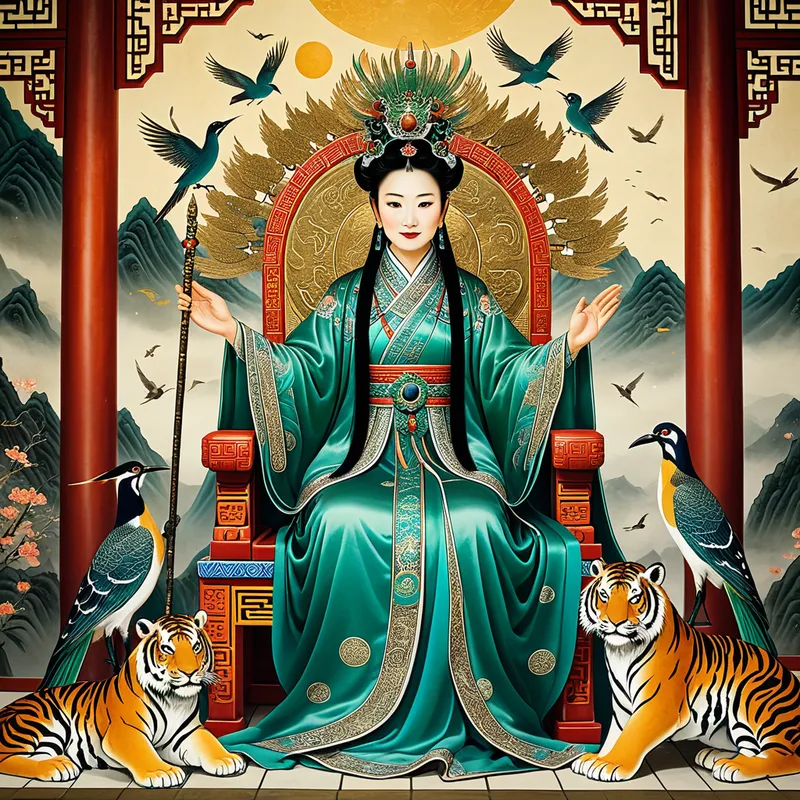
Beyond the farthest western passes, where the earth folds into the ribs of the world, lies a realm untouched by mortal time. Here, the Kunlun Mountains pierce the veil of heaven, their peaks sheathed in eternal jade and cloaked in clouds that are the breath of dragons. At their heart lies a palace not built by hands, but woven from destiny and Li. This is the domain of Xi Wangmu, the Sovereign of the West.
She who sits upon a throne of white tiger skin and polished jade. Her hair is the color of a raven’s wing at midnight, adorned with the Sheng headdress, a symbol of cosmic authority. Her eyes hold the patience of millennia and the sharpness of a leopard’s gaze. Around her dance her attendants: the Yunu, beings of serene beauty, and the three-legged blue bird that carries her celestial decrees across the nine heavens.
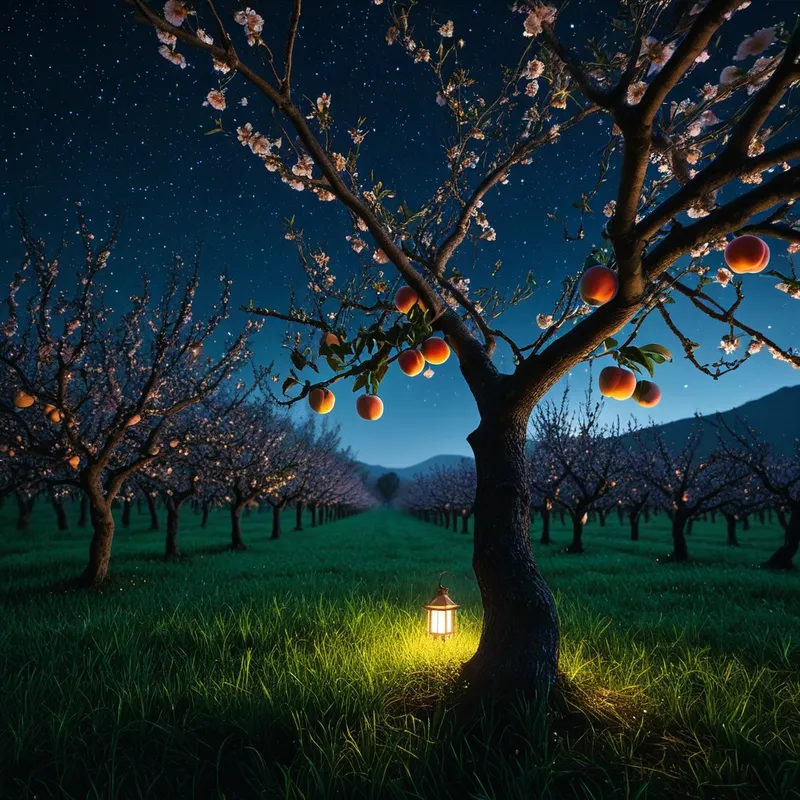
In her garden grows the sacred orchard. Once every three thousand years, the trees bear fruit—the Pantao. Each peach is a globe of captured sunset, its skin blushing with the light of a thousand dawns, its flesh holding the secret of the undying Shen. To taste it is to step outside the wheel of birth and decay, to become a guest at the eternal banquet of the stars.
The myth tells of a seeker, often a virtuous king or a pure-hearted adept. He must undertake the perilous Xiyou, crossing demon-haunted wastes and rivers of forgetting, guided only by a longing for wisdom that burns brighter than fear. He arrives not as a conqueror, but as a supplicant, his mortal pride worn away by the journey. At the jade gates, he is met not by wrath, but by a profound, assessing silence.
The Queen Mother does not give her gifts lightly. She is the guardian of the ultimate treasure. The seeker is tested—not with riddles of the tongue, but with the riddle of his own heart. Does he seek immortality for power, or for the peace to align with the Dao? In her presence, all pretense falls away. If his spirit is found worthy, if his intention resonates with the harmony of the cosmos, then the resolution unfolds. A single peach is bestowed. A cup of jade is filled with the wine of the heavens. In that moment of reception, the mortal is transfigured. He does not become a god, but he is granted a share in the timeless order she embodies. The conflict is not vanquished, but dissolved into a higher accord. The banquet begins, and for a night that lasts an eon, the seeker feasts among the immortals, having passed from the realm of striving into the grace of being.
Cultural Origins & Context
The figure of the Queen Mother of the West is a profound tapestry woven from threads of ancient shamanism, early Chinese cosmology, and later, institutionalized Taoism. Her earliest traces appear on oracle bones from the Shang dynasty, suggesting a powerful western deity associated with plague, death, and oracular power—a ruler of spirits and the afterlife. Over centuries, through texts like the Shanhaijing and the fervent immortality-seeking culture of the Han dynasty, her image was alchemically transformed.
She evolved from a fearsome, bestial goddess with tiger’s teeth and a panther’s tail into the majestic, benevolent bestower of eternal life central to Taoist lore. This was not a dilution, but a deepening. Taoist adepts and court scribes passed down her stories, refining her into the ultimate symbol of achieved spiritual transcendence and cosmic governance. Societally, she functioned as the divine patron of seekers, a reassurance that the cosmos had a regal, orderly center where wisdom and immortality were not mere fantasies, but potential realities for those who undertook the inner and outer journey. She represented the ultimate validation of the Taoist path—that harmony with the Dao led to a celestial sovereignty.
Symbolic Architecture
Psychologically, Xi Wangmu is the archetypal ruler of the deep, structured unconscious. She is not the chaotic, nurturing Great [Mother](/symbols/mother “Symbol: The symbol of ‘Mother’ represents nurturing, protection, and the foundational aspect of one’s emotional being, often associated with comfort and unconditional love.”/), but the ordering Mother. Her western abode symbolizes the setting sun, the [realm](/symbols/realm “Symbol: The symbol of ‘Realm’ often signifies the boundaries of one’s consciousness, experiences, or emotional states, suggesting aspects of reality that are either explored or ignored.”/) of completion, introspection, and the gathering of experiences into wisdom. The Kunlun Mountains are the psychic [spine](/symbols/spine “Symbol: The spine symbolizes strength, support, and the foundational structure of one’s life and identity.”/), the [axis](/symbols/axis “Symbol: A central line or principle around which things revolve, representing stability, orientation, and the fundamental structure of reality or consciousness.”/) where personal [consciousness](/symbols/consciousness “Symbol: Consciousness represents the state of awareness and perception, encompassing thoughts, feelings, and experiences.”/) (the [seeker](/symbols/seeker “Symbol: A person actively searching for meaning, truth, or a higher purpose, often representing the dreamer’s own quest for identity or fulfillment.”/)) meets transpersonal order (the celestial court).
She represents the internal authority that emerges when one has faced the wilderness of the psyche and returned not with trophies, but with a mandate to govern one’s own inner kingdom.
Her peaches are the [fruit](/symbols/fruit “Symbol: Fruit symbolizes abundance, nourishment, and the fruits of one’s labor in dreams.”/) of psychological [integration](/symbols/integration “Symbol: The process of unifying disparate parts of the self or experience into a cohesive whole, often representing psychological wholeness or resolution of internal conflict.”/)—the hard-won prize of a [life](/symbols/life “Symbol: The symbol of ‘Life’ represents a journey of growth, interconnectedness, and existential meaning, encompassing both the joys and challenges that define human experience.”/) examined and synthesized. They do not grant childish omnipotence, but a mature, timeless [perspective](/symbols/perspective “Symbol: Perspective in dreams reflects one’s viewpoints, attitudes, and how one interprets experiences.”/). Her tests are the ego’s confrontation with its own motives. The [tiger](/symbols/tiger “Symbol: The tiger symbolizes power, courage, and primal instincts, often representing untamed energy and aggression.”/) [skin](/symbols/skin “Symbol: Skin symbolizes the boundary between the self and the world, representing identity, protection, and vulnerability.”/) on her [throne](/symbols/throne “Symbol: A seat of authority, power, and sovereignty, representing leadership, divine right, or social hierarchy.”/) signifies the taming of raw, instinctual power (Qi) into a seat of [authority](/symbols/authority “Symbol: A symbol representing power structures, rules, and control, often reflecting one’s relationship with societal or personal governance.”/). She is the [conjunction](/symbols/conjunction “Symbol: In arts and music, a conjunction represents the harmonious or dissonant merging of separate elements to create a new, unified whole.”/) of opposites: fierce and gracious, distant and bestowing, the keeper of the threshold to the ultimate state of Self.
The Dreamer’s Resonance
When the Queen Mother appears in modern dreams, she heralds a profound encounter with the psyche’s own governing principle. This is not a dream of comfort, but of audition. The dreamer may find themselves in a vast, awe-inspiring palace feeling acutely out of place, or standing before a formidable, regal woman who demands an account of their life’s journey.
Somatically, this can feel like a tightening in the chest—not from fear, but from the weight of a silent, immense presence. Psychologically, it signals a process where the dreamer’s scattered identities and life roles are being called to order. The Queen Mother dream asks: “By what authority do you live? What chaotic instincts or petty desires rule you? Are you prepared to receive a higher responsibility for your own existence?” It is the psyche’s initiation into a phase of profound self-responsibility and integration, often following a period of seeking or turmoil. The dream may leave a residue of solemnity, a sense of having been seen and measured by an inner standard far beyond the ego’s petty concerns.

Alchemical Translation
The myth models the alchemical process of Individuation, where the base metal of the personality is transmuted into the gold of the Self. The perilous journey west is the nigredo—the descent into the shadow, the confrontation with one’s own inner wilderness and illusions. Arriving at Kunlun is the albedo—the washing clean, the clarification of intention before the ultimate threshold.
The audience with the Queen Mother is the critical rubedo, the reddening. Here, the ego’s desire (for immortality, perfection, glory) is held in the fiery gaze of the Self. It is burned clean of narcissism. To receive her gift, the ego must surrender its claim to ownership and become a vessel.
The peach of immortality is not consumed to escape death, but to die to the mortal, egoic perspective and be reborn into the timeless pattern of the Self.
This is psychic transmutation. The adept does not become the Queen Mother; he is granted a seat at her table. He internalizes her ordering principle. The outer search for an external savior or formula is complete; it is replaced by an inner alignment with a cosmic sovereignty. The individual becomes, in their own sphere, a ruler—not through domination, but through harmonious governance of their own complex psyche, in accord with the greater Dao. The banquet is the ongoing, joyful participation in the meaningful order one has earned the right to inhabit.
Associated Symbols
Explore related symbols from the CaleaDream lexicon:
- Mother — The archetypal source of life and order, here refined into a regal, judicial aspect that governs rather than merely nurtures, demanding maturity from her children.
- Mountain — Represents the arduous spiritual ascent, the axis mundi (Kunlun) where heaven and earth meet, and the stable, enduring foundation of the Self.
- Peach — The fruit of immortality, symbolizing the achieved goal of psychic integration, wholeness, and the sweet reward of the completed inner journey.
- Queen — The sovereign feminine principle, embodying authority, self-containment, and the right to bestow blessings or withhold them based on inner law.
- Western — The direction of sunset, completion, introspection, and the realm where things are gathered, assessed, and brought to their final, wise form.
- Journey — The essential ordeal of the seeker, representing the life-long process of confronting the unknown within and without to reach a state of enlightenment.
- Taoist Alchemy — The precise, symbolic process of inner transformation that the myth encapsulates, turning the lead of base consciousness into the gold of immortal awareness.
- Order — The cosmic and psychic principle that Xi Wangmu embodies and enforces, the harmonious structure underlying reality that the seeker must align with.
- Immortality — Not literal endless life, but the psychological state of transcending identification with the ephemeral ego and participating in the timeless patterns of the archetypal world.
- Gate — The threshold to her palace, representing the critical point of transition between the profane world and the sacred, between ego-consciousness and the realm of the Self.
- Mirror — Implied in her assessing gaze, it represents the unflinching self-reflection required to see one’s true motives and worth before the inner sovereign.
- Banquet — The state of joyful, communal participation in the fruits of spiritual achievement, symbolizing the richness and fulfillment of the integrated psyche.