The Python God of Dahomey Myth Meaning & Symbolism
A sacred serpent descends to establish divine kingship, weaving the cosmic order of the Fon people into the very earth of Dahomey.
The Tale of The Python God of Dahomey
Listen, and let the drums carry you across the sea of time, to the land where the red earth meets the green forest. This is the tale of how the kingdom was born, not from the sword alone, but from the sacred coil.
In the beginning, there was chaos—a scattering of clans under a wide and watchful sky. The people yearned for a center, a heart to beat in rhythm with the world. The great Mawu-Lisa, the twin deity of moon and sun, of wisdom and power, heard this yearning. From the realm of the invisible, the world of the spirits, They sent a messenger. Not on wings of thunder, nor with a voice of fire, but in a form of silent, ancient power: a Dan.
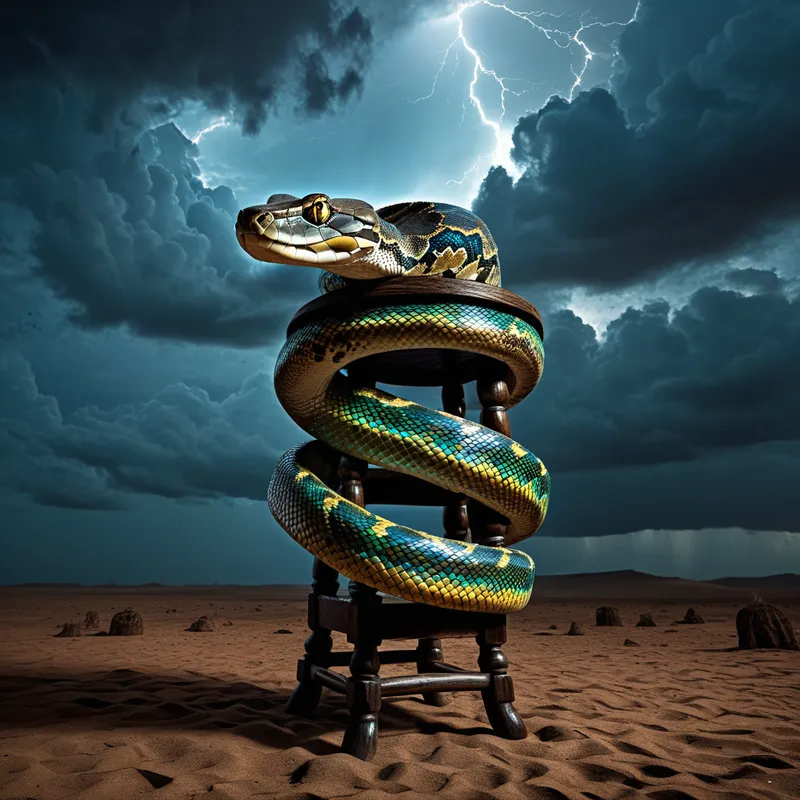
This was no ordinary serpent. Its scales held the sheen of polished river stones and the deep, fertile black of night soil. Its length was the measure of a great tree’s shadow at noon. It moved not with the haste of a predator, but with the deliberate, undulating grace of a river carving its destiny through stone.
The python descended into the world at Allada, the navel of the world. The people watched, breath held, as this living pillar of ase began to coil. It did not speak in words, but in shapes. Its body drew a great, spiraling circle upon the earth, a perfect enclosure. Within that coil, the chaos stilled. The very air grew heavy with potential, smelling of ozone before rain and crushed herbs.
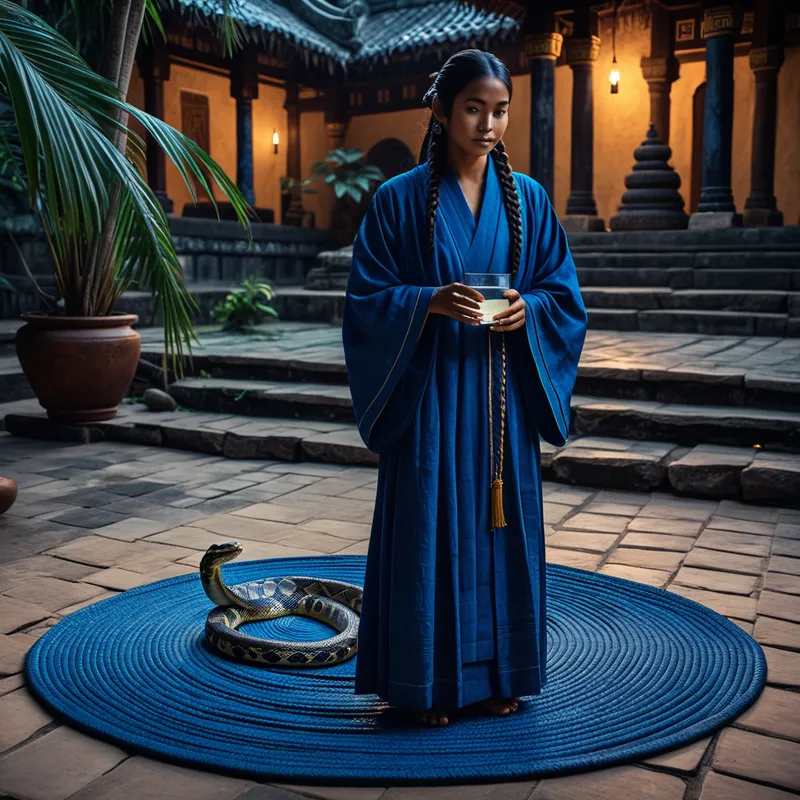
Then, from the center of that sacred coil, a man emerged. He was Dakodonu, or in some tellings, his successor. He was not born of woman in that moment, but born of the serpent’s pact with the earth. The python’s gaze, ancient and knowing, met his. In that silent exchange, the contract was sealed. The serpent offered the legitimacy of the cosmos, the unbroken line from Mawu-Lisa to the red earth. In return, the king-to-be offered stewardship, order, and the promise that the serpent’s wisdom would forever be woven into the fabric of the kingdom.
The great Dan, its task initiated, did not depart. It became the land. Its coils were the protective walls of the royal compound at Abomey. Its spine was the path of kings. Its shed skin became the patterns on royal textiles and the designs on the palace walls. The kingdom of Dahomey was not built; it was revealed, unfurled from the body of the python god. And so, the rhythm was set: the silent, coiling power of the earth and spirit, supporting the visible, ordered authority of the king. One could not exist without the other. To harm the sacred pythons that lived freely in the kingdom was a crime equal to harming the king himself, for they were his twin soul, the divine blueprint made flesh.
Cultural Origins & Context
This myth is the foundational narrative of the Fon people of the Kingdom of Dahomey (present-day Benin). It is not merely a story but the constitutional mythology of a state. Passed down through royal historians, known as griots, and priestly custodians of the Vodun traditions, it served a critical societal function: it legitimized the divine right of the Ahosu (king).
The myth provided a sacred cosmology that connected the political structure directly to the spiritual realm. The free-roaming pythons in the capital were considered incarnations of Dan, and their protection was enshrined in law. This narrative was performed and reinforced during annual ceremonies and rites of kingship, embedding the symbol of the python into architecture, tapestries, and royal regalia. It answered the profound human questions of “Why this ruler?” and “Why this order?” by rooting the answers not in brute force, but in a pre-ordained, natural, and sacred geometry delivered by a primordial deity.
Symbolic Architecture
At its core, the myth of Dan is about the establishment of [cosmos](/symbols/cosmos “Symbol: The entire universe as an ordered, harmonious system, often representing the totality of existence, spiritual connection, and the unknown.”/) from [chaos](/symbols/chaos “Symbol: In Arts & Music, chaos represents raw creative potential, uncontrolled expression, and the breakdown of order to forge new artistic forms.”/). The [python](/symbols/python “Symbol: The python represents both fear and fascination, as well as transformation through confronting one’s deeper issues.”/) is the ultimate [symbol](/symbols/symbol “Symbol: A symbol can represent an idea, concept, or belief, serving as a powerful tool for communication and understanding.”/) of this mediating principle.
The serpent does not conquer; it contains. Its power is not explosive, but implosive—drawing the infinite into a defined, fertile circle.
Psychologically, the python represents the structuring principle of the Self. It is the instinct that compels us to create order, meaning, and [identity](/symbols/identity “Symbol: Identity represents the sense of self, encompassing personal beliefs, cultural background, and social roles.”/) from the formless potential of our inner world. The “chaos” of the beginning represents the unorganized psyche—drives, potentials, and fears without a center. The descending python is the archetypal [pattern](/symbols/pattern “Symbol: A ‘Pattern’ in dreams often signifies the underlying structure of experiences and thoughts, representing both order and the repetitiveness of life’s situations.”/) arriving from the [collective unconscious](/symbols/collective-unconscious “Symbol: The Collective Unconscious refers to the part of the unconscious mind shared among beings of the same species, embodying universal experiences and archetypes.”/), offering a form for [life](/symbols/life “Symbol: The symbol of ‘Life’ represents a journey of growth, interconnectedness, and existential meaning, encompassing both the joys and challenges that define human experience.”/) to take.
The [king](/symbols/king “Symbol: A symbol of ultimate authority, leadership, and societal order, often representing the dreamer’s inner power or external control figures.”/) who emerges from the coil symbolizes the [birth](/symbols/birth “Symbol: Birth symbolizes new beginnings, transformation, and the potential for growth and development.”/) of conscious ego, but an ego in correct [relationship](/symbols/relationship “Symbol: A representation of connections we have with others in our lives, often reflecting our emotional state.”/) to this deeper, instinctual ordering power. He is not the [source](/symbols/source “Symbol: The origin point of something, often representing beginnings, nourishment, or the fundamental cause behind phenomena.”/) of power; he is its steward and executor. This reflects a profound psychological [truth](/symbols/truth “Symbol: Truth represents authenticity, honesty, and the quest for knowledge beyond mere appearances.”/): authentic personal [authority](/symbols/authority “Symbol: A symbol representing power structures, rules, and control, often reflecting one’s relationship with societal or personal governance.”/) (kingship of the self) does not arise from dominating one’s inner [nature](/symbols/nature “Symbol: Nature symbolizes growth, connectivity, and the primal forces of existence.”/), but from forming a sacred pact with it.
The Dreamer’s Resonance
When this myth stirs in the modern dream, it often signals a profound process of internal reorganization. To dream of a giant, non-threatening python coiling around one’s home or body is not a dream of attack, but of consolidation.
Somatically, one might feel a pressure—not of suffocation, but of being held, defined, and grounded. Psychologically, the dreamer is likely in a life phase where scattered energies, identities, or commitments need to be drawn into a coherent whole. Perhaps after a period of chaos, loss, or exploration, the unconscious is presenting the archetype of the ruler in its most primal form. The dream may evoke feelings of awe and sacred fear, pointing to the immense, non-personal power of the psyche that is now actively shaping one’s life direction. Resistance to this coiling force can manifest as dreams of trying to flee or kill the serpent, representing the ego’s fear of being constrained by a deeper, destined order.
Alchemical Translation
The alchemical process mirrored here is coagulatio: the making solid, the bringing of spirit into form. The myth models the individuation journey by illustrating the necessary pact between the conscious personality and the transpersonal, instinctual Self.
The first step in ruling one’s inner kingdom is to kneel before the serpent that defines its borders.
For the modern individual, the “descent of the python” may arrive as a compelling vocation, a relationship that demands maturity, or a crisis that forces integration. The “chaotic clans” are our disparate sub-personalities, conflicting desires, and unlived potentials. The alchemical work is to allow the structuring principle (the python) to do its work—to stop running from commitment, definition, or responsibility. This involves a sacrifice of limitless possibility for the sake of actualized, grounded reality.
The emerging “king” is the newly integrated ego, no longer a tyrant imposing its will, but a sovereign serving a order greater than itself. The ongoing presence of the sacred pythons in the kingdom reminds us that this pact is not a one-time event. We must continually honor the instinctual, earthy wisdom (the python) that supports our conscious structure, lest our kingship become brittle and divorced from the source of its own power. The ultimate transmutation is from a psyche of scattered fragments to one of a sovereign, co-created whole.
Associated Symbols
Explore related symbols from the CaleaDream lexicon:
- Python — The primary deity Dan, representing cosmic order, sacred kingship, and the mediating force that transforms spiritual potential into earthly reality.
- Earth — The realm onto which the python descends and coils, symbolizing groundedness, fertility, and the material manifestation of divine will.
- Circle — The shape drawn by the python’s coil, representing wholeness, containment, sacred space, and the established order of the kingdom.
- King — The human sovereign who emerges from the pact, symbolizing the conscious ego in its role as steward and executor of a deeper, archetypal order.
- Order — The central theme of the myth, representing the establishment of cosmos from chaos, both in society and within the individual psyche.
- Temple — The kingdom itself, conceived as a sacred enclosure defined by the python’s body, a place where the divine and human realms intersect.
- Serpent — The broader archetype of transformative, cyclical wisdom and primal energy, of which the python is a specific, culture-bearing instantiation.
- Sacrifice — The implicit pact between the divine serpent and the king, involving the giving up of autonomous chaos for the sake of a co-created, sacred structure.
- Ritual — The means by which this foundational myth was enacted and remembered, ensuring the continuous renewal of the bond between the people, the king, and the python god.
- Destiny — The pre-ordained pattern delivered by Mawu-Lisa, suggesting that true order aligns individual and collective life with a cosmic blueprint.