
The Purifying Breath Myth Meaning & Symbolism
A myth of a primordial entity whose exhalation scours the world, forcing all beings to confront the truth they have hidden within themselves.
The Tale of The Purifying Breath
Listen. Before the names of cities, before the first field was sown, the world was heavy. It was not a weight of stone or water, but a thickness of spirit. Stories untold silted the riverbeds. Secrets unconfessed hung in the air like humid mist. Lies, even the gentle ones told for comfort, settled like dust on every leaf and every heart. The world was real, yes, but it was cloaked, muffled, sleeping in a dream of its own making.
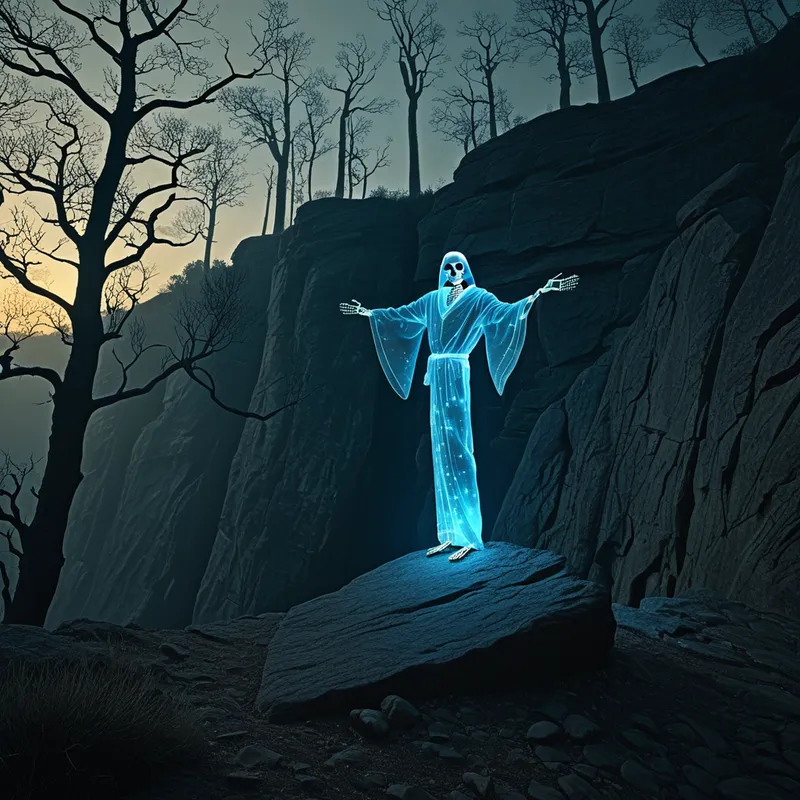
Then, from the place where the sky forgets itself, It came. It had no name that tongues could shape, for it was not a god of harvest or war, of love or thunder. It was a function, a necessity. The people, in their awe, called it The One Who Breathes For Us. Its form was the suggestion of a form: a vastness in the atmosphere, a gathering of light in the high passes, a pressure in the inner ear. It did not speak. It only was.
And It began to inhale.
It was not the inhalation that brought fear, but the profound, waiting silence that followed. The wind died. Birds fell mute in mid-flight. The very rustle of a mouse in the grass ceased. The world held its breath, pressed under the weight of an imminent truth. Every creature, from the elder beneath the great tree to the child clutching a doll of straw, felt a peculiar hollowing within their chest. It was the space being made.
Then, It exhaled.
This was not a wind. It was a Breath of Unmaking, a river of invisible fire and crystalline air. It did not blow upon things; it passed through them. As it swept across the land, it did not uproot trees or shatter stone. Instead, it scoured. The dust of forgotten oaths was whisked from mountain faces, revealing raw, gleaming rock. The murk of old feuds was rinsed from river water, making it so clear one could see the grief-smooth stones at the bottom.
But for the people, it was a more intimate terror. As the Breath touched them, it did not harm flesh. It bypassed skin and bone. It flowed directly into the hidden chambers of the self. And there, it found the things they had tucked away: the envy nursed like a ember, the love declared but never felt, the cowardice dressed as patience, the theft rationalized as survival. These were not thoughts now; under the Breath, they became objects. A man who had betrayed his brother felt a cold, hard knot of black iron manifest in his gut. A woman who secretly despised her vibrant daughter found a prickly, dead bramble coiled around her heart.
The world became a gallery of internal truth. People stumbled, clutching at the palpable symbols of their concealed selves. The air rang with the silent cacophony of a thousand private realities made unbearably public. Some wept in shame at the ugliness they carried. Others roared in rage at the injustice made solid within them. The village, the land, became a mirror—and no one could look away.
The Breath did not stop. It continued its inexorable passage. And here was the mystery, the turn in the tale: the Breath did not judge. It only revealed. And in that relentless, purifying exposure, a second process began. The iron knot, exposed to this clean, ruthless air, began to oxidize. It flaked, rusted, and slowly dissolved into a harmless red powder that the Breath carried away. The dead bramble, no longer fed by the dark soil of secrecy, dried, brittle, and crumbled to dust. The hidden thing, once brought utterly into the light of conscious acknowledgment, could not maintain its parasitic form. It was transmuted by the very act of being seen.
When the Breath finally sighed to a halt at the edge of the western sea, the world was not new. It was stripped. Raw. Trembling. But the thickness was gone. The air was sharp and clear, painful to lungs accustomed to lies. People looked at one another, and for the first time, they saw not masks, but beings marked by their struggles, cleansed by a shared ordeal. They were lighter. They were terrified. And they were, finally, true. The One Who Breathes For Us receded into the high atmosphere, its work complete, leaving behind a world capable of bearing the weight of its own honest story.
Cultural Origins & Context
The myth of the Purifying Breath is not the property of a single tribe or scroll, but a story-shape that emerges independently in Various traditions. It is found in fragments of epic poetry from nomadic steppe cultures, in the allegorical teaching-stories of desert mystics, and in the initiation rituals of forest-dwelling societies. Its tellers were often not the primary priests of the state gods, but the liminal figures: the healers who lived at the village edge, the traveling storytellers who carried news and nightmares, the ascetics who sought visions in solitude.
Its societal function was multifaceted. On one level, it was a cosmological etiological myth, explaining why the world periodically feels "cleansed" after a great storm or a societal catharsis. On a deeper level, it served as a profound ethical and psychological engine. It taught that concealment itself is a form of corruption, and that truth—no matter how painful—is not destructive, but ultimately purgative. The myth was often recited during times of collective stagnation, moral confusion, or before major communal decisions, acting as a psychic reset, a reminder that health begins with ruthless self-honesty.
Symbolic Architecture
The myth’s power lies in its stark, elegant symbolism. The One Who Breathes For Us is not a personal deity but an archetypal force of consciousness itself. It represents the impersonal, inevitable drive within the psyche toward integration and wholeness—what Jung termed the Self. Its breath is the agent of this process: the illuminating light of awareness that we cannot ultimately avoid.
The Breath does not destroy the shadow; it forces the shadow into form, where it can finally be seen, and thus, transformed.
The central, terrifying mechanism of the myth is the materialization of the psychological. Envy becomes iron. Self-deception becomes a bramble. This symbolizes the somatic reality of repressed content: it does take up space, it does create tension, illness, and neurosis. The psyche naturally expresses its conflicts in the body and in symbolic imagery (dreams, projections). The myth externalizes this internal, unconscious process into a world-event.
The resolution—the rusting and crumbling—is the core of the healing mystery. It signifies that the energy bound up in repression is released when the repressed material is consciously acknowledged. The "toxin" is neutralized not by being fought, but by being fully exposed to the air of consciousness. The iron was always capable of rusting; it only needed oxygen.
The Dreamer's Resonance
When this myth stirs in the modern unconscious, it rarely appears as a literal tale. It manifests as dream motifs of cleansing winds, revealing lights, or terrifying exposures. To dream of a wind that strips away the walls of your house, leaving you and your possessions naked to the neighborhood, is to dream the Purifying Breath. To dream of a light so bright it shows the skeletons within the living, or of vomiting up coins, keys, or black oil, is to experience this archetypal pattern.
Somnatically, the dreamer may be undergoing a process where long-held psychological structures—defenses, self-narratives, buried traumas—are becoming untenable. The psyche is applying its own "Breath," creating dreams of exposure to initiate a purge. The feeling upon waking is often one of raw vulnerability, but also of a peculiar, shaky clarity. The ego feels assaulted, because its carefully curated self-image is being dismantled. But the Self is orchestrating this, forcing a confrontation with what has been hidden to make room for a more authentic existence.

Alchemical Translation
In the alchemical journey of individuation, the Purifying Breath maps directly onto the critical stage of Nigredo. This is the dark night of the soul, where the contents of the personal unconscious are stirred up and brought to the surface. It is not a gentle process. It feels like a breakdown, an invasion, a terrifying loss of the known self.
The modern individual undergoes this not as a world-event, but as an inner one. A life crisis, therapy, profound loss, or simply the accumulated weight of inauthenticity can trigger it. The "Breath" is the courageous act of turning one's awareness inward to confront what is there: the iron knot of a childhood wound, the bramble of a jealous pattern, the dust of neglected potentials.
The alchemical vessel is not the sealed flask, but the open, trembling space of honest self-reflection. There, in the oxygen of attention, leaden secrets transmute into the gold of integrated understanding.
The triumph in the myth is not a victory over an external monster, but the endurance of a necessary truth. The goal is catharsis in its original sense: purification. For the individual, this means moving from a life lived in reaction to hidden complexes, to a life where those complexes have been acknowledged, their energy reclaimed, and their narrative integrated into a larger, more conscious story. One does not become perfect or sinless. One becomes transparent to oneself, and thus, capable of a more genuine relationship with the world. The Purifying Breath leaves the landscape stark, but it is only on clear, hard ground that true building can begin.
Associated Symbols
Explore related symbols from the CaleaDream lexicon: