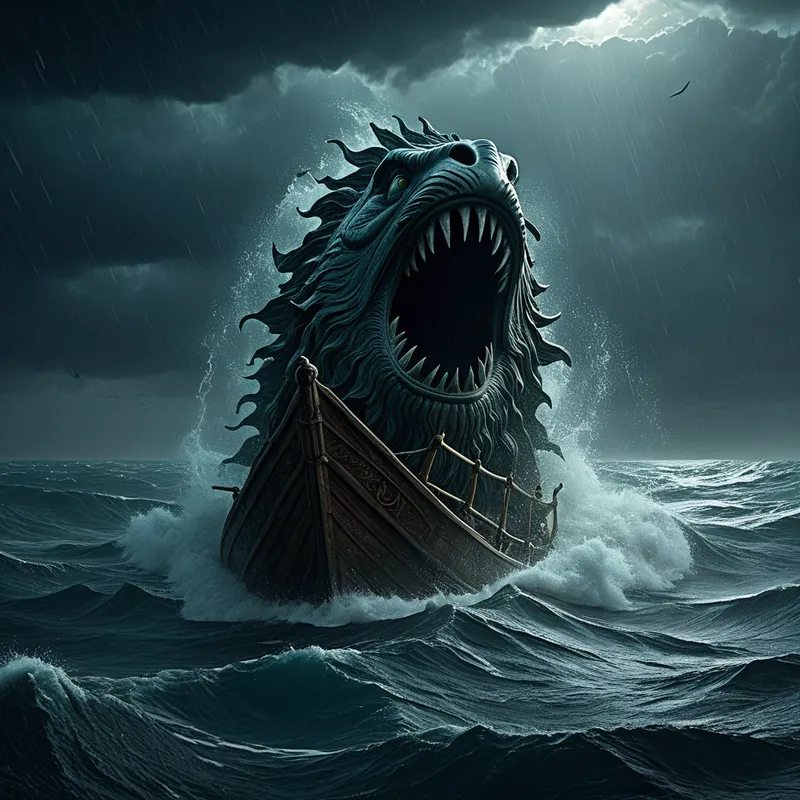
The Prophet Jonah Myth Meaning & Symbolism
A prophet flees his divine calling, is swallowed by a great fish, and emerges transformed, carrying a message of repentance to a foreign city.
The Tale of The Prophet Jonah
Hear now the tale of Jonah, son of Amittai, a man who tried to outrun the voice of the sky. The word of Yahweh came to him, sharp and clear as a command carved in stone: “Arise, go to Nineveh, that great city, and cry out against it, for their wickedness has risen up before me.”
But Jonah’s heart turned to cold lead in his chest. Nineveh! The jewel of the Assyrian terror, a metropolis of blood and conquest, the enemy of his people. To walk its broad streets and pronounce its doom? It was a sentence of death. So Jonah arose—but not for Nineveh. He fled toward Tarshish, away from the presence of Yahweh. In the port of Joppa, he found a ship bound for the edge of the world, paid its fare, and went down into its dark hold, seeking to hide from the divine in the belly of a wooden beast.
Out on the great sea, the sky grew black. The Lord hurled a mighty wind upon the waters, and a tempest arose so violent that the ship threatened to shatter. The seasoned sailors, men who prayed to a hundred gods, cried out each to his own deity and cast the cargo into the raging sea to lighten the ship. But Jonah had gone down into the innermost parts, fallen into a deep, troubled sleep. The captain found him and roared, “What do you mean, sleeper? Arise, call on your god!”
The lot was cast to find the cause of this calamity, and it fell upon Jonah. “Tell us,” they demanded, their faces etched with fear of the deep. “Who are you? Where do you come from?” And Jonah confessed: “I am a Hebrew, and I fear Yahweh, the God of heaven, who made the sea and the dry land.” He told them of his flight. A greater terror seized the men. “What shall we do to you that the sea may quiet down for us?” The waves climbed the sides like mountains.
Jonah’s voice was calm, resigned to a fate he had chosen. “Pick me up and hurl me into the sea; then the sea will quiet down for you, for I know it is because of me that this great tempest has come upon you.” The men rowed desperately for land, but could not, for the sea grew more and more tempestuous. At last, with a prayer for mercy to Jonah’s god, they took him and cast him into the fury. The sea ceased its raging at once.
But this was not the end. The Lord had appointed a great fish to swallow Jonah. Down, down he went, into a living darkness, into a chamber of gastric brine and rhythmic, crushing pressure. For three days and three nights, Jonah was in the belly of the fish, in a tomb that was also a womb.
From that profound depth, a prayer rose—a psalm of distress and remembering, of descent and hope. “I called out to Yahweh, out of my distress, and he answered me; out of the belly of Sheol I cried, and you heard my voice.” And the word of Yahweh came to the fish, and it vomited Jonah out upon the dry land.
The word came a second time: “Arise, go to Nineveh.” And Jonah arose and went, a man remade by the deep. He walked a day’s journey into the immense city and proclaimed, “Yet forty days, and Nineveh shall be overthrown!” And a miracle greater than the fish occurred: the people believed. From the greatest to the least, they put on sackcloth and fasted. The king himself rose from his throne, covered himself in sackcloth, and sat in ashes, decreeing that every man and beast should cry mightily to God and turn from evil.
God saw their works, that they turned from their evil way, and God relented of the disaster he had said he would bring upon them. And this relenting displeased Jonah exceedingly, and he was angry. He prayed, “Is this not what I said when I was still in my own country? I fled to Tarshish, for I knew you are a gracious God and merciful, slow to anger and abounding in steadfast love.” He asked to die, for he found his own success bitter.
He went out of the city and made a booth, sitting in its shade to see what would become of the city. And The Lord God appointed a plant, a qiqayon, which grew up over Jonah to shade his head and deliver him from his discomfort. Jonah was exceedingly glad because of the plant. But at dawn the next day, God appointed a worm that attacked the plant, so that it withered. When the sun rose, God appointed a scorching east wind, and the sun beat down on Jonah’s head until he grew faint and again asked for death.
God said to Jonah, “Do you do well to be angry for the plant?” And Jonah said, “Yes, I do well to be angry, angry enough to die.” And Yahweh said, “You pity the plant, for which you did not labor, nor did you make it grow, which came into being in a night and perished in a night. And should I not pity Nineveh, that great city, in which there are more than 120,000 persons who do not know their right hand from their left, and also much cattle?” The story ends here, with the question hanging in the air, unanswered, for Jonah and for all who hear it.

Cultural Origins & Context
The Book of Jonah is a unique work within the Hebrew prophetic canon. Unlike the direct oracles of an Isaiah or Jeremiah, it is a narrative about a prophet, framed as historical biography but functioning as profound theological parable. Scholars place its final composition in the post-exilic period (5th-4th century BCE), a time when Judah was a small province within the Persian Empire, grappling with questions of identity, divine justice, and the relationship between the God of Israel and the Gentile nations.
It was likely told and retold not merely as a record of events, but as a didactic story, a “midrash in narrative form” designed to challenge and expand the communal imagination. The figure of Jonah son of Amittai is mentioned briefly in 2 Kings as a prophet during the reign of Jeroboam II, but the legendary tale of the fish is attached to his name as its primary vehicle. The story served to critique narrow nationalism and prophetic self-righteousness, arguing for a vision of a God whose compassion is vast enough to encompass even the most hated of enemies, if they but turn from violence. It was a radical call to embody the very mercy one claims to worship.
Symbolic Architecture
At its core, the myth of Jonah is a masterful depiction of the psychology of avoidance and the necessity of descent. Jonah is the archetypal reluctant soul, called to a difficult, frightening task that disrupts his sense of order and safety. His flight to Tarshish is not mere cowardice; it is a symbolic movement away from destiny, consciousness, and growth, into the unconscious (the ship’s hold, the deep sleep).
The belly of the great fish is the ultimate vas of transformation. It is not a punishment, but a forced incubation.
The sea represents the chaotic, formless depths of the unconscious, the very substance from which ordered life emerged in the Genesis myth. To be thrown into it is to be dissolved back into primal matter. The fish, a creature of the deep, becomes the containing vessel for this dissolution. The three-day period mirrors other myths of descent and return (e.g., Christ in the tomb, Inanna in the underworld), symbolizing the complete cycle of death and rebirth necessary for a fundamental change of heart and perspective. Jonah does not conquer the fish; he is digested by his own refusal, stripped of his egoic resistance, and only then is he vomited forth—not as a victor, but as a servant finally ready to deliver his message, albeit with a heart still struggling to catch up to the divine will.

The Dreamer’s Resonance
When this myth pattern stirs in the modern psyche, it often manifests in dreams of being swallowed, trapped in enclosed organic spaces (submarines, caves, elevators that become stomachs), or fleeing a relentless, impersonal authority. The somatic experience is one of compression, suffocation, and profound helplessness. Psychologically, the dreamer is in a “Jonah state”: they have received a call from the Self—perhaps to leave a soul-crushing job, to confront a relationship truth, to create, or to forgive—and have actively chosen to flee it.
The ensuing “storm” in their waking life—anxiety, depression, a series of frustrating obstacles—is the psyche’s attempt to force a course correction. The dream of the belly is the unconscious illustrating the state they are already in: encapsulated in their own resistance, in a dark, digestive process where old identities and certainties are being broken down. It is a claustrophobic but necessary stage. The emergence from this dream-space, if it occurs, signals that the period of intense introversion and processing is nearing its end, and a new, if uncomfortable, direction is now possible.

Alchemical Translation
The alchemical journey of Jonah is a perfect map for the process of individuation. The initial call to Nineveh represents the stirring of the Self, the total personality, which often presents a demand that is deeply inconvenient to the conscious ego (the ego). The flight to Tarshish is the repression or active neglect of this call.
The alchemical nigredo occurs in the storm and the belly: the blackening, the dissolution, the utter despair that precedes illumination.
The storm is the conflict that arises when the conscious life is radically out of alignment with the Self’s intent—a state of psychic civil war. The casting into the sea is the surrender of the ego’s control, the beginning of the introversion of libido (psychic energy). The fish’s belly is the vas hermeticum, where the old Jonah undergoes solutio. His prayer from the deep is the beginning of a dialogue with the transpersonal, the first recognition of a reality larger than his grievance.
His emergence onto dry land is the albedo, a chastened clarity. He performs his duty, but the final act—his anger at God’s mercy and his attachment to the shade-giving plant—reveals the final, most subtle layer of ego to be transmuted: his sense of privileged righteousness, his conditional love. The book ends not with Jonah’s enlightenment, but with God’s question. The alchemical gold here is not Jonah’s perfect character, but the expansion of the reader’s consciousness to hold the terrifying, beautiful scope of a compassion that transcends tribal identity and personal comfort. The work is not done when the task is accomplished, but when the heart has grown large enough to contain the mystery of grace.
Associated Symbols
Explore related symbols from the CaleaDream lexicon: