The Promised Land from the Heb Myth Meaning & Symbolism
A people, exiled and wandering, are guided by a divine promise toward a land of destiny, forging their identity through covenant and trial in the wilderness.
The Tale of The Promised Land from the Heb
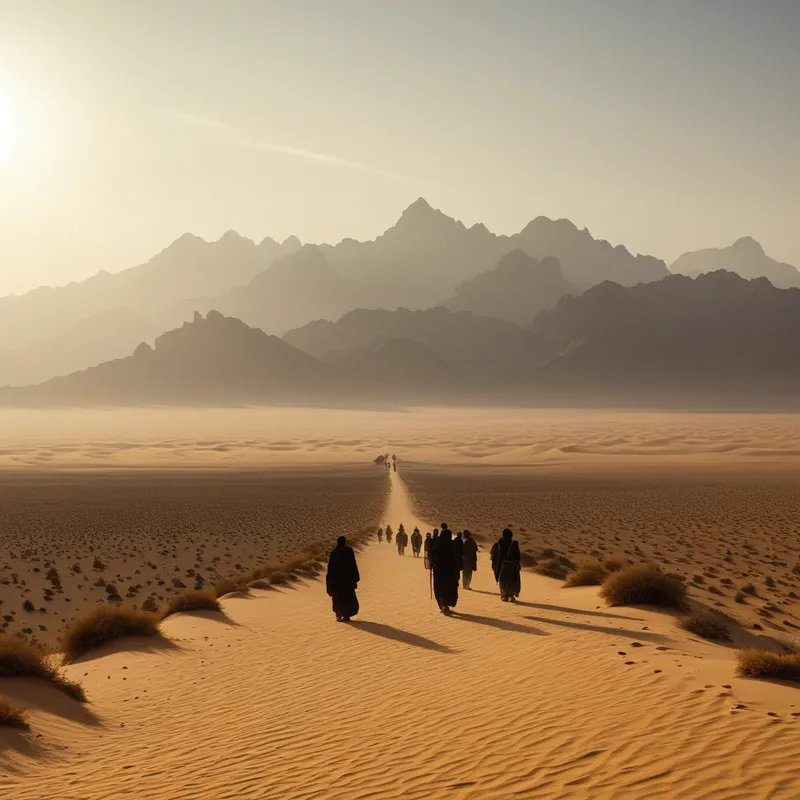
Hear now the tale whispered on the wind of the wastes, carried on the sigh of the displaced. It begins not in glory, but in the grinding weight of brick and straw. A people, their backs bent under a foreign sun, their spirits crushed beneath the heel of a mighty empire. They were the Heb, their name itself a sigh, a breath of servitude. Their world was the narrow strip between the taskmaster’s lash and the mud of the Nile, a land of flesh-pots that fed the body but starved the soul.
Then, a voice. Not in thunder, but in the crackle of a burning bush that was not consumed. It spoke to a fugitive, a man with blood on his hands and sand between his toes, a shepherd named Moshe. The voice named itself “I Am,” a presence older than pyramids, and it issued a promise that was also a command: “I have seen the affliction of my people. I will bring them out… to a land flowing with milk and honey.”
What followed was not a march, but an unmaking. Plagues broke the spine of the empire. A sea, stirred by an east wind, parted its watery jaws, offering a path of damp earth between walls of churning terror. The host of the Heb crossed over, leaving the old life to drown in the returning tide. They were free. But freedom, they learned, was a vast and terrifying emptiness.
The wilderness of Sin became their crucible. The sky rained bread like coriander seed, white and sweet. Water sprang from stricken rock. But their hearts remained heavy with the memory of onions and garlic. They grumbled against the emptiness, against the voice, against Moshe. Their god was a pillar of cloud by day, a tower of fire by night—a constant, unsettling companion who led them not to comfort, but to a barren mountain wreathed in smoke and the deafening blast of a shofar.
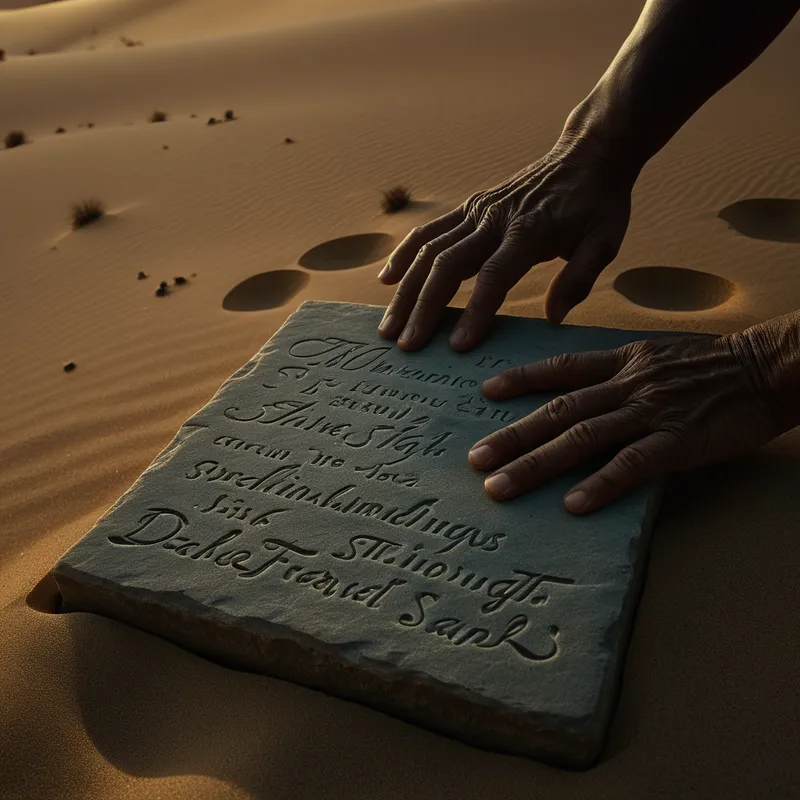
There, in that electric silence at the summit, the covenant was forged. Not just a promise of land, but a law of life—a intricate architecture of justice, purity, and remembrance carved into stone by divine finger. The land was not a gift for the taking; it was a destiny to be earned, a space that would hold their identity only if they held to the law. For forty years, a generation of slaves had to die in the sand, their children tempered by the wind, before they could even glimpse the river that marked the border.
They stood at last on the eastern bank, looking across the Jordan at wooded hills and stone cities. Moshe, the lawgiver, was gone, buried by the divine hand in an unknown grave. A new leader, Yehoshua, stood in his place. The promise hovered in the air, tangible as the scent of ripening figs from the other side. It was a land of giants and walled cities, a land that would demand blood and courage. The journey from the “what was” to the “what could be” was ending. The harder journey—of becoming a people worthy of the promise—was just beginning.
Cultural Origins & Context
This narrative core is one of humanity’s most potent and migratory stories. While its most detailed and influential codification exists within the Hebrew Bible, the pattern it describes—exile, divine guidance, a covenantal law, and a destined homeland—resonates as a universal cultural archetype. It is the foundational myth of diaspora and return, of ethnic and spiritual identity forged in opposition to oppression.
In its primary context, it functioned as the national epic of ancient Israel, recited during festivals like Passover to answer the child’s question, “Why is this night different?” It was a story of origin and destiny, explaining not just where the people came from (the house of bondage), but who they were: a people bound by a unique covenant with a transcendent deity. The law (Torah) given in the wilderness was the constitution of this new identity, making the wandering not a detour, but the essential birthplace of the nation. The story was preserved by priests, prophets, and storytellers, its transmission itself an act of cultural survival through Babylonian exile, Roman destruction, and global dispersion, ensuring the “promised land” remained a psychic reality long after geographical possession was lost.
Symbolic Architecture
Psychologically, the myth maps the soul’s journey from a state of unconscious enslavement to a conscious, responsible individuality. Egypt represents the complex—the familiar, regressive state that nourishes us (the flesh-pots) but limits our growth and autonomy. It is the tyranny of the known, the parental or societal expectations that shape our identity before we choose it for ourselves.
The wilderness is the liminal space of transformation, the necessary nigredo or chaos where the old self dissolves. The divine sustenance (manna, water from rock) symbolizes grace or unconscious support that emerges only when one has courageously left the old security behind.
The covenant is the critical pivot. It represents the moment the psyche moves from passive reception of a promise to active participation in a demanding structure of meaning.
The Law is not arbitrary restriction, but the symbolic architecture of the nascent Self. It provides boundaries, ethics, and rituals—a psychic container that allows a coherent identity to form out of the chaos of newfound freedom. The forty years of wandering signify the long, often tedious, process of integrating this new law, allowing the “slave mentality” to die off so a generation capable of self-governance can emerge.
The Promised Land, therefore, is not a place of mere rest and reward. It symbolizes the achieved state of psychological integration—a “flowing with milk and honey” indicating psychic fertility and nourishment that comes from living in alignment with one’s deepest covenant or calling. Yet, it is also a land with “giants,” representing the ongoing inner struggles, shadows, and complexities that remain even after a major threshold is crossed.

The Dreamer’s Resonance
When this myth stirs in the modern dreamscape, it often manifests during periods of profound life transition or existential crisis. The dreamer may find themselves in a vast, featureless desert, feeling profoundly lost yet driven by an inexplicable sense of direction. They may dream of being part of a large, faceless group on a march, or of standing before an immense, insurmountable wall (a city wall, a mountain) that they know they must breach.
Somatically, these dreams can be accompanied by feelings of acute yearning, restless legs, or a tightness in the chest—the body remembering the tension between the longing for destination and the anxiety of the journey. Psychologically, the dreamer is in the wilderness phase. They have left an old “Egypt”—a job, a relationship, a belief system—but have not yet arrived at the new structure. The dream reflects the psyche’s navigation of this unstructured space, its search for the inner “pillar of fire” (intuition, guiding principle) and its grumbling against the deprivation of old comforts. Dreaming of receiving tablets of law or a scroll signifies the unconscious offering a new personal ethic or code to adopt for the next stage of life.

Alchemical Translation
The alchemical process mirrored here is the entire opus, from initial separation to final coagulation. The exodus is the separatio—the conscious, often painful, decision to differentiate from the mass of the unconscious (Egypt). The wilderness wanderings encompass the stages of nigredo (the despair and grumbling), albedo (the purification and clarification through the law), and citrinitas (the dawning understanding of one’s purpose).
The crossing of the Jordan represents the final rubedo, the decisive commitment to incarnate the transformed self into the world of action and relationship.
For the modern individual, the myth models that a true promised land is never merely found; it is forged through covenant. The psychic transmutation occurs not in the arrival, but in the solemn agreement made in the wilderness—the conscious acceptance of a demanding, sacred law unique to one’s own soul. This law might be a creative discipline, an ethical commitment, a vow of self-honesty. It is the structure that turns wandering into pilgrimage. The “giants” in the land are the resistant complexes and personal shadows we must continually engage. Thus, individuation is shown not as a static state of blissful arrival, but as the dynamic, lifelong process of inhabiting a hard-won inner territory, governed by a law of one’s own deepest truth, forever flowing with the milk and honey of meaning.
Associated Symbols
Explore related symbols from the CaleaDream lexicon: