
The Promised Land Myth Meaning & Symbolism
A divine covenant of exile and return, where a people's forty-year desert wandering becomes a crucible for forging identity and destiny.
The Tale of The Promised Land
Hear now a tale of dust and stars, of a promise whispered in the dark of night. It begins not in a palace, but in the crushing heat of brick and straw, with the groans of a people bound. Their cries rose like smoke from the kilns of Egypt, a bitter incense that reached the very heavens. And the heavens heard.
A voice spoke from a bush that burned yet was not consumed, a voice that named itself YHWH. It called to a fugitive prince, a shepherd named [Moses](/myths/moses “Myth from Biblical culture.”/), whose staff would become a serpent and whose hand would leprously shine. “I have seen the misery of my people. I will bring them out… to a land flowing with milk and honey.” Thus was the covenant forged: liberation for loyalty, a journey for a home.
And so they fled, a ragged multitude, pursued by chariots of iron. [The sea](/myths/the-sea “Myth from Greek culture.”/) itself was cleft asunder, walls of [water](/myths/water “Myth from Chinese culture.”/) standing as a tomb for their pursuers and a womb for their new birth. They entered the vast, terrible embrace of the wilderness. Here, the promise was a distant rumor, and hunger was a present god. [Manna](/myths/manna “Myth from Biblical culture.”/) fell like frost each morning, and [water](/myths/water “Myth from Chinese culture.”/) sprang from stricken rock, yet their hearts hardened like clay in the sun. They built a calf of gold, a tangible god for an intangible journey, and the mountain thundered with divine wrath.
For forty years they wandered, a generation dying under the relentless sun, their bones becoming one with [the desert](/myths/the-desert “Myth from Biblical culture.”/) sands. Their children grew, knowing only the taste of manna and the weight of the promise. Scouts returned from Canaan with clusters of grapes so large they hung from a pole between two men, but also with tales of giants and walled cities that touched [the sky](/myths/the-sky “Myth from Persian culture.”/). Fear, that old serpent, coiled in their hearts once more. And so the circle of wandering continued, a slow, grinding pilgrimage of purification.
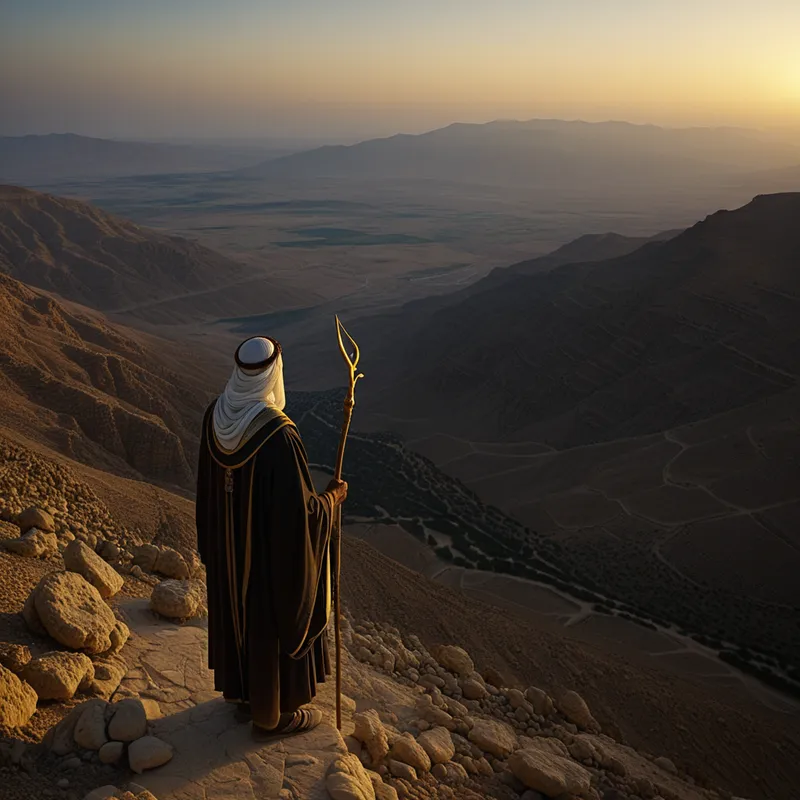
At last, they stood on the eastern banks of the Jordan, a new generation with fire in their eyes. Moses, the lawgiver, climbed the windswept ridges of Nebo. There, alone with [the wind](/myths/the-wind “Myth from Various culture.”/) and the Voice, he was shown the whole land—from the grey waters of the Great Sea to the palm trees of [Jericho](/myths/jericho “Myth from Biblical culture.”/). He saw it, this land of promise, with the clarity of one who cannot enter. He saw the end of the journey, and then he died, his work complete, his home the mountain and the memory of God. The mantle passed to Joshua, and the waters of the Jordan parted once more. [The walls of Jericho](/myths/the-walls-of-jericho “Myth from Biblical culture.”/) fell not to battering rams, but to the blast of shofars and a shout of faith. The long exile was over. The promise, at last, had a geography.
Cultural Origins & Context
This epic is the foundational national narrative of ancient Israel, woven from oral traditions, tribal stories, and liturgical recitations over centuries before being codified into [the Torah](/myths/the-torah “Myth from Jewish culture.”/), the first five books of the Hebrew Bible. It was not a single author’s creation but a collective memory, told around campfires, sung during Passover Seders, and proclaimed by priests at major festivals. Its primary function was identity-formation. For a people often politically small and under threat from empires, the story answered core questions: Who are we? We are the people Abraham was promised a land. Why are we here? Because God liberated us from bondage. What is expected of us? To uphold the covenant law given in [the wilderness](/myths/the-wilderness “Myth from Biblical culture.”/).
The myth served as a theological anchor, explaining possession of the land not merely through conquest, but as a divine grant contingent on ethical and ritual fidelity. It transformed geography into theology, making every hill and valley a testament to a story of chosenness, testing, and eventual fulfillment. In periods of exile, such as the Babylonian Captivity, the story gained even greater potency, becoming a map of hope for a future return, a second exodus.
Symbolic Architecture
At its [heart](/symbols/heart “Symbol: The heart symbolizes love, emotion, and the core of one’s existence, representing deep connections with others and self.”/), the myth of the [Promised Land](/myths/promised-land “Myth from Biblical culture.”/) is not a real estate contract, but a profound map of the [human](/symbols/human “Symbol: The symbol of a human represents individuality, complexity of emotions, and social relationships.”/) [psyche](/myths/psyche “Myth from Greek culture.”/)’s [journey](/symbols/journey “Symbol: A journey in dreams typically signifies adventure, growth, or a significant life transition.”/) toward [integration](/symbols/integration “Symbol: The process of unifying disparate parts of the self or experience into a cohesive whole, often representing psychological wholeness or resolution of internal conflict.”/). The core symbols form a complete [alchemy](/symbols/alchemy “Symbol: A transformative process of purification and creation, often symbolizing personal or spiritual evolution through difficult stages.”/) of the [soul](/symbols/soul “Symbol: The soul represents the essence of a person, encompassing their spirit, identity, and connection to the universe.”/).
The Promised Land is not a place you find, but a state of being you become worthy of through the ordeal of the desert.
Egypt represents the unconscious state of bondage—to literal oppression, but also to ingrained habits, collective identities, and comfort in suffering. It is the known [misery](/symbols/misery “Symbol: A profound state of emotional suffering, often involving deep sadness, hopelessness, and psychological distress that can manifest physically.”/). The Exodus is the first, violent act of [differentiation](/symbols/differentiation “Symbol: The process of distinguishing or separating parts of the self, emotions, or identity from a whole, often marking a developmental or psychological milestone.”/), [the ego](/myths/the-ego “Myth from Jungian culture.”/)’s painful [separation](/symbols/separation “Symbol: A spiritual or mythic division between realms, states of being, or consciousness, often marking a transition or loss of connection.”/) from the maternal/paternal complex of the familiar.
The [wilderness](/symbols/wilderness “Symbol: Wilderness often symbolizes the untamed aspects of the self and the unconscious mind, representing a space for personal exploration and discovery.”/) is the critical liminal [space](/symbols/space “Symbol: Dreaming of ‘Space’ often symbolizes the vastness of potential, personal freedom, or feelings of isolation and exploration in one’s life.”/), the psyche’s vas. Here, in the featureless void, the old [identity](/symbols/identity “Symbol: Identity represents the sense of self, encompassing personal beliefs, cultural background, and social roles.”/) (the slave generation) must die off. The giving of the Torah at Sinai in the [midst](/symbols/midst “Symbol: Midst often signifies being in the center of an experience, representing a state of engagement or confrontation with pressing life situations.”/) of this [emptiness](/symbols/emptiness “Symbol: Emptiness signifies a profound sense of void or lack in one’s life, often related to existential fears, loss, or spiritual quest.”/) is key: [structure](/symbols/structure “Symbol: Structure in dreams often symbolizes stability, organization, and the framework of one’s life, reflecting how one perceives their environment and personal life.”/) (law) is not the opposite of freedom, but its necessary container. The forty years symbolize the full cycle of purification, a time where the distractions of the old [life](/symbols/life “Symbol: The symbol of ‘Life’ represents a journey of growth, interconnectedness, and existential meaning, encompassing both the joys and challenges that define human experience.”/) fall away, forcing a confrontation with the divine (the [pillar of cloud](/myths/pillar-of-cloud “Myth from Biblical culture.”/)/fire) and with one’s own faithlessness ([the golden calf](/myths/the-golden-calf “Myth from Biblical culture.”/)).
Canaan itself is the [symbol](/symbols/symbol “Symbol: A symbol can represent an idea, concept, or belief, serving as a powerful tool for communication and understanding.”/) of [the Self](/myths/the-self “Myth from Jungian culture.”/), the psychic center where [consciousness](/symbols/consciousness “Symbol: Consciousness represents the state of awareness and perception, encompassing thoughts, feelings, and experiences.”/) (the Israelite identity) and the unconscious (the indigenous “others,” the giants) must engage in a continual, often difficult, process of [assimilation](/symbols/assimilation “Symbol: The process of integrating new experiences, identities, or knowledge into one’s existing self, often involving adaptation and transformation.”/) and settlement. It is not a state of perfect [peace](/symbols/peace “Symbol: Peace represents a state of tranquility and harmony, both internally and externally, often reflecting a desire for resolution and serenity in one’s life.”/), but of responsible engagement with one’s own inner complexity.
The Dreamer’s Resonance
When this myth stirs in the modern dreamer, it often manifests as a profound sense of longing coupled with frustration. One may dream of a beautiful, lush country always visible across a chasm or a raging river, yet find every path toward it blocked or looping back. Alternatively, one might dream of wandering in a vast, monotonous desert (an office building that becomes endless, a featureless highway) with a fading memory of a destination.
Somatically, this can feel like a deep restlessness in the bones, a feeling of being “stuck” in a life that feels like exile. Psychologically, it signals that the ego has outgrown its old “Egypt”—a job, a relationship, a self-concept—but is terrified of or resistant to the necessary wilderness phase. The dream is highlighting the interim period of dissolution, where the old supports are gone (the leeks and onions of Egypt) and the new sustenance (manna) feels alien and insufficient. The dreamer is in [the crucible](/myths/the-crucible “Myth from Alchemical culture.”/), being asked to trust a process whose end is not yet in sight.

Alchemical Translation
The alchemical journey of the Promised Land is [the opus](/myths/the-opus “Myth from Alchemical culture.”/) of individuation. It begins with the [nigredo](/myths/nigredo “Myth from Alchemical culture.”/): the blackening, the felt oppression and crisis in Egypt that makes the current life untenable. The call of [the burning bush](/myths/the-burning-bush “Myth from Christian culture.”/) is the first stirring of the Self, the transcendent function that demands a rupture.
[The Exodus](/myths/the-exodus “Myth from Abrahamic culture.”/) is the [separatio](/myths/separatio “Myth from Alchemical culture.”/), the forceful division from the familiar matrix. Then comes the long albedo, the whitening in the desert. This is the stage of reflection, purification, and the reception of the “law”—not as external rule, but as the internal structure of one’s own authentic ethics and values, forged in solitude. The murmuring and rebellion are the inevitable psychic resistances, the ego’s temptation to return to the known misery or to erect false idols (new, simplistic identities) to avoid the terrifying ambiguity of the journey.
The wilderness does not punish; it reveals. It strips away everything that is not essential to the covenant between your conscious life and your soul’s purpose.
Moses’s vision from Nebo and his death before entering represent a crucial psychological truth: the guide of one phase of life—the liberator, [the law](/myths/the-law “Myth from Biblical culture.”/)-bringer—cannot be the guide of the next. That part of the psyche must be relinquished. Joshua (whose name means “YHWH is salvation”) represents a new psychic authority, one that carries [the law](/myths/the-law “Myth from Biblical culture.”/) within and is capable of the active, confrontational work of settlement—facing the “giants” of our own unresolved complexes and “walled cities” of defensive structures.
Arriving in the Promised Land is the [rubedo](/myths/rubedo “Myth from Alchemical culture.”/), the reddening, not as a final static state, but as the beginning of a new, more demanding work: to cultivate, build, and dwell in the hard-won territory of the integrated Self. It is the moment when the journey inward becomes the foundation for a life lived outward, in authenticity and belonging. The promise is fulfilled not in possession, but in the ongoing, faithful engagement with the land of one’s own soul.
Associated Symbols
Explore related symbols from the CaleaDream lexicon: