The Prison of Saturn Myth Meaning & Symbolism
A myth of the exiled god Saturn, bound in a celestial prison of his own making, awaiting the alchemical key that will transmute leaden fate into golden wisdom.
The Tale of The Prison of Saturn
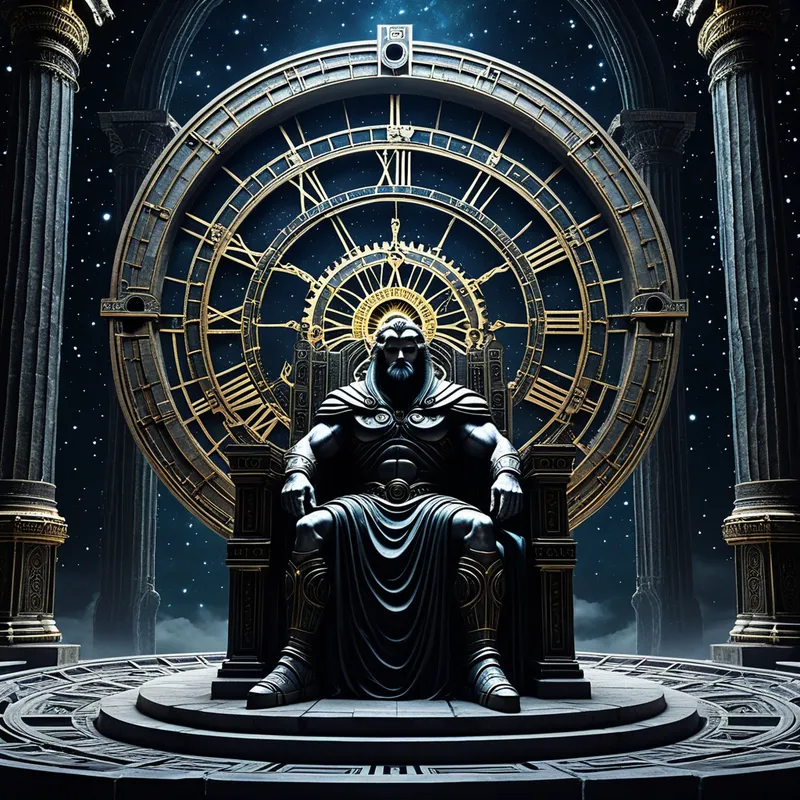
Listen. Before the seven metals knew their names, before the first alembic caught a single tear of dew, there was a silence. Not a peaceful quiet, but the profound, aching stillness of a throne room long abandoned. In this silence sat [Saturn](/myths/saturn “Myth from Alchemical culture.”/), the Old King. His realm was not of earth, but of the cold, high places between the wandering stars—a domain of perfect order, immutable law, and relentless cycles.
He was [the architect](/myths/the-architect “Myth from Various culture.”/) of boundaries, the weigher of souls, the scythe that harvests all things in their season. From the substance of his own being, he forged his kingdom: walls of celestial lead, buttressed by the unyielding mathematics of fate, moated by [the river](/myths/the-river “Myth from Buddhist culture.”/) of time itself. It was a perfect, terrible creation. Every action had its equal and opposite reaction; every birth contained its death; every ascent promised a fall. This was his great work, and he ruled from its exact center, a sovereign of sublime, sterile certainty.
But sovereignty, when absolute, becomes a cage. The very laws he spun to govern the cosmos began to govern him. The walls meant to define his power became bars. The cycles meant to demonstrate order became a wheel upon which he was bound. He did not notice the change at first, for a prison of one’s own essence is indistinguishable from [the self](/myths/the-self “Myth from Jungian culture.”/). He continued to judge, to measure, to enact the cold [justice](/myths/justice “Myth from Tarot culture.”/) of entropy. Yet, a deep melancholy settled in his leaden bones. The stars outside his windows traced their perfect, predictable paths, and their silent dance was a mirror of his own immobility. He was not deposed; he was entombed by his own masterpiece. The [prima materia](/myths/prima-materia “Myth from Alchemical culture.”/) of his being had been shaped into a perfect, inescapable form.
He awaited nothing, for his laws predicted everything. Yet, in the deep marrow of his metallic form, a strange, impossible seed lay dormant—a longing not for escape, but for dissolution. Not an end, but a breaking apart so complete that something new might, from the fragments, be imagined. He awaited [the alchemist](/myths/the-alchemist “Myth from Various culture.”/) who would not seek to conquer him, but to converse with him; not to shatter the prison, but to understand its lock. The key would not be of iron or gold, but of a question he had never thought to ask himself. And so, the Old King waits still, in the solemn twilight of his own making, the sovereign and the sole inmate of the Prison of Saturn.
Cultural Origins & Context
This myth does not belong to a single grimoire or a named philosopher’s stone. It is the underlying melody of the entire alchemical opus, whispered in the furnace glow of medieval laboratories and encoded in the cryptic emblems of the Renaissance. The “Alchemical” culture referenced here is not a nation, but a transnational, trans-temporal fraternity of seekers—philosophers, artists, proto-scientists, and mystics—who used the language of metallurgy and mythology to map the terra incognita of the soul.
The tale of Saturn’s imprisonment was passed down not as a linear narrative, but as a constellation of symbols: the scythe, the cube, the lead, the melancholic pose of the [nigredo](/myths/nigredo “Myth from Alchemical culture.”/). It was told in the recipe that called for “the lead of the philosophers,” in the warning that the work required “the baptism of Saturn,” and in the image of the god who devours his children—a metaphor for time consuming all creations. Its societal function was initiatory. It served as a warning and a map for [the adept](/myths/the-adept “Myth from Alchemical culture.”/): your greatest strength, your defining structure, will become the very [thing](/myths/thing “Myth from Norse culture.”/) that confines you. The work begins not in seeking power, but in recognizing one’s own, self-created captivity.
Symbolic Architecture
At its [heart](/symbols/heart “Symbol: The heart symbolizes love, emotion, and the core of one’s existence, representing deep connections with others and self.”/), the [Prison](/symbols/prison “Symbol: Prison in dreams typically represents feelings of restriction, confinement, or a lack of freedom in one’s life or mind.”/) of Saturn is not a place, but a state of [consciousness](/symbols/consciousness “Symbol: Consciousness represents the state of awareness and perception, encompassing thoughts, feelings, and experiences.”/). Saturn represents [the principle](/symbols/the-principle “Symbol: A fundamental truth, law, or doctrine that serves as a foundation for a system of belief, behavior, or reasoning, often representing moral or ethical standards.”/) of [structure](/symbols/structure “Symbol: Structure in dreams often symbolizes stability, organization, and the framework of one’s life, reflecting how one perceives their environment and personal life.”/): [the ego](/myths/the-ego “Myth from Jungian culture.”/), the super-ego, the societal norms, the internal critic, the [timeline](/symbols/timeline “Symbol: A symbolic representation of life’s progression, connecting past, present, and future. It embodies the human experience of time and personal evolution.”/) of our achievements, the rigid [identity](/symbols/identity “Symbol: Identity represents the sense of self, encompassing personal beliefs, cultural background, and social roles.”/) we construct to navigate [the world](/myths/the-world “Myth from Tarot culture.”/). This [structure](/symbols/structure “Symbol: Structure in dreams often symbolizes stability, organization, and the framework of one’s life, reflecting how one perceives their environment and personal life.”/) is necessary. It gives form to [chaos](/symbols/chaos “Symbol: In Arts & Music, chaos represents raw creative potential, uncontrolled expression, and the breakdown of order to forge new artistic forms.”/). But when it becomes an end in itself—when we worship the map instead of exploring the territory—it petrifies. The [prison](/symbols/prison “Symbol: Prison in dreams typically represents feelings of restriction, confinement, or a lack of freedom in one’s life or mind.”/) is built from the lead of our unquestioned assumptions, our “shoulds,” our fears of [chaos](/symbols/chaos “Symbol: In Arts & Music, chaos represents raw creative potential, uncontrolled expression, and the breakdown of order to forge new artistic forms.”/), and our attachment to a fixed self.
The guardian of the threshold is not a monster from the deep, but the architect of the doorway itself.
The myth’s profound psychological [truth](/symbols/truth “Symbol: Truth represents authenticity, honesty, and the quest for knowledge beyond mere appearances.”/) is that our most binding limitations are often self-imposed. They are forged from our talents, our traumas, our successful adaptations that have outlived their usefulness. The melancholia of Saturn is the depression of the [spirit](/symbols/spirit “Symbol: Spirit symbolizes the essence of life, vitality, and the spiritual journey of the individual.”/) that has achieved its goals only to find itself in a [gilded cage](/symbols/gilded-cage “Symbol: The gilded cage represents a paradox of luxury and confinement, where the beauty of one’s surroundings contrasts with a sense of entrapment and lack of freedom.”/). The awaited “alchemist” is the emerging Self, the part of the [psyche](/myths/psyche “Myth from Greek culture.”/) that can observe the prison from a [perspective](/symbols/perspective “Symbol: Perspective in dreams reflects one’s viewpoints, attitudes, and how one interprets experiences.”/) not entirely contained within its walls.
The Dreamer’s Resonance
When this myth stirs in the modern unconscious, it manifests in dreams of profound constraint and eerie, geometric stillness. One may dream of being trapped in a familiar room whose walls slowly close in, or of trying to run through a city of clockwork where every street leads back to the same square. The dreamer might find themselves in a job, relationship, or life pattern that feels perfectly constructed yet utterly suffocating—a “golden handcuff” scenario made manifest.
Somatically, this can feel like a heavy weight on the chest (the lead of Saturn), a stiffening of the joints, or a pervasive fatigue that sleep does not cure. Psychologically, it is the process of confronting what Jung called the midlife crisis, or more universally, any point where the [persona](/myths/persona “Myth from Greek culture.”/)—[the mask](/myths/the-mask “Myth from Various culture.”/) we wear for the world—cracks to reveal the stagnation beneath. The dream is not merely showing a problem; it is presenting the architecture of the prison itself, inviting the dreamer to become the cartographer of their own captivity as the first, crucial step toward liberation.
Alchemical Translation
The alchemical journey modeled here is the transmutation of lead into gold. This is not about destroying Saturn, but about redeeming him. The first operation, the nigredo, is the full, conscious entry into the prison. It is [the dark night of the soul](/myths/the-dark-night-of-the-soul “Myth from Christian Mysticism culture.”/) where one stops fighting the walls and instead sits, like Saturn, in the melancholic truth of one’s confinement. This despair is the solvent that begins to soften the rigid structures of the ego.
The key to the prison is forged in the heat of one’s own acknowledged limitation.
The subsequent stages—albedo, citrinitas, and finally [rubedo](/myths/rubedo “Myth from Alchemical culture.”/)—represent the slow transformation of that leaden self-awareness. The ego’s rigid laws (Saturn’s governance) are not broken, but informed by a deeper, more compassionate wisdom. Time becomes not just a scythe, but a medium for growth. Structure becomes not just a cage, but a vessel. The individual who undergoes this process achieves a paradoxical freedom: they still live within the boundaries of reality, time, and morality, but they are no longer an inmate of those principles. They have become, like the redeemed Saturn, the conscious steward of their own nature. The prison, understood, becomes [the crucible](/myths/the-crucible “Myth from Alchemical culture.”/). The lead, transmuted, becomes the gold of hard-won, embodied wisdom.
Associated Symbols
Explore related symbols from the CaleaDream lexicon: