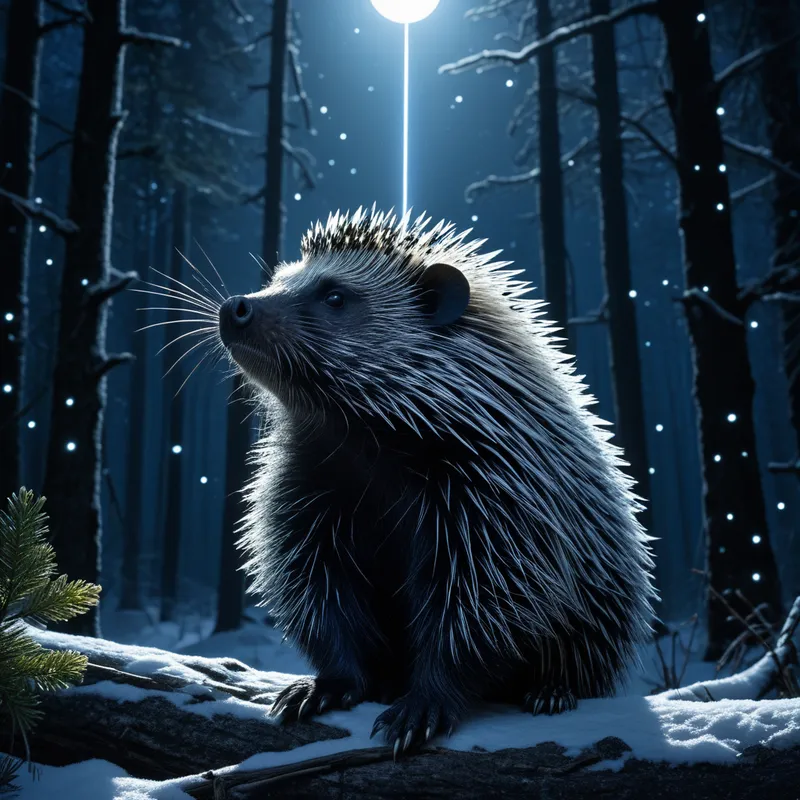
The Porcupine Myth Meaning & Symbolism
A community of animals, freezing in winter, must decide if the porcupine's warmth is worth the pain of its sharp quills.
The Tale of The Porcupine
Listen, and hear a tale from the time when [the world](/myths/the-world “Myth from Tarot culture.”/) was younger, and animals still spoke in the language of need. The great cold had come, a winter so fierce it seemed the sun had forgotten [the earth](/myths/the-earth “Myth from Hindu culture.”/). [The wind](/myths/the-wind “Myth from Various culture.”/) was a blade of ice, and the snow lay deep as a grave over the forest.
In this white silence, the creatures suffered. The fox’s breath hung in frozen clouds, the rabbit’s nose twitched with a chill that sank into the bone, and the badger in its sett felt the deep earth’s warmth stolen away. They were a parliament of shivers, a council of the nearly-frozen, huddled in the lee of a great, fallen oak. Their shared misery was a thin thread connecting them.
Then, through the glittering veil of snowfall, came a slow, deliberate shape. It was the porcupine, a walking fortress of shadows and sharpness. Its thousand quills, each a needle of polished dusk, rattled softly like dry reeds as it moved. It did not speak, but its presence was an offer and a question. Its body, beneath that fearsome armor, held the simple, animal warmth of life—a furnace small but potent.
“Come,” the winter seemed to whisper through the fox’s chattering teeth. “Share its heat, or die alone.” One by one, driven by a need deeper than fear, they drew close. The badger was first, pressing its thick fur against the porcupine’s flank. A sigh, almost a sob of relief, escaped it. Warmth, true and vital, flowed into its frozen limbs. The rabbit followed, then the fox, forming a desperate, trembling circle of life around the spiky heart of their salvation.
For a moment, it was paradise. The shared heat was a tiny sun in the darkness. But the porcupine, in its simple being, could not retract its nature. A shift, a sigh in sleep, a minor adjustment for comfort—and the sharp points found tender flesh. The rabbit squealed, leaping back with a pinprick of blood on its paw. The fox cursed, a quill embedded in its shoulder. The badger grunted in annoyed pain.
They retreated, nursing their small wounds, back into the bitter embrace of the cold. The warmth was a memory, a taunt. The cold, however, was a certainty—a slow, creeping death. Again, the agony of the frost drove them forward. Again, they pressed against the living heater. Again, after a time of blessed warmth, the inevitable prick, the sharp reminder, the painful retreat.
This dance of agony—the advance for warmth, the retreat from pain—became the rhythm of their long night. There was no malice in the porcupine, only the unchangeable fact of its quills. There was no cruelty in the animals, only the unbearable fact of the cold. The resolution was not a victory, but a grim, discovered truth. They found the precise distance—a hair’s breadth, a breath of space—where the porcupine’s radiant warmth could still be felt, just barely, without the piercing kiss of its quills. They slept fitfully in that fragile, negotiated space, neither fully warm nor fully wounded, surviving the night in a state of tense, necessary truce.

Cultural Origins & Context
This fable, attributed to the legendary storyteller Aesop, is a cornerstone of a global folklore tradition centered on animal allegory. Unlike myths of gods and heroes, Aesopic fables were pragmatic, worldly stories used by everyone from enslaved philosophers to Athenian statesmen. They were not recited in temples but in marketplaces, symposia, and the home; their tellers were not priests but slaves, travelers, and mothers. Their primary function was didactic—to impart worldly wisdom, social caution, and ethical principles in a memorable, accessible package.
The porcupine’s tale fits perfectly within this corpus. It is a story of social contract and political philosophy born from biological reality. It doesn’t deal with the divine right of kings but with the practical problem of coexistence. It was a tool for discussing the fundamental tensions of community: the individual’s inherent nature versus the group’s need, the cost of belonging, and the negotiation of personal boundaries for collective survival. In a world without central heating or social safety nets, the fable was a cold, clear model for understanding that sometimes, the solution to a shared problem is not perfect unity, but a carefully managed distance.
Symbolic Architecture
At its core, the myth presents an irreducible [paradox](/symbols/paradox “Symbol: A contradictory yet true concept that challenges logic and perception, often representing unresolved tensions or profound truths.”/) of [relationship](/symbols/relationship “Symbol: A representation of connections we have with others in our lives, often reflecting our emotional state.”/). The porcupine symbolizes [the Self](/myths/the-self “Myth from Jungian culture.”/) in its complete, defended integrity. Its quills are not weapons of aggression but instruments of [boundary](/symbols/boundary “Symbol: A conceptual or physical limit defining separation, protection, or identity between entities, spaces, or states of being.”/) [defense](/symbols/defense “Symbol: A protective mechanism or barrier against perceived threats, representing boundaries, security, and resistance to external or internal challenges.”/). They represent our innate traits, our traumas, our passions, our neuroses—the sharp, unyielding aspects of our [personality](/symbols/personality “Symbol: Personality in dreams often symbolizes the traits and characteristics of the dreamer, reflecting how they perceive themselves and how they believe they are perceived by others.”/) that are simply part of our [structure](/symbols/structure “Symbol: Structure in dreams often symbolizes stability, organization, and the framework of one’s life, reflecting how one perceives their environment and personal life.”/). The warmth is our [capacity](/symbols/capacity “Symbol: A measure of one’s potential, limits, or ability to contain, process, or achieve something, often reflecting self-assessment or external demands.”/) for [connection](/symbols/connection “Symbol: Connection symbolizes relationships, communication, and bonds among individuals.”/), [empathy](/symbols/empathy “Symbol: The capacity to understand and share the feelings of others, often manifesting as emotional resonance or intuitive connection in dreams.”/), love, and generative power—the vital [energy](/symbols/energy “Symbol: Energy symbolizes vitality, motivation, and the drive that fuels actions and ambitions.”/) we bring to any [relationship](/symbols/relationship “Symbol: A representation of connections we have with others in our lives, often reflecting our emotional state.”/) or [community](/symbols/community “Symbol: Community in dreams symbolizes connection, support, and the need for belonging.”/).
The other animals symbolize the collective, the community, or the other individuals who need what we have to offer (our warmth) but who are inevitably wounded by our full, undefended [presence](/symbols/presence “Symbol: Presence in dreams often signifies awareness or acknowledgment of something significant in one’s life.”/) (our quills).
The myth teaches that the Self, in its wholeness, is both a source of life and a source of pain. To deny the quills is to die of cold; to ignore them is to bleed.
The [winter](/symbols/winter “Symbol: Winter symbolizes a time of reflection, introspection, and dormancy, often representing challenges or a period of transformation.”/) is the [condition](/symbols/condition “Symbol: Condition reflects the state of being, often focusing on physical, emotional, or situational aspects of life.”/) of [life](/symbols/life “Symbol: The symbol of ‘Life’ represents a journey of growth, interconnectedness, and existential meaning, encompassing both the joys and challenges that define human experience.”/) itself—harsh, demanding, and necessitating connection for survival. The painful, repetitive dance of approach and retreat is the very process of socialization and intimacy. We are forever calibrating: How close can I get before I am hurt? How much of my own sharpness can I reveal before I am abandoned? The “[solution](/symbols/solution “Symbol: A solution symbolizes resolution, clarity, and the overcoming of obstacles, often representing a sense of accomplishment.”/)” of the precise [distance](/symbols/distance “Symbol: Distance in dreams often symbolizes emotional separation, unattainable goals, or the need for personal space and reflection.”/) is not a happy ending, but the [achievement](/symbols/achievement “Symbol: Symbolizes success, mastery, or reaching a goal, often reflecting personal validation, social recognition, or overcoming challenges.”/) of a sustainable [tension](/symbols/tension “Symbol: A state of mental or emotional strain, often manifesting physically as tightness, pressure, or unease, signaling unresolved conflict or anticipation.”/). It is the establishment of a functional boundary, a psychic [space](/symbols/space “Symbol: Dreaming of ‘Space’ often symbolizes the vastness of potential, personal freedom, or feelings of isolation and exploration in one’s life.”/) where connection and self-protection exist in a dynamic, fragile [equilibrium](/symbols/equilibrium “Symbol: A state of balance, stability, or harmony between opposing forces, often representing inner peace or external order.”/).

The Dreamer’s Resonance
When this myth pattern stirs in the modern unconscious, it often manifests in dreams of fraught intimacy. One might dream of trying to hold a beloved whose skin is made of glass or thorns, feeling both love and cutting pain. Or of a house where every room offers comfort, but the walls are lined with hidden needles. There may be somatic sensations upon waking—a tight chest, a feeling of being “prickly” or raw, an ache of loneliness despite being surrounded.
These dreams signal a psychological process of boundary reassessment. The dreamer is likely navigating a relationship—romantic, familial, professional, or communal—where their authentic nature (their “quills”) is causing friction or where they are being wounded by another’s inherent traits. The [psyche](/myths/psyche “Myth from Greek culture.”/) is working through the core dilemma: the desperate need for the warmth of connection versus the acute pain of unreserved closeness. The dream state rehearses the approach and retreat, seeking that elusive “precise distance.” It is the somatic and emotional processing of a truth the waking mind may resist: that love does not conquer all nature, and that survival sometimes requires a respectful gap.

Alchemical Translation
In the individuation process, the Porcupine myth models a critical stage of psychic transmutation: the conscious integration of one’s defensive structures. The alchemical work is not to file down the quills, but to recognize them as golden, essential components of the Self. The initial “[nigredo](/myths/nigredo “Myth from Alchemical culture.”/)” or blackening is the freezing winter of isolation, the feeling that one’s defended nature condemns them to loneliness. The “albedo” or whitening is the painful, repeated experimentation with closeness, the bleeding that leads to awareness.
The true transmutation occurs when the individual, like the animals in the tale, stops seeking a perfect, painless merger and instead learns to consciously negotiate the space.
The alchemical gold is not a state of blissful unity, but the earned wisdom to hold the tension of proximity and separation without falling into the fantasy of fusion or the despair of exile.
For the modern individual, this means moving from a childlike demand for unconditional acceptance (which is often a demand for others to ignore our quills) to an adult capacity for conditional intimacy based on mutual respect for boundaries. It is the translation of a biological fable into a psychological art form: the art of the viable relationship. We learn to radiate our warmth while acknowledging the honest danger of our spines, inviting others to find their own sustainable distance. In doing so, we cease to be a problem to be solved and become a reality to be skillfully, respectfully engaged—a whole creature, warm and sharp, surviving the long winter night in a state of conscious, chosen connection.
Associated Symbols
Explore related symbols from the CaleaDream lexicon: