The Platypus Creation Story Myth Meaning & Symbolism
A myth of the platypus, born from conflict and compromise, becoming a sacred symbol of unity and the beauty of impossible wholeness.
The Tale of The Platypus Creation Story
Listen. In the First Time, the Dreaming, the world was still being sung into shape. The rivers were finding their courses, the trees were stretching towards the newborn sun, and the animal families were settling into their own countries. In a land of deep, clear billabongs and whispering gum trees, there was peace, but it was a peace of separation. The water people and the land people kept to their own.
Elder Duck ruled the reedy shores and the still waters. Her children were graceful, their webbed feet perfect for paddling, their bills made for sifting the water’s surface. They sang songs of the morning mist and the taste of water-lilies. On the banks, in the dense undergrowth, Elder Water-Rat held sway. His people were sleek and strong, made for burrowing and diving, their sharp claws and thick fur suited to earth and current. They told stories of dark roots and the secrets of the riverbed.
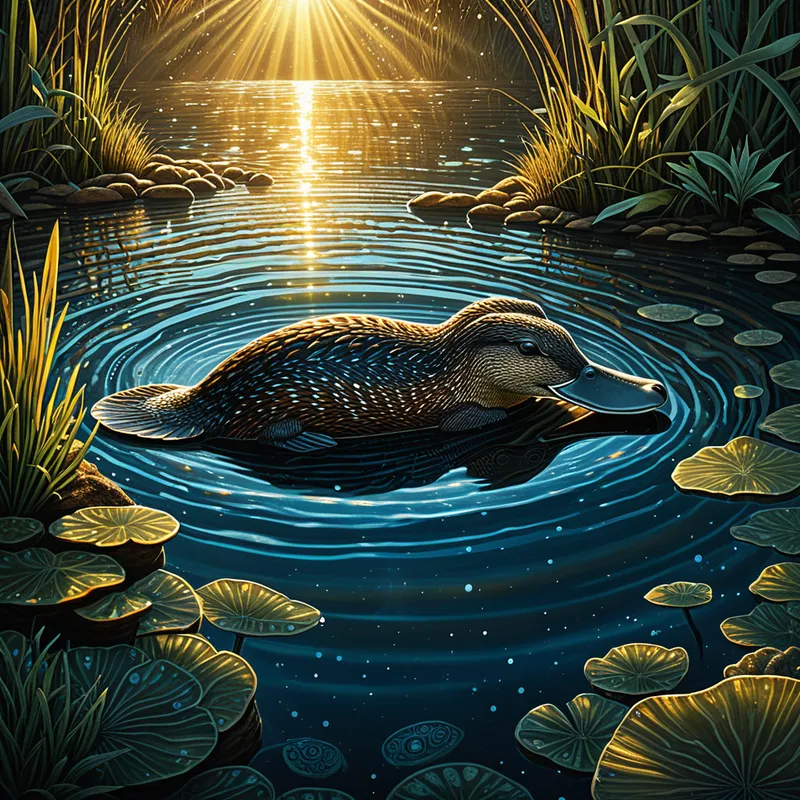
But from the union of these separate worlds, a new life was born. A child unlike any other. It had the bill and webbed feet of its duck mother, but the thick fur, clawed feet, and long, flat tail of its water-rat father. When the elders saw it, silence fell like a stone.
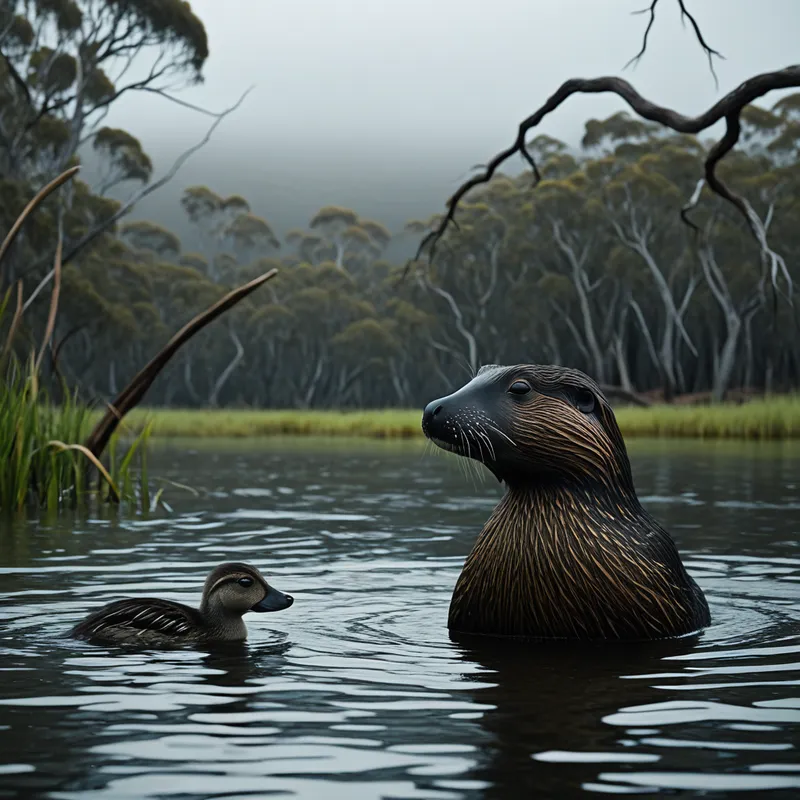
Elder Duck looked upon the child and felt a cold fear. “This is not of my people! Look at that tail, those claws—it is a creature of the mud!” She pushed it towards the bank. Elder Water-Rat recoiled. “It wears the face of the duck! It does not belong in our burrows. Take it back to the water!”
The child was caught between worlds, rejected by both. It tried to paddle with the ducks, but its fur grew heavy. It tried to burrow with the water-rats, but its bill was clumsy in the earth. It was an orphan of its own existence, a puzzle written in flesh and fur. The conflict grew, a storm of honking and chittering accusations that shook the leaves. The very land seemed to grieve for this impossible child.
Then, from the deep places where the earth’s spirit sleeps, the wise old Totem of the billabong stirred. It had watched the discord, feeling the song of the land grow discordant. In a voice that was the sound of water over ancient stone, it spoke to all the animals. “You argue over borders your own hearts have drawn. You see difference and call it wrong. Look!”
All eyes turned to the strange child, now sitting alone at the water’s edge, a perfect line between liquid and solid. “This child is not a mistake,” boomed the Totem. “It is a new song. It carries the gift of the duck to read the water’s surface and the gift of the water-rat to know the river’s heart. It is a bridge. It is a reminder that the world was not made in pieces, but as a whole.”
A profound silence settled. Elder Duck and Elder Water-Rat looked at the child, and for the first time, they did not see a reflection of their own lack, but a embodiment of a greater possibility. The child, feeling the shift, slipped into the water. It did not paddle like a duck, nor dive like a water-rat. It moved with a fluid, rolling grace that was entirely its own, a seamless dance between two elements. It had forged, in its loneliness, a new way of being. And so, the platypus was given its place, not on one side or the other, but in the sacred space between, a living testament to the creativity of the Dreaming.
Cultural Origins & Context
This story belongs to the rich tapestry of Aboriginal Australian mythology, with variations found among nations whose Country includes the eastern waterways where the platypus lives. It is a Creation Narrative, specifically a djun or “story of origin.” These narratives are not mere fables but the foundational legal, spiritual, and ecological constitutions of the world. They encode The Law.
The story would have been transmitted orally across generations, not as a simple bedtime tale, but as a vital lesson during ceremony and initiation. Elders, as custodians of knowledge, would recount it to teach about kinship obligations, the dangers of exclusion, and the sacredness of all life forms, especially those that defy easy categorization. The platypus itself, as a monotreme (egg-laying mammal), is a biological anomaly that science would struggle to explain for millennia. For Aboriginal cultures, its existence was already explained and sanctified by this myth, integrating the inexplicable into the ordered, meaningful cosmos of the Dreaming. The story functioned as a social tool, reinforcing that community is defined not by rigid purity, but by the ability to incorporate and honor difference.
Symbolic Architecture
At its heart, the Platypus Creation Story is a profound allegory for the birth of individual identity from the conflict of collective pressures. The platypus is the archetypal Orphan. It is the psyche that contains multitudes—inherited traits, conflicting parental complexes, societal expectations—that do not form a coherent, socially approved whole.
The true self is often born in the no-man’s-land between tribes, in the refusal to be wholly one thing or another.
The Duck and Water-Rat represent more than animal species; they symbolize primal opposites: water and earth, surface and depth, grace and grit, the maternal and the paternal lineages. Their initial rejection is not mere cruelty, but the instinctual fear of the psyche when faced with a synthesis it cannot comprehend. The conflict is the necessary tension that precedes creation. The wise Totem represents the transcendent function of the psyche—the Self, in Jungian terms—which emerges to resolve impossible conflicts by revealing a higher, unifying perspective. It does not choose a side but reveals a third, previously unimaginable option: integration.
The platypus’s ultimate home, the water’s edge, is the ultimate symbol. It is the Liminal Space, the shoreline of consciousness. It is not a compromise but a new territory altogether, the birthplace of authentic identity.
The Dreamer’s Resonance
When this mythic pattern stirs in the modern dreamer, it often manifests as dreams of profound alienation or bizarre hybridity. You may dream of being in a familiar family gathering but speaking a language no one understands. You may see yourself in a mirror, and your reflection is a composite of different animals or people. You might be trying to enter a house (the Duck’s water) or a cave (the Water-Rat’s burrow) but find your body is somehow wrong, barred from entry.
These are not nightmares of failure, but somatic signals of a psyche laboring to give birth to a more complete identity. The feeling of “not fitting in” any available box is the orphaned self knocking at the door of consciousness. The dream is rehearsing the ancient conflict, forcing the dreamer to feel the full weight of their internal divisions. The somatic experience—the heavy fur in water, the clumsy bill in earth—translates as anxiety, a sense of being unsuited to life’s demands. This is the necessary suffering that precedes the Totem’s intervention: the ego must fully experience the deadlock before the deeper Self can offer the reconciling symbol.
Alchemical Translation
The journey of the platypus is a perfect map for the Jungian process of Individuation. It begins in the prima materia of inherited traits and familial complexes (Duck and Water-Rat). The conflict (the rejection) is the essential nigredo, the blackening, the state of despair and confusion where all known identities fail.
The alchemical gold is not found in purity, but in the conscious embrace of one’s own paradoxical nature.
The orphaned creature’s lonely existence at the edge is the mortificatio, a symbolic death of the old, tribal identities. It is here, in this state of suspension, that the transcendent function (the Totem) can activate. This function does not come from the ego but from the archetypal depths of the Self. It performs the coniunctio oppositorum—the sacred marriage of opposites. The duck-bill and the rat-tail are not erased; they are unified into a new functional totality.
For the modern individual, this myth instructs us that wholeness is not about eliminating our contradictions, but about finding the unique, rolling gait—our own “way of swimming”—that uses all parts of our being. Our perceived flaws, our mixed heritage, our conflicting desires, are not errors to be corrected, but the very quills of creation with which we write our unique song into the world. To become the platypus is to cease seeking belonging from external tribes and to become the sacred, sovereign country where all parts of oneself are finally welcome.
Associated Symbols
Explore related symbols from the CaleaDream lexicon:
- Water — Represents the emotional, fluid realm of the Mother (Duck), the unconscious, and the surface of things, against which the new identity must first be tested.
- Earth — Symbolizes the grounded, instinctual, and hidden realm of the Father (Water-Rat), the practical world of burrows and roots from which the self must also differentiate.
- Bridge — The platypus itself is a living bridge, and its story models the psychic function of connecting disparate inner worlds, enabling passage from conflict to wholeness.
- Orphan — The core archetype of the myth, representing the part of the psyche that feels fundamentally alien, rejected, and tasked with forging its own identity from scratch.
- Dream — The entire narrative occurs within the Dreaming, the foundational layer of reality, indicating that this process of identity-creation is a primordial, sacred act.
- Origin — This is a story of origin not just for a species, but for the very concept of complex, non-binary identity born from synthesis.
- Shadow — The rejected, “impossible” child embodies the personal and collective shadow—the traits deemed unacceptable by the inner “elders” or society, which hold the key to completeness.
- Key — The platypus’s unique form and eventual acceptance become the key that unlocks a new understanding of kinship, law, and the nature of belonging itself.
- River — The flowing boundary and life-source where the drama unfolds, representing the ongoing process of life and the psyche, which carries the orphan towards its destiny.
- Circle — The storytelling circle of the animals, and ultimately the harmonious integration of opposites, symbolizing the completed Self where all parts belong.