The Platonic Solids Myth Meaning & Symbolism
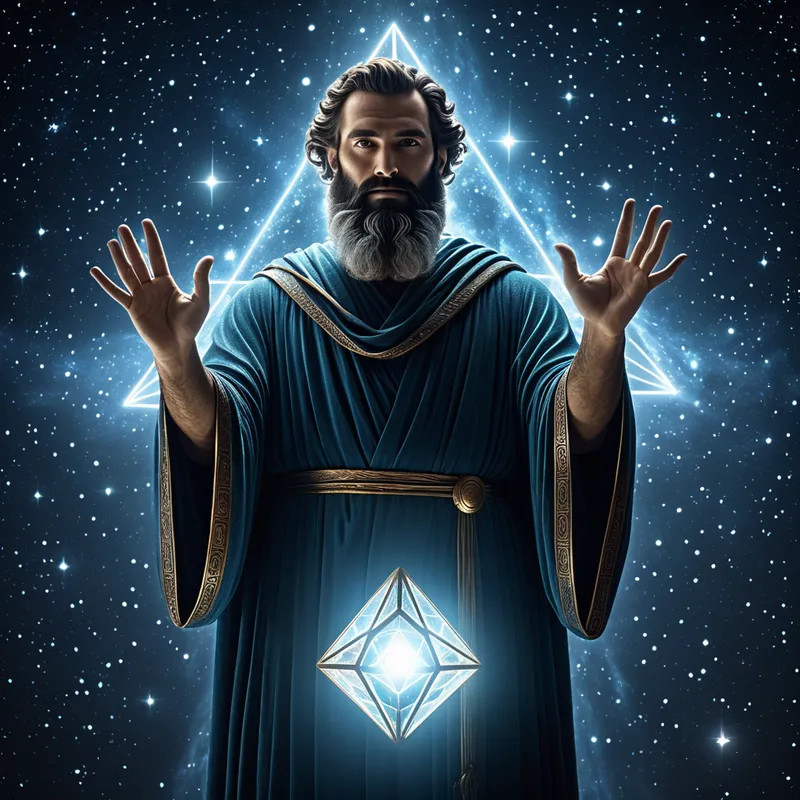
The Demiurge, gazing into the realm of perfect Forms, shapes chaotic matter into the five sacred solids, imposing divine order on the primal void.
The Tale of The Platonic Solids
Before time was measured, before the first star had a name, there existed only two realms. Above, silent and eternal, lay the realm of The Forms. Here, perfection was not an achievement but a state of being—a silent symphony of pure idea, of absolute truth, beauty, and justice. Below, churning in a ceaseless, blind dance, sprawled the realm of Khora—the Receptacle. It was a soup of potential, a shadowy flux of “all that could be,” but without shape, without order, without voice.
Between these two realms stood a solitary consciousness: the Demiurge. He was not a god of whimsy or wrath, but a divine artisan, a being whose very nature was benevolent reason. Gazing upward, he beheld the radiant, immutable Forms. Gazing downward, he perceived the chaotic, yearning potential of the Khora. A profound desire, born of his goodness, stirred within him: to bring the beauty he witnessed above into the shadowy substance below. He would craft a cosmos.
But the Khora was stubborn, ruled by a blind, necessary force called Ananke. It resisted order. It swirled and eddied in meaningless patterns. The Demiurge reached into its depths, and his hands met not solidity, but a slippery, recalcitrant mist. He would impose a shape, and it would melt away. He needed a language, a grammar of creation that could bridge the perfect world of thought and the flawed world of stuff.
He turned his gaze once more to the realm of Forms, and there he saw them: not stories, not creatures, but perfect shapes. The first was the Tetrahedron, a pyramid of blazing certainty. Then the Hexahedron, a steadfast anchor. The eight-faced Octahedron spun with elegant grace. The twenty-faced Icosahedron flowed with infinite possibility. And finally, the Dodecahedron, a sphere of many facets, in which the whole heavens seemed to be inscribed.
These were the keys. With a thought that was also an act, the Demiurge took the essence of these five perfect solids and imprinted them upon the Khora. He did not create them; he discovered them, eternal and waiting. He spoke not with words, but with geometry. Where his will touched the chaos, the Tetrahedron crystallized, and Fire leapt into being—sharp, ascending, and penetrating. He stamped the Hexahedron, and Earth settled—solid, immovable, and granting purchase. He set the Octahedron spinning, and Air whispered into existence—light, mobile, and connecting. He cupped the Icosahedron, and Water flowed—smooth, yielding, and embracing.
Finally, with the Dodecahedron, he did something different. He did not use it to create a single element, but to quilt the very fabric of the night sky, stitching the fixed stars upon its twelve pentagonal faces, making the vault of heaven itself a perfect, if distant, reflection of divine reason. The cosmos was born—a living, intelligent being, a “visible god” fashioned in the image of the eternal. The Demiurge looked upon his work, the marriage of Necessity and Reason, of perfect Form and imperfect Matter, and saw that it was good. The Solids were not merely shapes; they were the first verbs of a spoken universe, the archetypal bones of reality.
Cultural Origins & Context
This myth is not found in epic poetry but in philosophical dialogue—Plato’s Timaeus, written in Athens circa 360 BCE. It was not recited by bards in mead halls but debated by students in the Academy. Its primary teller is the title character, Timaeus, a learned astronomer and philosopher from Locri. The setting is a sober conversation following a day of discussion on the ideal state.
Its function was profoundly pedagogical and cosmological. In a culture transitioning from purely Homeric, anthropomorphic gods to more abstract philosophical principles, the myth of the Demiurge and the Solids provided a bridge. It offered a narrative that explained the origin and nature of the physical world (cosmogony) while upholding the supreme value of rational order (logos) over chaos. It was a “likely story,” as Timaeus calls it—a mythic model to help the human mind grasp the incomprehensible act of creation. It served to elevate mathematics and geometry from practical arts to sacred languages, the very script used by the divine to write the world into existence.
Symbolic Architecture
At its core, this myth is about the imposition of intelligible structure onto the unintelligible. The Demiurge represents the active, ordering principle of consciousness itself—the human (and cosmic) capacity for reason, purpose, and benevolent creation. The Khora, with its Ananke, symbolizes the raw, unconscious, and chaotic ground of being—the somatic, the instinctual, the material world with its blind laws and resistances.
The five Solids are the archetypal mediators, the primordial patterns that allow spirit to take on substance and chaos to gain a voice.
Each solid is a fundamental psychic operator. The Tetrahedron is the archetype of focused will and penetrating insight (Fire). The Hexahedron is the principle of stability, embodiment, and manifest reality (Earth). The Octahedron is the function of relationship, intellect, and communication (Air). The Icosahedron is the realm of emotion, intuition, and the fluid unconscious (Water). The Dodecahedron transcends these four, representing the organizing principle of the Self—the container of the entire psychic cosmos, the blueprint for wholeness.
The myth narrates the birth of the Logos from the union of divine pattern and necessary matter. It is not a creation ex nihilo, but a bringing-to-light of what was eternally latent. The struggle is not against a monster, but against formlessness—the most primordial adversary of the conscious mind.
The Dreamer’s Resonance
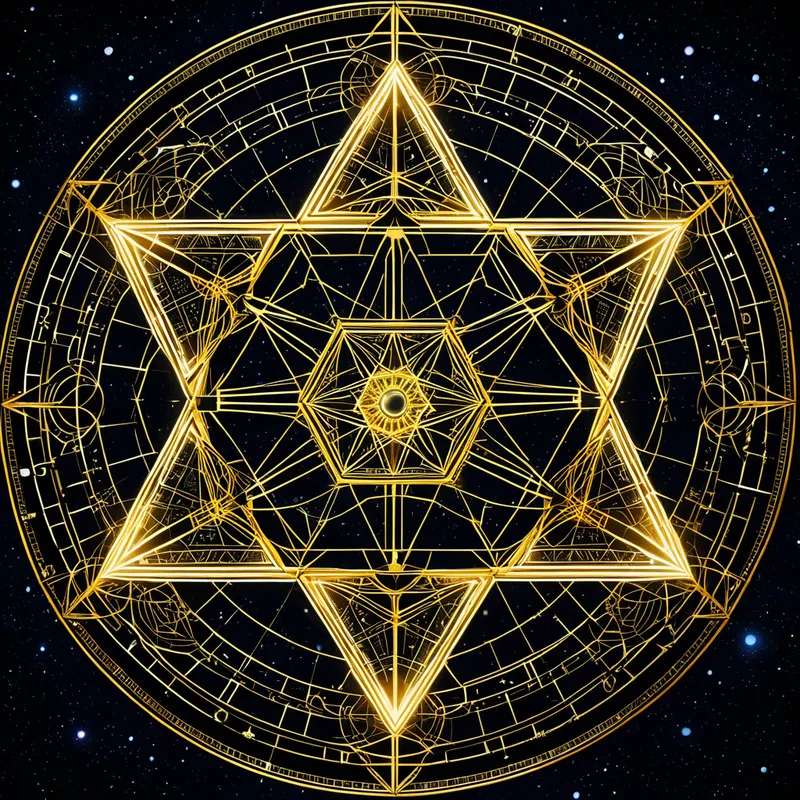
When these geometric forms appear in modern dreams, they signal a profound process of psychic structuring. A dream of a floating, glowing cube (Hexahedron) may emerge when the dreamer is seeking stability, building a career, or grounding a new idea in reality. It is the psyche laying its foundation. A spinning octahedron might accompany a time of crucial decision-making or social reconfiguration—the mind sorting and connecting.
Dreams of the icosahedron, with its many fluid facets, often coincide with emotional overwhelm or deep intuitive downloads, where feelings are too complex for simple shapes. The tetrahedron can appear as a piercing light or a sharp crystalline structure during breakthroughs, moments of sudden clarity that “cut through” confusion. The dodecahedron is the rarest visitor, a dream of cosmic belonging, suggesting the dreamer is touching the periphery of a greater, more harmonious pattern in their life, glimpsing the mandala of their own Self.
Somatically, these dreams can feel crystalline, electric, or deeply calm. They mark the unconscious mind working as a divine geometer, attempting to assemble the scattered pieces of experience into a coherent, living whole.
Alchemical Translation
For the modern individual, the myth models the entire journey of individuation. We are all, in a sense, the Demiurge in our own psychic universe. We begin in a state of inner Khora—a chaos of impulses, complexes, inherited patterns, and unformed potentials (the prima materia of the soul). Our conscious ego, the nascent Demiurge, looks to the “Forms”—the archetypal potentials for love, integrity, and purpose within the collective unconscious.
The work of a lifetime is to take the chaotic substance of our inherited and experiential matter and patiently, benevolently, impress upon it the patterns of wholeness.
The “Solids” we must discover and employ are the innate structures of our own being: the fire of our will and passion, the earth of our physical and practical life, the air of our intellect and relationships, the water of our emotional and intuitive depths. The conflict is the resistance of Ananke—our habits, our biology, our traumas, the “way things have always been” inside us. The act of creation is slow, fraught with imperfection (for we work with flawed material), yet driven by a benevolent intent toward greater order and beauty.
The triumph is not a perfect cosmos, but a cosmos—a ordered world where before there was chaos. It is the creation of a personal reality where reason and necessity, spirit and matter, conscious choice and unconscious depth, are woven together into a unique, living whole. To recognize the Platonic Solids within is to realize we are not building from nothing, but sculpting with eternal patterns, participating in the same divine geometry that first whispered the stars into existence.
Associated Symbols
Explore related symbols from the CaleaDream lexicon: