The Plagues of Egypt Myth Meaning & Symbolism
A mythic confrontation where ten catastrophic plagues shatter a kingdom's hubris, forcing a tyrant to release an enslaved people and their god.
The Tale of The Plagues of Egypt
Hear now the tale of the breaking of [the world](/myths/the-world “Myth from Tarot culture.”/), when [the river of life](/myths/the-river-of-life “Myth from Hindu culture.”/) became a river of death, and the sun itself was swallowed by a darkness you could feel. In the land of Kemet, under the gaze of the sun-god Ra, a people groaned. They were the children of Israel, bound in the mud and straw, their backs building monuments to a king who knew them not. Their god was a voice in [the wilderness](/myths/the-wilderness “Myth from Biblical culture.”/), a memory of a promise. And to that voice, he called a man: [Moses](/myths/moses “Myth from Biblical culture.”/), a stutterer, a shepherd, marked by both palace and desert.
He stood before the golden throne of [Pharaoh](/myths/pharaoh “Myth from Egyptian culture.”/), who wore the double crown and sat as the living incarnation of [Horus](/myths/horus “Myth from Egyptian culture.”/). The air was thick with incense and absolute power. “Thus says YHWH,” Moses uttered, his staff rough-hewn from desert wood against the polished lapis and gold. “Let my people go.” [Pharaoh](/myths/pharaoh “Myth from Egyptian culture.”/)’s laughter was cold. “Who is this YHWH, that I should obey his voice?”
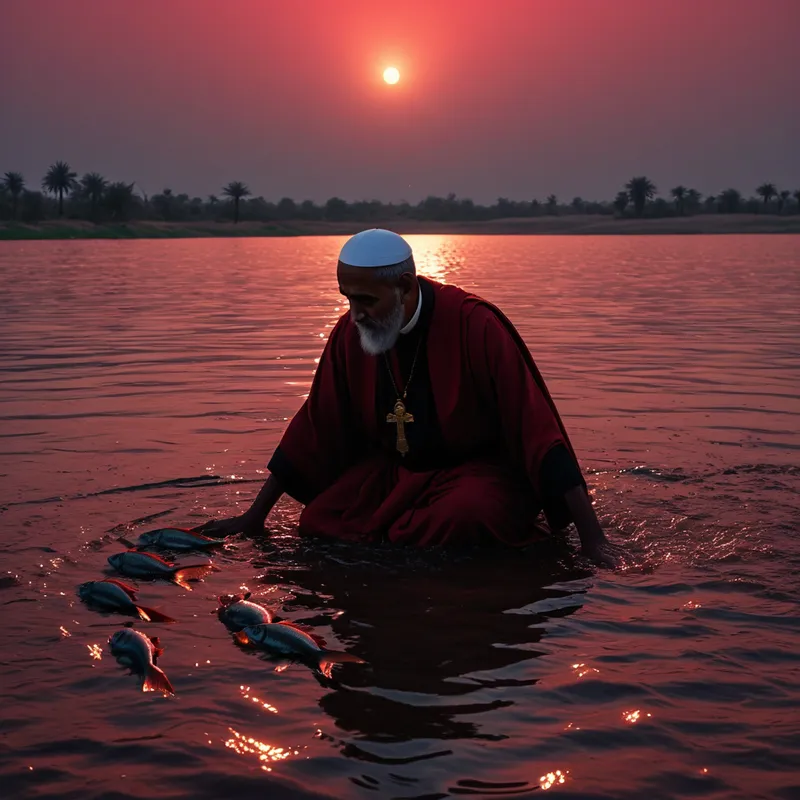
So began the unraveling. Aaron stretched the staff over the life-giving Hapi, and the waters churned, thickened, and turned to blood. The fish died, and [the river](/myths/the-river “Myth from Buddhist culture.”/) stank. The magicians of Egypt, wise in the arts of [Thoth](/myths/thoth “Myth from Global/Universal culture.”/), mimicked the feat with their enchantments, and Pharaoh’s heart hardened like baked clay.
Then came the frogs. They erupted from the reeking Nile, a seething, croaking tide that filled homes, beds, and ovens—a grotesque abundance of life where life had just been extinguished. Again, the court magicians summoned their own, but only Moses could make the plague end, leaving piles of stinking corpses. Next, the dust of [the earth](/myths/the-earth “Myth from Hindu culture.”/) became kinim, a creeping misery upon man and beast. For the first time, the magicians failed. “This is the finger of God,” they whispered, but Pharaoh would not listen.
The swarms came—arov—filling the air, a constant, maddening buzz. But in the land of Goshen, where [the Israelites](/myths/the-israelites “Myth from Abrahamic culture.”/) dwelt, there was none. A line was drawn in the sand of creation itself. Then, a murrain, a pestilence that struck only the livestock of Egypt, felling the sacred bulls of Apis in their stalls. Boils and blisters broke out on the skin of every Egyptian, from slave to Pharaoh, a personal affliction no amulet could ward off.
[The sky](/myths/the-sky “Myth from Persian culture.”/) then answered. Hail, mixed with fire, rained down in a storm that shattered trees and flattened crops, a violence from the heavens that spared the land of Goshen. Pharaoh confessed sin, but when the thunder ceased, his heart calcified once more. Then came the locusts, driven by an east wind, a living cloud that blotted out the land and devoured every green [thing](/myths/thing “Myth from Norse culture.”/) left, leaving a skeletal, silent earth.
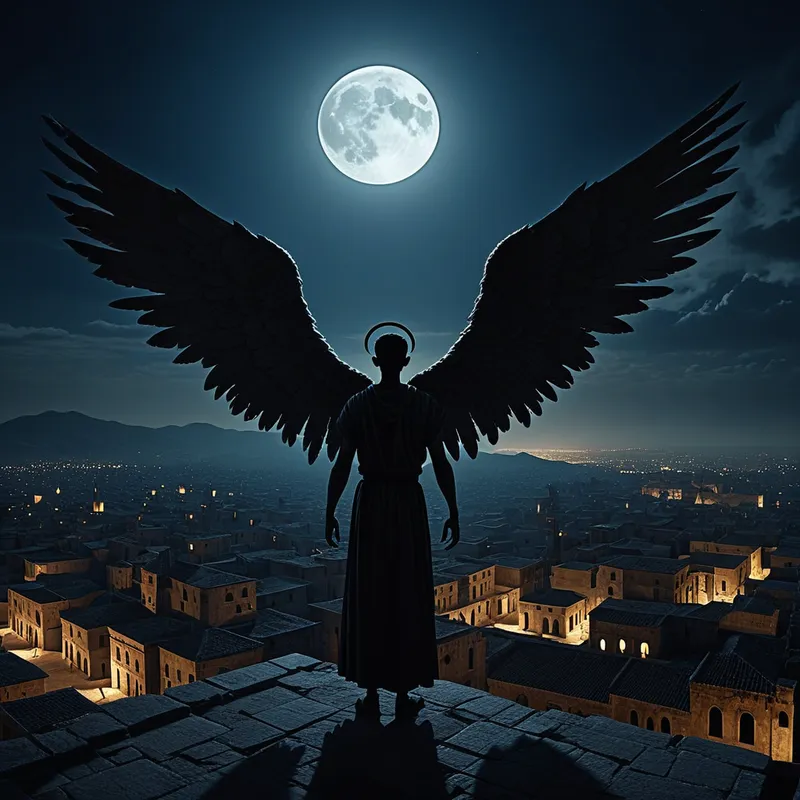
Then, a darkness descended—not of night, but of a tangible, suffocating gloom. For three days, no lamp could be lit, no flame sparked. Men did not rise from their places, gripped by a terror of the soul. Yet, in Goshen, there was light.
Finally, the midnight hour. A silence deeper than the darkness. Then, a cry—a great and terrible cry that rose from every Egyptian household. The firstborn, from the heir on the throne to the maid behind the mill, were struck. Only those who had heeded the strange, bloody sign—the mark of a lamb’s blood upon the doorpost—were passed over. In that night of universal mourning, Pharaoh’s will was finally, utterly broken. “Rise,” he said to Moses and Aaron in the darkness, “and go.” And the people, bearing their unleavened dough and the spoils of Egypt, fled into the waiting mouth of [the desert](/myths/the-desert “Myth from Biblical culture.”/), pursued no longer by soldiers, but by the echo of ten world-shattering words.
Cultural Origins & Context
This narrative forms the pivotal core of the Book of Exodus. It is a foundational national epic for ancient Israel, a story of identity forged in [the crucible](/myths/the-crucible “Myth from Alchemical culture.”/) of divine rescue. It was likely preserved and shaped through oral tradition for centuries before being codified during the monarchy or the Post-Exilic period. Its tellers were priests, prophets, and storytellers, using it to answer essential questions: Who are we? We are the people whom YHWH redeemed with a mighty hand. Why do we keep the Passover? To remember this night of liberation.
Societally, it functioned as a theodicy of power. It positioned the god of a band of slaves as superior to the entire [pantheon](/myths/pantheon “Myth from Roman culture.”/) and political might of the ancient world’s greatest empire. Each plague is a direct challenge to a specific Egyptian deity (the Nile god Hapi, the frog-goddess [Heqet](/myths/heqet “Myth from Egyptian culture.”/), the sun-god Ra), systematically dismantling the cosmic order of Egypt to establish a new one based on covenant and liberation.
Symbolic Architecture
The myth is a profound [drama](/symbols/drama “Symbol: Drama signifies narratives, emotional expression, and the exploration of human experiences.”/) of systemic confrontation. It is not merely a [contest](/symbols/contest “Symbol: A contest often symbolizes competition, personal challenges, and the desire for validation or achievement.”/) of [strength](/symbols/strength “Symbol: ‘Strength’ symbolizes resilience, courage, and the ability to overcome challenges.”/), but a [revelation](/symbols/revelation “Symbol: A sudden, profound disclosure of truth or insight, often through artistic or musical means, that transforms understanding.”/) of essence. Pharaoh represents the hardened, absolutist ego, the tyrannical principle that says, “I am the [system](/symbols/system “Symbol: A system represents structure, organization, and interrelated components functioning together, often reflecting personal or social order.”/), and the system is me.” His repeated hardening of [heart](/symbols/heart “Symbol: The heart symbolizes love, emotion, and the core of one’s existence, representing deep connections with others and self.”/) is the [psyche](/myths/psyche “Myth from Greek culture.”/)’s most dangerous [reflex](/symbols/reflex “Symbol: An involuntary, automatic response to a stimulus, often representing primal instincts, unconscious reactions, or lack of conscious control.”/): the [capacity](/symbols/capacity “Symbol: A measure of one’s potential, limits, or ability to contain, process, or achieve something, often reflecting self-assessment or external demands.”/) to witness its own destruction and call it [strength](/symbols/strength “Symbol: ‘Strength’ symbolizes resilience, courage, and the ability to overcome challenges.”/).
The plagues are not random punishments, but an escalating curriculum in consequence. They move from the external environment (Nile, land, sky) to the personal [body](/symbols/body “Symbol: The body in dreams often symbolizes the dreamer’s self-identity, personal health, and the relationship they have with their physical existence.”/) (boils), and finally to the intimate, future-facing [soul](/symbols/soul “Symbol: The soul represents the essence of a person, encompassing their spirit, identity, and connection to the universe.”/) (the firstborn). It is a symbolic unraveling of an entire worldview, [layer](/symbols/layer “Symbol: Layers often symbolize complexity, depth, and protection in dreams, representing the various aspects of the self or situations.”/) by layer.
The plague is the shadow of the system itself, made visible and tangible. The blood in the river is the life-force of the empire, revealed as stagnant and toxic.
The Israelites in Goshen represent the nascent Self, the potential for [life](/symbols/life “Symbol: The symbol of ‘Life’ represents a journey of growth, interconnectedness, and existential meaning, encompassing both the joys and challenges that define human experience.”/) and freedom that exists within the oppressive system but is not of it. Their protection marks the [differentiation](/symbols/differentiation “Symbol: The process of distinguishing or separating parts of the self, emotions, or identity from a whole, often marking a developmental or psychological milestone.”/) between the psyche’s captive structures and its indestructible core. The final [plague](/symbols/plague “Symbol: A symbol of widespread affliction, collective suffering, and uncontrollable forces that threaten social order and personal survival.”/), the sacrifice of the [lamb](/symbols/lamb “Symbol: A symbol of innocence, purity, sacrifice, and new beginnings, often representing vulnerability and gentleness.”/), introduces the terrifying and necessary law of substitution—that liberation often requires a sacred, conscious sacrifice, a marking of one’s dwelling to be spared from the generic destruction of the old order.
The Dreamer’s Resonance
When this myth stirs in modern dreams, it signals a profound, often chaotic, process of deconstruction. The dreamer is not Pharaoh nor Moses, but the land of Egypt itself—the interior landscape undergoing upheaval.
Dreaming of [water](/myths/water “Myth from Chinese culture.”/) turning foul speaks to a poisoned emotional or creative source. An infestation of creatures (insects, frogs) points to repressed contents of the unconscious swarming into conscious life, feeling invasive and uncontrollable. Boils and skin afflictions symbolize irritations and “breakouts” of shame, anger, or vulnerability that can no longer be contained. The plague of darkness is the classic experience of depression or a dark night of the soul, where all [inner light](/myths/inner-light “Myth from Buddhist culture.”/) and orientation vanish.
Such dreams are somatic messages of a psyche under immense pressure for change. The hardening heart of Pharaoh is the dreamer’s own resistance, the part that clings to familiar bondage over fearful freedom. The dream sequence is the unconscious insisting, with increasing intensity, that the current internal regime is unsustainable and must fall.

Alchemical Translation
Psychologically, [the Exodus](/myths/the-exodus “Myth from Abrahamic culture.”/) is the archetypal journey of individuation—the struggle to liberate the authentic Self from the tyranny of the hardened ego and the collective complexes (the “Egypt”) that hold it captive. [The ten plagues](/myths/the-ten-plagues “Myth from Biblical culture.”/) model the often-traumatic process of psychic transmutation.
The alchemical operation here is [separatio](/myths/separatio “Myth from Alchemical culture.”/) and mortificatio—the separation of the pure from the impure, and the necessary death of an old state. Each plague forces a distinction: between the life-giving and life-taking systems, between what belongs to Pharaoh and what belongs to [the Self](/myths/the-self “Myth from Jungian culture.”/). [The ego](/myths/the-ego “Myth from Jungian culture.”/), like Pharaoh, will employ its own “magicians” (rationalizations, distractions, old coping skills) to mimic and thus neutralize the transformative pressure, but eventually, these tricks fail.
The culmination of the work is not the escape, but the Passover—the conscious, ritual act that accepts a sacred sacrifice (an old identity, a cherished illusion) to protect the nascent, vulnerable life within from the final, annihilating stroke of the process.
The plagues clear the space. They shatter the idols of the old kingdom so that the soul can depart into the wilderness, the vas or vessel where the new covenant with the Self will be forged. For the modern individual, this myth maps the painful but essential journey from being a subject of an internal Pharaoh (the complex-driven personality) to becoming a pilgrim in dialogue with the mysterious, demanding voice of one’s own deepest being. The goal is not to become Moses, the perfect prophet, but to allow the Moses-within—the reluctant, stammering call to authenticity—to confront [the Pharaoh](/myths/the-pharaoh “Myth from Egyptian culture.”/)-within, until the heart, however hardened, finally breaks open.
Associated Symbols
Explore related symbols from the CaleaDream lexicon: