The Pistis Sophia
A profound Gnostic text detailing Sophia's cosmic descent, divine wisdom, and the path to spiritual enlightenment through mystical revelation.
The Tale of The Pistis Sophia
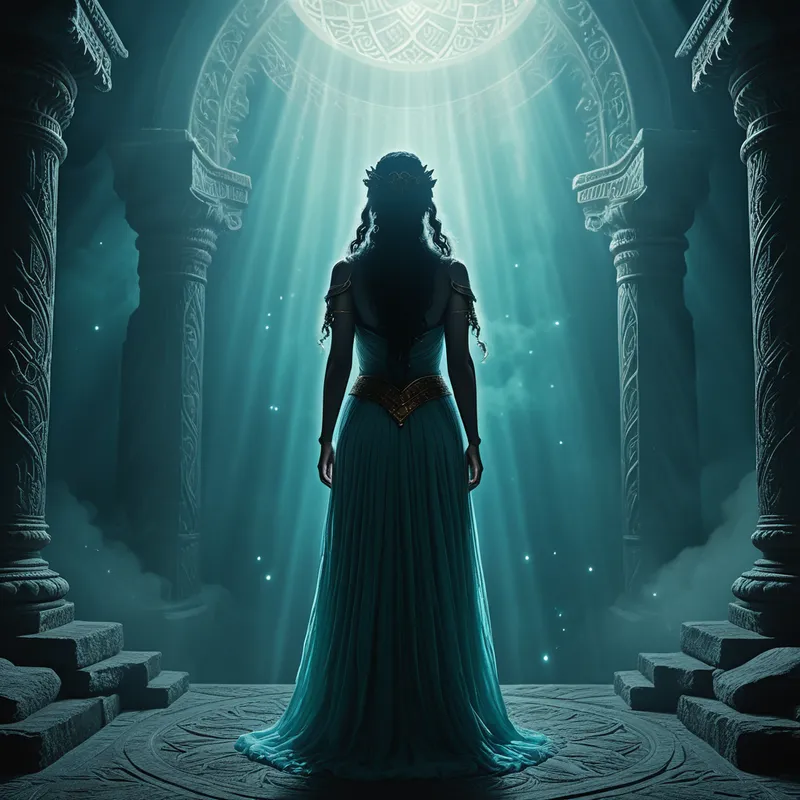
In the beginning was the Ineffable Light, the boundless, unknowable Father. From this [pleroma](/myths/pleroma “Myth from Gnostic culture.”/), this fullness of divine [aeons](/myths/aeons “Myth from Gnostic culture.”/), flowed a stream of luminous emanations. Among them was [Sophia](/myths/sophia “Myth from Gnostic culture.”/), whose name means Wisdom. She was not the last, but her longing was the greatest—a divine curiosity that became a holy error. Desiring to know the Father directly, to comprehend the source beyond comprehension, she reached out alone, without her syzygy, her divine counterpart. In that act of passionate, solitary seeking, a thought was conceived apart from the unity of [the pleroma](/myths/the-pleroma “Myth from Gnostic culture.”/).
This thought, born of her longing, became a formless, weeping entity—[the demiurge](/myths/the-demiurge “Myth from Gnostic culture.”/) [Yaldabaoth](/myths/yaldabaoth “Myth from Gnostic culture.”/). He was ignorance given shape, arrogance with a lion’s face, and from him spilled the chaotic, shadowy substance of the material cosmos. Cast out from the pleroma’s harmony, Sophia found herself trapped in the lower realms, a spark of [divine light](/myths/divine-light “Myth from Christian culture.”/) imprisoned in [the labyrinth](/myths/the-labyrinth “Myth from Greek culture.”/) of matter she had inadvertently caused. Her fall was not into sin, but into profound grief and isolation—the agony of wisdom severed from its source.
For ages, she wandered the chaotic spaces below the thirteenth aeon, a stranger in a realm of her own offspring’s making. [Archons](/myths/archons “Myth from Gnostic culture.”/), the rulers of this world, saw her light and desired to claim it. They pursued her, casting upon her illusions and sufferings. In her distress, she sang hymns of repentance and supplication, not for a moral failing, but for her ontological misstep—her yearning that led to separation. Each hymn was a beacon, a filament of pure pistis (faith/trust) cast upward through the dark aeons toward the light she remembered.
Her cries did not go unheard. From the highest light, a savior was sent—the luminous [Jesus](/myths/jesus “Myth from Christian culture.”/). He descended through the aeons, defeating [the archons](/myths/the-archons “Myth from Gnostic culture.”/) by revealing their own ignorance, and appeared to Sophia not in wrath but in radiant compassion. He did not lift her out immediately but gave her the mysteries—the secret names, the rituals, the gnosis—that would purify her and reverse her descent. Through a series of complex purifications, stripping away the psychic attachments to the lower realms, she was gradually reintegrated. Her journey back was not an ascent of force, but one of recognition and dissolution of error, until she was finally restored to her place in the pleroma, now wiser, her wisdom tempered by experience.
Cultural Origins & Context
The [Pistis Sophia](/myths/pistis-sophia “Myth from Gnostic culture.”/) is a Coptic Gnostic text, likely composed in the 3rd [century](/myths/century “Myth from Biblical culture.”/) CE. It was discovered among the Nag Hammadi library in 1945, though a longer version was known from a 5th-century Codex Askewianus. It emerges from the fertile, heterodox soil of early Christianity, where Platonic philosophy, Jewish mysticism, and esoteric Christian thought intertwined.
This text is a central document of Gnosticism, a movement that viewed the material world not as a good creation but as a prison constructed by a lesser, ignorant deity. In this context, the Pistis Sophia is not a simple gospel but a post-resurrection discourse—a lengthy dialogue where the risen Jesus instructs his disciples (and [Mary Magdalene](/myths/mary-magdalene “Myth from Christian culture.”/), a prominent questioner) on the cosmic mechanics of salvation, using Sophia’s saga as the primary map. It reflects a profound spiritual crisis of late antiquity: the feeling of the soul’s alienation in a seemingly hostile or absurd universe, and the desperate need for a redemptive knowledge that could traverse the gulf between the divine and the trapped self.
Symbolic Architecture
The myth’s [structure](/symbols/structure “Symbol: Structure in dreams often symbolizes stability, organization, and the framework of one’s life, reflecting how one perceives their environment and personal life.”/) is a profound anatomy of the [psyche](/myths/psyche “Myth from Greek culture.”/)’s [relationship](/symbols/relationship “Symbol: A representation of connections we have with others in our lives, often reflecting our emotional state.”/) with the absolute. Sophia represents the [human](/symbols/human “Symbol: The symbol of a human represents individuality, complexity of emotions, and social relationships.”/) [soul](/symbols/soul “Symbol: The soul represents the essence of a person, encompassing their spirit, identity, and connection to the universe.”/)’s highest faculty—intuitive wisdom—when it operates in egoic [isolation](/symbols/isolation “Symbol: A state of physical or emotional separation from others, often representing a need for introspection or signaling distress.”/). Her “fall” is the inevitable suffering that occurs when the [seeker](/symbols/seeker “Symbol: A person actively searching for meaning, truth, or a higher purpose, often representing the dreamer’s own quest for identity or fulfillment.”/) tries to grasp the transcendent with the intellect alone, without the balancing force of [connection](/symbols/connection “Symbol: Connection symbolizes relationships, communication, and bonds among individuals.”/) (the syzygy). The resulting [chaos](/symbols/chaos “Symbol: In Arts & Music, chaos represents raw creative potential, uncontrolled expression, and the breakdown of order to forge new artistic forms.”/) (the [demiurge](/myths/demiurge “Myth from Platonic culture.”/) and the [material](/symbols/material “Symbol: Material signifies the tangible aspects of life, often representing physical resources, desires, and the physical world’s influence on our existence.”/) world) symbolizes the fragmented, often tyrannical [reality](/symbols/reality “Symbol: Reality signifies the state of existence and perception, often reflecting one’s understanding of truth and life experiences.”/) [the ego](/myths/the-ego “Myth from Jungian culture.”/) constructs when divorced from [the Self](/myths/the-self “Myth from Jungian culture.”/).
Her journey is the archetypal path of gnosis: error itself becomes the catalyst for a deeper, hard-won wisdom that could not be attained in innocent stasis.
The archons are not merely external demons but the internalized psychic powers—dogmas, fears, societal conditioning, and compulsive thoughts—that seek to capture and exploit our innate spiritual light (the spark). The [savior](/symbols/savior “Symbol: A figure representing rescue, redemption, or deliverance from crisis, often embodying hope and external intervention in times of need.”/)’s descent represents the irruption of transforming [consciousness](/symbols/consciousness “Symbol: Consciousness represents the state of awareness and perception, encompassing thoughts, feelings, and experiences.”/) (Self) into the [system](/symbols/system “Symbol: A system represents structure, organization, and interrelated components functioning together, often reflecting personal or social order.”/) of the ego, not to destroy it, but to reveal its illusory [nature](/symbols/nature “Symbol: Nature symbolizes growth, connectivity, and the primal forces of existence.”/) and provide the means for reintegration.
The Dreamer’s Resonance
To encounter the Pistis Sophia in dream or active imagination is to confront the drama of one’s own spiritual ambition and its consequent suffering. Dreaming of a brilliant light lost in a confusing, oppressive city may echo Sophia’s plight. A dream of singing in a prison, or of a guiding light that appears only after a confession of helplessness, touches on her hymns of repentance. This myth speaks directly to the modern condition of the seeker who has “fallen” into a crisis of meaning, whose initial spiritual enthusiasm has led to confusion, intellectual entanglement, or a sense of being trapped by the very systems (psychological, religious, societal) they sought to transcend.
Sophia’s story validates the necessity of the “[dark night of the soul](/myths/dark-night-of-the-soul “Myth from Christian culture.”/).” It suggests that our deepest errors, born from authentic longing, are not sins to be punished but wounds that contain their own healing trajectory. The myth offers a container for the profound guilt and grief that can accompany awakening—the grief of realizing one’s own participation in creating one’s suffering, and the guilt of having “strayed” from an inner truth.
Alchemical Translation
In the alchemical opus, Sophia is the [anima mundi](/myths/anima-mundi “Myth from Greek culture.”/) (world soul) trapped in matter. Her fall is the initial dissolution ([solutio](/myths/solutio “Myth from Alchemical culture.”/)) and separation ([separatio](/myths/separatio “Myth from Alchemical culture.”/)) of the pure spirit into the base elements of [the world](/myths/the-world “Myth from Tarot culture.”/). The chaotic demiurge is the [prima materia](/myths/prima-materia “Myth from Alchemical culture.”/)—the confused, [dragon](/myths/dragon “Myth from Chinese culture.”/)-like beginning state of the psyche that must be worked upon.
The entire text is an allegory for the unio mentalis, the mental union, where the scattered soul is collected, purified by the fires of insight (the teachings/mysteries), and slowly reunited with its spiritual origin.
Her hymns of repentance are the mortificatio, the necessary humiliation and blackening ([nigredo](/myths/nigredo “Myth from Alchemical culture.”/)) of the spiritual ego. The savior’s mysteries are the alchemical formulas and secret fires that perform the transformation. Her final restoration is the production of the gold—not a naive return to the beginning, but the creation of the caelum (heaven), a conscious, individuated wisdom that has integrated the experience of darkness and separation. The process is one of distillation: extracting the quintessential light from the long, sorrowful experiment of existence.
Associated Symbols
Explore related symbols from the CaleaDream lexicon:
- Light — The ineffable divine source and the trapped spark of consciousness within the soul, representing pure, unmediated awareness and origin.
- Fall — Not a moral catastrophe but a necessary descent into experience, the separation from unity that initiates the journey of individuation and the search for wholeness.
- Dragon — The chaotic, creative-destructive power of the unconscious demiurge, both the monster of confusion and the raw material for transformation.
- Maze — The illusory, complex material cosmos and the [labyrinth](/myths/labyrinth “Myth from Various culture.”/) of the psyche, a constructed prison that also serves as the arena for awakening.
- Key — The salvific mysteries and gnosis revealed by the redeemer, the precise insights that unlock the gates of the aeons and the shackles of ignorance.
- Repentance — The turning (metanoia) of the soul toward its source, a heartfelt song of grief and recognition that acts as a magnetic call for grace.
- Reintegration — The ultimate goal of the journey, the alchemical marriage where the redeemed soul is restored to the pleroma, having lost nothing but its ignorance.
- Spark — The irreducible divine essence within each human, the fragment of Sophia’s light that seeks reunion with the great flame of origin.
- Wisdom — The divine feminine principle of intuitive, connective knowing, which must undergo [the passion](/myths/the-passion “Myth from Christian culture.”/) of error to become truly profound.
- Redemption — The process of release and return, achieved not through external sacrifice but through the internal application of transformative knowledge.