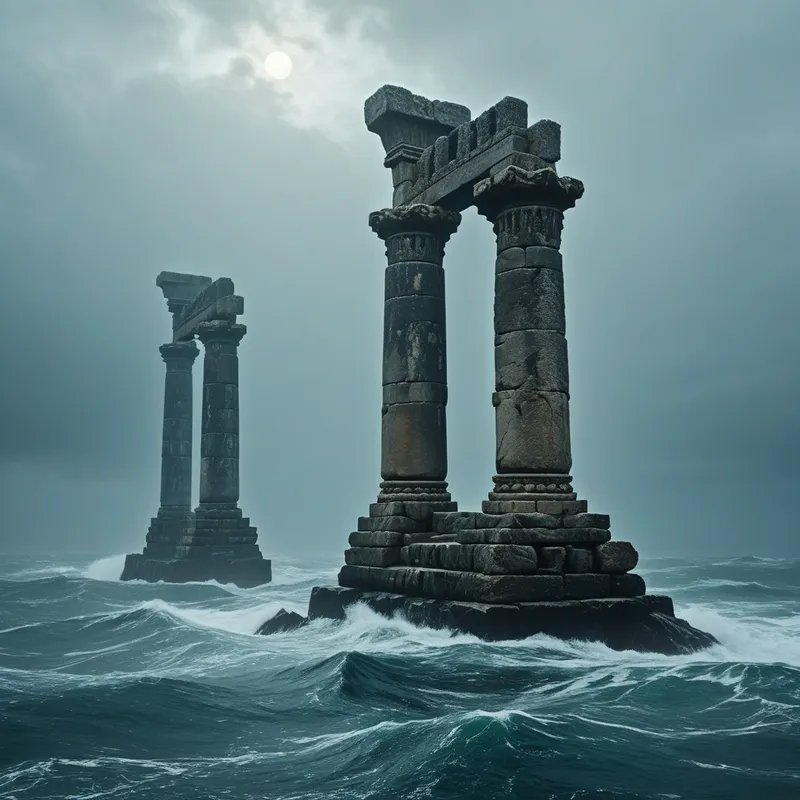
The Pillars of Heracles Myth Meaning & Symbolism
The demigod Heracles, in a moment of rage or triumph, raises two mountains as a boundary marker, creating the ultimate threshold of the ancient world.
The Tale of The Pillars of Heracles
Listen, and hear the tale of the edge of the world.
Before the maps were drawn, when the earth was a disc cradled by the river Oceanus, there was a place where all known things ended. It was a strait of churning, wine-dark water, a narrow throat between two lands. To the north, a great, rugged rock; to the south, another. Beyond them lay only the abyss, the realm of primal chaos and monsters not yet named.
Into this place came Heracles, his lion-skin cloak smelling of sun and blood, his breath a furnace from labors no mortal could conceive. His tenth task, a curse disguised as a command, was to journey to the western edge of the earth, to the island of Erytheia, and steal the crimson cattle of the three-bodied giant Geryon. The journey itself was a trial, a stripping away of civilization, until only the hero and the horizon remained.
He reached the narrow strait. The passage was treacherous, the cliffs themselves seeming to lean in, jealous of their role as the final sentinels. Some bards sing that, in his fury at the journey’s endlessness, Heracles cleaved a single mountain in twain with his god-forged club, parting the stone to let the waters through. Others whisper a grander, more terrifying deed. They say that after his victory over Geryon, driving the stolen herd back towards the world of men, he stood at that very precipice. The vast, unknown ocean roared before him, a challenge and a taunt. A final, defiant pride swelled in his chest—not to conquer the abyss, but to mark his passage for all time.
With a roar that rivaled his father Zeus, he planted his feet upon the earth. He called upon the last dregs of his divine strength, a strength that had held up the sky. He grasped the roots of the mountains to the north and south. The earth groaned. Stone cracked. And with a heave that made the stars tremble, he raised them. He did not create them, but he set them apart, lifting their peaks as a shepherd raises boundary stones. He placed them as eternal pillars, Calpe in the north, Abila in the south. Upon them, by some accounts, he carved a warning for sailors and a declaration for the ages: Non Plus Ultra—“Nothing Further Beyond.”
In that act, the formless end was given form. The infinite was given a frame. The hero, by defining a limit, created the first and greatest threshold.

Cultural Origins & Context
The Pillars of Heracles were not merely a story, but a fundamental geographic and cosmological fact for the ancient Greeks. They represented the absolute western limit of the navigable world, the point beyond which lay only the terrifying and fascinating realm of Oceanus. The myth is a classic example of aition—a story explaining the origin of a place or custom.
The tale was woven into the epic cycle of Heracles’ Labors, most thoroughly in accounts like those of Homer and later systematized by writers such as Diodorus Siculus. It functioned on multiple levels: as a heroic adventure, as a divine sanction for Greek exploration (to the pillars, but not beyond), and as a psychological bulwark. For a culture that saw the sea as both a highway and a grave, the pillars were a comforting landmark. They said, “This far is safe, this far is known. We have measured the world with our hero’s strength.” They transformed existential dread into a manageable boundary, a monument to human (and semi-divine) achievement against chaos.
Symbolic Architecture
The Pillars are the ultimate symbol of the limen—the threshold. They do not represent a wall, but a gateway. Their power lies in their duality: they simultaneously mark an end and invite a beginning. They are the boundary between the cosmos and the chaos, the ego and the unconscious, the mapped territory and the terra incognita.
The true function of a boundary is not to imprison, but to define the self. By saying “this is where I end,” you discover what “I” am.
Heracles, the archetypal persona of strength and action, in his final western labor, encounters not a monster to slay, but a void to acknowledge. His act of raising the pillars is a profound psychological maneuver: it is the ego’s attempt to impose order on the overwhelming vastness of the unconscious. The warning inscription is the ego’s voice, fearful of dissolution. Yet, the very existence of the gateway suggests the possibility, however terrifying, of passage.
The Dreamer’s Resonance
When this myth stirs in the modern psyche, it often manifests in dreams of thresholds: standing before a massive door, hesitating at the mouth of a tunnel, or seeing a bridge that leads into mist. The somatic sensation is one of suspension—a tightness in the chest, a feeling of being poised on the edge of a cliff. This is the psyche at a point of existential navigation.
Dreaming of the Pillars signifies a confrontation with a personal Non Plus Ultra. It may appear when one faces a career change, the end of a relationship, a spiritual crisis, or any profound identity shift. The two pillars in the dream represent the dual aspects of the choice: security versus the unknown, the known self versus the potential self. The dreamer in the strait is the ego, caught between the solid land of past identity and the oceanic pull of future transformation. The anxiety is not about the pillars themselves, but about the vast, uncharted sea they frame. The dream asks: Will you turn back to the familiar mainland, or will you provision your ship and sail for the setting sun?
Alchemical Translation
The alchemical journey is one of individuation, and the Pillars of Heracles model a critical phase: the separatio followed by the solutio. First, one must perform Heracles’ labor. The ego must consciously recognize and define its limits (separatio). This is the hard, heroic work of self-knowledge—“This is my trauma, this is my pattern, this is where my old world ends.” Erecting the pillars is an act of courage; it means staring into your own personal abyss and saying, “Here. This is the edge.”
The alchemical gold is not found by staying within the pillars, but by understanding that they are the doorway through which you must dissolve to be remade.
Then comes the more terrifying, more necessary phase: the solutio, the dissolution. This is the journey through the pillars. It is the surrender of the heroic ego that built them. The known self—the Heracles who labors for recognition—must metaphorically die in the ocean beyond. The cattle of Geryon (the “red gold,” the instinctual, prized possessions of the monstrous, fragmented self) are driven through this gateway, not kept safely within the old bounds. To integrate the treasure, one must cross the threshold into the unconscious and be changed. The ultimate triumph is not in marking the limit, but in realizing the limit itself was the invitation to become boundless. The final labor is to sail past your own warning signs, into the creative chaos where the true self, no longer just a hero but a whole being, awaits its own discovery.
Associated Symbols
Explore related symbols from the CaleaDream lexicon: