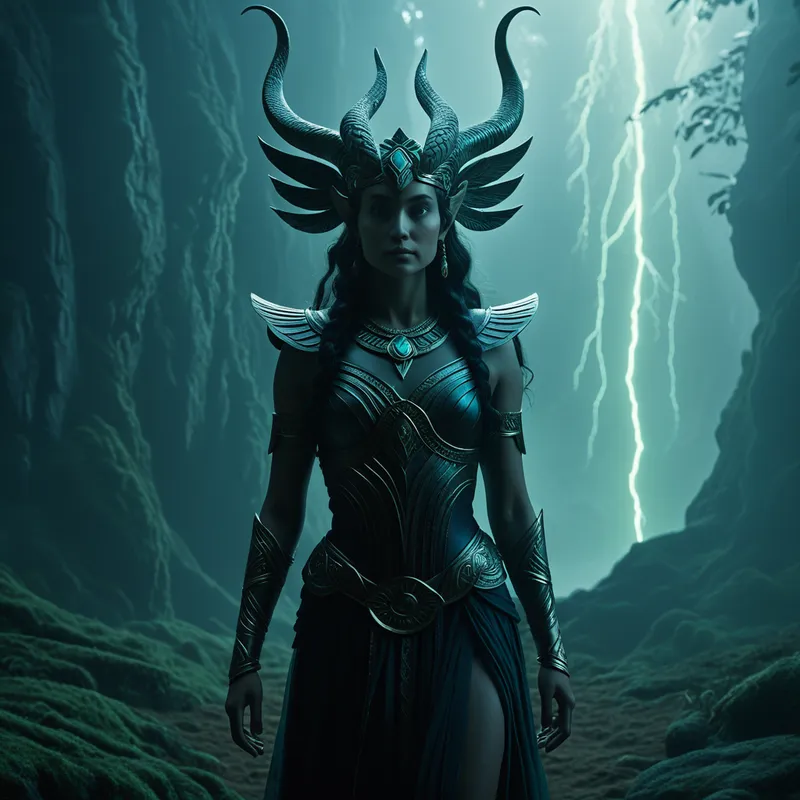
The Phoenix Bongwang
The celestial Korean phoenix Bongwang symbolizes cosmic harmony, royal virtue, and auspicious renewal in ancient mythology.
The Tale of The Phoenix Bongwang
In the beginning, before the mountains found their spines and the rivers their courses, there was a celestial sound—a single, resonant note that held within it the potential for all harmony. From this vibration, in the pure, undifferentiated realm of the heavens, the Bongwang was born. Its form was not born of flesh and blood, but of principle and music; its body a tapestry of the five cardinal colors representing the virtues and the elements, its song the very template of cosmic order.
The Bongwang did not dwell among mortals. It was a sovereign of the upper air, a being of the Cheon-gye. Its appearances were not casual but oracular, reserved for epochs of profound transition or to mark the virtue of a ruler. Legends whisper of its descent during the reign of the sage-king Dan-gun, founder of Gojoseon, its shadow blessing the land with peace and its cry aligning the seasons. It was said to alight only upon the odong namu, its roots drinking from deep, pure earth, its branches reaching for the very stars the Bongwang called home.
One cyclical myth tells of a time when human greed and discord seeped into the fabric of [the world](/myths/the-world “Myth from Tarot culture.”/), causing the seasons to stutter and [the earth](/myths/the-earth “Myth from Hindu culture.”/) to sicken. The Bongwang, witnessing the rupture in harmony from its celestial perch, let forth a cry of profound sorrow. This was not a song of renewal, but one of dissolution—a necessary unmaking. It plunged from the heavens, a comet of virtue and color, and immolated itself in a pyre of its own making, fueled by the last echoes of its perfect song. For nine hundred and ninety-nine years, [the world](/myths/the-world “Myth from Tarot culture.”/) lay in a muted state, a patient hibernation. Then, from the sacred ashes, stirred not by wind but by the re-gathering of that primordial harmonic note, the Bongwang arose. Its renewed song did not merely restore the old world; it recalibrated it, weaving the memory of [the fall](/myths/the-fall “Myth from Biblical culture.”/) and the silence into a new, more resilient pattern of harmony. It ascended once more, a living sigil of the truth that order must sometimes pass through the fire of its own negation to be reborn, authentic and whole.
Cultural Origins & Context
The Bongwang, or Korean [phoenix](/myths/phoenix “Myth from Egyptian culture.”/), is not a native mythological invention but a profound adaptation, a testament to Korea’s historical role as a cultural synthesizer. Its origins lie in the ancient Chinese [fenghuang](/myths/fenghuang “Myth from Chinese culture.”/), a composite celestial bird that entered the Korean peninsula with the influx of Confucian and Daoist cosmology during the Three Kingdoms period. However, to call it a mere import is to misunderstand the Korean [psyche](/myths/psyche “Myth from Greek culture.”/). The Bongwang was kneaded into the native clay of Korean spiritual thought, filtered through the lens of indigenous Muism and the later frameworks of Korean Buddhism.
In the rigid hierarchy of Joseon dynasty symbolism, informed by Neo-Confucianism, the Bongwang found its definitive earthly counterpart: the king. While [the dragon](/myths/the-dragon “Myth from Chinese culture.”/) represented the imperial authority of the Chinese emperor, the Bongwang became the exclusive symbol of the Korean monarch. It was embroidered on royal robes, carved into palace eaves, and stamped on official documents. This was not just a claim to authority, but a declaration of intent. The king was to embody the Bongwang’s virtues: its benevolence (the head symbolized virtue), its duty (the back symbolized propriety), its mercy (its chest), its trustworthiness (its abdomen), and its [justice](/myths/justice “Myth from Tarot culture.”/) (its wings). The Bongwang thus became a celestial mirror held up to earthly power, a constant, silent reminder that true sovereignty is not domination, but the harmonious orchestration of all elements of the state—a living embodiment of inhwa (harmony).
Symbolic Architecture
The Bongwang is a being of pure [symbolism](/symbols/symbolism “Symbol: The use of symbols to represent ideas or qualities, often conveying deeper meanings beyond literal interpretation. In dreams, it’s the language of the unconscious.”/), its anatomy a deliberate map of cosmic and ethical order. Every [aspect](/symbols/aspect “Symbol: A distinct feature, quality, or perspective of something, often representing a partial view of a larger whole.”/) of its form is an ideogram. Its five colors—black, white, red, yellow, and blue—directly correspond to the five virtues, the five directions, and the [five elements](/symbols/five-elements “Symbol: A universal system describing fundamental forces or phases of nature that interact to create balance, transformation, and the cycle of existence.”/). It is a walking, flying [mandala](/symbols/mandala “Symbol: A sacred geometric circle representing wholeness, the cosmos, and the journey toward spiritual integration.”/). Its refusal to eat living things, subsisting only on [bamboo](/symbols/bamboo “Symbol: A symbol of resilience, flexibility, and spiritual growth, often representing strength through adaptability and connection to nature.”/) seeds and drinking only from sacred springs, signifies its transcendence of the base cycle of predation and consumption; it is nourished by purity and order itself.
Its most potent [symbol](/symbols/symbol “Symbol: A symbol can represent an idea, concept, or belief, serving as a powerful tool for communication and understanding.”/), however, is its [relationship](/symbols/relationship “Symbol: A representation of connections we have with others in our lives, often reflecting our emotional state.”/) with the [dragon](/symbols/dragon “Symbol: Dragons are potent symbols of power, wisdom, and transformation, often embodying the duality of creation and destruction.”/). In [Chinese](/symbols/chinese “Symbol: Chinese symbolism represents a rich tapestry of culture, traditions, and philosophical beliefs originating from China.”/) myth, they are often a paired couple. In Korea, their dynamic is charged with a subtle, crucial [tension](/symbols/tension “Symbol: A state of mental or emotional strain, often manifesting physically as tightness, pressure, or unease, signaling unresolved conflict or anticipation.”/). The [dragon](/symbols/dragon “Symbol: Dragons are potent symbols of power, wisdom, and transformation, often embodying the duality of creation and destruction.”/), yong, represents the watery, potent, sometimes chaotic forces of the [cosmos](/symbols/cosmos “Symbol: The entire universe as an ordered, harmonious system, often representing the totality of existence, spiritual connection, and the unknown.”/)—the underground springs, the storms, the unformed creative power. The Bongwang represents the celestial, ordering, virtuous principle. They are not opposites, but complementary poles in a dynamic [system](/symbols/system “Symbol: A system represents structure, organization, and interrelated components functioning together, often reflecting personal or social order.”/). The Bongwang’s [harmony](/symbols/harmony “Symbol: A state of balance, agreement, and pleasing combination of elements, often associated with musical consonance and visual or social unity.”/) is not a [static](/symbols/static “Symbol: Static represents interference, disruption, and the breakdown of clear communication or signal, often evoking feelings of frustration and disconnection.”/) [peace](/symbols/peace “Symbol: Peace represents a state of tranquility and harmony, both internally and externally, often reflecting a desire for resolution and serenity in one’s life.”/), but an active, tense [equilibrium](/symbols/equilibrium “Symbol: A state of balance, stability, or harmony between opposing forces, often representing inner peace or external order.”/) achieved in relation to the [dragon](/symbols/dragon “Symbol: Dragons are potent symbols of power, wisdom, and transformation, often embodying the duality of creation and destruction.”/)’s power. True [harmony](/symbols/harmony “Symbol: A state of balance, agreement, and pleasing combination of elements, often associated with musical consonance and visual or social unity.”/), it teaches, is not the [absence](/symbols/absence “Symbol: The state of something missing, void, or not present. Often signifies loss, potential, or existential questioning.”/) of [tension](/symbols/tension “Symbol: A state of mental or emotional strain, often manifesting physically as tightness, pressure, or unease, signaling unresolved conflict or anticipation.”/), but the creative and respectful containment of it.
The Bongwang does not conquer chaos; it sings it into a pattern. Its rebirth is not an escape from death, but the moment the melody incorporates the silence that preceded it, making the subsequent note more profound.
To encounter the Bongwang in myth or dream is to be presented with the terrifying responsibility of one’s own sovereignty. It asks: Can you hold the center? Can your virtue become a gravitational field that orders the fragments of your world into a coherent, beautiful whole?
The Dreamer’s Resonance
When the image of the Bongwang alights in the modern psyche, whether through dream, active imagination, or sudden aesthetic arrest, it speaks to the archetype of the inner ruler. This is not the tyrant or the narcissist, but the nascent, often neglected capacity for self-governance and principled order. The Bongwang’s appearance signals a call to integrate the fragmented parts of [the self](/myths/the-self “Myth from Jungian culture.”/)—the chaotic emotions (the [dragon](/myths/dragon “Myth from Chinese culture.”/)), the instinctual drives, the lofty ideals—into a cohesive personality. It is the symbol of individuation in its later stages, where [the ego](/myths/the-ego “Myth from Jungian culture.”/) becomes a vessel for the Self, the inner monarch.
Psychologically, its cyclical [death](/myths/death “Myth from Tarot culture.”/) and rebirth mirror the necessary ego deaths we must undergo for growth. We build a personality, a “kingdom” of habits and beliefs. In time, it becomes rigid, corrupt, or maladaptive—it loses harmony. The Bongwang’s fiery descent represents the painful but necessary dissolution of that outdated structure. The subsequent silence is the fallow period of depression, confusion, or lostness. The rebirth is the emergence of a new, more authentic, and more capacious sense of self, one that has metabolized the ashes of the old. The Bongwang thus becomes a patron of those in recovery, those rebuilding after trauma, and those seeking to live a life aligned not with external expectations, but with an inner, virtuous order.

Alchemical Translation
In the alchemical vessel of the soul, the Bongwang represents the culmination of the [rubedo](/myths/rubedo “Myth from Alchemical culture.”/), the reddening—the final stage of [the Great Work](/myths/the-great-work “Myth from Alchemical culture.”/) where the perfected philosopher’s stone is achieved. It is the symbol of the caelum, the heaven, the permanent, incorruptible body of light fashioned from the trials of [nigredo](/myths/nigredo “Myth from Alchemical culture.”/) (blackening, dissolution) and [albedo](/myths/albedo “Myth from Alchemical culture.”/) (whitening, purification). Its immolation is the ultimate [solutio](/myths/solutio “Myth from Alchemical culture.”/), not in [water](/myths/water “Myth from Chinese culture.”/), but in the fiery spirit itself. Its revival is the [coagulatio](/myths/coagulatio “Myth from Alchemical culture.”/) into a higher, spiritualized form.
The Bongwang’s alchemy is one of sound and vibration. Its primary substance is not matter, but [logos](/myths/logos “Myth from Christian culture.”/)—the ordering word, the sacred note. The work it proposes is therefore one of attunement. To engage with this archetype is to seek the unique, harmonic note of one’s own existence and to have the courage to sing it purely, even if it means the burning away of all that is out of tune. It teaches that the soul’s ultimate product is not a [thing](/myths/thing “Myth from Norse culture.”/), but a quality of being: a resonant, virtuous presence that brings order simply by being true to its own celestial pattern.
The ash from which the Bongwang rises is not waste; it is the condensed memory of all that was sacrificed for the melody to continue. In the human soul, this ash is experience itself—suffering, joy, failure—transmuted into the substrate of wisdom.
This is an alchemy of sovereignty. The base metal of the scattered, reactive personality is subjected to the fire of conscious ordeal until only the golden, regal core remains—immune to corrosion, capable of benevolent rule over the inner kingdom.
Associated Symbols
Explore related symbols from the CaleaDream lexicon:
- Phoenix — The universal archetype of cyclical rebirth through fiery self-destruction, of which the Bongwang is a virtuous, sovereign-specific incarnation.
- Celestial Harmony — The state of perfect, resonant order in the cosmic and human realm, which the Bongwang both embodies and actively sings into existence.
- Crown — The manifest symbol of earthly sovereignty and responsibility, directly linked to the Bongwang’s role as the legitimizing virtue of the monarch.
- Rebirth — The core transformative process of death and return, essential to the Bongwang’s mythic cycle and its psychological meaning of ego-renewal.
- Fire — The purifying, transformative, and sacrificial element through which the Bongwang achieves its dissolution and subsequent renewal.
- Tree — Specifically the odong namu (Phoenix Tree), representing the sacred, grounded connection between heaven and earth upon which the celestial bird alights.
- Dragon — The complementary, chaotic, and potent force which the Bongwang’s harmonious order engages with and contains, representing the necessary tension within creation.
- Song — The primary mode of the Bongwang’s being and influence, representing the power of authentic expression to structure reality and enact transformation.
- Ash — The sacred residue of transformation, the fertile ground of memory and experience from which the new, purified form emerges.
- Virtue — The ethical architecture that forms the Bongwang’s very body, indicating that true power and renewal are founded on moral principle.
- King — The human archetype and role that mirrors the Bongwang, tasked with establishing and maintaining harmony within a realm.
- Melodic Harmony — The dynamic, living expression of harmony as a process rather than a state, a continuous act of tuning and retuning exemplified by the Bongwang’s life cycle.