
The Philosopher's Stone Elixir Myth Meaning & Symbolism
An alchemical legend of a hidden substance that transmutes base matter to gold and grants eternal life, symbolizing the soul's quest for perfection.
The Tale of The Philosopher's Stone Elixir
Listen, and I will tell you of a secret older than the oldest oak, a truth whispered not in the wind, but in the silent, patient work of fire and vessel. It is not a story of kings and battles, but of the quiet war waged in the soul’s deepest chamber.
In a time when the world was a book written in symbols, there lived seekers who turned their backs on the marketplace and the pulpit. They retreated into chambers thick with the scent of sulfur and salt, their world defined by the curve of the alembic and the patient heat of the athanor. They were not mere chemists; they were gardeners of the soul, tending to the Prima Materia—the dark, formless muck of existence itself.
Their quest was for the Lapis Philosophorum, the Philosopher’s Stone. But more than the stone, they sought its tears: the Elixir Vitae. The legends spoke of a substance of such perfect equilibrium, it could do the impossible: heal all sickness, grant eternal youth, and—most famously—transmute base lead into pure, solar gold. But this was no recipe of simple herbs. The path was the Magnum Opus, a journey through blackening, whitening, yellowing, and finally, the glorious reddening.
The seeker, our anonymous adept, begins in Nigredo. In the stillness of his laboratory, he faces not his tools, but the shadow of his own nature—his greed, his pride, his despair. The materials in his crucible blacken and foul, mirroring the rot within. This is the death that must come before life.
From that blackness emerges Albedo. A silvery, lunar light seems to cleanse the matter. It is a time of washing, of tears, of humility. The crude ego is stripped away. Then comes Citrinitas, a dawning golden awareness, where the seeker begins to see the connections between the stars above and the processes below.
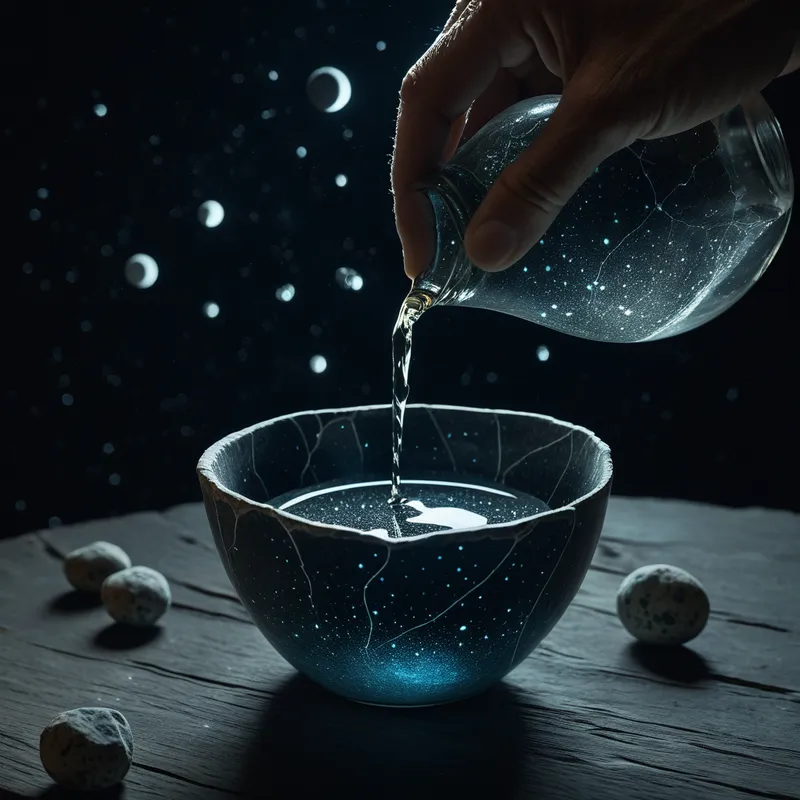
And finally, the furnace roars for the last time. In a moment of perfect, fiery tension, the matter does not burn—it blooms. A deep, ruby-red crystal forms, radiating a warmth that is not of fire but of life itself. This is Rubedo. From it, a single drop of liquid, heavy like mercury yet light like spirit, is drawn. This is the Elixir. It does not sparkle; it glows with a steady, inner sun. When the seeker, now an adept, anoints a piece of lead with a single drop, the metal does not melt but transfigures, softening, brightening, until it shines with the unmistakable, incorruptible gleam of gold. The quest is complete. The base has become noble. The mortal has touched the eternal.
Cultural Origins & Context
This myth did not spring from a single storyteller around a village fire. It was born in the scriptoriums and laboratories of Medieval and Renaissance Europe, a hybrid of practical proto-chemistry, Hermetic philosophy, Christian mysticism, and Arab scholarship. Its primary vessels were not bards, but alchemists—figures like Hermes Trismegistus (a syncretic fusion of the Greek god Hermes and the Egyptian Thoth), the enigmatic Basil Valentine, or the Swiss physician Paracelsus.
The texts were deliberately obscure, written in a language of allegory, coded symbols (the green lion, the royal marriage, the Ouroboros), and paradoxical recipes. This served a dual function: to protect the art from the unworthy (and from charges of heresy) and to insist that the Work was not merely mechanical but deeply spiritual. The myth was passed down in lavishly illustrated manuscripts, its societal function being nothing less than a parallel path to salvation—a material gospel for those who sought God not only in scripture, but in the very fabric of Creation.
Symbolic Architecture
At its heart, the myth of the Stone and its Elixir is a supreme metaphor for the transformation of consciousness. The laboratory is the psyche. The base metals—lead, tin, iron—represent the crude, unconscious, and often burdensome aspects of the self: our instincts, our complexes, our "heaviness."
The Stone is not a thing to be found, but a state of being to be achieved; it is the fully integrated Self, the psychological Self that harmonizes all opposites.
The Elixir, then, is the living, active principle of this wholeness—the conscious awareness that can "heal" or integrate any fragmented part of the personality ("transmute base metal"). Gold symbolizes the incorruptible, eternal value of this achieved consciousness, while immortality is not literal endless life, but the experience of transcending the petty fears and desires of the mortal ego to participate in something timeless and essential. The entire process models the death of the old, limited personality (Nigredo) and the slow, painful birth of a new, more complete one.
The Dreamer's Resonance
When this myth stirs in the modern dreamer, it rarely appears as a medieval alchemist. Instead, one might dream of trying to combine two incompatible substances in a kitchen bowl to create a healing salve, or of discovering a forgotten, glowing rock in a basement that makes everything it touches feel "right" and complete. The somatic sensation is often one of intense, focused pressure or heat (the athanor's fire) giving way to a profound, liquid calm (the Elixir).
Psychologically, these dreams signal a process of deep, often difficult, integration. The dreamer is in their own Nigredo—a depression, a crisis of meaning, a feeling of being "stuck" in base-metal emotions like envy or resentment. The dream points towards the necessity of this stage; the blackening is not failure, but the first, crucial step of dissolution. The appearance of any transforming agent—a liquid, a light, a special stone—is the psyche's assurance that the process, though arduous, is underway and holds the promise of a golden resolution.
Alchemical Translation
For the individual today, the myth provides a powerful map for the journey of individuation—the process of becoming who one truly is. Our "base metals" are our neuroses, our inherited traumas, our shadow qualities we disown. The "laboratory" is the container of therapy, introspection, creative work, or any disciplined practice of self-observation.
The first and most critical operation is the solve: to dissolve the rigid structures of the persona and confront the shadow in the Nigredo of honest self-appraisal.
The subsequent stages—Albedo, Citrinitas, Rubedo—mirror the slow work of purification (understanding one's motives), illumination (gaining insight), and final integration. The "gold" we produce is not wealth, but authenticity, resilience, and the ability to bring value into the world from a place of wholeness. The "Elixir" is the wisdom and vitality that flows from this state, which indeed has the power to "heal" our relationships and our engagement with life. The myth ultimately teaches that the greatest treasure, the true Elixir of immortality, is a fully realized and conscious Self, forged in the fires of our own lived experience.
Associated Symbols
Explore related symbols from the CaleaDream lexicon: