The Philippine Creation Myth Myth Meaning & Symbolism
A myth of primordial separation, where the Sky and Sea, once one, are parted to create the world, birthing humanity from bamboo.
The Tale of The Philippine Creation Myth
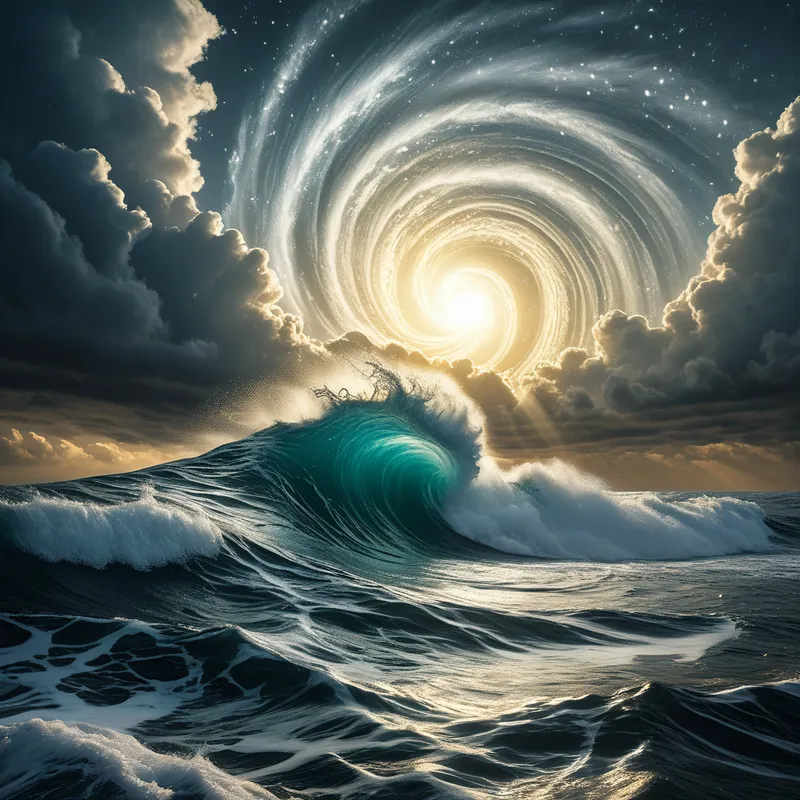
In the beginning, there was no beginning. There was only the Kawalan, the great and formless void. But within that nothingness, a presence stirred. It was not a presence of body, but of intent. From this intent, two great powers emerged, not as rivals, but as lovers in an eternal embrace: the Sky, vast and luminous, and the Sea, deep and boundless.
They were one. The silver mist of the Sky kissed the shimmering surface of the Sea, and where they met, there was only a seamless, shimmering horizon—a perfect, unbroken circle of existence. There was no up, no down, only the gentle, rocking unity of their being. In this timeless embrace, the world was cradled in potential, but it was a world asleep, a dream without form.
Then, a new consciousness dawned within the unity. It was [Bathala](/myths/bathala “Myth from Filipino culture.”/), the great ruler and shaper. [Bathala](/myths/bathala “Myth from Filipino culture.”/) gazed upon the loving embrace of Sky and Sea and saw not just peace, but possibility. He saw that for life to be, for land to breathe and creatures to walk, there must be distinction. There must be space for becoming.
With a thought that was both a blessing and a sorrow, Bathala reached into the heart of the unity. He did not tear, but gently, irrevocably, parted the lovers. The Sky, with a sigh that became the first wind, was drawn upward, becoming a great, arching dome of light and air. The Sea, with a mournful pull, receded downward, becoming the fathomless, teeming depths. Between them now stretched a new thing: Space. It was a silence, a gasp, a chamber waiting to be filled.
And fill it, Bathala did. From the substance of the parted lovers, he began to craft. He took the foam from the Sea’s crest and the light from the Sky’s heart and spun the first islands, emerald jewels scattered upon the dark blue breast of the waters. He breathed upon the space, and it filled with the sigh of the Sky and the salt of the Sea, becoming the air.
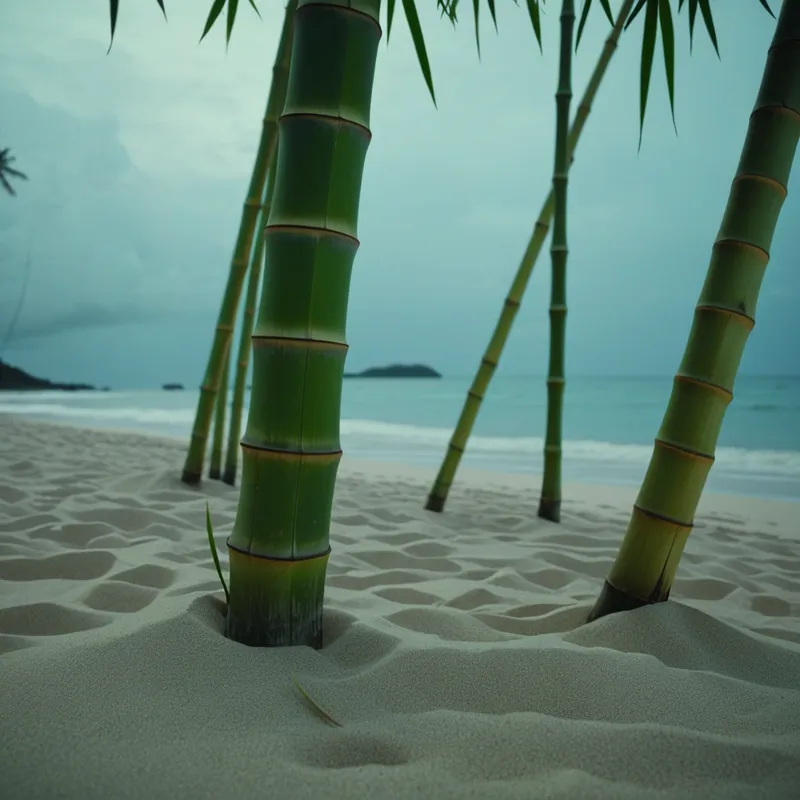
Yet the world was beautiful, and empty. Bathala walked the new shores, and his shadow fell upon a stand of bamboo, tall and jointed, whispering in the new wind. Moved by its resilient, hollow form, he took two mighty reeds and struck them together against the rocks. The sound was a sharp crack, a birth-cry that echoed across the silent world.
The bamboo split, and from its golden, segmented chamber, the first humans emerged. From one node came Malakas, strong and upright. From the other came Maganda, graceful and radiant. They stepped onto the sand, blinking in the new light, children of both the parted Sky and the receded Sea, born from the enduring earth. They looked at each other, then at the world—the soaring vault above, the restless expanse below—and in that look was the dawn of wonder, of story, and of all that was to come.
Cultural Origins & Context
This creation narrative, with variations in the names of deities and specific details, is a foundational story found across many ethnolinguistic groups in the Philippine archipelago, most prominently among the Tagalog peoples. It was not preserved in ancient texts, but in the living breath of oral tradition—passed down by the babaylan and the community elders around evening fires, in the rhythmic cadence of epic chants, and in the whispered lessons to children. Its function was profoundly cosmological and social. It answered the fundamental questions of origin: Where did the world come from? Where did we come from? It established a sacred geography where the divine (Sky and Sea) is not distant but is the very substance of the land and its people. The myth served as a cultural anchor, explaining the natural environment of an archipelago—the constant dialogue between sky, sea, and land—and embedding human life within that sacred triad. The emergence from bamboo, a ubiquitous, fast-growing, and immensely useful plant, directly connected human genesis to the practical and spiritual ecology of the islands.
Symbolic Architecture
At its core, this is not a myth of creation ex nihilo (out of nothing), but of creation through [differentiation](/symbols/differentiation “Symbol: The process of distinguishing or separating parts of the self, emotions, or identity from a whole, often marking a developmental or psychological milestone.”/). The primordial unity must be separated to generate the multiplicity of the world. This is the fundamental act of [consciousness](/symbols/consciousness “Symbol: Consciousness represents the state of awareness and perception, encompassing thoughts, feelings, and experiences.”/): to distinguish self from other, light from dark, [idea](/symbols/idea “Symbol: An ‘Idea’ represents a spark of creativity, innovation, or realization, often emerging as a solution to a problem or a new outlook on life.”/) from form.
The first creative act is not addition, but division. The world is born from a sacred separation that creates the space for relationship.
The Sky and Sea represent the archetypal masculine and feminine principles in a state of unconscious, undifferentiated union—the unus mundus of [alchemy](/symbols/alchemy “Symbol: A transformative process of purification and creation, often symbolizing personal or spiritual evolution through difficult stages.”/). Bathala represents the emerging conscious principle, the ordering mind that must intervene to [structure](/symbols/structure “Symbol: Structure in dreams often symbolizes stability, organization, and the framework of one’s life, reflecting how one perceives their environment and personal life.”/) [chaos](/symbols/chaos “Symbol: In Arts & Music, chaos represents raw creative potential, uncontrolled expression, and the breakdown of order to forge new artistic forms.”/) into [cosmos](/symbols/cosmos “Symbol: The entire universe as an ordered, harmonious system, often representing the totality of existence, spiritual connection, and the unknown.”/). The [bamboo](/symbols/bamboo “Symbol: A symbol of resilience, flexibility, and spiritual growth, often representing strength through adaptability and connection to nature.”/) is a profound [symbol](/symbols/symbol “Symbol: A symbol can represent an idea, concept, or belief, serving as a powerful tool for communication and understanding.”/) of the vas or [vessel](/symbols/vessel “Symbol: A container or structure that holds, transports, or protects something essential, representing the self, emotions, or life journey.”/) of transformation. It is hollow (receptive), segmented (ordered), and resilient. It is the [womb](/symbols/womb “Symbol: A symbol of origin, potential, and profound transformation, representing the beginning of life’s journey and the unconscious source of creation.”/) of the world, the container where the potential of the separated elements is brought together to incubate new [life](/symbols/life “Symbol: The symbol of ‘Life’ represents a journey of growth, interconnectedness, and existential meaning, encompassing both the joys and challenges that define human experience.”/). [Malakas and Maganda](/myths/malakas-and-maganda “Myth from Filipino culture.”/) are not just the first humans; they are the embodied reconciliation of the parted opposites—[strength](/symbols/strength “Symbol: ‘Strength’ symbolizes resilience, courage, and the ability to overcome challenges.”/) and [beauty](/symbols/beauty “Symbol: This symbol embodies aesthetics, harmony, and the appreciation of life’s finer qualities.”/), [earth](/symbols/earth “Symbol: The symbol of Earth often represents grounding, stability, and the physical realm, embodying a connection to nature and the innate support it provides.”/) and [spirit](/symbols/spirit “Symbol: Spirit symbolizes the essence of life, vitality, and the spiritual journey of the individual.”/), born from the same [source](/symbols/source “Symbol: The origin point of something, often representing beginnings, nourishment, or the fundamental cause behind phenomena.”/).
The Dreamer’s Resonance
When this myth stirs in the modern psyche, it often manifests in dreams of profound transitions and emergences. One might dream of standing on a shore where the ocean and sky are indistinguishable, feeling both immense peace and a yearning for definition. This somatic state reflects the pre-conscious bliss of infancy or a life phase that, while comfortable, lacks differentiation and purpose. The cracking sound of the bamboo may translate to a sudden, jarring dream event—a door slamming, a bone breaking, a tree falling—that, upon waking, is associated not with terror, but with a sense of necessary rupture. To dream of emerging from a confined, tubular space (a cave, a tunnel, a hallway) into dazzling light is to dream the birth of Malakas and Maganda. It signifies the psyche ready to step into a new level of conscious self-awareness, often following a period of incubation or difficulty. The dream is the psyche performing its own Bathala-like act, parting the waters of the unconscious to make space for a new identity to stand.

Alchemical Translation
The individuation journey mirrors this myth precisely. We all begin in a state of psychic unity with the parental and cultural world—a kind of inner Kawalan where our identity is undifferentiated. The first, crucial step toward becoming an individual is the separatio, the often-painful process of distinguishing our own inner Sky (mind, spirit, aspirations) from our inner Sea (emotions, the unconscious, the body). This is the work of Bathala-within.
The alchemical vessel is not the comfortable union, but the courageous space created by separation. Our true self is born in the gap between what was and what must be.
We must consciously part these inner elements to create the “space”—the psychological container—where our unique personality can form. This process feels like loss, like the mourning of a primal unity. The “bamboo” in our lives is that period of containment, the depression, the creative block, or the silent meditation where the separated elements are held together under pressure. The “striking of the bamboo” is the catalytic crisis, the insight, or the courageous decision that finally cracks the shell of our old, undifferentiated self. From it, we do not emerge as a perfect, finished being, but as Malakas and Maganda—a dual-natured self, strong in our resolve and beautiful in our authenticity, stepping onto the shore of a world we are now ready to engage with as conscious co-creators.
Associated Symbols
Explore related symbols from the CaleaDream lexicon:
- Sky — Represents the archetypal masculine principle, consciousness, spirit, and the limitless realm of potential and order.
- Sea — Symbolizes the archetypal feminine principle, the unconscious, emotion, the womb of all life, and the deep, unknown psyche.
- Earth — The manifested world born from the separation of Sky and Sea; the grounded reality and the stage for human life and experience.
- Tree — Echoed in the bamboo, it represents the axis mundi, the connection between the realms (Sky, Earth, Sea), and the resilient growth of life from a single source.
- Separation — The core action of the myth; the necessary, often painful division of a primal unity to create the space and tension required for creation and consciousness.
- Emergence — The act of Malakas and Maganda stepping from the bamboo; symbolizes birth, revelation, the coming into being of a new state of consciousness or identity.
- Vessel — The bamboo stalk is the ultimate vessel, a natural container that holds and incubates the potential for human life until the moment of catalytic rupture.
- Creation — The overarching theme of the myth, depicting a non-violent, deliberate process of bringing form from a state of loving unity through differentiation.
- Mythic Hero — Bathala fulfills this role not through battle, but through a sovereign act of will and shaping, establishing the cosmic order for the benefit of nascent life.
- Dream — The primordial state of Kawalan and the unified Sky-Sea can be seen as the world-soul dreaming itself into existence, a process mirrored in human creative and psychological genesis.
- Bridge — The space created between Sky and Sea becomes a metaphorical bridge, the atmosphere where life breathes and where communication between the separated realms becomes possible.
- Seed — The potential for humanity and the world lay latent within the unity of Sky and Sea, like a seed, requiring the specific conditions of separation and containment to germinate.