The Pharisees Myth Meaning & Symbolism
A tale of scribes and scholars who built a fortress of law to preserve a sacred way, only to find the spirit they sought had fled its walls.
The Tale of The Pharisees
Listen, and hear a tale not of monsters and magic, but of ink and intention. In the land between [the river](/myths/the-river “Myth from Buddhist culture.”/) and [the sea](/myths/the-sea “Myth from Greek culture.”/), under a sky that had witnessed empires rise like dust and fall like rain, a people clung to a promise. They had returned from exile, their temple rebuilt but their world fragile, a delicate vase placed on the edge of a precipice.
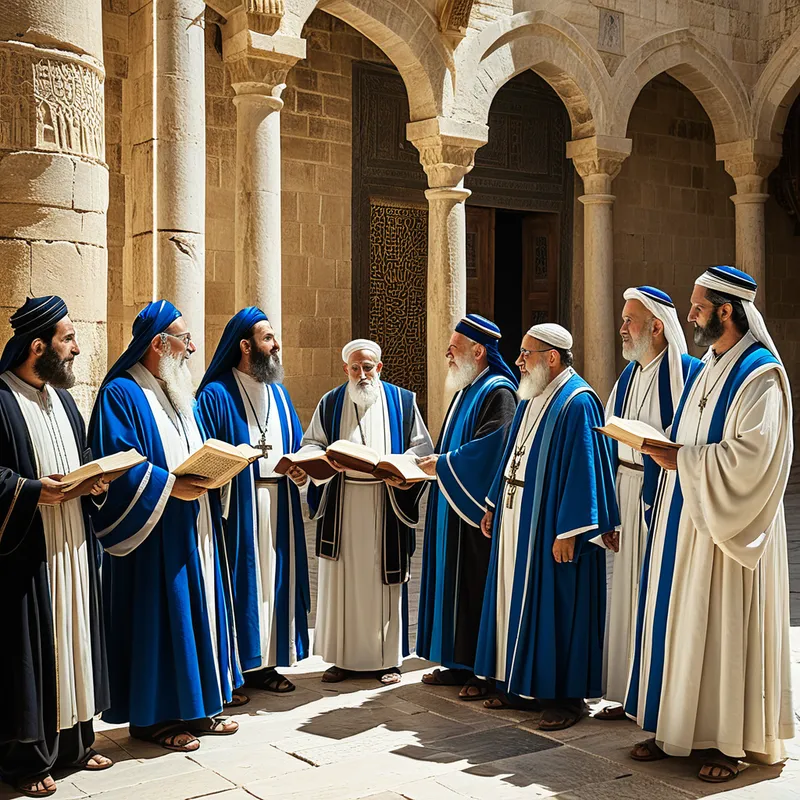
From among them rose the Pharisees. They were not kings with crowns, but guardians of [the word](/myths/the-word “Myth from Biblical culture.”/). Their battleground was the scroll, their weapon the pen. They saw a holy chaos threatening to swallow the people whole—the seductive pull of Greek thought, the heavy boot of Roman rule, the slow forgetting of [the way](/myths/the-way “Myth from Taoist culture.”/). And so, they began to build. Not walls of stone, but a fence of law.
With meticulous care, they studied the sacred texts, the Torah. Around each commandment, they constructed a hedge of interpretation, a seyag la-Torah, to keep the holy [thing](/myths/thing “Myth from Norse culture.”/) safe from careless feet. When the text said “remember [the Sabbath](/myths/the-sabbath “Myth from Abrahamic culture.”/),” they asked: What is work? What is rest? How far may one walk? How may one heal? Their debates filled courtyards with passionate heat, their rulings sought to make every moment of life a conscious act of devotion. They dreamed of a nation of priests, a kingdom built not on territory, but on purity of practice.
Their fortress of piety grew tall and intricate. To be a Pharisee was to be separate, set apart, a living vessel of [the law](/myths/the-law “Myth from Biblical culture.”/). They tithed mint and dill, they washed with ritual precision, they wore scripture on their arms and foreheads. The law was their map, their compass, their very skin against [the world](/myths/the-world “Myth from Tarot culture.”/)‘s profanity.
Then, a voice arose from the Galilee, speaking not of fences, but of foundations. A teacher who moved through their carefully ordered world like [water](/myths/water “Myth from Chinese culture.”/) through cracks. He spoke of the spirit of the law that breathed before the letter was inscribed. He healed on the [Sabbath](/myths/sabbath “Myth from Judeo-Christian culture.”/), dined with the unclean, called the tax collectors and the broken. To the Pharisees, this was not a new teaching; it was the dismantling of the fence, an invitation to the very chaos they had sworn to hold at bay.
The conflict was not of swords, but of visions. In marketplaces and temple courts, the clash echoed. The Pharisees questioned, tested, sought a flaw in his adherence to their sacred architecture. They saw in his freedom a threat to the entire structure that preserved the people’s soul. The tension coiled like a spring, a tragic dance between the protectors of the form and the prophet of the essence. In the end, the political machinery of the age, which cared little for their theological duel, would consume them both—the teacher to the cross, the protectors to the relentless tide of history, their temple soon to be dust once more. Their great work, their magnificent fence, stood guard over a city that would soon fall, a poignant monument to the human attempt to house the divine wind in a chamber of perfect law.
Cultural Origins & Context
The Pharisees emerged in the Second Temple period, a time of profound existential crisis and reconstruction. Following the return from the Babylonian Exile, Jewish identity was no longer tied solely to a sovereign kingdom but to a sacred text and a covenantal way of life. The Pharisees were one of several Jewish “schools of thought,” alongside the priestly Sadducees and [the ascetic](/myths/the-ascetic “Myth from Christian culture.”/) Essenes.
They were primarily a lay movement of scribes, teachers, and community leaders, distinct from the hereditary Temple aristocracy. Their power base was the synagogue and the house of study. They believed in an Oral Torah given alongside the written one—a living tradition of interpretation that allowed the ancient law to speak to new circumstances. This was revolutionary; it democratized holiness, making it accessible through study and practice to every Jew, not just the priests in [the Temple](/myths/the-temple “Myth from Jewish culture.”/).
The myth of the Pharisees was passed down and shaped primarily through two lenses: their own evolving tradition, which became Rabbinic Judaism, and the narratives of the early Christian movement recorded in the New Testament. In the former, they are the honored sages, the fathers of the tradition. In the latter, they are often cast as the primary interlocutors and antagonists of [Jesus](/myths/jesus “Myth from Christian culture.”/). This dual transmission created a complex archetype: the rigorous guardian of tradition, whose very strength can become a tragic rigidity when confronted with a paradigm-shattering spirit.
Symbolic Architecture
Psychologically, the Pharisee represents the superstructure of the ego—the complex, necessary, and ultimately fragile [system](/symbols/system “Symbol: A system represents structure, organization, and interrelated components functioning together, often reflecting personal or social order.”/) of rules, identities, and principles we construct to navigate the world and maintain a sense of order and purity. They embody the principle of order in its most dedicated form.
The law is the psyche’s attempt to build a permanent home for a transient guest—the soul.
Their meticulous rituals symbolize the [human](/symbols/human “Symbol: The symbol of a human represents individuality, complexity of emotions, and social relationships.”/) need for containers—habits, ethics, disciplines—that give shape to inner [life](/symbols/life “Symbol: The symbol of ‘Life’ represents a journey of growth, interconnectedness, and existential meaning, encompassing both the joys and challenges that define human experience.”/) and protect it from the [chaos](/symbols/chaos “Symbol: In Arts & Music, chaos represents raw creative potential, uncontrolled expression, and the breakdown of order to forge new artistic forms.”/) of the unconscious or the demands of the instinctual world. The “fence around [the Torah](/myths/the-torah “Myth from Jewish culture.”/)” is a perfect [symbol](/symbols/symbol “Symbol: A symbol can represent an idea, concept, or belief, serving as a powerful tool for communication and understanding.”/) for the psychological [defense](/symbols/defense “Symbol: A protective mechanism or barrier against perceived threats, representing boundaries, security, and resistance to external or internal challenges.”/) mechanisms and personal codes we erect to protect our core values and vulnerabilities.
The conflict with the prophetic figure represents the inevitable and necessary [crisis](/symbols/crisis “Symbol: A crisis symbolizes turmoil, urgent challenges, and the need for immediate resolution or change.”/) when the [spirit](/symbols/spirit “Symbol: Spirit symbolizes the essence of life, vitality, and the spiritual journey of the individual.”/) outgrows the form. The Self, in its [movement](/symbols/movement “Symbol: Movement symbolizes change, progress, and the dynamics of personal growth, reflecting an individual’s desire or need to transform their circumstances.”/) toward greater [integration](/symbols/integration “Symbol: The process of unifying disparate parts of the self or experience into a cohesive whole, often representing psychological wholeness or resolution of internal conflict.”/) and wholeness, often must disrupt the comfortable, well-ordered [kingdom](/symbols/kingdom “Symbol: A kingdom symbolizes authority, belonging, and a sense of identity within a larger context or community.”/) of the conscious [personality](/symbols/personality “Symbol: Personality in dreams often symbolizes the traits and characteristics of the dreamer, reflecting how they perceive themselves and how they believe they are perceived by others.”/). The Pharisee’s [shadow](/symbols/shadow “Symbol: The ‘shadow’ embodies the unconscious, repressed aspects of the self and often represents fears or hidden emotions.”/) is not evil, but [inflation](/symbols/inflation “Symbol: A dream symbol representing feelings of diminishing value, loss of control, or expansion beyond sustainable limits in one’s life or psyche.”/): the mistake of believing the map is the territory, the [ritual](/symbols/ritual “Symbol: Rituals signify structured, meaningful actions carried out regularly, reflecting cultural beliefs and emotional needs.”/) is the encounter, [the law](/symbols/the-law “Symbol: Represents external rules, societal order, moral boundaries, and the tension between personal freedom and collective structure.”/) is the [spirit](/symbols/spirit “Symbol: Spirit symbolizes the essence of life, vitality, and the spiritual journey of the individual.”/). Their tragedy is the tragedy of the [guardian](/symbols/guardian “Symbol: A protector figure representing safety, authority, and guidance, often embodying parental, societal, or spiritual oversight.”/) who, in loving the [wall](/symbols/wall “Symbol: Walls in dreams often symbolize boundaries, protection, or obstacles in one’s life, reflecting the dreamer’s feelings of confinement or security.”/), forgets what it was built to protect.

The Dreamer’s Resonance
To dream of the Pharisee archetype is to dream of the structures of one’s own life being scrutinized. One might dream of being trapped in a building of endless, identical corridors ([the labyrinth](/myths/the-labyrinth “Myth from Greek culture.”/) of law), of arguing passionately over a tiny rule while a fire burns in the distance, or of meticulously cleaning an object that remains perpetually stained.
Somatically, this can feel like rigidity—a tightness in the jaw, neck, and shoulders, the body itself armoring against perceived disorder. Psychologically, the dreamer is likely encountering a point of inner conflict where a long-held belief, a personal code, or a way of life is being challenged by a rising inner truth or a new life circumstance. The Pharisee in the dream is the part of the [psyche](/myths/psyche “Myth from Greek culture.”/) that digs in, that cites precedent and fears the collapse of order. The dream is not condemning this part, but revealing its activated state. It signals a struggle between the psyche’s conservative, self-preserving tendency and its progressive, transformative impulse.
Alchemical Translation
The alchemical journey modeled here is the transmutation of literalism into wisdom, of structure into spirit. The initial stage is [Nigredo](/myths/nigredo “Myth from Alchemical culture.”/)—the confrontation with [the shadow](/myths/the-shadow “Myth from Jungian culture.”/) of one’s own righteousness. The individual must recognize the Pharisee within: the part that is rigid, judgmental (of self and others), and identified with its own system of control.
The alchemy begins not by destroying the law, but by hearing the silence between its letters.
The Albedo, the washing, involves a conscious dissolution of this identification. One must ask: What sacred principle was this rule originally meant to serve? What life was this structure built to protect? This is a descent from the head (the debate over law) to the heart (the intention behind it). It is the moment the scribe looks up from the ink-stained parchment and feels [the wind](/myths/the-wind “Myth from Various culture.”/) from the open window.
The final transmutation, [Rubedo](/myths/rubedo “Myth from Alchemical culture.”/), is not the abandonment of form, but its redemption. It is the emergence of the Senex archetype infused with the spirit of the [Puer Aeternus](/myths/puer-aeternus “Myth from Roman culture.”/). The individual no longer is the law; they hold the law lightly, as a useful tool, a respected elder, but not as the master of the living soul. They achieve a discerning wisdom that knows when [the vessel](/myths/the-vessel “Myth from Alchemical culture.”/) must be honored, and when the wine must be poured into new wineskins. The [triumph](/myths/triumph “Myth from Roman culture.”/) is the integration of order and chaos, structure and spirit, resulting in a grounded yet flexible consciousness—a law written not on stone, but on the heart.
Associated Symbols
Explore related symbols from the CaleaDream lexicon: