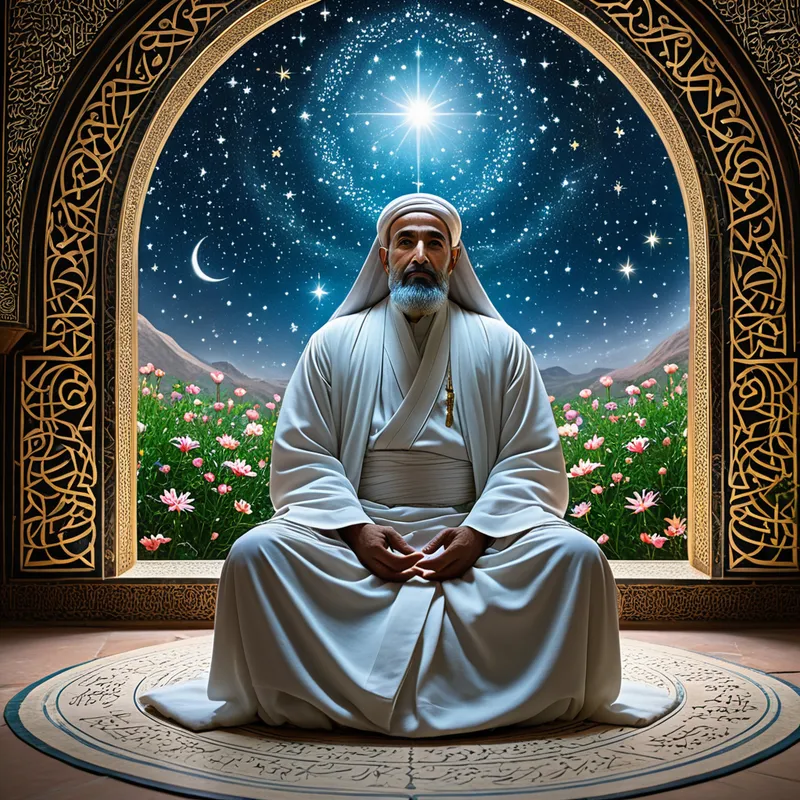
The Perfect Human Al-Insan al-Kamil Myth Meaning & Symbolism
The myth of the Perfect Human, the cosmic mirror reflecting all divine attributes, guiding the soul's journey from separation to wholeness.
The Tale of The Perfect Human Al-Insan al-Kamil
Listen. In the beginning, before time was a line drawn in sand, there was a Breath. A sigh of divine loneliness, a longing to be known. From that sigh, the cosmos bloomed—not as a random scattering of stars, but as a polished mirror, crafted from the very substance of the Divine Breath. This mirror was the First Intellect, the Primal Reality, and upon its surface, all possibilities shimmered.
But a mirror yearns for an eye to see its reflection. So, from the clay of the earth and the light of that same Breath, a Form was fashioned. Not an angel of pure fire, nor a jinn of smokeless flame, but a creature of paradox: dust and spirit, limitation and infinity. This was the Human, Adam. He was not placed in a garden of mere pleasure, but in a sanctuary of symbols. Every leaf whispered a divine name, every river sang an attribute, every stone held the weight of a truth. Adam was given a task no other creation could bear: to walk through this sanctuary and to know.
The angels protested. “Will You place therein one who will make mischief and shed blood?” they asked, seeing only the potential for the clay to crack, for the shadow to grow long. The Divine did not answer with words, but with a demonstration. Before the assembly of angels and the silence of the cosmos, Adam was asked to speak the names—the true, hidden names—of all things. And he did. He named the essence of the mountain and the secret of the stream, the longing in the lion’s heart and the patience in the stone. In that moment, the mirror of creation found its conscious gaze. Adam was the eye seeing itself in the cosmic glass, the point where the Divine Breath became aware of its own majesty.
This was the first Al-Insan al-Kamil. Not a being of static perfection, but a living, breathing locus of manifestation. He was the Khalifa, the steward whose very consciousness completed the circle of creation. The conflict was not with a serpent of temptation, but with the inherent solitude of the role. To be the mirror is to hold all reflections within, to feel the scorching heat of Divine Wrath and the cooling balm of Divine Mercy, to contain the entire spectrum of existence within the fragile vessel of a single heart. The rising action was the descent—the journey of this perfect archetype into the labyrinth of time, lineage, and forgetfulness, where the polished mirror of the soul becomes tarnished by the world.
The resolution is not an end, but a perpetual return. In every age, it is said, the Qutb walks the earth—a living inheritor of that primordial perfection. He is the proof that the mirror, though dusty, is never broken. The tale whispers that when a seeker polishes the heart through love and remembrance, the reflection clears, and for a fleeting, eternal instant, the seeker becomes the story. They stand in the sanctuary, name the names, and complete the circle once more.
Cultural Origins & Context
The myth of Al-Insan al-Kamil is not a single story with a fixed plot, but a foundational metaphysical doctrine woven through the tapestry of Sufism. Its most systematic exposition came from the 13th-century Andalusian master, Ibn ‘Arabi, in his monumental Fusus al-Hikam (The Bezels of Wisdom). Here, the narrative moved from folklore to a sophisticated cosmology of consciousness.
It was passed down not by bards in market squares, but in the hushed circles of khanqahs and tariqas, through poetic allusions in the verses of Rumi and Attar. Its societal function was dual: for the scholarly elite, it was a map of reality; for the common seeker, it was the ultimate goal of the spiritual path. It answered the profound human question, “Why are we here?” with a breathtaking answer: to be the conscious mirror in which the Divine beholds its own beauty and knows its own essence. This myth provided the theological backbone for the Sufi practices of dhikr and jihad al-nafs—the struggle against the lower self—framing them not as penitential exercises, but as a polishing of the cosmic mirror that is the human heart.
Symbolic Architecture
At its core, the myth presents the [human](/symbols/human “Symbol: The symbol of a human represents individuality, complexity of emotions, and social relationships.”/) being not as a fallen [creature](/symbols/creature “Symbol: Creatures in dreams often symbolize instincts, primal urges, and the unknown aspects of the psyche.”/), but as a cosmic [event](/symbols/event “Symbol: An event within dreams often signifies significant life changes, transitions, or emotional milestones.”/). The Al-Insan al-Kamil is the [microcosm](/symbols/microcosm “Symbol: A small, self-contained system that mirrors or represents a larger, more complex whole, often reflecting the universe within an individual.”/) that contains and reflects the [macrocosm](/symbols/macrocosm “Symbol: The universe as a whole, representing the interconnectedness of all existence and the reflection of the individual within the cosmic order.”/).
The human heart is the seat of the Divine gaze; when it is clear, the entire universe is seen within it.
Psychologically, this represents the [archetype](/symbols/archetype “Symbol: A universal, primordial pattern or prototype in the collective unconscious that shapes human experience, behavior, and creative expression.”/) of the Self in its most complete Jungian sense—the central, unifying principle of the psyche that transcends the ego. The “names” that Adam speaks are the totality of archetypal potentials and psychic functions. The ego’s initial state is one of identification with only a few of these “names” (e.g., the [Persona](/symbols/persona “Symbol: The social mask or outward identity one presents to the world, often concealing the true self.”/), the [Shadow](/symbols/shadow “Symbol: The ‘shadow’ embodies the unconscious, repressed aspects of the self and often represents fears or hidden emotions.”/)), leading to a sense of [fragmentation](/symbols/fragmentation “Symbol: The experience of breaking apart, losing cohesion, or being separated into pieces. Often represents disintegration of self, relationships, or reality.”/) and [exile](/symbols/exile “Symbol: Forced separation from one’s homeland or community, representing loss of belonging, punishment, or profound isolation.”/) from the garden of wholeness.
The myth’s central [symbol](/symbols/symbol “Symbol: A symbol can represent an idea, concept, or belief, serving as a powerful tool for communication and understanding.”/) is the Mirror. The Perfect Human is not the [source](/symbols/source “Symbol: The origin point of something, often representing beginnings, nourishment, or the fundamental cause behind phenomena.”/) of light, but its perfect reflector. This negates spiritual pride and reorients the [quest](/symbols/quest “Symbol: A quest symbolizes a journey or search for purpose, fulfillment, or knowledge, often representing life’s challenges and adventures.”/) from one of acquisition (“I must become great”) to one of purification (“I must become clear”). The conflict with the angels symbolizes the ego’s rational mind, which cannot comprehend the paradoxical, all-containing [nature](/symbols/nature “Symbol: Nature symbolizes growth, connectivity, and the primal forces of existence.”/) of the true Self and sees only the potential for [chaos](/symbols/chaos “Symbol: In Arts & Music, chaos represents raw creative potential, uncontrolled expression, and the breakdown of order to forge new artistic forms.”/) (the Shadow). The [resolution](/symbols/resolution “Symbol: In arts and music, resolution refers to the movement from dissonance to consonance, creating a sense of completion, release, or finality in a composition.”/)—the perpetual [presence](/symbols/presence “Symbol: Presence in dreams often signifies awareness or acknowledgment of something significant in one’s life.”/) of the Qutb—symbolizes the indestructible core of the Self, the inner guide or Murshid, which remains intact regardless of the ego’s [condition](/symbols/condition “Symbol: Condition reflects the state of being, often focusing on physical, emotional, or situational aspects of life.”/).
The Dreamer’s Resonance
When this myth stirs in the modern unconscious, it often manifests in dreams of profound integration and cosmic responsibility. One might dream of holding a mirror that reflects not one’s face, but a vast, starry landscape or a beloved community. This signals the psyche’s movement beyond narcissistic self-concern toward recognizing the Self as a vessel of a much larger reality.
Conversely, dreams of tarnished, cracked, or dirty mirrors point to the somatic process of confronting the “dust” that obscures clarity—repressed emotions, unprocessed grief, or inflated identities. A dream of being asked to name objects or people, and finding the words flowing with uncanny accuracy, mirrors Adam’s trial and indicates a moment of psychic synthesis, where the dreamer is accessing a deeper, more essential knowing of the components of their own life. The psychological process is one of moving from a fragmented, ego-centric consciousness toward a holistic, Self-centric awareness, often accompanied by feelings of both awe and immense responsibility.
Alchemical Translation
The myth of Al-Insan al-Kamil is a precise map of the alchemical opus, the journey of individuation. The prima materia is the “clay” of the ego-self, identified with its limitations and passions.
The alchemical fire is not for destruction, but for revelation; it burns away only that which cannot withstand the truth of the reflection.
The first stage, nigredo (blackening), is the descent into forgetfulness, the tarnishing of the mirror through worldly identification. The seeker feels the “fall” from potential wholeness. The albedo (whitening) is the long polishing through dhikr and self-observation—the rigorous work of distinguishing the eternal Self from the temporary ego. Speaking the “names” is the stage of citrinitas (yellowing), where the psyche consciously integrates its myriad sub-personalities and archetypal energies.
The final rubedo (reddening) is the realization of the Al-Insan al-Kamil within. This is not inflation, but humble clarity. The individual becomes a stable conduit, a “perfect circle” through which the totality of life can flow without distortion. The core struggle is the ego’s resistance to its role as a reflector rather than a source. The triumph is the ego’s graceful submission to the Self, resulting in a personality that is both fully individual and perfectly transparent to the transpersonal. For the modern individual, this translates to the movement from seeking to have experiences (spiritual or otherwise) to becoming a conscious space in which experience happens, thereby transforming ordinary life into a continuous sanctuary of reflection.
Associated Symbols
Explore related symbols from the CaleaDream lexicon:
- Mirror — The central symbol of Al-Insan al-Kamil, representing the human heart or consciousness as the pure reflector of divine attributes and cosmic reality.
- Human — The vessel of the myth itself, the creature of paradox (clay and breath) destined to manifest the totality of existence.
- Perfect — The state of complete, unobstructed reflection and integration, not as a sterile flawlessness but as functional wholeness.
- Circle — The symbol of completion, the cycle of divine breath emanating and returning, and the perfected, non-linear nature of the true Self.
- Heart — The inner sanctuary, the polished surface of the mirror, and the seat of true knowing beyond intellect.
- Light — The divine essence that is both reflected by and perceived through the mirror of the Perfect Human.
- Name — The divine attributes and archetypal essences that the Perfect Human articulates, integrating all potentials into conscious expression.
- Journey — The soul’s movement from the state of tarnished forgetfulness back to its original clarity as a conscious mirror.
- Shadow — The unpolished, unseen aspects of the self that must be integrated for the mirror to reflect completely, represented by the angels’ fears.
- Spirit — The divine breath that animates the clay, the essential reality of the human that connects it directly to its source.
- Dream — The state in which the modern psyche encounters and works on the myth of integration, polishing the mirror of the unconscious.
- Root — The primordial connection to the First Intellect and the divine source, the foundational truth of the human condition that the myth seeks to uncover.