The Peloponnese Myth Meaning & Symbolism
A cursed prince wins a kingdom through cunning and divine aid, his name forever branding a land born from betrayal, sacrifice, and a golden shoulder.
The Tale of The Peloponnese
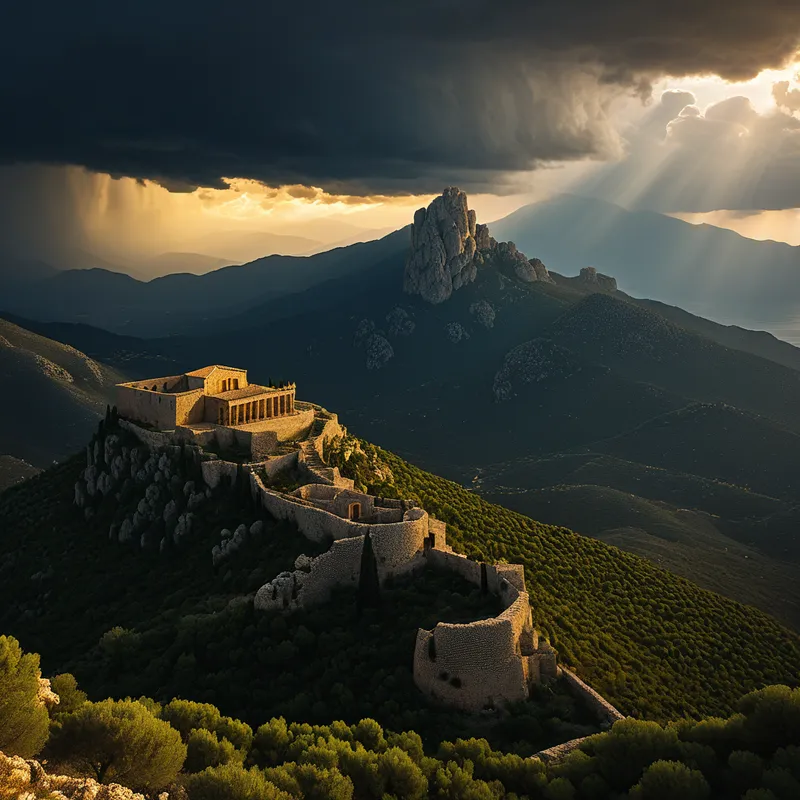
Hear now of a land named for a man, and of the man forged in a cauldron of divine wrath and paternal sin. The air in Lydia was thick with the scent of myrrh and dread, for King Tantalus, beloved of the gods, had committed an atrocity that stilled the very winds. To test the omniscience of the Olympians, he had slain his own son, the young prince Pelops, butchered his flesh, and served it in a stew at a divine banquet. The cosmos recoiled. Only Demeter, distraught over her lost daughter, consumed a piece—the shoulder.
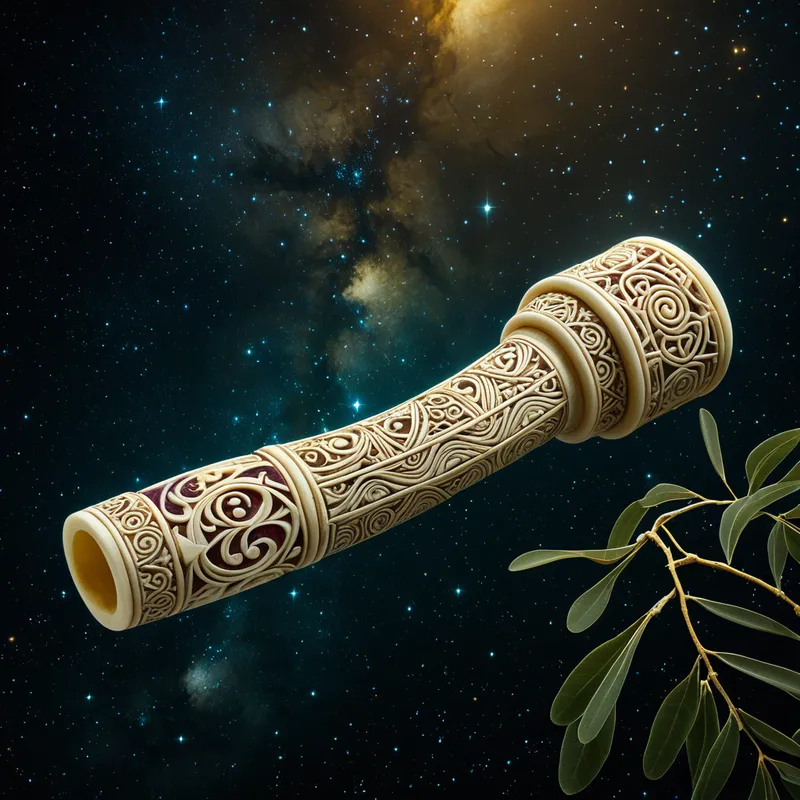
The gods, in their horror and fury, restored the boy to life. Hephaestus forged a shoulder of gleaming ivory to replace the devoured one. But the stain remained. Pelops, though whole, carried the mark of his father’s blasphemy—a patch of luminous, deathless ivory upon his living skin. An outcast, he sailed across the wine-dark sea to the southern land of Hellas, seeking a kingdom to call his own, a destiny to overwrite his cursed origin.
His chance lay in Pisa, where King Oenomaus had a daughter of legendary beauty, Hippodamia, and a deadly chariot race. The king, haunted by an oracle foretelling his death by his son-in-law, challenged each suitor to a race. Victory would win the princess; defeat meant death, for the king would spear the loser from behind as he fled. Thirteen heads already adorned his palace walls.
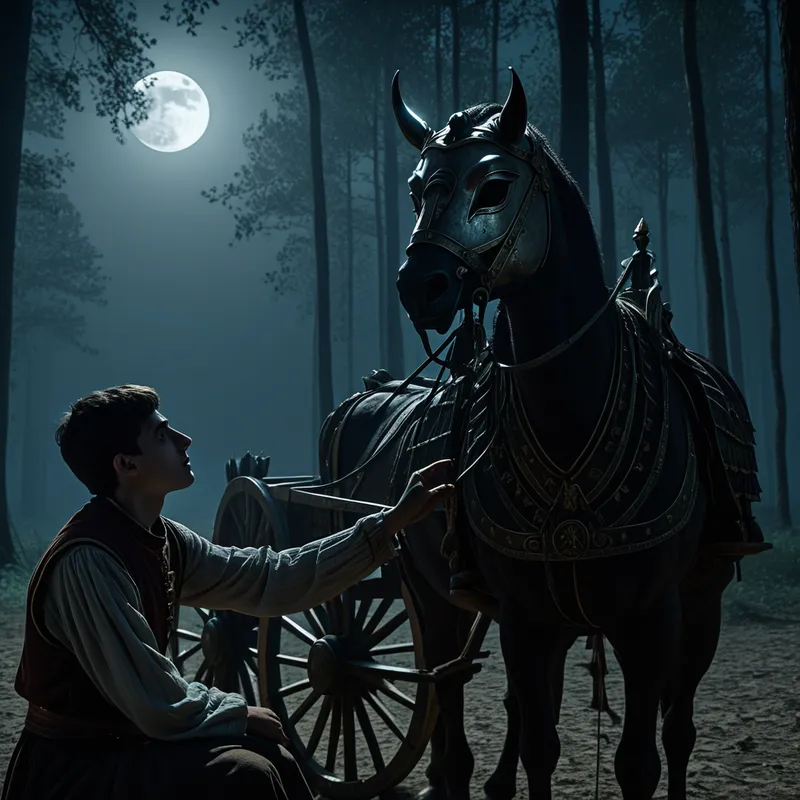
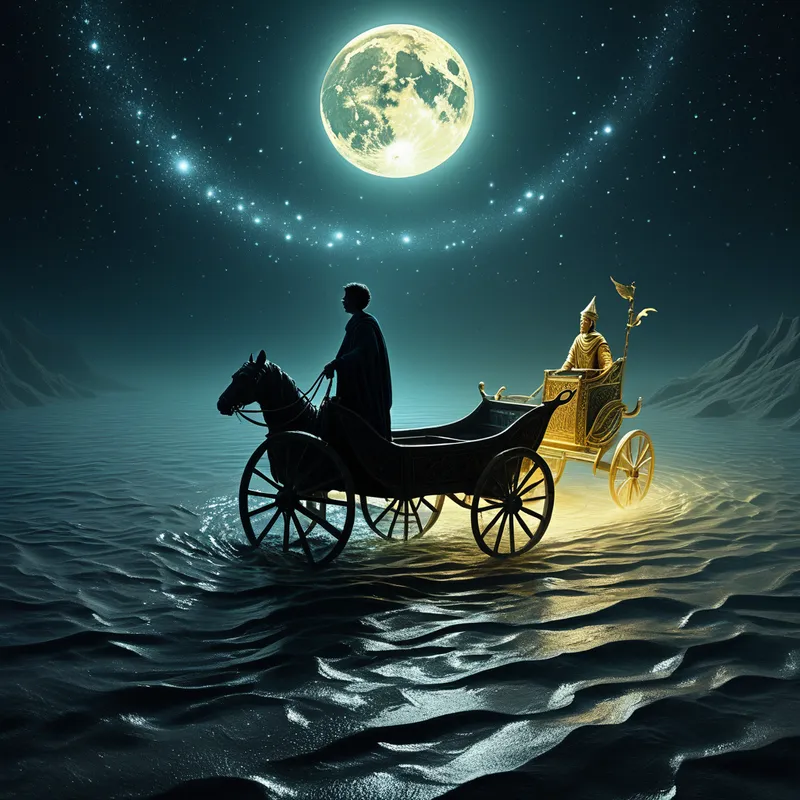
Pelops, seeing the princess, felt a fate beyond fear. But he also saw the king’s immortal horses, a gift from Ares. He did not pray for strength alone. He went to the shore and called upon the sea itself, to Poseidon, his former lover. The earth shook, and from the foaming waves emerged a chariot drawn by horses of wind and vapor, tireless and swift as thought.
Yet Pelops knew speed might not be enough. He sought out the king’s charioteer, Myrtilus</abbr. A promise was whispered in the dark: “Help me, and you shall share the bride’s bed this first night.” Greed and ambition stirred. Myrtilus, the faithful servant, replaced the bronze linchpins of the king’s chariot with ones of beeswax.
The day came, sun blazing on the dusty track. Two chariots thundered forth, a cloud of dust and destiny. Pelops, guided by Poseidon’s power, held the lead. Oenomaus, raging, whipped his divine team, closing the gap, his spear poised for the kill. Then, as the chariots took a fierce turn, the wax pins melted. The wheels flew from the king’s chariot, the axle screamed against the earth, and Oenomaus was tangled in the reins, dragged and broken, his curse fulfilled.
Pelops won his bride and his kingdom. But when Myrtilus came to claim his reward, Pelops, seized by revulsion and a king’s prerogative, refused. He cast the charioteer from a high cliff into the sea. As he fell, Myrtilus cursed the entire line of Pelops with his dying breath. And so the land was won—through divine favor, cunning betrayal, and a fresh murder. From that day, the great southern peninsula was known as the Peloponnesos, the legacy of a man pieced back together by gods, racing from his past toward a bloody throne.
Cultural Origins & Context
This foundational myth is not a single, standardized tale but a tapestry woven from local cult traditions, epic poetry fragments, and later compilations by authors like Pseudo-Hesiod and the tragedians. It served as a divine charter myth for the ruling dynasties of the Peloponnese, most notably the Spartan kings and the Atreids, legitimizing their power by tracing it back to heroic, if fraught, divine intervention.
The story was performed and recounted at religious sites, particularly the sanctuary of Olympia, which myth located as the very site of the fateful chariot race. Here, the cult of Pelops was significant, and the myth explained the origin of the Olympic Games—either as funeral games for Pelops or for Oenomaus. It functioned as a societal narrative about the brutal necessities of kingship, the inescapable weight of ancestral sin (miasma), and the precarious alliance between mortal ambition and capricious divine will.
Symbolic Architecture
The myth of Pelops is a profound allegory of the fractured self seeking wholeness through action, yet perpetually marked by its origins. Pelops begins as a dismembered child, literally taken apart. His restoration is incomplete; he carries an ivory prosthesis. This ivory shoulder is the core symbol: it is a divine gift that repairs a profound lack, but it is also a permanent, gleaming scar. It signifies the psychological truth that profound trauma or “original sin” is never fully erased; it is integrated, transformed into a source of unique strength and identity, but remains visible.
The wound that the gods suture becomes the seat of their favor, and the mark that sets the hero apart from ordinary men.
The chariot race is the archetypal ordeal of the ego. Pelops does not rely solely on his own virtue (arete). He employs divine aid (Poseidon’s horses) and shadowy cunning (the betrayal of Myrtilus). This illustrates the complex, often morally ambiguous resources the psyche must mobilize to achieve a conscious goal—overthrowing the oppressive “old king” (the entrenched, tyrannical complex, here Oenomaus). The victory is tainted because the methods dwell in the shadow. Myrtilus, the betrayed accomplice, represents the necessary but despised aspect of the self that is sacrificed for social conformity or conscious ambition, and whose curse ensures the victory is never pure.
The Dreamer’s Resonance
When this myth stirs in the modern unconscious, it may manifest in dreams of being fundamentally reassembled after a crisis, perhaps with a visible, unnatural yet beautiful “patch.” Dreams of high-stakes races or competitions where one feels outmatched, but discovers a secret, almost unfair advantage, speak to the Pelops dynamic. The somatic sensation might be a peculiar, localized numbness or a phantom coolness in the shoulder, representing that integrated yet foreign part of the self.
The dream may also feature treacherous allies who demand a price the dreamer is unwilling to pay, or scenes of being pursued by a relentless, mechanized force (the chariot). These are signals of the psyche wrestling with the shadow costs of ambition and transformation. The dreamer is in the process of “winning their kingdom”—forging an identity, achieving a goal—but is acutely, perhaps guiltily, aware of what was broken, betrayed, or left behind to make it possible.
Alchemical Translation
The alchemical journey modeled here is not of pure gold, but of electrum—a natural alloy of gold and silver, symbolizing the mixed, human-divine nature. The nigredo, the initial blackening, is the horrific dismemberment and cannibalistic feast—the total dissolution of the naive self. The albedo, the whitening, is the reconstruction by the gods and the ivory replacement—the spirit’s intervention to make the psyche functional again, but in a new, hybrid form.
The chariot race is the arduous citrinitas, the yellowing or solar stage, where the conscious will (Pelops) must integrate powerful instinctual forces (Poseidon’s horses) and shadowy cunning (the plot with Myrtilus) to overcome a rigid, life-denying complex (Oenomaus and his deadly oracle).
The final stage, the rubedo or reddening, is not a clean triumph. It is the bloody founding of the kingdom and the murder of the accomplice. It represents the painful, guilt-laden consciousness that true individuation requires acknowledging and taking responsibility for the dark, sacrificial acts that enabled one’s sovereignty. The curse of Myrtilus is the perpetual psychic tension that keeps the new kingdom honest, a reminder that the integrated self is built upon, and must forever honor, the parts it had to sacrifice or subdue. The land is not named “The Pure Victory,” but “The Island of Pelops”—forever identified with the flawed, scarred, striving hero at its heart.
Associated Symbols
Explore related symbols from the CaleaDream lexicon: