The Peacock's Cry
A Sufi mystical tale where the peacock's mournful cry symbolizes the soul's yearning for divine reunion and spiritual awakening.
The Tale of The Peacock’s Cry
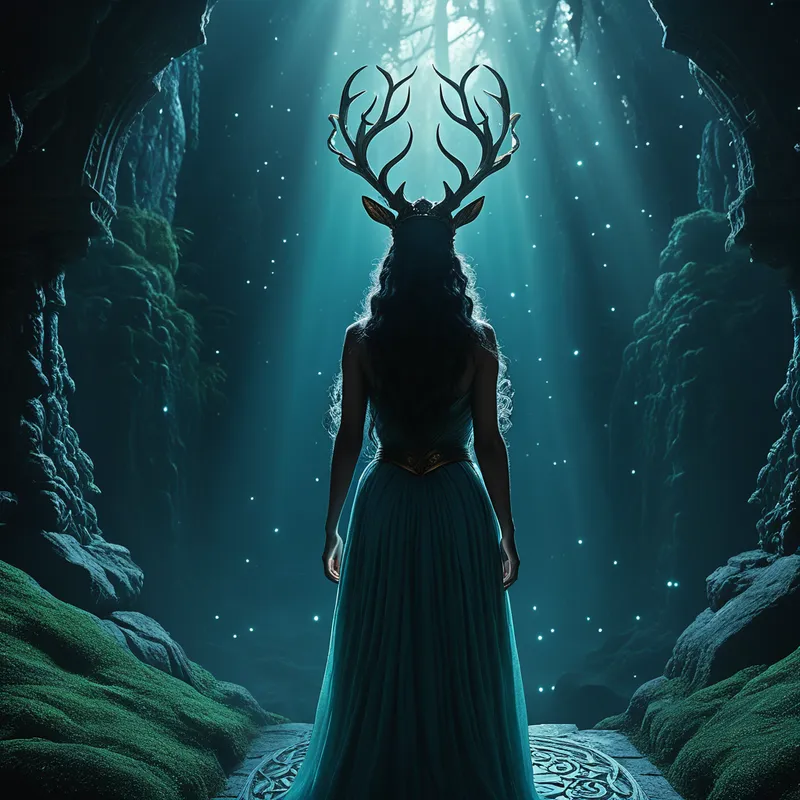
In the beginning, before the worlds were spun from the divine breath, there existed a state of pure, undifferentiated unity. From this luminous singularity, the Creator willed the existence of the universe, scattering the sparks of consciousness into the myriad forms of creation. Among the first and most magnificent of these forms was the Peacock. It was arrayed in a cloak of a thousand eyes, each a jewel reflecting the infinite light of the Divine Presence. The Peacock dwelled in the paradisiacal garden, in direct communion with the Beloved, its very being a hymn of praise.
Yet, within this perfection, a divine drama was set in motion. To know itself, the Beloved desired to be known. To love, the Beloved required a lover separate from Itself. Thus, a great and mysterious veil was drawn—[the veil](/myths/the-veil “Myth from Various culture.”/) of separation. The Peacock, along with all nascent souls, was cast from the intimate garden into the vast expanse of manifestation. This exile was not a punishment, but a sacred necessity, the first step on the soul’s epic journey of return.
As the Peacock found itself in [the world](/myths/the-world “Myth from Tarot culture.”/) of form, a profound memory stirred within its heart. It looked upon its own glorious tail, and where once it saw only reflections of [divine light](/myths/divine-light “Myth from Christian culture.”/), it now saw a haunting absence. Each brilliant “eye” became a reminder of the Eye it could no longer behold directly. A searing longing, a holy homesickness, took root in its being. This longing could not be contained. It welled up from the depths of the Peacock’s spirit and escaped its throat not as a song, but as a piercing, mournful cry—a sound utterly dissonant with its radiant beauty.
This cry echoes through the ages, heard by every seeker who has ever felt a pang of inexplicable sadness amidst worldly beauty, a sense of profound nostalgia for a home they cannot name. The Peacock’s cry is the soul’s first authentic prayer. It is not a cry of despair, but of recognition. In that raw, unadorned sound, the soul confesses its true state: it is a stranger in a strange land, a royal exile remembering its throne.
Cultural Origins & Context
The symbolism of the peacock is woven deeply into the tapestry of Islamic and Sufi thought. In Islamic tradition, the peacock is often associated with the story of Iblis (Shaytan), who, in some interpretations, was the chief of the angels before his fall. He refused to bow to Adam out of pride, a pride born of his own luminous creation from fire. Some mystical narratives suggest Iblis was once the Peacock of the Angels, his beauty a direct gift from God. His fall, therefore, mirrors the soul’s initial descent from unity—a fall not into evil, but into the consciousness of self and other.
Sufi poets and masters, particularly within the Persianate tradition, transformed this narrative. They saw in the peacock not a figure of condemnation, but one of profound empathy. The 12th-[century](/myths/century “Myth from Biblical culture.”/) Sufi philosopher Shihab al-Din Suhrawardi wrote of the “Peacock of the Heaven of the Hurqalya,” a celestial being whose cry signifies the soul’s lament in the world of separation. For the great poet Farid ud-Din Attar, the peacock in his epic [The Conference of the Birds](/myths/the-conference-of-the-birds “Myth from Persian culture.”/) is a reluctant pilgrim, too enamored with its own beauty and the comforts of the world to easily undertake the journey to the [Simurgh](/myths/simurgh “Myth from Persian culture.”/), the divine king.
The cry, therefore, becomes central. It is the moment the soul’s spiritual complacency is shattered by the memory of its origin. This is not a theological doctrine to be studied, but an experiential truth to be heard in the silence of the heart. The cry marks the birth of shawq—burning longing—which the Sufis consider the essential fuel for the path of return. Without this sacred discontent, the soul slumbers.
Symbolic Architecture
The myth is built upon a [foundation](/symbols/foundation “Symbol: A foundation symbolizes the underlying support systems, values, and beliefs that shape one’s life, serving as the bedrock for growth and development.”/) of potent, interlocking symbols. The Peacock itself is a [paradox](/symbols/paradox “Symbol: A contradictory yet true concept that challenges logic and perception, often representing unresolved tensions or profound truths.”/): a [creature](/symbols/creature “Symbol: Creatures in dreams often symbolize instincts, primal urges, and the unknown aspects of the psyche.”/) of breathtaking [beauty](/symbols/beauty “Symbol: This symbol embodies aesthetics, harmony, and the appreciation of life’s finer qualities.”/) whose voice expresses piercing sorrow. This embodies the [human](/symbols/human “Symbol: The symbol of a human represents individuality, complexity of emotions, and social relationships.”/) [condition](/symbols/condition “Symbol: Condition reflects the state of being, often focusing on physical, emotional, or situational aspects of life.”/)—our outer lives may be adorned with success, relationships, and sensory pleasures (the magnificent [tail](/symbols/tail “Symbol: A tail in dreams can symbolize instincts, connection to one’s roots, or the hidden aspects of personality.”/)), while our inner being utters a cry we often ignore or misunderstand.
The thousand eyes on the tail are multifaceted. They represent the [soul](/symbols/soul “Symbol: The soul represents the essence of a person, encompassing their spirit, identity, and connection to the universe.”/)’s [capacity](/symbols/capacity “Symbol: A measure of one’s potential, limits, or ability to contain, process, or achieve something, often reflecting self-assessment or external demands.”/) for witness and [awareness](/symbols/awareness “Symbol: Conscious perception of self, surroundings, or internal states. Often signifies awakening, insight, or heightened sensitivity.”/). Initially, they reflected only God; now, they are turned [outward](/symbols/outward “Symbol: Movement or orientation away from the self or center; expansion, expression, or externalization of inner states into the world.”/), reflecting the fragmented multiplicity of the world. Each “eye” is a potential point of remembrance, a [window](/symbols/window “Symbol: Windows in dreams symbolize opportunities for insight, clarity, and a desire to connect with the outside world or one’s inner self.”/) through which the light of the [origin](/symbols/origin “Symbol: The starting point of a journey, often representing one’s roots, source, or initial state before transformation.”/) might still be glimpsed, however dimly. The cry is the sound of all these eyes turning [inward](/symbols/inward “Symbol: A journey toward self-awareness, introspection, and the exploration of one’s inner world, thoughts, and unconscious mind.”/) simultaneously, aching for their original focus.
The Garden signifies the pre-eternal state of union (‘ayn al-jam’), the homeland of the soul. The [exile](/symbols/exile “Symbol: Forced separation from one’s homeland or community, representing loss of belonging, punishment, or profound isolation.”/) is the necessary descent into [differentiation](/symbols/differentiation “Symbol: The process of distinguishing or separating parts of the self, emotions, or identity from a whole, often marking a developmental or psychological milestone.”/) (tafriqa), the [realm](/symbols/realm “Symbol: The symbol of ‘Realm’ often signifies the boundaries of one’s consciousness, experiences, or emotional states, suggesting aspects of reality that are either explored or ignored.”/) of trial and experience where the soul develops [consciousness](/symbols/consciousness “Symbol: Consciousness represents the state of awareness and perception, encompassing thoughts, feelings, and experiences.”/) and, ultimately, the capacity for conscious love.
The Peacock’s cry is the audible form of huzn—a sacred sorrow. It is not the grief of worldly loss, but the grief of the spirit for its Beloved. This grief is preferable to a thousand joys of forgetfulness, for it alone orientates the soul toward its true North.
The [journey](/symbols/journey “Symbol: A journey in dreams typically signifies adventure, growth, or a significant life transition.”/) prompted by the cry is one of transformation. The beautiful but [static](/symbols/static “Symbol: Static represents interference, disruption, and the breakdown of clear communication or signal, often evoking feelings of frustration and disconnection.”/) form must be surrendered. The feathers, for all their glory, are a [weight](/symbols/weight “Symbol: Weight symbolizes burdens, responsibilities, and emotional loads one carries in life.”/) that keeps the Peacock earthbound. The [path](/symbols/path “Symbol: The ‘path’ symbolizes a journey, choices, and the direction one’s life is taking, often representing individual growth and exploration.”/) home requires a [molt](/symbols/molt “Symbol: The shedding of skin, feathers, or exoskeleton by an animal to allow for growth, renewal, or transformation.”/)—a shedding of the very [identity](/symbols/identity “Symbol: Identity represents the sense of self, encompassing personal beliefs, cultural background, and social roles.”/) built upon [separation](/symbols/separation “Symbol: A spiritual or mythic division between realms, states of being, or consciousness, often marking a transition or loss of connection.”/) and beauty.
The Dreamer’s Resonance
For the modern seeker, the Peacock’s cry manifests in the [psyche](/myths/psyche “Myth from Greek culture.”/) as a specific quality of longing. It is that sudden, piercing feeling of melancholy when listening to a certain piece of music, watching a sunset, or experiencing a moment of perfect quiet. It is the feeling that there is a “more” to existence that is just out of reach, a perfection remembered but not attained. In psychological terms, this is the call of [the Self](/myths/the-self “Myth from Jungian culture.”/), the central archetype of wholeness in Jungian psychology, to the conscious ego.
The cry disrupts [the ego](/myths/the-ego “Myth from Jungian culture.”/)’s comfortable identification with its “plumage”—our achievements, social roles, and self-image. It whispers that this, for all its glitter, is not who we truly are. This can precipitate a crisis, often felt as depression, anxiety, or a sense of meaninglessness. Yet, from a depth perspective, this is not pathology but a summons. The soul is demanding attention, forcing a confrontation with the superficiality of an unexamined life.
The dreamer may encounter the peacock in dreams or active imagination. Its appearance is rarely neutral. A silent, displaying peacock may indicate an inflation of the ego, a pride in one’s own spiritual or psychological “beauty.” But a crying peacock is a direct message from the depths: your soul is in exile. It is a call to begin the inner work, to trace the sound of that cry back to its source within.

Alchemical Translation
The myth of the Peacock’s Cry maps perfectly onto the alchemical opus, [the great work](/myths/the-great-work “Myth from Alchemical culture.”/) of soul-making. The initial state of unity is the [prima materia](/myths/prima-materia “Myth from Alchemical culture.”/), the unconscious, undifferentiated mass. The exile into manifestation is the [separatio](/myths/separatio “Myth from Alchemical culture.”/), the necessary division that allows for work to begin. The Peacock, with its iridescent colors, represents the [cauda pavonis](/myths/cauda-pavonis “Myth from Alchemical culture.”/)—the “Peacock’s Tail”—a celebrated stage in alchemy where a dazzling array of colors appears in [the alembic](/myths/the-alembic “Myth from Alchemical culture.”/). This is often mistaken for the culmination, the philosopher’s stone itself. But the Sufi myth corrects this: the Peacock’s Tail is a glorious but intermediate stage. It is the development of a rich and complex psyche, full of insights and experiences.
The cry is the nigredo, the blackening. It is the moment the brilliant colors dissolve into the black of despair, of melancholia. This is not a regression, but the essential death of the ego’s attachment to its own spiritual beauty. The soul must “blacken” in the fire of longing before it can be reborn in truth.
The subsequent journey is the [albedo](/myths/albedo “Myth from Alchemical culture.”/) (whitening) and [rubedo](/myths/rubedo “Myth from Alchemical culture.”/) (reddening)—the purification and integration. The soul must molt its brilliant but burdensome feathers (its fixed identifications) to find its wings. The final reunion is not a return to a static, unconscious garden, but the creation of the [lapis philosophorum](/myths/lapis-philosophorum “Myth from Alchemical culture.”/): the conscious, individuated soul that has integrated the experience of exile and now loves the Divine not out of innocence, but out of hard-won wisdom and choice. The cry of separation becomes, in the end, the song of reunited lovers.
Associated Symbols
Explore related symbols from the CaleaDream lexicon:
- Longing — The divine engine of the soul’s journey, a burning desire (shawq) for reunion that is more precious than fulfillment, as it perpetually moves the seeker forward.
- Exile — The foundational state of the incarnate soul, a sacred separation that creates the conditions for consciousness, love, and the epic journey of return.
- Separation — The necessary veil between Creator and creation that allows for relationship, the painful space across which the cry of longing echoes.
- Soul — The eternal spark of divine origin, the traveler who hears the Peacock’s cry within and undertakes the perilous journey from multiplicity back to unity.
- Journey — The central motif of spiritual existence, the path of transformation prompted by the cry, leading from forgetfulness through remembrance to reunion.
- Transformation — The essential process demanded by the myth; the soul must not merely return, but be fundamentally changed by the experience of exile and longing.
- Beauty — A double-edged symbol; the radiant plumage that can be a trap of egoic pride or, when seen through, a reflection of divine attributes and a reminder of origin.
- Cry — The authentic voice of the soul in distress, the first prayer, the sound that breaks the trance of worldly life and initiates the seeker onto the path.
- Garden — The archetypal homeland of the soul, the pre-eternal state of unity and intimate communion that is both lost and the ultimate destination.
- Eye — The symbol of awareness and witness; each feather’s “eye” represents a facet of consciousness turned outward to the world but yearning to behold the Divine face.
- Fire — The transformative element of longing and love (‘ishq) that burns away the attachments of the ego, refining the soul in its alchemical return.
- Rebirth — The promised outcome of the journey; not a return to a prior innocence, but a birth into a new, conscious unity forged in [the crucible](/myths/the-crucible “Myth from Alchemical culture.”/) of separation and longing.