The Path to Golgotha Myth Meaning & Symbolism
The final journey of a condemned man carrying his cross, a myth of profound sacrifice, transformative suffering, and the paradoxical path to liberation.
The Tale of The Path to Golgotha
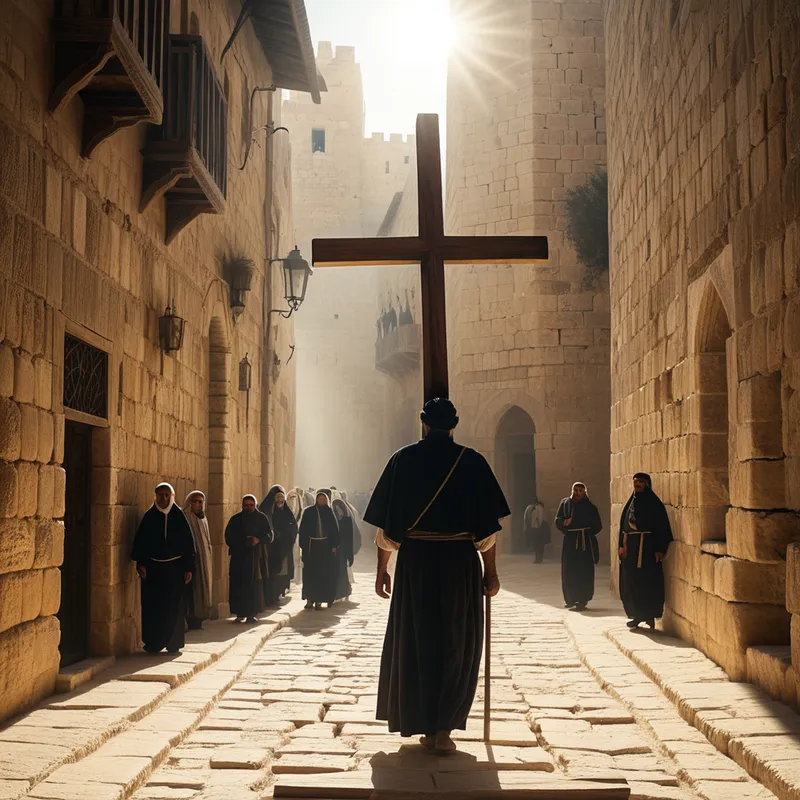
Listen. The air in [Jerusalem](/myths/jerusalem “Myth from Biblical culture.”/) is thick, a stew of dust, incense, and the metallic tang of fear. The sun, a merciless bronze disc, beats upon the stones of the Antonia Fortress. From its dark gate emerges a procession not of [triumph](/myths/triumph “Myth from Roman culture.”/), but of crushing finality.
At its heart is a man. They call him Yeshua of Nazareth. His body is a map of recent violence—lashes have opened rivers on his back, a crown of thorns presses into his brow like a diadem of agony. His eyes, however, hold a terrible clarity, a depth that seems to swallow the noise of the mob. Upon his shoulders is laid the instrument of his death: a heavy, rough-hewn crossbeam of timber. This is the [Via Dolorosa](/myths/via-dolorosa “Myth from Christian culture.”/), the Path of Sorrows.
The journey begins. The weight is immense, a physical law meant to break spirit before body. The stones of the street are uneven, slick in places. He stumbles. The wood grates against raw flesh. Soldiers bark orders, their voices flat and bored. The crowd is a living wall—faces contorted with hatred, others veiled in pity, many simply curious, drawn to the spectacle of a dying god.
He falls. A first time, the impact shuddering through the dusty ground. The weight pins him. For a moment, there is only the press of earth and [the shadow](/myths/the-shadow “Myth from Jungian culture.”/) of the wood. Hands—not a soldier’s—reach down. A stranger from the crowd, [Simon of Cyrene](/myths/simon-of-cyrene “Myth from Christian culture.”/), is seized and forced to bear the load. The burden is shared, yet the destination remains unchanged.
He rises. The path narrows. Women of Jerusalem weep for him. He speaks to them, his voice a rasp that cuts through their lament, a prophecy of sorrows yet to come. The exchange is brief, a moment of eerie compassion amidst the march to annihilation.
He falls again. And again. Each fall is a little death, a surrender to gravity and pain. The soldiers grow impatient. The destination, [Golgotha](/myths/golgotha “Myth from Christian culture.”/), looms ahead—a barren hill shaped like a cranium, a place of public execution and ultimate exposure.
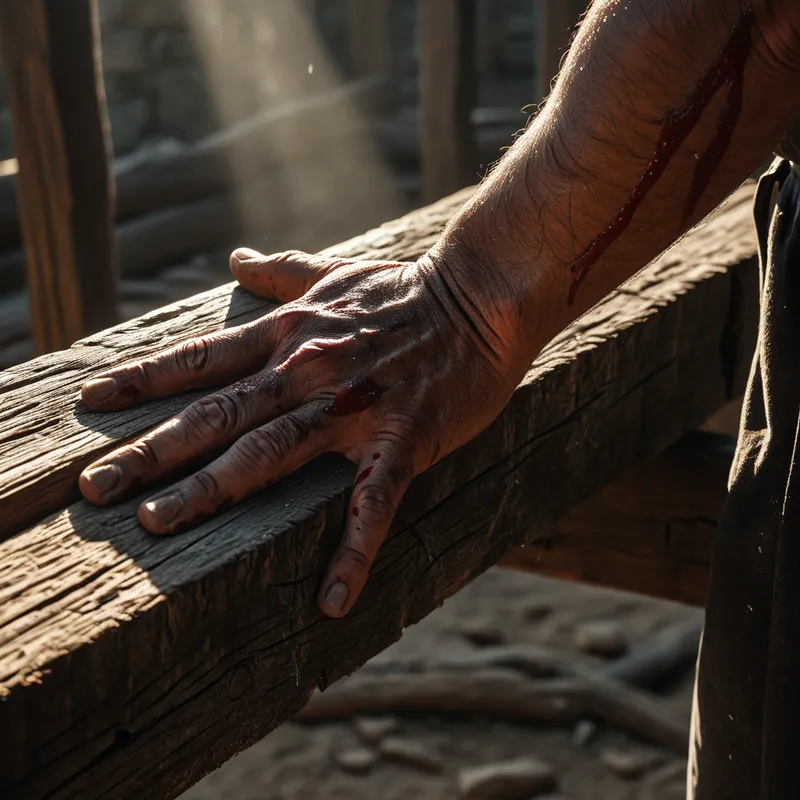
The final ascent is the steepest. Every step is a negotiation between will and collapse. The crowd’s roar fades into a buzzing hum. [The world](/myths/the-world “Myth from Tarot culture.”/) narrows to the next stone, the next breath, the immense, splintered weight grinding into bone. He does not look back. The path ends not in a palace or a temple, but at the crest of the skull-hill, where upright posts wait like hungry teeth. The crossbeam is lifted from his shoulders. For a fleeting moment, he is weightless. Then the nails are brought forward.
Cultural Origins & Context
This is not a myth born in the misty prehistory of gods on mountains, but one etched into the specific, gritty reality of first-century Judea under Roman occupation. The story of the Path to Golgotha is the narrative core of [the Passion](/myths/the-passion “Myth from Christian culture.”/), the suffering and death of [Jesus](/myths/jesus “Myth from Christian culture.”/). Its primary vessels were the Gospel accounts, oral traditions recited in clandestine house churches before being codified into text.
The storytellers were witnesses and believers, crafting a testimony meant not as dry history, but as sacred drama—a story to be performed in the mind and heart of the listener. Its societal function was multifaceted: for the persecuted early Christians, it was a story of solidarity with suffering and a model of non-violent endurance. It transformed an emblem of Roman terror—the cross—into a symbol of ultimate victory through apparent defeat. The Path, the Via Dolorosa, became a psychic and later a physical pilgrimage route, a way to ritually participate in the central mystery of their faith: that divine love enters fully into [the abyss](/myths/the-abyss “Myth from Kabbalistic culture.”/) of human suffering.
Symbolic Architecture
The myth is a masterclass in symbolic [density](/symbols/density “Symbol: Represents the concentration of matter, energy, or meaning in a given space, often symbolizing complexity, weight, or substance.”/). The [Path](/symbols/path “Symbol: The ‘path’ symbolizes a journey, choices, and the direction one’s life is taking, often representing individual growth and exploration.”/) itself is the central [symbol](/symbols/symbol “Symbol: A symbol can represent an idea, concept, or belief, serving as a powerful tool for communication and understanding.”/)—not a road from A to B, but the very process of conscious suffering. It is the individuation [journey](/symbols/journey “Symbol: A journey in dreams typically signifies adventure, growth, or a significant life transition.”/) made brutally literal.
The cross one carries is never of one’s own choosing, yet it is the one thing that is authentically, terrifyingly one’s own.
The falling represents the inevitable failures, [the ego](/myths/the-ego “Myth from Jungian culture.”/)‘s repeated collapses under the [weight](/symbols/weight “Symbol: Weight symbolizes burdens, responsibilities, and emotional loads one carries in life.”/) of a [destiny](/symbols/destiny “Symbol: A predetermined course of events or ultimate purpose, often linked to spiritual forces or cosmic order, representing life’s inherent direction.”/) or a [truth](/symbols/truth “Symbol: Truth represents authenticity, honesty, and the quest for knowledge beyond mere appearances.”/) too large to bear. Simon of Cyrene is the [archetype](/symbols/archetype “Symbol: A universal, primordial pattern or prototype in the collective unconscious that shapes human experience, behavior, and creative expression.”/) of the compelled helper, the unexpected grace, the [community](/symbols/community “Symbol: Community in dreams symbolizes connection, support, and the need for belonging.”/) or [insight](/symbols/insight “Symbol: A sudden, deep understanding of a complex situation or truth, often arriving unexpectedly and illuminating hidden connections.”/) that arrives when the individual can go no further alone. The weeping women symbolize the unintegrated emotional [body](/symbols/body “Symbol: The body in dreams often symbolizes the dreamer’s self-identity, personal health, and the relationship they have with their physical existence.”/), the raw pity that must be witnessed but also transcended for the journey to continue.
Golgotha is the ultimate [destination](/symbols/destination “Symbol: Signifies goals, aspirations, and the journey one is on in life.”/) of ego-[death](/symbols/death “Symbol: Symbolizes transformation, endings, and new beginnings; often associated with fear of the unknown.”/). The “[skull](/symbols/skull “Symbol: The skull often symbolizes mortality, the afterlife, and the fragility of life.”/)” is the seat of the rational mind, the [crown](/symbols/crown “Symbol: A crown symbolizes authority, power, and achievement, often representing an individual’s aspirations, leadership, or societal role.”/) of the individual self. To die there is for the conscious, controlling self to be dismantled upon its own [throne](/symbols/throne “Symbol: A seat of authority, power, and sovereignty, representing leadership, divine right, or social hierarchy.”/).
The Dreamer’s Resonance
When this myth stirs in the modern dreamscape, it rarely appears with biblical costumes. Instead, the dreamer finds themselves on a similar archetypal trajectory. They may dream of carrying an impossibly heavy, vague object—a block of stone, a tangled mass of wires, a sick loved one—up an endless staircase or through a bleak, labyrinthine city. The feeling is one of profound, solitary burden.
The somatic experience is key: the ache in the shoulders, the buckling knees, the shortness of breath. This is the [psyche](/myths/psyche “Myth from Greek culture.”/) somatizing a psychological or moral weight. It is the dream of the overburdened caregiver, the entrepreneur facing collapse, the artist bearing the weight of a vision, anyone crushed by a responsibility or a truth they feel they must carry to its conclusion, even if it destroys them. The dream is a map of the nervous system under the pressure of an existential crisis. The absence of a clear “why” in the dream mirrors the myth’s own stark reality: the path must be walked because it is there, because it is the truth of the situation.
Alchemical Translation
Psychologically, the Path to Golgotha models the alchemical stage of [nigredo](/myths/nigredo “Myth from Alchemical culture.”/)—the blackening, the descent, the confrontation with the shadow and the experience of utter hopelessness. This is not pathology, but a necessary phase of psychic death.
The alchemy occurs not in avoiding the fall, but in the conscious choice to rise again, bearing a weight that has been transformed by the very act of carrying it.
The individual’s “cross” is their unique complex of fate, wounding, and destiny: a failed marriage, a chronic illness, a family legacy of trauma, a calling that demands everything. The path is the conscious endurance of that complex without denial or spiritual bypass. Each “fall” is a surrender of a layer of ego-illusion—the illusion of control, of fairness, of being understood.
The triumph is not in escaping the hill, but in reaching its summit. At Golgotha, the identified ego (the [persona](/myths/persona “Myth from Greek culture.”/)) is crucified—stripped, exposed, and rendered powerless. This death is the prerequisite for rebirth. What dies is the old self that was in conflict with its fate. What is born, potentially, is a consciousness that has integrated the suffering, finding a paradoxical freedom in having carried the unbearable to its end. The path transforms the carrier. The weight, once only a sentence, becomes, through conscious endurance, the very timber of one’s transformation. The journey to the skull becomes the birth canal of a new, more resilient, and compassionate consciousness.
Associated Symbols
Explore related symbols from the CaleaDream lexicon: