The Passion Myth Meaning & Symbolism
The story of a divine figure's betrayal, suffering, and death, culminating in a world-altering resurrection, symbolizing the ultimate sacrifice and renewal.
The Tale of The Passion
Listen, and hear a tale not of a distant age, but of a moment that split time itself. In a land taut under the heel of empire, walked a man who spoke with the voice of the heavens. He was a teacher, a healer, a rabbi from Galilee, yet in his eyes flickered a knowing that unsettled kings and comforted the broken. His name was Jesus.
The air in Jerusalem was thick with the scent of Passover lambs and political dread. He entered not on a warhorse, but on a donkey’s colt, to the cries of “Hosanna!” from crowds who saw in him a different kind of king. He walked into the temple, his silence a thunderclap as he overturned the tables of money-changers, a cleansing fury that sealed his fate.
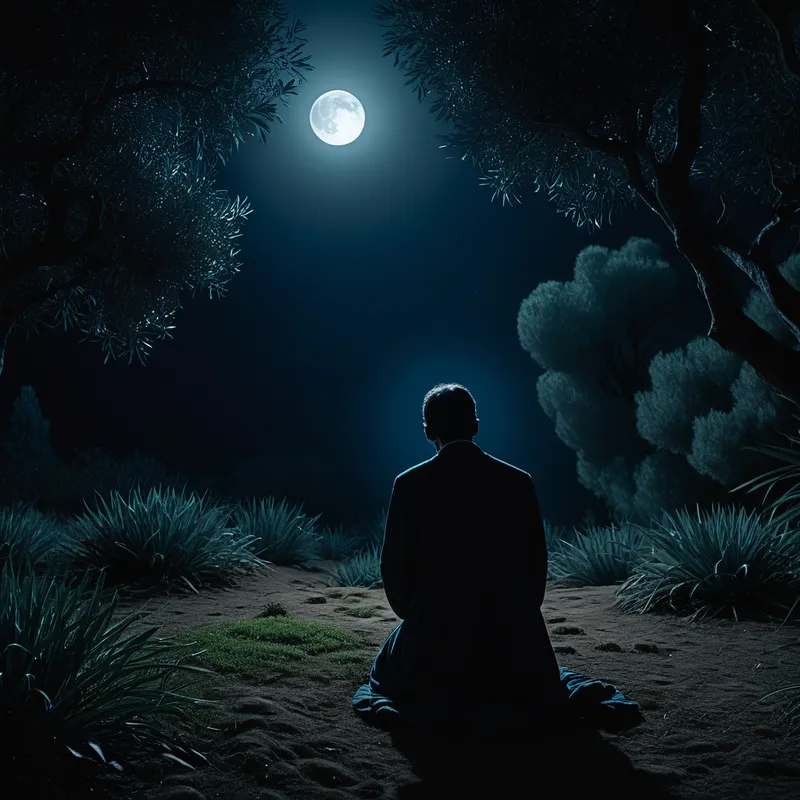
Then, in a garden heavy with the perfume of olives and impending doom, the true trial began. Under a gnarled tree, he knelt. The weight of a world’s sorrow pressed upon him. “Let this cup pass from me,” he whispered into the dark soil, sweat falling like drops of blood. Here was the agony of choice, the terror of the path seen clearly. His closest friends, pledged to stand with him, slept nearby, lost in mundane dreams.
The betrayal came with a kiss. A friend’s signal in the torchlight. Soldiers seized him. The trials that followed were a pantomime of justice—a nervous priest, a cynical governor, Pontius Pilate, washing his hands of the crowd’s fevered demand. “Crucify him!” The word became a drumbeat. They scourged him, a crown of cruel thorns pressed into his brow, a purple robe of mockery thrown over his torn flesh.
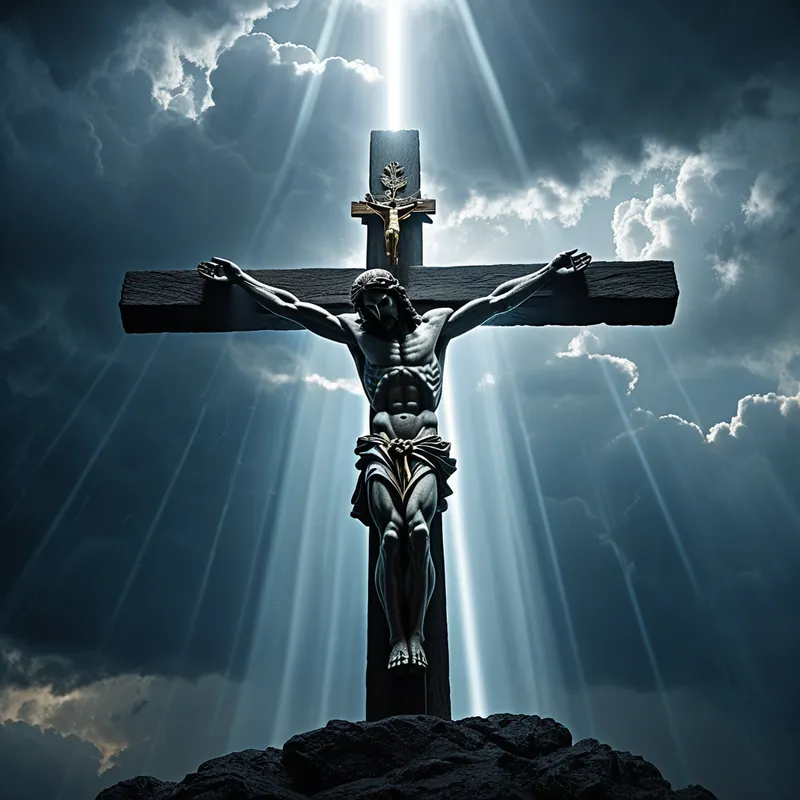
He was forced to carry the instrument of his death—a rough-hewn crossbeam—through the jeering streets, up the skull-shaped hill of Golgotha. Nails were driven. The cross was raised, a stark silhouette against a sky that turned black at noon. For three hours, a profound darkness covered the land. From the cross came words that echoed through the ages: forgiveness for his tormentors, promise to a penitent thief, a cry of ultimate dereliction—“My God, my God, why have you forsaken me?” And finally, a surrender: “It is finished.”
He breathed his last. The earth quaked. In a nearby garden tomb, donated by a secret disciple, his body was laid, wrapped in linen and spices, sealed behind a stone heavy with finality.
But the stone was not the end. On the third day, at dawn, women who came to anoint the body found the tomb gaping open, empty. A being of dazzling light asked, “Why do you seek the living among the dead?” He appeared to his followers—not as a ghost, but in a body bearing the wounds of his passion, yet transformed, capable of passing through walls and sharing a meal of broiled fish. The one who was dead lived. The story of the world was rewritten from the inside out.
Cultural Origins & Context
This narrative, known as The Passion, is the foundational mythos of Christianity. Its primary sources are the four Gospels, composed in the decades following the events they describe, within a culture of oral storytelling and intense communal memory among early Jewish followers of The Christ. It was not initially a written theological treatise but a kerygma—a proclaimed, living story of salvation.
Societally, it functioned on multiple levels. For a persecuted minority in the Roman Empire, it was a story of ultimate victory through apparent defeat, legitimizing their suffering and offering a cosmic hope that transcended imperial power. It provided a new cosmogony, re-framing human history around a single act of divine love and sacrifice. The ritual re-enactment of this story in the Eucharist and during Holy Week served to bind the community, renew their identity, and connect them directly to the transformative power at the myth’s heart.
Symbolic Architecture
At its core, The Passion is a master symbol of the psyche’s most profound operation: the death of the old self for the birth of the new. It is not merely a historical account but a map of inner transformation.
The crucifixion is the ultimate image of the ego’s necessary sacrifice on the altar of the Self.
The hero, Jesus, represents the emerging, integrated consciousness—the Self—that must confront and be broken by the collective norms, personal betrayals (the Judas archetype), and legalistic moralism (the Pharisees) of the entrenched psyche. The Cross is the archetypal intersection of the vertical (divine/transcendent) and the horizontal (human/immanent), the point of maximum tension where opposites are held and transcended. The cry of forsakenness is the darkest night of the soul, the felt experience of the ego’s separation from its deep source.
The Resurrection is not a simple reversal but a transmutation. It symbolizes the birth of a new psychological order where what was once identified with (the mortal ego-body) is now recognized as a vessel for an indestructible, transpersonal life. The wounds remain, but they are now luminous, integrated into the new whole—no longer sources of shame, but marks of identity and compassion.

The Dreamer’s Resonance
When this mythic pattern stirs in the modern dreamer, it signals a profound initiation into a deeper layer of being. One may not dream of biblical figures, but of carrying an unbearable weight up a steep hill, of being betrayed by a trusted colleague or loved one in a symbolic setting, or of undergoing a painful, surgical procedure that feels like a public execution.
Somatically, this can manifest as a feeling of crushing pressure on the chest (the weight of the cross), a sense of being stripped bare and exposed (the scourging and nakedness), or a paralyzing fatigue (the surrender of the spirit). Psychologically, it is the process of the conscious personality being dismantled by the demands of life or the unconscious. The dreamer is in the Gethsemane phase—facing a terrifying but necessary choice that feels like death. The archetype of Pilate may appear as an inner voice of cynical rationality, washing its hands of the soul’s deeper calling. These dreams are not prophecies of literal doom, but somatic-psychic dramas of an old identity structure dying so a more authentic one can be born.
Alchemical Translation
The Passion is the ultimate alchemical opus. It models the full cycle of nigredo (the blackening: betrayal, agony, death), albedo (the whitening: the tomb as a vessel of incubation, the linen shroud), and rubedo (the reddening: the resurrection, the glorified body, the gift of the spirit).
To individuate is to consent to one’s own crucifixion—to let the persona be nailed to the limits of reality, so the Self may rise.
For the modern individual, this translates to the courage to fully inhabit one’s suffering, meaning, and limitation without spiritual bypass. It is the “passion” of allowing a cherished ambition, a defining relationship, or a rigid self-image to die. The “tomb” is the necessary period of depression, incubation, and seeming sterility that follows such a death. The “resurrection” is the unexpected, often quiet, emergence of a new orientation, a deeper resilience, and a compassion forged in the fires of personal suffering. One does not become divine, but one becomes fully human—a vessel through which a transpersonal, life-giving spirit can flow. The myth teaches that the path to our highest potential does not circumvent the cross, but passes directly through its terrible and transformative center.
Associated Symbols
Explore related symbols from the CaleaDream lexicon: