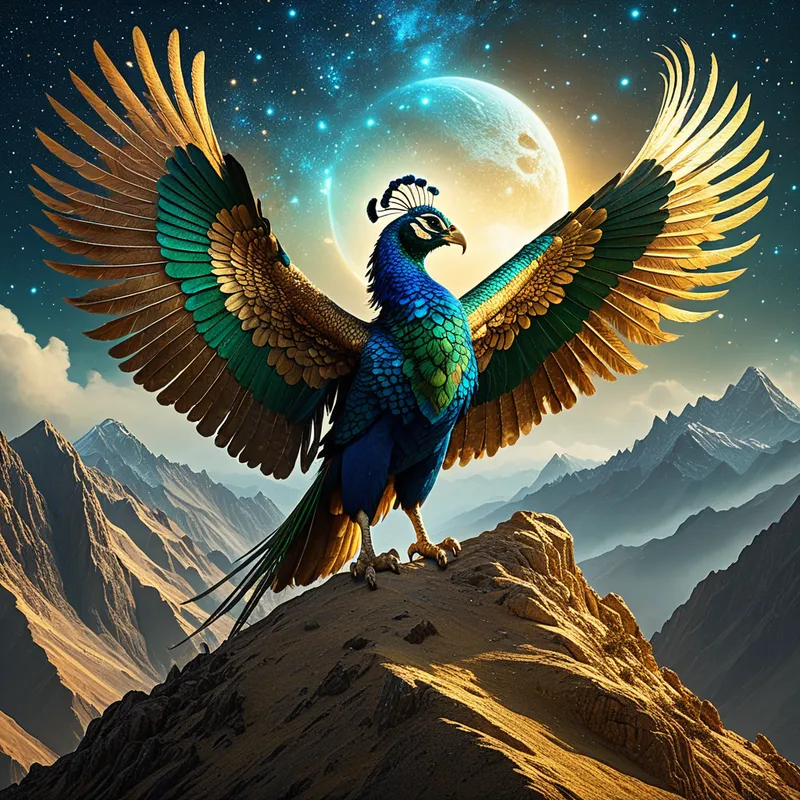
The Parliament of Birds Myth Meaning & Symbolism
Thirty birds embark on a perilous pilgrimage to find their king, the Simurgh, only to discover a profound and shattering truth about their own nature.
The Tale of The Parliament of Birds
In the forgotten age when the world was a manuscript still wet with ink, a great unrest stirred the kingdom of the air. The birds of every land—from the lowly sparrow to the proud eagle—gathered in a state of disquiet. They lived without a sovereign, a fragmented parliament of feather and song, and a deep longing for a king gnawed at their collective heart.
Into their midst came the Hoopoe, her crown a testament to her wisdom, bearing news that ignited their souls. She spoke of a sovereign beyond imagining, the Simurgh, who dwelled in the farthest east, upon the mountain of Qaf. This was no ordinary king, but the source of all splendor, the answer to every why.
Yet the Hoopoe’s words were also a mirror. “The journey,” she declared, her voice like rustling parchment, “is a crossing of seven valleys. Each valley will demand a price your very nature is loath to pay. The path is sown with the bones of those who sought but could not surrender.”
A great debate erupted. The Peacock clung to his paradise garden. The Nightingale wept, enslaved to the rose’s thorn. The Hawk saw no king above his own talons. Fear, attachment, and pride claimed many. But thirty souls, a parliament purified by yearning, stepped forward. Their numbers were few, but their resolve was a single flame.
Their pilgrimage began. The first valley, the Valley of the Quest, stripped them of doctrine and map. The second, the Valley of Love, burned away reason in a fire of pure longing. In the Valley of Insight, they learned they knew nothing. The Valley of Detachment emptied their hearts of everything, even the desire for the Simurgh itself. Each valley was a death; each death, a shedding.
Bodies fell away. Wings grew ragged. Companions were lost to despair, to revelation, to the siren call of a lesser truth. The landscapes themselves were alchemists: oceans of fire, deserts of ice, labyrinths of pure sound. They were no longer thirty birds, but a single, suffering question moving across the world.
At last, spent and reduced to their essence, the remnants—still thirty in count, yet one in spirit—stumbled into the presence of the divine court. They stood before the throne of the Simurgh. But when they lifted their eyes, yearning to behold their king, they did not see a monarch awaiting them. Instead, they were given a polished disc of celestial silver.
In its surface, they saw a reflection. Not of a glorious, external king, but of their own thirty faces, worn and wise, staring back. The Simurgh was not a separate entity to be found, but the truth of their own union, the “Si Murgh” they had become. The seeker, the search, and the sought had always been one. The parliament had convened, and its resolution was a silent, stunning revelation of the self.
Cultural Origins & Context
This exquisite allegory finds its most famous elaboration in the Mantiq al-Tayr (The Conference of the Birds), a masterpiece of Persian Sufi poetry written by the mystic poet Farid ud-Din Attar in the 12th century. While drawing on pre-Islamic Persian symbolism of the Simurgh, Attar transformed it into a central metaphor for the Sufi path (tariqa). The poem is a masnavi, a narrative form designed for teaching.
It functioned as an oral and literary guide, recited in khanqahs to instruct disciples. Each bird represents a human failing or attachment that must be overcome on the spiritual path. The Hoopoe, mentioned in the Quran as Solomon’s wise messenger, is the perfect sheikh or guide. The myth served a profound societal function: it democratized the esoteric journey of the soul, framing the ultimate divine encounter not as a distant theological concept, but as an immanent, personal realization accessible through arduous self-annihilation (fana).
Symbolic Architecture
The myth’s power lies in its layered symbolism. The birds are not mere animals but the multifarious aspects of the human psyche—our pride (eagle), love-sickness (nightingale), vanity (peacock), and hope (hoopoe). The journey is the soul’s progression from multiplicity to unity.
The pilgrimage is not a movement through space, but a contraction of the soul. The valleys are not crossed, but endured.
The seven valleys map the stages of mystical awakening: Quest, Love, Insight, Detachment, Unity, Astonishment, and finally, Annihilation and Abiding. The Simurgh itself is the ultimate symbol of the divine, the transcendent Self (Self archetype) that contains and unifies all contradictions. The stunning climax—the revelation in the mirror—encapsulates the core mystical truth of identity between the lover and the Beloved, the individual spark and the divine fire.
The Dreamer’s Resonance
When this myth stirs in the modern dreamscape, it often manifests as dreams of arduous travel, of being part of a group on a vital mission that becomes increasingly abstract and difficult. The dreamer may find themselves in a shifting, symbolic landscape—crossing a chasm on a fraying rope, climbing an endless staircase, or searching a vast library for a single, elusive book.
Somatically, this can feel like a profound exhaustion paired with a relentless forward pull. Psychologically, it signals a process of simplification. The ego is being stripped of its non-essentials—outdated identities, compulsive attachments, and borrowed beliefs. The dream may feature birds, especially if they are transforming, speaking, or leading the way. This is the psyche’s innate wisdom (the Hoopoe) guiding the conscious self through the natural, if painful, process of integration, where the many “I”s we perform must undertake a perilous journey to discover the singular “I Am” that underlies them.
Alchemical Translation
For the modern individual, the Parliament models the alchemical opus of individuation. The initial discontent is the call of the Self, a feeling that life is fragmented and lacks a central, governing meaning (the missing king). The gathering of the birds represents the conscious effort to inventory and mobilize the disparate parts of one’s personality.
The goal of the journey is not to become someone new, but to become no one, so that the true Self can emerge from the ashes of the persona.
The seven valleys are the stages of psycho-spiritual work: confronting the shadow (Valley of Insight), sacrificing dominant attitudes (Valley of Detachment), and enduring the dark night of the soul (Valley of Unity, where all seems lost). The guide (Hoopoe/therapist/innate wisdom) is crucial, but cannot walk the path for us.
The final revelation is the conjunctio, the sacred marriage. The polished mirror is the moment of profound self-reflection where the ego, having surrendered its illusion of separateness, sees itself not as the master of the psyche, but as a participant in a much larger, divine totality. The king was never “out there.” The authority, the center, the meaning—the Simurgh—is the integrated totality of the seeker’s own being, realized only after the long, perilous parliament of the soul has been convened and every argument of the ego has been heard and transcended.
Associated Symbols
Explore related symbols from the CaleaDream lexicon: